Pennsylvania: Emergency vehicles & work zones — Part 2 Practice Test
Questions in this part include: “What happens to fines for certain violations, including speeding, in active work zones?” · “Who can report unsafe motorists, speeders, and aggressive drivers to police in a work zone using a Police Arrest Form?”
Independent educational site · not affiliated with any government agency or DMV
Ready? Test yourself
Answer to start, or tap Start below:
What happens to fines for certain violations, including speeding, in active work zones?
- Instant feedback with an explanation
- Every answer cites its source in the manual
- Your best score is saved on this device
- Keyboard: press 1 to 4 to answer and Enter for the next question
Questions are original and based on the official manual "Pennsylvania Driver's Manual" (Pub 95), Pennsylvania Department of Transportation (PennDOT), Bureau of Driver Licensing.
All 21 questions in this practice test
Take the test above first, then use this list to study. Tap “Show answer” to see the correct answer and explanation.
Show the questions and answersHide the questions
-
What happens to fines for certain violations, including speeding, in active work zones?
- They are waived for first-time offenders
- They stay the same as elsewhere
- They are reduced
- They are doubled
Show answer
Correct answer: They are doubled
Fines are doubled for certain violations in active work zones, including speeding, and some violations can result in license suspension.
Source: Pennsylvania Driver's Manual (Pub 95), page 54 · Open this page in the manual (Manual page 54)
-
According to the manual, about how many people are injured or killed each year in the U.S. in work zone vehicle crashes?
- About 4,000
- About 4 million
- About 40,000
- About 400,000
Show answer
Correct answer: About 40,000
The manual's Did You Know box states about 40,000 people are injured or killed each year in U.S. work zone crashes.
Source: Pennsylvania Driver's Manual (Pub 95), page 54 · Open this page in the manual (Manual page 54)
-
What does the manual say are the main causes of traffic fatalities in work zones?
- Carelessness and speeding
- Poor lighting and fog
- Vehicle mechanical failure
- Wildlife crossing the road
Show answer
Correct answer: Carelessness and speeding
The manual identifies carelessness and speeding as the main causes of traffic fatalities in work zones.
Source: Pennsylvania Driver's Manual (Pub 95), page 54 · Open this page in the manual (Manual page 54)
-
According to the manual, should you use cruise control in a work zone?
- Yes, it helps maintain a steady speed
- Only on the highway portion of the work zone
- No, you should not use cruise control in work zones
- Only if traffic is light
Show answer
Correct answer: No, you should not use cruise control in work zones
The manual's safety rules explicitly say not to use your cruise control in work zones.
Source: Pennsylvania Driver's Manual (Pub 95), page 54 · Open this page in the manual (Manual page 54)
-
What is the most common crash type in work zones, according to the manual, and how should you adjust your following distance?
- Sideswipes; drive closer to the shoulder
- Rollovers; reduce your following distance
- Head-on collisions; leave your following distance unchanged
- Rear-end collisions; double your following distance
Show answer
Correct answer: Rear-end collisions; double your following distance
Rear-end collisions are the most common crash type in work zones, so the manual advises doubling your following distance.
Source: Pennsylvania Driver's Manual (Pub 95), page 54 · Open this page in the manual (Manual page 54)
-
In a work zone, what should you do if you see a message telling you your lane is closed ahead?
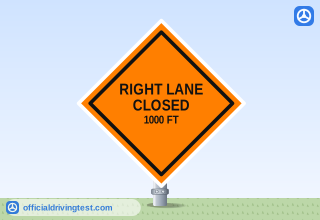
- Prepare to change lanes right away
- Speed up to pass before the closure
- Stop immediately in your lane
- Ignore it until you reach the closure
Show answer
Correct answer: Prepare to change lanes right away
The manual instructs drivers to prepare to change lanes as soon as they see a message that their lane is closed ahead.
Source: Pennsylvania Driver's Manual (Pub 95), page 54 · Open this page in the manual (Manual page 54)
-
What does the manual say about crossing a solid white line in a work zone?
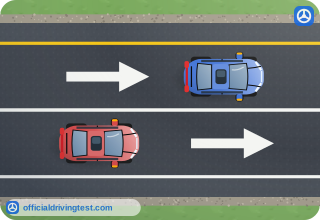
- It is allowed if you use your turn signal
- You should not cross it and should stay in your lane
- It is allowed if no other vehicles are present
- It is allowed only to pass a stalled vehicle
Show answer
Correct answer: You should not cross it and should stay in your lane
The manual says not to cross a solid white line in a work zone and to stay in your lane.
Source: Pennsylvania Driver's Manual (Pub 95), page 54 · Open this page in the manual (Manual page 54)
-
In a work zone, whose authority overrides conventional traffic control devices?
- A tow truck driver's
- A flagger's
- A construction supervisor's
- A passing motorist's
Show answer
Correct answer: A flagger's
The manual instructs drivers to obey flaggers, since their authority overrides conventional traffic control devices.
Source: Pennsylvania Driver's Manual (Pub 95), page 54 · Open this page in the manual (Manual page 54)
-
Who can report unsafe motorists, speeders, and aggressive drivers to police in a work zone using a Police Arrest Form?
- Work zone flaggers
- Toll booth operators
- Any passing motorist
- Only the Pennsylvania State Police
Show answer
Correct answer: Work zone flaggers
The manual notes that work zone flaggers can report unsafe motorists, speeders, and aggressive drivers to police using a Police Arrest Form.
Source: Pennsylvania Driver's Manual (Pub 95), page 54 · Open this page in the manual (Manual page 54)
-
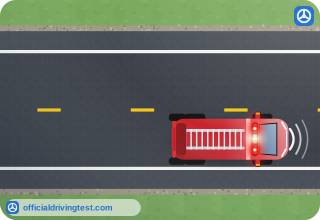
When you hear a siren or see a vehicle with flashing red lights (or red and blue) approaching from any direction, what must you do?
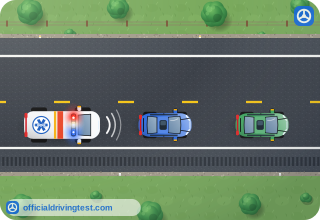
- Stop only if the vehicle is coming up behind you
- Pull over to the curb or side of the road and stop
- Continue driving at the same speed
- Speed up to clear the area as quickly as you can
Show answer
Correct answer: Pull over to the curb or side of the road and stop
You must pull over to the curb or side of the road and stop when you hear a siren or see an emergency vehicle's flashing lights approaching from any direction.
Source: Pennsylvania Driver's Manual (Pub 95), page 59 · Open this page in the manual (Manual page 59)
-
On a one-way street, which direction should you drive when yielding to an approaching emergency vehicle?
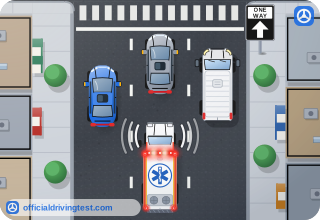
- In reverse
- Toward the center of the road
- It does not matter
- Toward the nearest roadside
Show answer
Correct answer: Toward the nearest roadside
On one-way streets, drive toward the nearest roadside and stop for an approaching emergency vehicle.
Source: Pennsylvania Driver's Manual (Pub 95), page 59 · Open this page in the manual (Manual page 59)
-
After an emergency vehicle passes you, how far away should you stay before starting to drive again?
- At least 200 feet
- At least 1,000 feet
- At least 500 feet
- At least 100 feet
Show answer
Correct answer: At least 500 feet
The manual instructs staying at least 500 feet away from an emergency vehicle after it passes, before starting to drive again.
Source: Pennsylvania Driver's Manual (Pub 95), page 59 · Open this page in the manual (Manual page 59)
-
During an emergency situation, whose direction must all drivers obey?
- Any uniformed police officer or properly attired person
- Only a state trooper's, never a local police officer's
- Only a tow truck operator's at the crash scene
- Only a vehicle owner's, if one is at the scene
Show answer
Correct answer: Any uniformed police officer or properly attired person
During an emergency, all drivers must obey the direction of any uniformed police officer, sheriff, constable, or any properly attired person, including fire police.
Source: Pennsylvania Driver's Manual (Pub 95), page 59 · Open this page in the manual (Manual page 59)
-
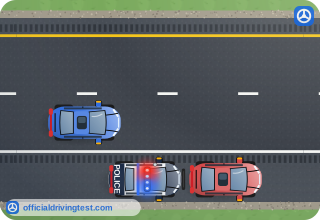
What does Pennsylvania's Move Over law require motorists to do?
- Move to a lane not next to an emergency response area or disabled vehicle
- Use their horn to alert workers and responders as they pass
- Slow down only if a police car with its flashing lights is visible
- Stop completely near any emergency vehicle
Show answer
Correct answer: Move to a lane not next to an emergency response area or disabled vehicle
The Move Over law requires motorists to move into a lane that is not adjacent to an emergency response area and/or a disabled vehicle.
Source: Pennsylvania Driver's Manual (Pub 95), page 59 · Open this page in the manual (Manual page 59)
-
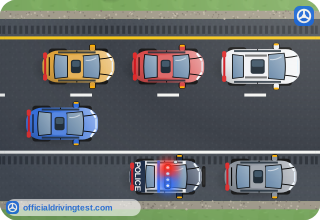
If you cannot move over because of traffic or other conditions, what must you do under the Move Over law?
- Turn on your high beams to warn the responders
- Stop completely in your lane until the scene clears
- Increase your speed to pass the scene quickly
- Slow to at least 20 mph below the posted speed limit
Show answer
Correct answer: Slow to at least 20 mph below the posted speed limit
If drivers cannot move over, they must reduce their speed to at least 20 mph below the posted speed limit.
Source: Pennsylvania Driver's Manual (Pub 95), page 59 · Open this page in the manual (Manual page 59)
-
Who may report Move Over law violations in cases where law enforcement is not present?
- Only news reporters
- Road workers and emergency responders
- Only other motorists
- No one; a citation cannot be issued without an officer present
Show answer
Correct answer: Road workers and emergency responders
The law allows road workers and emergency responders to report Move Over violations by motorists when law enforcement may not be present.
Source: Pennsylvania Driver's Manual (Pub 95), page 59 · Open this page in the manual (Manual page 59)
-
What is the maximum fine for a first offense of the Move Over law?
- $500
- $100
- $2,000
- $1,000
Show answer
Correct answer: $500
A first offense of the Move Over law carries a fine of up to $500.
Source: Pennsylvania Driver's Manual (Pub 95), page 59 · Open this page in the manual (Manual page 59)
-
What is the maximum fine for a third or subsequent offense of the Move Over law?
- $1,000
- $2,000
- $500
- $1,500
Show answer
Correct answer: $2,000
A third and subsequent offense carries a fine of up to $2,000, and fines are doubled for violations occurring in work zone areas.
Source: Pennsylvania Driver's Manual (Pub 95), page 59 · Open this page in the manual (Manual page 59)
-
How many points are assessed to a driving record for a Move Over law conviction?
- 3 points
- 2 points
- 1 point
- 5 points
Show answer
Correct answer: 2 points
A conviction under the Move Over law carries 2 points on the driving record.
Source: Pennsylvania Driver's Manual (Pub 95), page 59 · Open this page in the manual (Manual page 59)
-
If a Move Over law violation leads to the serious bodily injury or death of another person, what license penalty applies?
- A 90-day suspension
- A 6-month suspension
- A 30-day suspension
- A 1-year suspension
Show answer
Correct answer: A 90-day suspension
A Move Over violation causing serious bodily injury or death carries a 90-day license suspension and a fine of up to $1,000.
Source: Pennsylvania Driver's Manual (Pub 95), page 59 · Open this page in the manual (Manual page 59)
-
If a Move Over law violation leads to the death of an emergency responder or a person in or near a disabled vehicle, what suspension and maximum fine apply?
- A 90-day suspension and a fine up to $1,000
- A 6-month suspension and a fine up to $5,000
- No suspension, only a fine
- A 1-year suspension and a fine up to $10,000
Show answer
Correct answer: A 1-year suspension and a fine up to $10,000
If the violation leads to the death of an emergency responder or a person in or near a disabled vehicle, a 1-year suspension and a fine of up to $10,000 could result.
Source: Pennsylvania Driver's Manual (Pub 95), page 59 · Open this page in the manual (Manual page 59)