Pennsylvania: Emergency vehicles & work zones
The Move Over law, school buses, and work-zone rules. Split into 2 shorter tests so you're not stuck in one long quiz.
Independent educational site · not affiliated with any government agency or DMV
Choose a part
Emergency vehicles & work zones — Part 1
Questions in this part include: “If you are pulled over by police for a traffic violation in a work zone and your headlights are not on, what happens?”
Emergency vehicles & work zones — Part 2
Questions in this part include: “What happens to fines for certain violations, including speeding, in active work zones?”
Questions are original and based on the official manual "Pennsylvania Driver's Manual" (Pub 95), Pennsylvania Department of Transportation (PennDOT), Bureau of Driver Licensing.
All 43 Emergency vehicles & work zones questions with answers
Choose a part above to take a practice test, or study every question and answer here.
Show the questions and answersHide the questions
1Part 122 questions
-
Under Pennsylvania law, when must you turn on your headlights while traveling through a posted work zone?
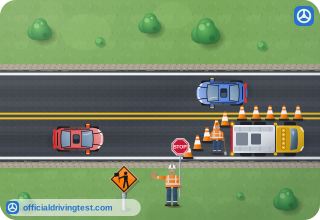
- Only at night or in poor visibility
- Only when workers are present on the roadway
- Only if directed by a flagger
- At any time of day, even when the zone is not active
Show answer
Correct answer: At any time of day, even when the zone is not active
Turning on your headlights in a work zone is the law for all posted work zones, not just active ones, no matter what time of day.
Source: Pennsylvania Driver's Manual (Pub 95), page 18 · Open this page in the manual (Manual page 18)
-
If you are pulled over by police for a traffic violation in a work zone and your headlights are not on, what happens?
- You are fined an additional $25
- No additional penalty beyond the original violation
- Your license is automatically suspended
- You receive two additional points only, with no fine
Show answer
Correct answer: You are fined an additional $25
If you are pulled over for a traffic violation in a work zone and your headlights are not on, you will be fined an additional $25.
Source: Pennsylvania Driver's Manual (Pub 95), page 18 · Open this page in the manual (Manual page 18)
-
What is an "active work zone"?
- Any work zone with signs posted, even if no workers are present
- The part with workers on the road or on the shoulder next to an open lane
- A work zone with no speed limit changes
- Only zones with lane closures overnight
Show answer
Correct answer: The part with workers on the road or on the shoulder next to an open lane
An active work zone is the portion of a work zone where construction, maintenance or utility workers are on the roadway, or on the shoulder next to an open travel lane.
Source: Pennsylvania Driver's Manual (Pub 95), page 18 · Open this page in the manual (Manual page 18)
-
A ROAD WORK AHEAD sign informs you that:
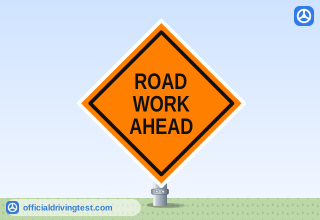
- the road ahead is permanently closed
- a detour is mandatory
- road work is ahead and you should slow down
- construction ahead has been completed
Show answer
Correct answer: road work is ahead and you should slow down
This sign informs you there is road work ahead and cautions you to slow down.
Source: Pennsylvania Driver's Manual (Pub 95), page 18 · Open this page in the manual (Manual page 18)
-
A LANE CLOSED AHEAD sign, such as one reading "RIGHT LANE CLOSED 1000 FT," tells you:
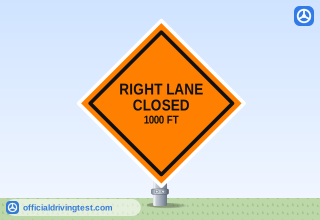
- a particular lane will be closed at a specified distance ahead
- the entire roadway is closed 1000 feet ahead
- the speed limit is reduced to 1000 feet per minute
- there is no closure, only a warning of possible future work
Show answer
Correct answer: a particular lane will be closed at a specified distance ahead
This sign tells you a particular lane will be closed at a specified distance ahead.
Source: Pennsylvania Driver's Manual (Pub 95), page 18 · Open this page in the manual (Manual page 18)
-
A WORKERS AHEAD sign warns that:
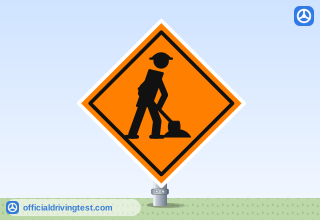
- all lanes are closed ahead
- workers may be on or very close to the roadway
- the work zone has ended
- only pedestrians are affected, not drivers
Show answer
Correct answer: workers may be on or very close to the roadway
Workers may be on or very close to the roadway, so take special care when traveling through the area.
Source: Pennsylvania Driver's Manual (Pub 95), page 18 · Open this page in the manual (Manual page 18)
-
According to the manual, what can happen if a highway worker reports a motorist who speeds or drives unsafely in a work zone to police?
- Nothing, since highway workers cannot file such reports
- Only a warning letter is sent to the driver
- The police may issue a ticket, resulting in fines and points
- The report is only used for statistical purposes
Show answer
Correct answer: The police may issue a ticket, resulting in fines and points
Highway workers have forms to report unsafe motorists to police, who may then issue a ticket, resulting in fines and points.
Source: Pennsylvania Driver's Manual (Pub 95), page 18 · Open this page in the manual (Manual page 18)
-
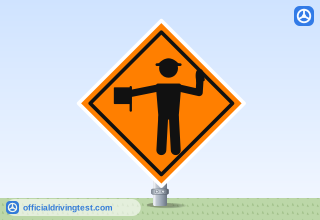
A FLAGGER AHEAD (ROAD CONSTRUCTION AHEAD) sign tells drivers that:
- all workers have left the roadway
- the road is closed permanently
- no further signs will follow
- a flagger is controlling traffic ahead
Show answer
Correct answer: a flagger is controlling traffic ahead
This sign shows that a flagger is controlling traffic ahead.
Source: Pennsylvania Driver's Manual (Pub 95), page 18 · Open this page in the manual (Manual page 18)
-
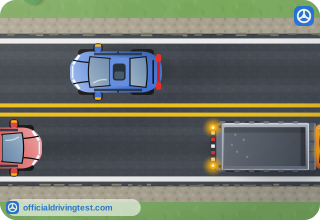
In a highway work zone, a flagger controls traffic using:
- STOP and SLOW paddles or a red flag
- A handheld stop sign only
- Orange traffic cones only
- Hand signals only, no paddles or flags
Show answer
Correct answer: STOP and SLOW paddles or a red flag
Flaggers use STOP and SLOW paddles or a red flag to signal you to stop or slow down as you approach and travel through a work zone.
Source: Pennsylvania Driver's Manual (Pub 95), page 18 · Open this page in the manual (Manual page 18)
-
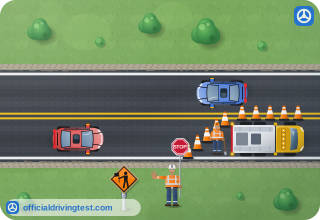
When approaching and traveling through a work zone where a flagger is present, you should:
- Turn on your hazard lights and stop
- Pay special attention to the flagger's signals
- Sound your horn to alert the flagger
- Proceed at normal speed unless flagged down
Show answer
Correct answer: Pay special attention to the flagger's signals
The manual advises drivers to pay special attention to flaggers when approaching and traveling through a work zone.
Source: Pennsylvania Driver's Manual (Pub 95), page 18 · Open this page in the manual (Manual page 18)
-
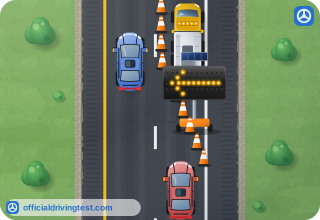
A large electronic arrow panel in a work zone showing a MOVE/MERGE RIGHT or MOVE/MERGE LEFT message tells you to:
- Stop immediately and wait
- Turn around and find another route
- Begin merging well in advance of the sign
- Ignore it unless a flagger is also present
Show answer
Correct answer: Begin merging well in advance of the sign
Electric arrow panels advise approaching motorists of lane closures; you should begin your merge well in advance of the sign.
Source: Pennsylvania Driver's Manual (Pub 95), page 19 · Open this page in the manual (Manual page 19)
-
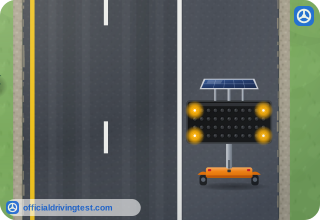
When a work-zone arrow panel displays a caution pattern instead of a directional arrow, it means:
- The equipment is malfunctioning and should be ignored
- Traffic is closed in both directions ahead
- Merge left immediately
- There is a work area ahead next to the travel lane
Show answer
Correct answer: There is a work area ahead next to the travel lane
An arrow panel displaying a caution message indicates a work area ahead next to the travel lane; drive with extra caution.
Source: Pennsylvania Driver's Manual (Pub 95), page 19 · Open this page in the manual (Manual page 19)
-
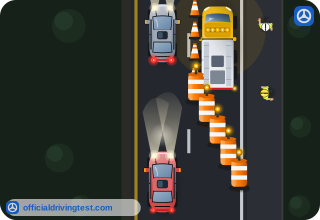
Barrels, tubes, cones and vertical panels used to guide drivers through changing traffic patterns in a work zone are known as:
- Channeling devices
- Flagger stations
- Guide signs
- Route markers
Show answer
Correct answer: Channeling devices
Barrels, tubes, cones and vertical panels are channeling devices used in work zones to guide you through changing traffic patterns and keep you away from hazards.
Source: Pennsylvania Driver's Manual (Pub 95), page 19 · Open this page in the manual (Manual page 19)
-
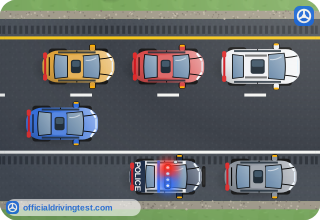
If you cannot move into a nonadjacent lane while passing an emergency scene, police stop, or a tow truck picking up a disabled vehicle, you must reduce your speed to at least how much below the posted speed limit?
- 5 mph
- 10 mph
- 15 mph
- 20 mph
Show answer
Correct answer: 20 mph
If you cannot move over, you must reduce your speed to at least 20 miles per hour below the posted speed limit.
Source: Pennsylvania Driver's Manual (Pub 95), page 43 · Open this page in the manual (Manual page 43)
-
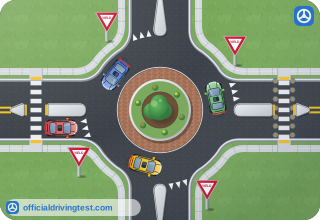
If an emergency vehicle is approaching while you are already inside a roundabout, what should you do?
- Stop immediately where you are inside the roundabout
- Speed up to exit before it arrives
- Reverse back to the entry point
- Immediately exit the roundabout and pull to the side
Show answer
Correct answer: Immediately exit the roundabout and pull to the side
If you are in the roundabout when an emergency vehicle approaches, immediately exit and pull to the side — never stop in the roundabout.
Source: Pennsylvania Driver's Manual (Pub 95), page 50 · Open this page in the manual (Manual page 50)
-
How are work zones typically identified, according to the manual?
- Green directional arrows
- White dashed lines only
- Blue reflective markers
- Orange channelizing devices
Show answer
Correct answer: Orange channelizing devices
Work zones are identified with orange channelizing devices, such as cones, or other temporary traffic control devices.
Source: Pennsylvania Driver's Manual (Pub 95), page 54 · Open this page in the manual (Manual page 54)
-
What might a flagger directing traffic in a work zone be wearing?
- A dark business suit
- Reflective clothing
- A police uniform only
- Casual clothing with no markings
Show answer
Correct answer: Reflective clothing
The manual notes you may encounter a flagger directing traffic and wearing reflective clothing.
Source: Pennsylvania Driver's Manual (Pub 95), page 54 · Open this page in the manual (Manual page 54)
-
Warning signs, advance warning vehicles, or variable message boards may be placed how far before a work zone?
- A minimum of 200 feet
- A minimum of 100 feet
- A minimum of 50 feet
- A minimum of 1,000 feet
Show answer
Correct answer: A minimum of 200 feet
These warnings may be placed a minimum of 200 feet approaching a work zone.
Source: Pennsylvania Driver's Manual (Pub 95), page 54 · Open this page in the manual (Manual page 54)
-
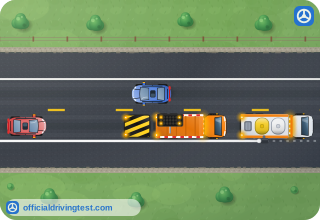
What is the purpose of a 'shadow vehicle' used during moving work operations such as line painting or mowing?
- To measure the road surface
- To carry extra equipment
- To transport workers to the site
- To warn drivers and protect the crew
Show answer
Correct answer: To warn drivers and protect the crew
Shadow vehicles at the back of a moving operation warn motorists there is a work zone ahead and protect the crew.
Source: Pennsylvania Driver's Manual (Pub 95), page 54 · Open this page in the manual (Manual page 54)
-
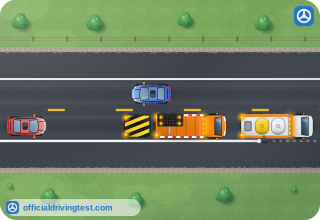
May you pass a moving work operation, such as a shadow vehicle, in a work zone?
- Yes, but only on the right
- Yes, at any speed
- No, not unless directed to do so
- Yes, always, if the lane is clear
Show answer
Correct answer: No, not unless directed to do so
The manual instructs drivers not to pass a moving operation unless directed to.
Source: Pennsylvania Driver's Manual (Pub 95), page 54 · Open this page in the manual (Manual page 54)
-
What kinds of abnormal conditions should you be prepared for in an active work zone?
- Additional passing lanes and wider shoulders
- Extra-wide lanes and freshly smoothed pavement
- Narrow lanes, rough pavement and abrupt lane shifts
- Higher speed limits and fewer warning signs
Show answer
Correct answer: Narrow lanes, rough pavement and abrupt lane shifts
In an active work zone, watch for construction workers and be prepared for narrow lanes, rough pavement, uneven lanes, and abrupt lane shifts.
Source: Pennsylvania Driver's Manual (Pub 95), page 54 · Open this page in the manual (Manual page 54)
-
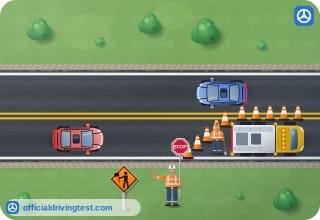
By law, what must you do with your headlights when driving through an active work zone?
- Turn them off completely
- Flash them repeatedly
- Use only your daytime running lights
- Turn them on
Show answer
Correct answer: Turn them on
By law, you must turn on your vehicle's headlights, not just the daytime running lights, when driving through an active work zone.
Source: Pennsylvania Driver's Manual (Pub 95), page 54 · Open this page in the manual (Manual page 54)
2Part 221 questions
-
What happens to fines for certain violations, including speeding, in active work zones?
- They are waived for first-time offenders
- They stay the same as elsewhere
- They are reduced
- They are doubled
Show answer
Correct answer: They are doubled
Fines are doubled for certain violations in active work zones, including speeding, and some violations can result in license suspension.
Source: Pennsylvania Driver's Manual (Pub 95), page 54 · Open this page in the manual (Manual page 54)
-
According to the manual, about how many people are injured or killed each year in the U.S. in work zone vehicle crashes?
- About 4,000
- About 4 million
- About 40,000
- About 400,000
Show answer
Correct answer: About 40,000
The manual's Did You Know box states about 40,000 people are injured or killed each year in U.S. work zone crashes.
Source: Pennsylvania Driver's Manual (Pub 95), page 54 · Open this page in the manual (Manual page 54)
-
What does the manual say are the main causes of traffic fatalities in work zones?
- Carelessness and speeding
- Poor lighting and fog
- Vehicle mechanical failure
- Wildlife crossing the road
Show answer
Correct answer: Carelessness and speeding
The manual identifies carelessness and speeding as the main causes of traffic fatalities in work zones.
Source: Pennsylvania Driver's Manual (Pub 95), page 54 · Open this page in the manual (Manual page 54)
-
According to the manual, should you use cruise control in a work zone?
- Yes, it helps maintain a steady speed
- Only on the highway portion of the work zone
- No, you should not use cruise control in work zones
- Only if traffic is light
Show answer
Correct answer: No, you should not use cruise control in work zones
The manual's safety rules explicitly say not to use your cruise control in work zones.
Source: Pennsylvania Driver's Manual (Pub 95), page 54 · Open this page in the manual (Manual page 54)
-
What is the most common crash type in work zones, according to the manual, and how should you adjust your following distance?
- Sideswipes; drive closer to the shoulder
- Rollovers; reduce your following distance
- Head-on collisions; leave your following distance unchanged
- Rear-end collisions; double your following distance
Show answer
Correct answer: Rear-end collisions; double your following distance
Rear-end collisions are the most common crash type in work zones, so the manual advises doubling your following distance.
Source: Pennsylvania Driver's Manual (Pub 95), page 54 · Open this page in the manual (Manual page 54)
-
In a work zone, what should you do if you see a message telling you your lane is closed ahead?
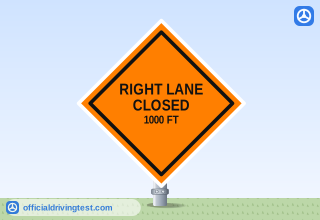
- Prepare to change lanes right away
- Speed up to pass before the closure
- Stop immediately in your lane
- Ignore it until you reach the closure
Show answer
Correct answer: Prepare to change lanes right away
The manual instructs drivers to prepare to change lanes as soon as they see a message that their lane is closed ahead.
Source: Pennsylvania Driver's Manual (Pub 95), page 54 · Open this page in the manual (Manual page 54)
-
What does the manual say about crossing a solid white line in a work zone?
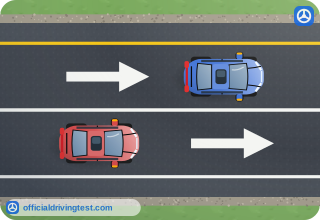
- It is allowed if you use your turn signal
- You should not cross it and should stay in your lane
- It is allowed if no other vehicles are present
- It is allowed only to pass a stalled vehicle
Show answer
Correct answer: You should not cross it and should stay in your lane
The manual says not to cross a solid white line in a work zone and to stay in your lane.
Source: Pennsylvania Driver's Manual (Pub 95), page 54 · Open this page in the manual (Manual page 54)
-
In a work zone, whose authority overrides conventional traffic control devices?
- A tow truck driver's
- A flagger's
- A construction supervisor's
- A passing motorist's
Show answer
Correct answer: A flagger's
The manual instructs drivers to obey flaggers, since their authority overrides conventional traffic control devices.
Source: Pennsylvania Driver's Manual (Pub 95), page 54 · Open this page in the manual (Manual page 54)
-
Who can report unsafe motorists, speeders, and aggressive drivers to police in a work zone using a Police Arrest Form?
- Work zone flaggers
- Toll booth operators
- Any passing motorist
- Only the Pennsylvania State Police
Show answer
Correct answer: Work zone flaggers
The manual notes that work zone flaggers can report unsafe motorists, speeders, and aggressive drivers to police using a Police Arrest Form.
Source: Pennsylvania Driver's Manual (Pub 95), page 54 · Open this page in the manual (Manual page 54)
-
When you hear a siren or see a vehicle with flashing red lights (or red and blue) approaching from any direction, what must you do?
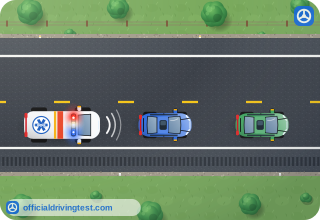
- Stop only if the vehicle is coming up behind you
- Pull over to the curb or side of the road and stop
- Continue driving at the same speed
- Speed up to clear the area as quickly as you can
Show answer
Correct answer: Pull over to the curb or side of the road and stop
You must pull over to the curb or side of the road and stop when you hear a siren or see an emergency vehicle's flashing lights approaching from any direction.
Source: Pennsylvania Driver's Manual (Pub 95), page 59 · Open this page in the manual (Manual page 59)
-
On a one-way street, which direction should you drive when yielding to an approaching emergency vehicle?
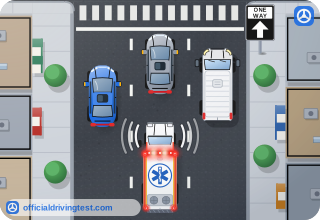
- In reverse
- Toward the center of the road
- It does not matter
- Toward the nearest roadside
Show answer
Correct answer: Toward the nearest roadside
On one-way streets, drive toward the nearest roadside and stop for an approaching emergency vehicle.
Source: Pennsylvania Driver's Manual (Pub 95), page 59 · Open this page in the manual (Manual page 59)
-
After an emergency vehicle passes you, how far away should you stay before starting to drive again?
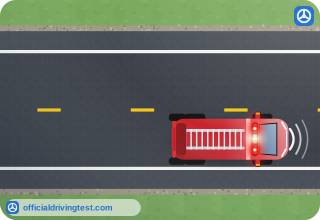
- At least 200 feet
- At least 1,000 feet
- At least 500 feet
- At least 100 feet
Show answer
Correct answer: At least 500 feet
The manual instructs staying at least 500 feet away from an emergency vehicle after it passes, before starting to drive again.
Source: Pennsylvania Driver's Manual (Pub 95), page 59 · Open this page in the manual (Manual page 59)
-
During an emergency situation, whose direction must all drivers obey?
- Any uniformed police officer or properly attired person
- Only a state trooper's, never a local police officer's
- Only a tow truck operator's at the crash scene
- Only a vehicle owner's, if one is at the scene
Show answer
Correct answer: Any uniformed police officer or properly attired person
During an emergency, all drivers must obey the direction of any uniformed police officer, sheriff, constable, or any properly attired person, including fire police.
Source: Pennsylvania Driver's Manual (Pub 95), page 59 · Open this page in the manual (Manual page 59)
-
What does Pennsylvania's Move Over law require motorists to do?
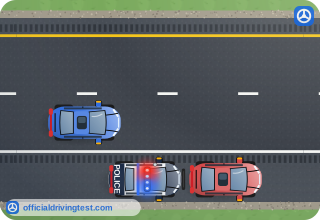
- Move to a lane not next to an emergency response area or disabled vehicle
- Use their horn to alert workers and responders as they pass
- Slow down only if a police car with its flashing lights is visible
- Stop completely near any emergency vehicle
Show answer
Correct answer: Move to a lane not next to an emergency response area or disabled vehicle
The Move Over law requires motorists to move into a lane that is not adjacent to an emergency response area and/or a disabled vehicle.
Source: Pennsylvania Driver's Manual (Pub 95), page 59 · Open this page in the manual (Manual page 59)
-
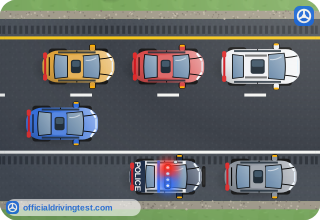
If you cannot move over because of traffic or other conditions, what must you do under the Move Over law?
- Turn on your high beams to warn the responders
- Stop completely in your lane until the scene clears
- Increase your speed to pass the scene quickly
- Slow to at least 20 mph below the posted speed limit
Show answer
Correct answer: Slow to at least 20 mph below the posted speed limit
If drivers cannot move over, they must reduce their speed to at least 20 mph below the posted speed limit.
Source: Pennsylvania Driver's Manual (Pub 95), page 59 · Open this page in the manual (Manual page 59)
-
Who may report Move Over law violations in cases where law enforcement is not present?
- Only news reporters
- Road workers and emergency responders
- Only other motorists
- No one; a citation cannot be issued without an officer present
Show answer
Correct answer: Road workers and emergency responders
The law allows road workers and emergency responders to report Move Over violations by motorists when law enforcement may not be present.
Source: Pennsylvania Driver's Manual (Pub 95), page 59 · Open this page in the manual (Manual page 59)
-
What is the maximum fine for a first offense of the Move Over law?
- $500
- $100
- $2,000
- $1,000
Show answer
Correct answer: $500
A first offense of the Move Over law carries a fine of up to $500.
Source: Pennsylvania Driver's Manual (Pub 95), page 59 · Open this page in the manual (Manual page 59)
-
What is the maximum fine for a third or subsequent offense of the Move Over law?
- $1,000
- $2,000
- $500
- $1,500
Show answer
Correct answer: $2,000
A third and subsequent offense carries a fine of up to $2,000, and fines are doubled for violations occurring in work zone areas.
Source: Pennsylvania Driver's Manual (Pub 95), page 59 · Open this page in the manual (Manual page 59)
-
How many points are assessed to a driving record for a Move Over law conviction?
- 3 points
- 2 points
- 1 point
- 5 points
Show answer
Correct answer: 2 points
A conviction under the Move Over law carries 2 points on the driving record.
Source: Pennsylvania Driver's Manual (Pub 95), page 59 · Open this page in the manual (Manual page 59)
-
If a Move Over law violation leads to the serious bodily injury or death of another person, what license penalty applies?
- A 90-day suspension
- A 6-month suspension
- A 30-day suspension
- A 1-year suspension
Show answer
Correct answer: A 90-day suspension
A Move Over violation causing serious bodily injury or death carries a 90-day license suspension and a fine of up to $1,000.
Source: Pennsylvania Driver's Manual (Pub 95), page 59 · Open this page in the manual (Manual page 59)
-
If a Move Over law violation leads to the death of an emergency responder or a person in or near a disabled vehicle, what suspension and maximum fine apply?
- A 90-day suspension and a fine up to $1,000
- A 6-month suspension and a fine up to $5,000
- No suspension, only a fine
- A 1-year suspension and a fine up to $10,000
Show answer
Correct answer: A 1-year suspension and a fine up to $10,000
If the violation leads to the death of an emergency responder or a person in or near a disabled vehicle, a 1-year suspension and a fine of up to $10,000 could result.
Source: Pennsylvania Driver's Manual (Pub 95), page 59 · Open this page in the manual (Manual page 59)