Oklahoma: Sharing the road — Part 5 Practice Test
Questions in this part include: “Where should you drive when you meet a truck coming from the opposite direction?” · “How do trucks usually make right turns?”
Independent educational site · not affiliated with any government agency or DMV
Ready? Test yourself
- Instant feedback with an explanation
- Every answer cites its source in the manual
- Your best score is saved on this device
- Keyboard: press 1 to 4 to answer and Enter for the next question
Questions are original and based on the official manual "Oklahoma Driver Manual" (2025 (updated November 24, 2025)), Service Oklahoma.
All 17 questions in this practice test
Take the test above first, then use this list to study. Tap “Show answer” to see the correct answer and explanation.
Show the questions and answersHide the questions
-
Where should you drive when you meet a truck coming from the opposite direction?
- Near the center line to give the truck room
- In the exact center of your lane
- On the shoulder at a reduced speed
- As far to the right side of the road as possible
Show answer
Correct answer: As far to the right side of the road as possible
Keeping as far right as possible avoids being sideswiped and reduces wind turbulence between you and the truck.
Source: Oklahoma Driver Manual (2025 (updated November 24, 2025)), page 54 · Open this page in the manual (Manual page 54)
-
What does the wind turbulence between you and an oncoming truck do?
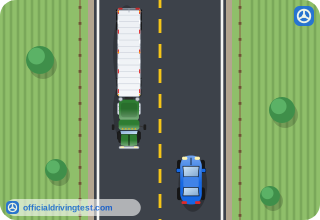
- Pushes vehicles apart
- Pulls vehicles together
- Pulls the smaller vehicle under the truck
- Lifts the smaller vehicle off the road
Show answer
Correct answer: Pushes vehicles apart
The manual states that the turbulence pushes vehicles apart rather than sucking them together.
Source: Oklahoma Driver Manual (2025 (updated November 24, 2025)), page 54 · Open this page in the manual (Manual page 54)
-
According to the manual, how safe are two-trailer trucks compared with single-trailer trucks?
- Less safe, because the second trailer often swerves
- Safe to pass only on downhill grades
- Just as safe as single-trailer trucks
- Safe only when passed on the left at night
Show answer
Correct answer: Just as safe as single-trailer trucks
Studies cited in the manual show two-trailer trucks are just as safe as single-trailer trucks, and you can pass them with care and skill.
Source: Oklahoma Driver Manual (2025 (updated November 24, 2025)), page 54 · Open this page in the manual (Manual page 54)
-
What should you do about the open space on the right side of a truck that might be making a right turn?
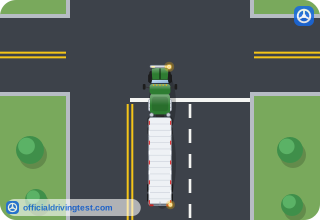
- Move into it to stay ahead of the turn
- Do not move into it or try to pass the truck
- Use it to pass if you stay close to the curb
- Move in if the truck driver signals you to pass
Show answer
Correct answer: Do not move into it or try to pass the truck
A car between the truck and the curb may be unseen by the driver and can be crunched or sideswiped.
Source: Oklahoma Driver Manual (2025 (updated November 24, 2025)), page 55 · Open this page in the manual (Manual page 55)
-
How do trucks usually make right turns?
- Tight turns that hug the curb
- Turns made only from the left lane
- Turns made only after the truck comes to a full stop
- Wide turns, often leaving an open space on the right
Show answer
Correct answer: Wide turns, often leaving an open space on the right
Trucks make wide right turns and often must leave open space on the right side.
Source: Oklahoma Driver Manual (2025 (updated November 24, 2025)), page 55 · Open this page in the manual (Manual page 55)
-
Why should you never try to cross behind a truck that is preparing to back up?
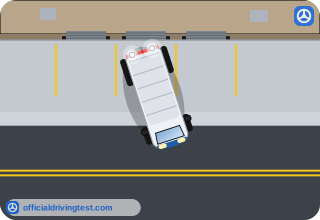
- You will be in the driver's blind spot
- The trailer door may swing open into your car
- The truck's exhaust can stall your engine
- The driver must stop for you first
Show answer
Correct answer: You will be in the driver's blind spot
Crossing behind a backing truck is a high-collision situation because the driver cannot see you.
Source: Oklahoma Driver Manual (2025 (updated November 24, 2025)), page 55 · Open this page in the manual (Manual page 55)
-
In most cases, farm equipment moving on public roads travels at less than what speed?
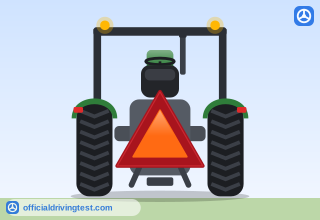
- 15 mph
- 35 mph
- 45 mph
- 25 mph
Show answer
Correct answer: 25 mph
The manual says slow-moving vehicles such as farm equipment usually travel at less than 25 mph.
Source: Oklahoma Driver Manual (2025 (updated November 24, 2025)), page 58 · Open this page in the manual (Manual page 58)
-
How much of the road can large farm equipment use on a state highway?
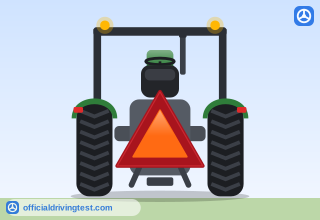
- More than one traffic lane
- Only the shoulder
- Only the right half of one lane
- Never more than one lane's width
Show answer
Correct answer: More than one traffic lane
Farm equipment can be very large and use more than one traffic lane.
Source: Oklahoma Driver Manual (2025 (updated November 24, 2025)), page 58 · Open this page in the manual (Manual page 58)
-
What rights do animal-drawn vehicles have to use the road?
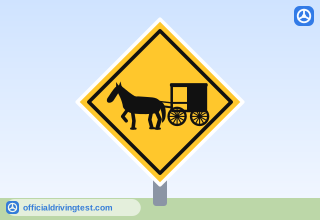
- Fewer rights than a motor vehicle
- They may use only the shoulder
- The same rights as a motor vehicle
- They may use the road only in daylight
Show answer
Correct answer: The same rights as a motor vehicle
Animal-drawn vehicles have the same rights to use the road as a motor vehicle.
Source: Oklahoma Driver Manual (2025 (updated November 24, 2025)), page 58 · Open this page in the manual (Manual page 58)
-
Which rules of the road must animal-drawn vehicles follow?
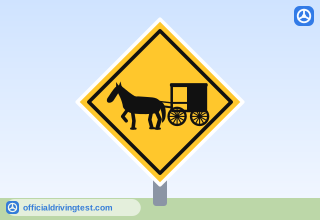
- Only the rules for bicycles
- The same rules of the road as motor vehicles
- No rules, because they are not motorized
- Only the rules posted on warning signs
Show answer
Correct answer: The same rules of the road as motor vehicles
They must follow the same rules of the road as motor vehicles.
Source: Oklahoma Driver Manual (2025 (updated November 24, 2025)), page 58 · Open this page in the manual (Manual page 58)
-
Where will warning signs be posted for animal-drawn vehicles?
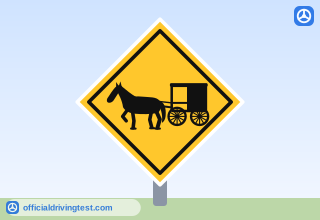
- Only on interstate highways and four-lane roads
- At every rural intersection in the state
- Only on roads that have no paved shoulder
- Where you are likely to find animal-drawn vehicles
Show answer
Correct answer: Where you are likely to find animal-drawn vehicles
Warning signs are posted in areas where animal-drawn vehicles are likely to be found.
Source: Oklahoma Driver Manual (2025 (updated November 24, 2025)), page 58 · Open this page in the manual (Manual page 58)
-
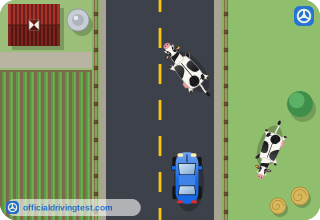
An animal suddenly runs in front of your vehicle. What does the manual say about swerving?
- Swerve into the next lane
- Swerve onto the shoulder
- Swerve only if you are driving slowly
- Do not swerve to avoid hitting the animal
Show answer
Correct answer: Do not swerve to avoid hitting the animal
Swerving may cause a more serious crash than hitting the animal.
Source: Oklahoma Driver Manual (2025 (updated November 24, 2025)), page 61 · Open this page in the manual (Manual page 61)
-
When are animals most active, so you should use extra caution while driving?
- At noon
- Late at night only
- At dawn or dusk
- In the middle of the afternoon
Show answer
Correct answer: At dawn or dusk
Dawn and dusk are when animals are most active.
Source: Oklahoma Driver Manual (2025 (updated November 24, 2025)), page 61 · Open this page in the manual (Manual page 61)
-
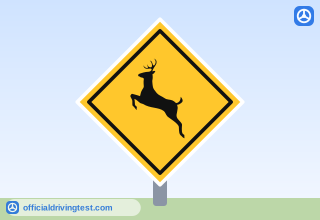
What should you do when driving on roadways marked with animal crossing signs?
- Drive faster to cross sooner
- Be extra alert
- Use your horn constantly
- Switch to your high beams
Show answer
Correct answer: Be extra alert
Roads with animal crossing signs call for extra alertness.
Source: Oklahoma Driver Manual (2025 (updated November 24, 2025)), page 61 · Open this page in the manual (Manual page 61)
-
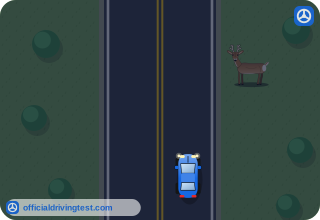
What should you watch for when scanning the sides of the road to spot animals at night?
- Their footprints on the pavement ahead
- Their shadows on the shoulder of the road
- The sound of their movement in the brush
- The reflection of your headlights in their eyes
Show answer
Correct answer: The reflection of your headlights in their eyes
Scanning the roadsides and watching for headlight reflections in animals' eyes helps you spot them.
Source: Oklahoma Driver Manual (2025 (updated November 24, 2025)), page 61 · Open this page in the manual (Manual page 61)
-
During which months do deer/vehicle crashes most often occur?
- October to December
- March to May
- June to August
- January to February
Show answer
Correct answer: October to December
The manual says deer/vehicle crashes most often occur from October to December.
Source: Oklahoma Driver Manual (2025 (updated November 24, 2025)), page 61 · Open this page in the manual (Manual page 61)
-
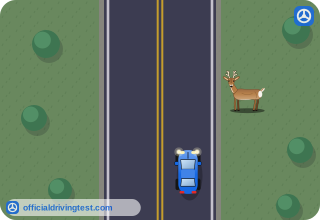
What should you do when approaching an animal standing near the roadway?
- Speed up to pass it quickly
- Honk and keep your speed
- Slow down
- Swerve toward the center line
Show answer
Correct answer: Slow down
The manual says to slow down when approaching an animal standing near the roadway.
Source: Oklahoma Driver Manual (2025 (updated November 24, 2025)), page 61 · Open this page in the manual (Manual page 61)