Oklahoma: Sharing the road — Part 2 Practice Test
Questions in this part include: “What does the manual call residential areas when it comes to bicyclists?” · “What equipment are bicyclists required to have at night?”
Independent educational site · not affiliated with any government agency or DMV
Ready? Test yourself
- Instant feedback with an explanation
- Every answer cites its source in the manual
- Your best score is saved on this device
- Keyboard: press 1 to 4 to answer and Enter for the next question
Questions are original and based on the official manual "Oklahoma Driver Manual" (2025 (updated November 24, 2025)), Service Oklahoma.
All 18 questions in this practice test
Take the test above first, then use this list to study. Tap “Show answer” to see the correct answer and explanation.
Show the questions and answersHide the questions
-
On a two-lane road, what should you avoid when passing a bicycle?
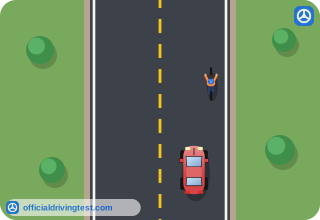
- Passing between the bicyclist and oncoming vehicles
- Moving left to give the rider plenty of room
- Slowing down to let oncoming vehicles pass first
- Passing when there is enough room to do it safely
Show answer
Correct answer: Passing between the bicyclist and oncoming vehicles
You should not squeeze between the rider and oncoming traffic; slow down, let traffic pass, then move left.
Source: Oklahoma Driver Manual (2025 (updated November 24, 2025)), page 51 · Open this page in the manual (Manual page 51)
-
If the street is too narrow to pass a bicycle safely, what should you do?
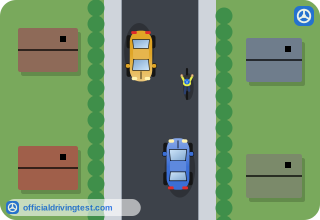
- Honk until the rider moves over
- Pass slowly with less than 3 feet of room
- Squeeze past on the left side while sounding your horn
- Wait until there is enough room to pass safely
Show answer
Correct answer: Wait until there is enough room to pass safely
The manual says never to pass a bicycle on a street that is too narrow and to wait for enough room.
Source: Oklahoma Driver Manual (2025 (updated November 24, 2025)), page 51 · Open this page in the manual (Manual page 51)
-
What does the manual call residential areas when it comes to bicyclists?
- Safe zones for bicyclists
- Danger zones
- Bike-only areas
- No-passing areas
Show answer
Correct answer: Danger zones
Residential areas are called danger zones because bicyclists have all the rights and responsibilities of drivers there.
Source: Oklahoma Driver Manual (2025 (updated November 24, 2025)), page 51 · Open this page in the manual (Manual page 51)
-
Where should you watch for bikes coming out?
- From driveways and from behind parked cars or other obstructions
- Only from marked bike lanes along the edge of the roadway
- Only from the right side of an intersection or crosswalk
- Only from sidewalks that run beside a marked crosswalk
Show answer
Correct answer: From driveways and from behind parked cars or other obstructions
Bikes can appear suddenly from driveways and from behind parked cars or obstructions.
Source: Oklahoma Driver Manual (2025 (updated November 24, 2025)), page 51 · Open this page in the manual (Manual page 51)
-
If you are about to pass a bicycle on a narrow roadway and think the rider does not know you are coming, what should you do with your horn?
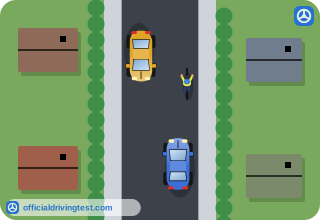
- Blast it so the rider moves off the road
- Not use it at all, because it may startle the rider
- Honk briefly as a signal that you are going to pass
- Honk twice and flash your headlights
Show answer
Correct answer: Honk briefly as a signal that you are going to pass
A brief honk signals your approach; you should not blast the horn or try to intimidate the rider.
Source: Oklahoma Driver Manual (2025 (updated November 24, 2025)), page 51 · Open this page in the manual (Manual page 51)
-
What equipment are bicyclists required to have at night?
- A rear light and a front reflector
- A front light and a rear reflector
- A bell and a rear light
- A front reflector and a flag
Show answer
Correct answer: A front light and a rear reflector
Bicyclists must have a front light and a rear reflector, but approaching lights can still make them hard to see.
Source: Oklahoma Driver Manual (2025 (updated November 24, 2025)), page 51 · Open this page in the manual (Manual page 51)
-
What should you do when you prepare for a right turn and a bicyclist is beside you?
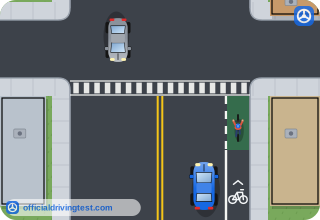
- Speed up so that you can turn right ahead of the bicyclist in time
- Stay in the left part of the lane and then swing wide to turn right
- Stop in the lane and wait for the bicyclist to make the turn first
- Merge with the bicycle traffic and do not turn directly across the rider's path
Show answer
Correct answer: Merge with the bicycle traffic and do not turn directly across the rider's path
The manual says to merge with bicycle traffic for a right turn rather than cut across the bicyclist.
Source: Oklahoma Driver Manual (2025 (updated November 24, 2025)), page 51 · Open this page in the manual (Manual page 51)
-
When are bicycle riders required to ride as far right in the lane as possible?
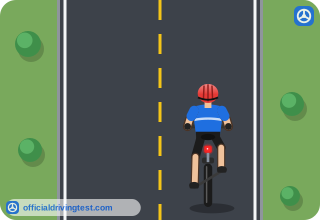
- At all times on every road and in every lane, however wide it is
- Only when there are no cars behind them for a distance of a block
- Only when the lane can be safely shared by a car and a bicycle side by side
- Only at night, when drivers have more trouble seeing bicyclists
Show answer
Correct answer: Only when the lane can be safely shared by a car and a bicycle side by side
The far-right rule applies only when a car and a bicycle can safely share the lane side by side.
Source: Oklahoma Driver Manual (2025 (updated November 24, 2025)), page 52 · Open this page in the manual (Manual page 52)
-
Which of these is a time when a bicyclist can ride in the full lane?
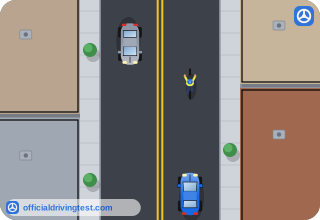
- When overtaking and passing another vehicle going in the same direction
- When the lane is wide enough for a car and a bicycle side by side
- When no vehicle is behind the bicyclist
- When the bicyclist is riding at night
Show answer
Correct answer: When overtaking and passing another vehicle going in the same direction
A bicyclist may take the full lane while passing another vehicle going the same direction.
Source: Oklahoma Driver Manual (2025 (updated November 24, 2025)), page 52 · Open this page in the manual (Manual page 52)
-
In which of these situations can a bicyclist ride in the full lane?
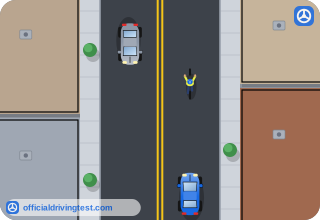
- When getting in place for a right turn at an intersection
- When approaching a stop sign with no traffic
- When riding beside a lane with no parked cars
- When getting in place for a left turn at an intersection
Show answer
Correct answer: When getting in place for a left turn at an intersection
A bicyclist preparing to turn left at an intersection or into a private road or driveway may take the full lane.
Source: Oklahoma Driver Manual (2025 (updated November 24, 2025)), page 52 · Open this page in the manual (Manual page 52)
-
Which unsafe condition in the roadway lets a bicyclist ride in the full lane?
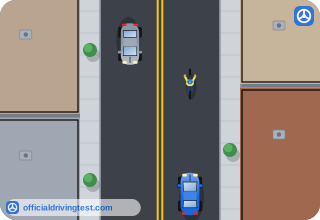
- A freshly painted center line
- Potholes and debris
- A wide, clear lane
- A posted speed limit sign
Show answer
Correct answer: Potholes and debris
Parked cars, moving vehicles, obstacles, pedestrians, animals, potholes and debris are unsafe conditions that allow a bicyclist to take the full lane.
Source: Oklahoma Driver Manual (2025 (updated November 24, 2025)), page 52 · Open this page in the manual (Manual page 52)
-
If a lane is too narrow for both a car and a bicycle to share safely, what is safest?
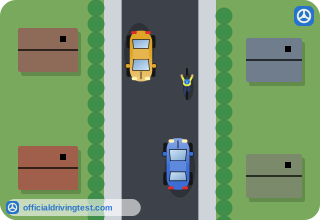
- To let the bicycle take the full lane
- To pass the bicycle within the same lane
- To move ahead of the bicycle quickly
- To honk until the bicycle moves to the right
Show answer
Correct answer: To let the bicycle take the full lane
In a lane too narrow to share, the manual says it is safest to let the bicycle take the full lane.
Source: Oklahoma Driver Manual (2025 (updated November 24, 2025)), page 52 · Open this page in the manual (Manual page 52)
-
What should you do when you see a flag on a bicycle?
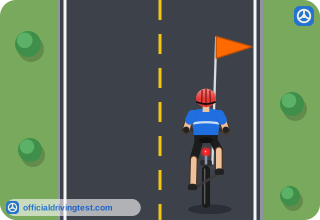
- Pass quickly so that you get out of the rider's way
- Honk loudly so that the rider can hear you coming
- Slow down, because the rider may have impaired hearing
- Stop and wait until the rider has left the roadway
Show answer
Correct answer: Slow down, because the rider may have impaired hearing
A flag on a bicycle can mean the rider has impaired hearing, so you should slow down.
Source: Oklahoma Driver Manual (2025 (updated November 24, 2025)), page 52 · Open this page in the manual (Manual page 52)
-
Which lane must all bicyclists ride in?
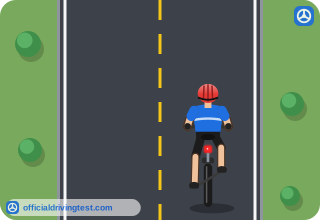
- Whichever lane faces oncoming traffic
- The correct lane of traffic
- Any lane that has the least traffic
- The lane farthest from parked cars
Show answer
Correct answer: The correct lane of traffic
The manual says all bicyclists must ride in the correct lane of traffic.
Source: Oklahoma Driver Manual (2025 (updated November 24, 2025)), page 52 · Open this page in the manual (Manual page 52)
-
In the manual's bicycle rules for stop signs and red traffic signals, what does "Immediate Hazard" refer to?
- Any vehicle stopped at the intersection at the same time as a bicyclist who has stopped
- A pedestrian waiting at the curb at an intersection who may step in front of the bicyclist
- Any vehicle that is parked beside the bicycle lane and blocks the bicyclist's view
- A vehicle approaching a bicyclist at a speed or distance that could lead to a potential collision
Show answer
Correct answer: A vehicle approaching a bicyclist at a speed or distance that could lead to a potential collision
An immediate hazard is a vehicle approaching at a speed or distance that could cause a collision with the bicyclist.
Source: Oklahoma Driver Manual (2025 (updated November 24, 2025)), page 52 · Open this page in the manual (Manual page 52)
-
What must cyclists do when approaching a stop sign?
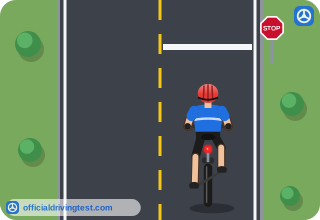
- Slow down
- Come to a complete stop in every case
- Dismount and walk across
- Speed up to clear the intersection
Show answer
Correct answer: Slow down
Cyclists must slow down at a stop sign and stop only when there is a risk of danger.
Source: Oklahoma Driver Manual (2025 (updated November 24, 2025)), page 52 · Open this page in the manual (Manual page 52)
-
When may a cyclist proceed through a stop sign without stopping?
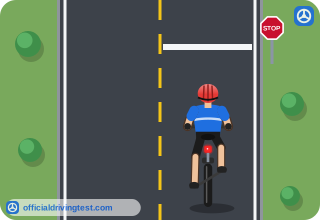
- Only if no pedestrians are on the sidewalk
- Only after counting to three
- Never, because a stop is always required
- If no danger is present
Show answer
Correct answer: If no danger is present
If there is no danger, cyclists can go on without stopping.
Source: Oklahoma Driver Manual (2025 (updated November 24, 2025)), page 52 · Open this page in the manual (Manual page 52)
-
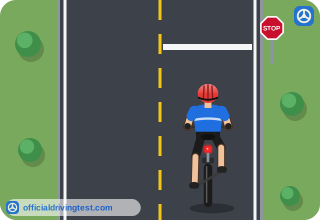
When a cyclist enters an intersection at a stop sign, whom should the cyclist yield to?
- Only motor vehicles
- Pedestrians and other traffic
- Only pedestrians
- No one, if the cyclist has slowed down
Show answer
Correct answer: Pedestrians and other traffic
Cyclists should yield to pedestrians and other traffic when entering the intersection.
Source: Oklahoma Driver Manual (2025 (updated November 24, 2025)), page 52 · Open this page in the manual (Manual page 52)