Oklahoma: Sharing the road
Bicycles, motorcycles, large trucks and their blind spots, slow-moving vehicles and road rage. Split into 5 shorter tests so you're not stuck in one long quiz.
Independent educational site · not affiliated with any government agency or DMV
Choose a part
Sharing the road — Part 1
Questions in this part include: “In which situation do you NOT have to stop for a school bus with flashing red lights?”
StartSharing the road — Part 2
Questions in this part include: “What does the manual call residential areas when it comes to bicyclists?”
StartSharing the road — Part 3
Questions in this part include: “How much of its lane do motorcycle riders need to handle hazards such as potholes and strong winds?”
StartSharing the road — Part 4
Questions in this part include: “What must a motorcycle operator wear if the motorcycle has no windshield?”
StartSharing the road — Part 5
Questions in this part include: “Where should you drive when you meet a truck coming from the opposite direction?”
StartAll 87 Sharing the road questions with answers
Choose a part above to take a practice test, or study every question and answer here.
Show the questions and answersHide the questions
-
The Slow Moving Vehicle emblem is used on vehicles traveling on public highways at what speed?
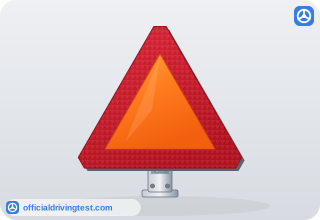
- 35 MPH or less
- 45 MPH or less
- 25 MPH or less
- 15 MPH or less
Show answer
Correct answer: 25 MPH or less
The emblem marks slow vehicles that travel at 25 MPH or less on public highways.
Source: Oklahoma Driver Manual (2025 (updated November 24, 2025)), page 24 · Open this page in the manual (Manual page 24)
-
Which of these uses the Slow Moving Vehicle emblem?
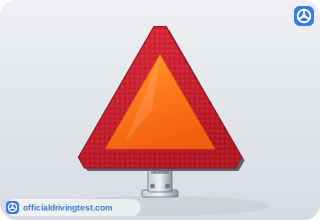
- A school bus traveling on its regular route
- Agricultural equipment traveling on a public highway
- A police patrol car traveling on the highway
- A passenger car traveling in the right lane
Show answer
Correct answer: Agricultural equipment traveling on a public highway
The emblem is used on slow vehicles such as agricultural, roadside construction and highway maintenance equipment.
Source: Oklahoma Driver Manual (2025 (updated November 24, 2025)), page 24 · Open this page in the manual (Manual page 24)
-
What does a bus with flashing red lights and/or a red STOP sign showing mean?
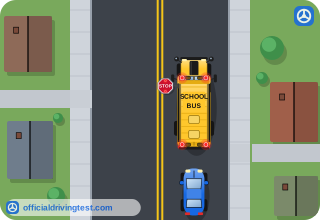
- Children are getting on or off the bus and you must stop
- The bus is about to pull away and you may pass
- The bus is broken down and you may pass with caution
- The bus is turning and you must give it room
Show answer
Correct answer: Children are getting on or off the bus and you must stop
Flashing red lights or a red STOP sign tell you children are boarding or leaving, so you must stop.
Source: Oklahoma Driver Manual (2025 (updated November 24, 2025)), page 30 · Open this page in the manual (Manual page 30)
-
You have stopped for a school bus. You must remain stopped until which of these happens?
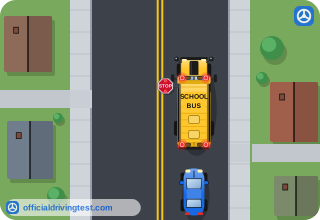
- The bus has started moving
- Another vehicle has passed the bus
- Ten seconds have passed
- The children have reached the sidewalk
Show answer
Correct answer: The bus has started moving
One condition for going on is that the bus has started moving.
Source: Oklahoma Driver Manual (2025 (updated November 24, 2025)), page 30 · Open this page in the manual (Manual page 30)
-
You have stopped for a school bus. You must remain stopped until which of these happens?
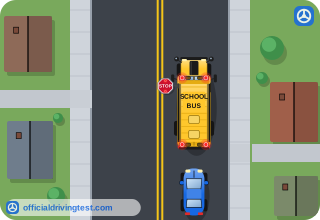
- A full minute has passed
- The bus driver motions for you to proceed
- Another driver goes around the bus
- The bus driver turns off the engine
Show answer
Correct answer: The bus driver motions for you to proceed
You may proceed when the bus driver motions for you to go.
Source: Oklahoma Driver Manual (2025 (updated November 24, 2025)), page 30 · Open this page in the manual (Manual page 30)
-
You have stopped for a school bus. You must remain stopped until which of these happens?
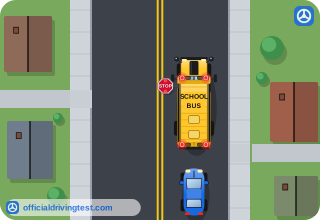
- Children on the bus are seated and its door is closed
- Cars in the other lane begin to drive past the bus
- The bus driver turns on the bus's yellow hazard lights
- The red flashing lights go off and/or the sign is pulled back
Show answer
Correct answer: The red flashing lights go off and/or the sign is pulled back
You may go on when the bus's red flashing lights go off or its sign is pulled back.
Source: Oklahoma Driver Manual (2025 (updated November 24, 2025)), page 30 · Open this page in the manual (Manual page 30)
-
In which situation do you NOT have to stop for a school bus with flashing red lights?
- The bus is a church bus
- The bus is stopped on a two-lane road with traffic in both directions
- The bus is on a different roadway
- No children can be seen at the moment
Show answer
Correct answer: The bus is on a different roadway
The manual says you do not have to stop when the bus is on a different roadway.
Source: Oklahoma Driver Manual (2025 (updated November 24, 2025)), page 30 · Open this page in the manual (Manual page 30)
-
You do not have to stop for a school bus when it is stopped in what kind of place?
- In a loading zone by a controlled-access highway where pedestrians cannot cross
- At a stop on a residential street where children cross to the bus
- In a loading zone by a school where pedestrians are allowed to cross
- On a two-lane road where no children are visible near the bus
Show answer
Correct answer: In a loading zone by a controlled-access highway where pedestrians cannot cross
A bus stopped in a loading zone by a controlled-access highway where pedestrians may not cross does not require you to stop.
Source: Oklahoma Driver Manual (2025 (updated November 24, 2025)), page 30 · Open this page in the manual (Manual page 30)
-
When should you check behind your car for bikes, tricycles and small children?
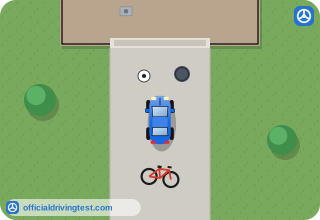
- After you shift into reverse
- Before you get into your car
- After you start backing up
- Only after you have checked the mirrors
Show answer
Correct answer: Before you get into your car
The safety tip says to check behind the car before you get in, which matters especially for vans and pickups.
Source: Oklahoma Driver Manual (2025 (updated November 24, 2025)), page 39 · Open this page in the manual (Manual page 39)
-
Which of these is an example of road rage?
- Signaling before you change lanes
- Giving a merging driver room to enter
- Slowing down for heavy rain
- Cutting off other vehicles
Show answer
Correct answer: Cutting off other vehicles
Tailgating, cutting off other vehicles, careless lane changes, speeding and running red lights are examples of road rage.
Source: Oklahoma Driver Manual (2025 (updated November 24, 2025)), page 41 · Open this page in the manual (Manual page 41)
-
Which of these is an example of escalated road rage?
- Using your turn signal early
- Waving another driver ahead of you
- Intentionally hitting another vehicle
- Slowing down in a school zone
Show answer
Correct answer: Intentionally hitting another vehicle
Escalated road rage includes obscene gestures, verbal assault, intentionally hitting another vehicle and threatening to use a weapon.
Source: Oklahoma Driver Manual (2025 (updated November 24, 2025)), page 41 · Open this page in the manual (Manual page 41)
-
Which is a precaution you can take behind the wheel to avoid road rage?
- Do not engage other drivers
- Speed up to get away from an aggressive driver
- Follow an aggressive driver to see where he or she goes
- Block the lane to stop an aggressive driver
Show answer
Correct answer: Do not engage other drivers
The manual lists avoiding offending other drivers, not engaging them and keeping your anger in check.
Source: Oklahoma Driver Manual (2025 (updated November 24, 2025)), page 41 · Open this page in the manual (Manual page 41)
-
If you suspect another driver is targeting you, where should you go?
- Straight home, where you can park in your own driveway at once
- A quiet side street where you can pull over and wait it out
- The nearest freeway entrance ramp to get away from the driver
- A safe place with people, such as a police, fire or gas station
Show answer
Correct answer: A safe place with people, such as a police, fire or gas station
Go to a safe place where there are people, such as a police, fire or gas station, and do not drive home.
Source: Oklahoma Driver Manual (2025 (updated November 24, 2025)), page 41 · Open this page in the manual (Manual page 41)
-
If you suspect another driver is targeting you, what should you do if necessary?
- Pull over and talk to the other driver
- Call 911 immediately
- Drive home and lock the doors
- Wait on the shoulder until the driver leaves
Show answer
Correct answer: Call 911 immediately
If necessary, you should call 911 immediately, and you should not drive home.
Source: Oklahoma Driver Manual (2025 (updated November 24, 2025)), page 41 · Open this page in the manual (Manual page 41)
-
What rights and responsibilities do bicyclists have on the streets?
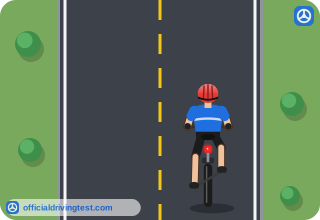
- Fewer responsibilities than drivers
- The rights of pedestrians only
- The same as drivers of other vehicles
- Rights but no responsibilities
Show answer
Correct answer: The same as drivers of other vehicles
Bicyclists have the same rights and responsibilities on the streets as other drivers.
Source: Oklahoma Driver Manual (2025 (updated November 24, 2025)), page 51 · Open this page in the manual (Manual page 51)
-
When you share the road with bicycles, what should you always expect the rider to do?
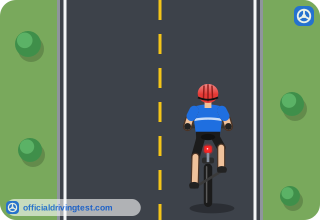
- Stay close to the curb
- Make sudden moves
- Signal every turn
- Stop for every car
Show answer
Correct answer: Make sudden moves
Surprises on the road can make a rider swerve, so you should always expect sudden moves.
Source: Oklahoma Driver Manual (2025 (updated November 24, 2025)), page 51 · Open this page in the manual (Manual page 51)
-
When overtaking and passing a bicycle going in the same direction, what is the least distance a motor vehicle must leave between itself and the bicycle?
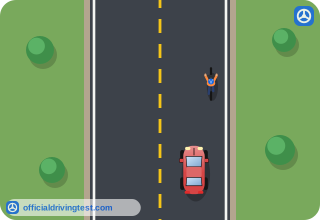
- 1 foot
- 2 feet
- 18 inches
- 3 feet
Show answer
Correct answer: 3 feet
The law requires at least 3 feet between the motor vehicle and the bicycle until the vehicle is safely past.
Source: Oklahoma Driver Manual (2025 (updated November 24, 2025)), page 51 · Open this page in the manual (Manual page 51)
-
Which bicycle riders does the manual say to watch for as likely to turn in front of you without looking or signaling?
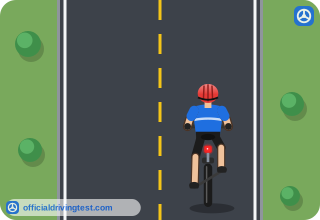
- Riders wearing helmets
- Riders carrying packages
- Children
- Riders in groups
Show answer
Correct answer: Children
The manual warns about riders turning without looking or signaling, especially children.
Source: Oklahoma Driver Manual (2025 (updated November 24, 2025)), page 51 · Open this page in the manual (Manual page 51)
-
On a two-lane road, what should you avoid when passing a bicycle?
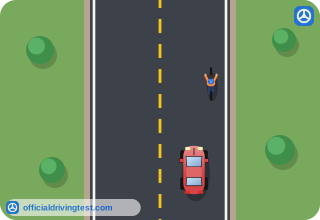
- Passing between the bicyclist and oncoming vehicles
- Moving left to give the rider plenty of room
- Slowing down to let oncoming vehicles pass first
- Passing when there is enough room to do it safely
Show answer
Correct answer: Passing between the bicyclist and oncoming vehicles
You should not squeeze between the rider and oncoming traffic; slow down, let traffic pass, then move left.
Source: Oklahoma Driver Manual (2025 (updated November 24, 2025)), page 51 · Open this page in the manual (Manual page 51)
-
If the street is too narrow to pass a bicycle safely, what should you do?
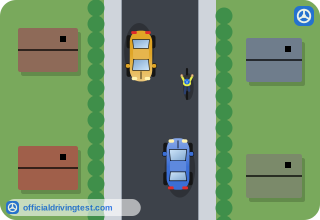
- Honk until the rider moves over
- Pass slowly with less than 3 feet of room
- Squeeze past on the left side while sounding your horn
- Wait until there is enough room to pass safely
Show answer
Correct answer: Wait until there is enough room to pass safely
The manual says never to pass a bicycle on a street that is too narrow and to wait for enough room.
Source: Oklahoma Driver Manual (2025 (updated November 24, 2025)), page 51 · Open this page in the manual (Manual page 51)
-
What does the manual call residential areas when it comes to bicyclists?
- Safe zones for bicyclists
- Danger zones
- Bike-only areas
- No-passing areas
Show answer
Correct answer: Danger zones
Residential areas are called danger zones because bicyclists have all the rights and responsibilities of drivers there.
Source: Oklahoma Driver Manual (2025 (updated November 24, 2025)), page 51 · Open this page in the manual (Manual page 51)
-
Where should you watch for bikes coming out?
- From driveways and from behind parked cars or other obstructions
- Only from marked bike lanes along the edge of the roadway
- Only from the right side of an intersection or crosswalk
- Only from sidewalks that run beside a marked crosswalk
Show answer
Correct answer: From driveways and from behind parked cars or other obstructions
Bikes can appear suddenly from driveways and from behind parked cars or obstructions.
Source: Oklahoma Driver Manual (2025 (updated November 24, 2025)), page 51 · Open this page in the manual (Manual page 51)
-
If you are about to pass a bicycle on a narrow roadway and think the rider does not know you are coming, what should you do with your horn?
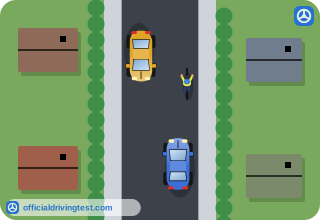
- Blast it so the rider moves off the road
- Not use it at all, because it may startle the rider
- Honk briefly as a signal that you are going to pass
- Honk twice and flash your headlights
Show answer
Correct answer: Honk briefly as a signal that you are going to pass
A brief honk signals your approach; you should not blast the horn or try to intimidate the rider.
Source: Oklahoma Driver Manual (2025 (updated November 24, 2025)), page 51 · Open this page in the manual (Manual page 51)
-
What equipment are bicyclists required to have at night?
- A rear light and a front reflector
- A front light and a rear reflector
- A bell and a rear light
- A front reflector and a flag
Show answer
Correct answer: A front light and a rear reflector
Bicyclists must have a front light and a rear reflector, but approaching lights can still make them hard to see.
Source: Oklahoma Driver Manual (2025 (updated November 24, 2025)), page 51 · Open this page in the manual (Manual page 51)
-
What should you do when you prepare for a right turn and a bicyclist is beside you?
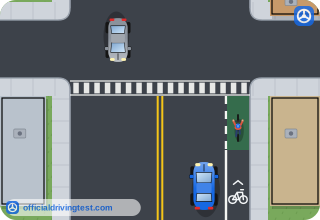
- Speed up so that you can turn right ahead of the bicyclist in time
- Stay in the left part of the lane and then swing wide to turn right
- Stop in the lane and wait for the bicyclist to make the turn first
- Merge with the bicycle traffic and do not turn directly across the rider's path
Show answer
Correct answer: Merge with the bicycle traffic and do not turn directly across the rider's path
The manual says to merge with bicycle traffic for a right turn rather than cut across the bicyclist.
Source: Oklahoma Driver Manual (2025 (updated November 24, 2025)), page 51 · Open this page in the manual (Manual page 51)
-
When are bicycle riders required to ride as far right in the lane as possible?
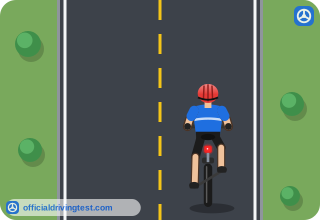
- At all times on every road and in every lane, however wide it is
- Only when there are no cars behind them for a distance of a block
- Only when the lane can be safely shared by a car and a bicycle side by side
- Only at night, when drivers have more trouble seeing bicyclists
Show answer
Correct answer: Only when the lane can be safely shared by a car and a bicycle side by side
The far-right rule applies only when a car and a bicycle can safely share the lane side by side.
Source: Oklahoma Driver Manual (2025 (updated November 24, 2025)), page 52 · Open this page in the manual (Manual page 52)
-
Which of these is a time when a bicyclist can ride in the full lane?
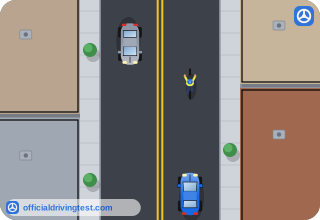
- When overtaking and passing another vehicle going in the same direction
- When the lane is wide enough for a car and a bicycle side by side
- When no vehicle is behind the bicyclist
- When the bicyclist is riding at night
Show answer
Correct answer: When overtaking and passing another vehicle going in the same direction
A bicyclist may take the full lane while passing another vehicle going the same direction.
Source: Oklahoma Driver Manual (2025 (updated November 24, 2025)), page 52 · Open this page in the manual (Manual page 52)
-
In which of these situations can a bicyclist ride in the full lane?
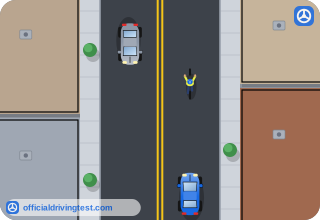
- When getting in place for a right turn at an intersection
- When approaching a stop sign with no traffic
- When riding beside a lane with no parked cars
- When getting in place for a left turn at an intersection
Show answer
Correct answer: When getting in place for a left turn at an intersection
A bicyclist preparing to turn left at an intersection or into a private road or driveway may take the full lane.
Source: Oklahoma Driver Manual (2025 (updated November 24, 2025)), page 52 · Open this page in the manual (Manual page 52)
-
Which unsafe condition in the roadway lets a bicyclist ride in the full lane?
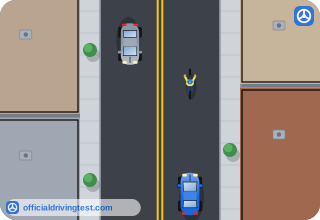
- A freshly painted center line
- Potholes and debris
- A wide, clear lane
- A posted speed limit sign
Show answer
Correct answer: Potholes and debris
Parked cars, moving vehicles, obstacles, pedestrians, animals, potholes and debris are unsafe conditions that allow a bicyclist to take the full lane.
Source: Oklahoma Driver Manual (2025 (updated November 24, 2025)), page 52 · Open this page in the manual (Manual page 52)
-
If a lane is too narrow for both a car and a bicycle to share safely, what is safest?
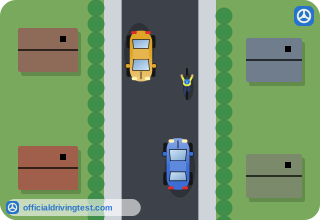
- To let the bicycle take the full lane
- To pass the bicycle within the same lane
- To move ahead of the bicycle quickly
- To honk until the bicycle moves to the right
Show answer
Correct answer: To let the bicycle take the full lane
In a lane too narrow to share, the manual says it is safest to let the bicycle take the full lane.
Source: Oklahoma Driver Manual (2025 (updated November 24, 2025)), page 52 · Open this page in the manual (Manual page 52)
-
What should you do when you see a flag on a bicycle?
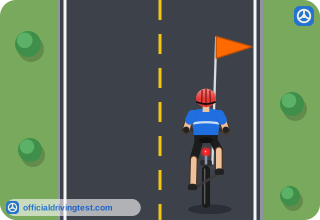
- Pass quickly so that you get out of the rider's way
- Honk loudly so that the rider can hear you coming
- Slow down, because the rider may have impaired hearing
- Stop and wait until the rider has left the roadway
Show answer
Correct answer: Slow down, because the rider may have impaired hearing
A flag on a bicycle can mean the rider has impaired hearing, so you should slow down.
Source: Oklahoma Driver Manual (2025 (updated November 24, 2025)), page 52 · Open this page in the manual (Manual page 52)
-
Which lane must all bicyclists ride in?
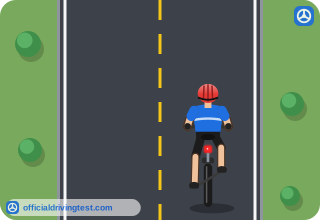
- Whichever lane faces oncoming traffic
- The correct lane of traffic
- Any lane that has the least traffic
- The lane farthest from parked cars
Show answer
Correct answer: The correct lane of traffic
The manual says all bicyclists must ride in the correct lane of traffic.
Source: Oklahoma Driver Manual (2025 (updated November 24, 2025)), page 52 · Open this page in the manual (Manual page 52)
-
In the manual's bicycle rules for stop signs and red traffic signals, what does "Immediate Hazard" refer to?
- Any vehicle stopped at the intersection at the same time as a bicyclist who has stopped
- A pedestrian waiting at the curb at an intersection who may step in front of the bicyclist
- Any vehicle that is parked beside the bicycle lane and blocks the bicyclist's view
- A vehicle approaching a bicyclist at a speed or distance that could lead to a potential collision
Show answer
Correct answer: A vehicle approaching a bicyclist at a speed or distance that could lead to a potential collision
An immediate hazard is a vehicle approaching at a speed or distance that could cause a collision with the bicyclist.
Source: Oklahoma Driver Manual (2025 (updated November 24, 2025)), page 52 · Open this page in the manual (Manual page 52)
-
What must cyclists do when approaching a stop sign?
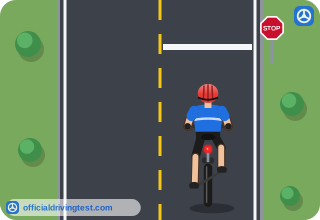
- Slow down
- Come to a complete stop in every case
- Dismount and walk across
- Speed up to clear the intersection
Show answer
Correct answer: Slow down
Cyclists must slow down at a stop sign and stop only when there is a risk of danger.
Source: Oklahoma Driver Manual (2025 (updated November 24, 2025)), page 52 · Open this page in the manual (Manual page 52)
-
When may a cyclist proceed through a stop sign without stopping?
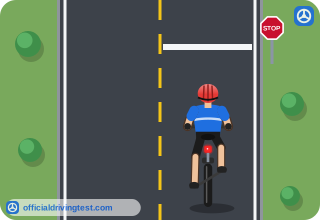
- Only if no pedestrians are on the sidewalk
- Only after counting to three
- Never, because a stop is always required
- If no danger is present
Show answer
Correct answer: If no danger is present
If there is no danger, cyclists can go on without stopping.
Source: Oklahoma Driver Manual (2025 (updated November 24, 2025)), page 52 · Open this page in the manual (Manual page 52)
-
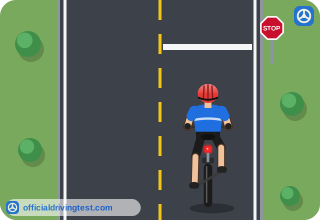
When a cyclist enters an intersection at a stop sign, whom should the cyclist yield to?
- Only motor vehicles
- Pedestrians and other traffic
- Only pedestrians
- No one, if the cyclist has slowed down
Show answer
Correct answer: Pedestrians and other traffic
Cyclists should yield to pedestrians and other traffic when entering the intersection.
Source: Oklahoma Driver Manual (2025 (updated November 24, 2025)), page 52 · Open this page in the manual (Manual page 52)
-
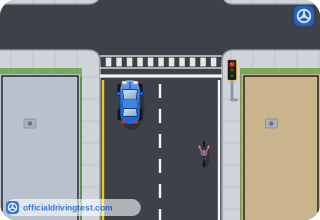
What must a cyclist do at a red traffic light before entering the intersection?
- Stop
- Slow down only
- Dismount and walk across
- Flash a hand signal and continue
Show answer
Correct answer: Stop
Cyclists must stop at a red light before entering the intersection.
Source: Oklahoma Driver Manual (2025 (updated November 24, 2025)), page 52 · Open this page in the manual (Manual page 52)
-
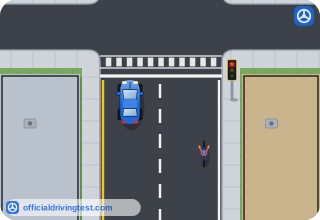
At a red light, which oncoming traffic must a cyclist yield to?
- Only vehicles that are turning
- Only vehicles traveling faster than the cyclist
- Traffic that poses an immediate hazard
- No oncoming traffic, once the cyclist has stopped
Show answer
Correct answer: Traffic that poses an immediate hazard
A cyclist must yield to oncoming traffic that poses an immediate hazard.
Source: Oklahoma Driver Manual (2025 (updated November 24, 2025)), page 52 · Open this page in the manual (Manual page 52)
-
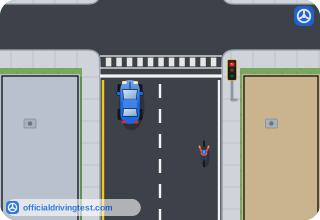
After stopping at a red light, when can a cyclist proceed through it?
- Only after counting to ten
- If it is safe
- Only when the cyclist is wearing a front light
- Only when the cyclist has a flag on the bicycle
Show answer
Correct answer: If it is safe
The manual says that if it is safe, cyclists can proceed through the red light.
Source: Oklahoma Driver Manual (2025 (updated November 24, 2025)), page 52 · Open this page in the manual (Manual page 52)
-
What must a cyclist do before making a right turn on red?
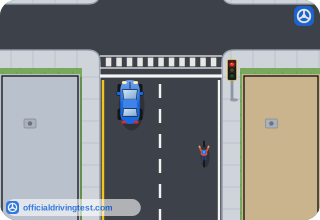
- Come to a complete stop and wait for a green arrow
- Dismount and walk across the intersection
- Stop and wait ten seconds
- Slow down and yield to traffic
Show answer
Correct answer: Slow down and yield to traffic
A cyclist can turn right on red after slowing down and yielding to traffic.
Source: Oklahoma Driver Manual (2025 (updated November 24, 2025)), page 52 · Open this page in the manual (Manual page 52)
-
Under what conditions can a cyclist make a left turn on red onto a one-way street?
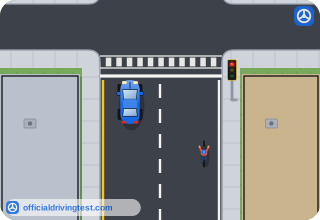
- After slowing down, with no need to yield
- Only when the street is a two-way street
- After stopping and yielding to oncoming traffic
- Only when no cars are waiting behind
Show answer
Correct answer: After stopping and yielding to oncoming traffic
A cyclist can turn left onto a one-way street on red after stopping and yielding to oncoming traffic.
Source: Oklahoma Driver Manual (2025 (updated November 24, 2025)), page 52 · Open this page in the manual (Manual page 52)
-
According to the manual, why is it hard for a driver to estimate a motorcycle's distance and speed?
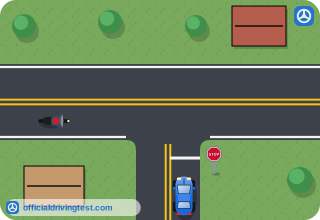
- Its profile is narrow and its body is short
- Motorcycles always travel faster than other traffic
- The engine noise hides where the motorcycle is
- Motorcycles ride only on the shoulder
Show answer
Correct answer: Its profile is narrow and its body is short
A motorcycle's narrow profile and short body make it harder to see and to judge how far away it is and how fast it is going.
Source: Oklahoma Driver Manual (2025 (updated November 24, 2025)), page 53 · Open this page in the manual (Manual page 53)
-
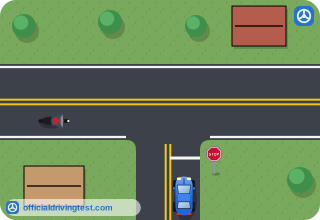
One reason drivers do not see motorcyclists is that motorists tend to look for what?
- Pedestrians and bicyclists only
- Large trucks and buses only
- Other cars rather than motorcycles
- Vehicles with flashing lights only
Show answer
Correct answer: Other cars rather than motorcycles
Drivers are used to scanning for cars, so a motorcycle can go unnoticed.
Source: Oklahoma Driver Manual (2025 (updated November 24, 2025)), page 53 · Open this page in the manual (Manual page 53)
-
How much of its lane do motorcycle riders need to handle hazards such as potholes and strong winds?
- Only the half nearest the shoulder
- The lane's full width
- Only a narrow strip in the center
- Only the width of one wheel track
Show answer
Correct answer: The lane's full width
Riders need the full width of the lane to respond to hazards, and a motorcycle has the right to use the lane.
Source: Oklahoma Driver Manual (2025 (updated November 24, 2025)), page 53 · Open this page in the manual (Manual page 53)
-
How should you treat the lane of a motorcycle you are driving near?
- Share the lane if you stay to one side of it
- Share the lane only when the rider is going slowly
- Share the lane only when you are at an intersection
- Do not try to share the lane; respect its space
Show answer
Correct answer: Do not try to share the lane; respect its space
The manual says you should not try to share a lane with a motorcycle and should respect its space and position in traffic.
Source: Oklahoma Driver Manual (2025 (updated November 24, 2025)), page 53 · Open this page in the manual (Manual page 53)
-
Why should you not pass a motorcycle too close or too fast?
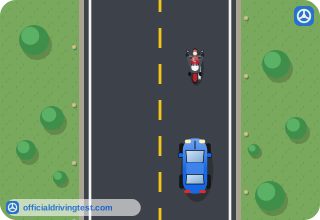
- The rider may not hear your horn
- The rider could be blinded by your headlights
- The blast of air can blow it out of control
- Motorcycles always speed up when passed
Show answer
Correct answer: The blast of air can blow it out of control
Passing a motorcycle too close or too fast creates a blast of air that can blow it out of control. Pass it as you would pass a car.
Source: Oklahoma Driver Manual (2025 (updated November 24, 2025)), page 53 · Open this page in the manual (Manual page 53)
-
What should you do when you make a left turn and a motorcycle may be approaching?
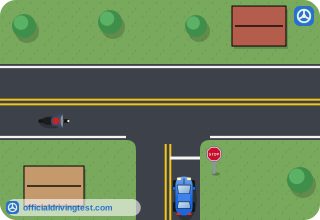
- Assume oncoming riders will stop for you
- Signal your intention and watch for oncoming motorcycles
- Turn quickly before the rider reaches the intersection
- Sound your horn instead of signaling
Show answer
Correct answer: Signal your intention and watch for oncoming motorcycles
For left turns the manual says to always signal and to watch for oncoming motorcycles.
Source: Oklahoma Driver Manual (2025 (updated November 24, 2025)), page 53 · Open this page in the manual (Manual page 53)
-
Why might a driver who changes lanes clip or hit a motorcycle?
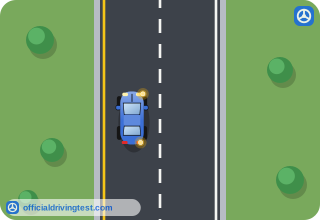
- Riders beside a lane of cars are often out of the driver's view
- Motorcycle riders almost never use their turn signals
- Motorcycles cannot be seen at all in daylight
- Motorcycles accelerate faster than any car on the road
Show answer
Correct answer: Riders beside a lane of cars are often out of the driver's view
Cyclists riding alongside a lane of cars are often out of the driver's view, so you must check your blind spots before changing lanes.
Source: Oklahoma Driver Manual (2025 (updated November 24, 2025)), page 53 · Open this page in the manual (Manual page 53)
-
Which of these is a reason a motorcyclist may change position within a lane?
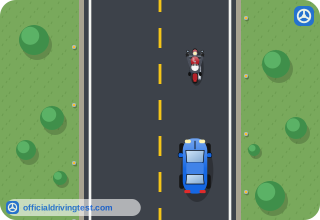
- To get closer to the vehicle ahead
- To warm up the engine
- To avoid windblast from other vehicles
- To save fuel on long rides
Show answer
Correct answer: To avoid windblast from other vehicles
The manual lists avoiding windblast from other vehicles among the reasons a rider changes lane position, along with avoiding hazards and being seen.
Source: Oklahoma Driver Manual (2025 (updated November 24, 2025)), page 53 · Open this page in the manual (Manual page 53)
-
At an intersection with a motorcycle nearby, when should you move into its path of travel?
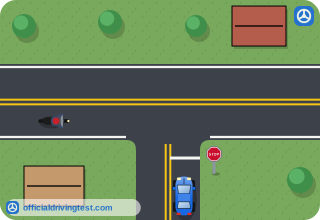
- As soon as the motorcycle slows down
- Only after the rider's intentions are absolutely clear
- Once the rider moves toward the edge of the lane
- Right away, because riders yield to cars
Show answer
Correct answer: Only after the rider's intentions are absolutely clear
Most collisions and injuries happen at intersections, so wait until you know whether the rider is turning or going straight.
Source: Oklahoma Driver Manual (2025 (updated November 24, 2025)), page 53 · Open this page in the manual (Manual page 53)
-
Why should you take extra care around motorcycles in rain, on wet roads, on ice, or in heavy winds?
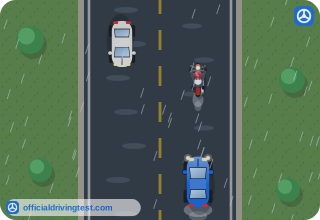
- Motorcycles are not permitted to travel on wet or icy roads
- Motorcycle headlights are far less visible in bad weather
- Riders are required to pull over until the weather clears
- The motorcycle's braking and handling abilities are impaired
Show answer
Correct answer: The motorcycle's braking and handling abilities are impaired
Difficult conditions reduce a motorcycle's braking and handling abilities, so give riders more room and care.
Source: Oklahoma Driver Manual (2025 (updated November 24, 2025)), page 53 · Open this page in the manual (Manual page 53)
-
At night, why can you easily misjudge the distance to a motorcycle?
- Its one headlight and one taillight can blend into other vehicles' lights
- Motorcycles travel noticeably faster at night than other traffic does
- Riders often switch off their lights at night to save the battery
- Motorcycle lights are always much dimmer than a car's headlights are
Show answer
Correct answer: Its one headlight and one taillight can blend into other vehicles' lights
A motorcycle has only one headlight and one taillight, which can blend into the lights of other vehicles and make distance hard to judge.
Source: Oklahoma Driver Manual (2025 (updated November 24, 2025)), page 53 · Open this page in the manual (Manual page 53)
-
What should you do with your headlights near a motorcycle at night?
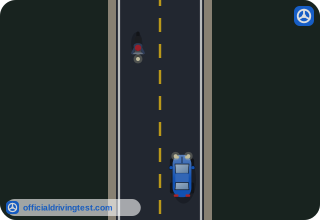
- Keep them on high beam so the rider sees you
- Turn them off briefly to signal the rider
- Dim them, as you would for cars and trucks
- Flash them to warn the rider of your position
Show answer
Correct answer: Dim them, as you would for cars and trucks
The manual says to always dim your headlights for motorcycles just as you do for cars and trucks.
Source: Oklahoma Driver Manual (2025 (updated November 24, 2025)), page 53 · Open this page in the manual (Manual page 53)
-
What must a motorcycle operator wear if the motorcycle has no windshield?
- Tinted sunglasses with attached side shields
- ANSI-approved goggles or face shield material
- A reflective vest and a pair of work gloves
- A visor clipped to the collar of a jacket
Show answer
Correct answer: ANSI-approved goggles or face shield material
State statutes require a windshield, or in its place the operator must wear ANSI-approved goggles or face shield material that protects against foreign objects.
Source: Oklahoma Driver Manual (2025 (updated November 24, 2025)), page 53 · Open this page in the manual (Manual page 53)
-
How far back should you stay when following a truck?
- Close enough to block other vehicles from cutting in
- Close enough to stay in the truck's draft
- Exactly one car length at any speed
- Far enough back to see the roadway ahead clearly
Show answer
Correct answer: Far enough back to see the roadway ahead clearly
Staying far enough back lets you see the roadway ahead clearly.
Source: Oklahoma Driver Manual (2025 (updated November 24, 2025)), page 54 · Open this page in the manual (Manual page 54)
-
What rule helps you tell whether a truck driver can see you?
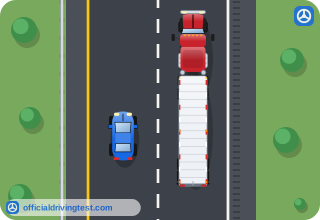
- If you can't see the truck's mirror, the driver can't see you
- If the truck's horn is silent, the driver can't see you
- If you can see the truck's tires, the driver can see you
- If the truck's turn signal is on, the driver can see you
Show answer
Correct answer: If you can't see the truck's mirror, the driver can't see you
A car that cannot see the truck's mirror is in a spot the driver cannot see, so move to where the mirror is visible.
Source: Oklahoma Driver Manual (2025 (updated November 24, 2025)), page 54 · Open this page in the manual (Manual page 54)
-
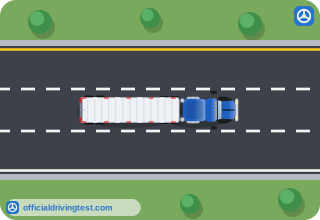
How far behind a truck can its rear blind spot extend?
- Up to 50 feet
- Up to 100 feet
- Up to 200 feet
- Up to 400 feet
Show answer
Correct answer: Up to 200 feet
A truck's blind spots include the area up to 200 feet behind it, as well as the areas just in front on either side of the cab.
Source: Oklahoma Driver Manual (2025 (updated November 24, 2025)), page 54 · Open this page in the manual (Manual page 54)
-
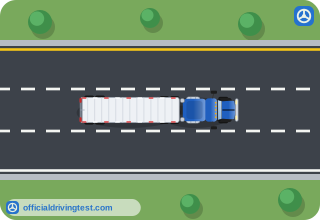
If a tractor has a long hood, how much of the road in front of the bumper may the trucker be unable to see?
- The first 3-5 feet
- The first 10-20 feet
- The first 50-60 feet
- The first 100-110 feet
Show answer
Correct answer: The first 10-20 feet
With a long hood the trucker may not see the first 10-20 feet in front of the bumper, enough room for a car to slip in unnoticed.
Source: Oklahoma Driver Manual (2025 (updated November 24, 2025)), page 54 · Open this page in the manual (Manual page 54)
-
If you are stopped behind a truck on an uphill grade, where should you position your car in your lane?
- Toward the right side of your lane
- As close behind the truck as you can
- Centered right behind the truck's bumper
- Toward the left side of your lane
Show answer
Correct answer: Toward the left side of your lane
Staying to the left in your lane lets the truck driver see you.
Source: Oklahoma Driver Manual (2025 (updated November 24, 2025)), page 54 · Open this page in the manual (Manual page 54)
-
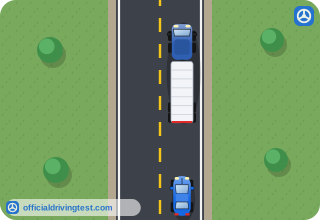
When stopped in a traffic lane behind a truck, why should you leave extra space in front of your car?
- The truck may roll back slightly when it starts to move
- The truck may need space to make a U-turn
- Trucks always accelerate faster than cars
- The truck driver may need to open the cab door
Show answer
Correct answer: The truck may roll back slightly when it starts to move
A truck can roll back a little when it starts moving, so extra space protects your car.
Source: Oklahoma Driver Manual (2025 (updated November 24, 2025)), page 54 · Open this page in the manual (Manual page 54)
-
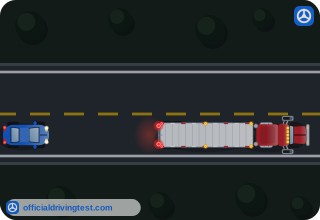
Why should you dim your lights at night when you are following a truck?
- Bright lights can overheat the truck's mirrors
- Dim lights tell the driver you plan to pass
- Bright lights reflected in the mirrors can blind the driver
- Trucks cannot be seen when your headlights are bright
Show answer
Correct answer: Bright lights reflected in the mirrors can blind the driver
Your bright lights reflect in the truck's mirrors and can blind the driver.
Source: Oklahoma Driver Manual (2025 (updated November 24, 2025)), page 54 · Open this page in the manual (Manual page 54)
-
Why should you stay back from a truck in rainy conditions?
- Truck brakes lose most of their stopping power on wet pavement
- Spray from the rear wheels can cover your windshield with water or mud
- The truck may drop part of its load on slippery roads
- Truck drivers cannot see cars at all when it is raining
Show answer
Correct answer: Spray from the rear wheels can cover your windshield with water or mud
Spray and splash from a truck's rear wheels can cover your windshield with sheets of water or mud, so keep your distance.
Source: Oklahoma Driver Manual (2025 (updated November 24, 2025)), page 54 · Open this page in the manual (Manual page 54)
-
When may you move into the passing lane to pass a truck?
- Whenever the truck is traveling uphill at slower speed
- Once the truck driver has sounded the horn
- Only after you slow to the truck's speed
- Only if it is clear and you are in a legal passing zone
Show answer
Correct answer: Only if it is clear and you are in a legal passing zone
Check to your front and rear first; pass only when the lane is clear and the passing zone is legal.
Source: Oklahoma Driver Manual (2025 (updated November 24, 2025)), page 54 · Open this page in the manual (Manual page 54)
-
How should you let a truck driver know you are passing?
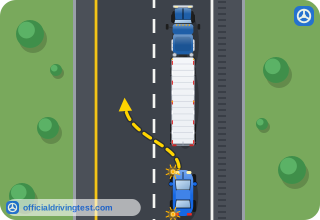
- Blink your headlights, especially at night
- Sound your horn for several seconds
- Flash your brake lights
- Turn on your hazard lights
Show answer
Correct answer: Blink your headlights, especially at night
Blinking your headlights tells the driver you are passing, and the driver will help by staying to the far side of the lane.
Source: Oklahoma Driver Manual (2025 (updated November 24, 2025)), page 54 · Open this page in the manual (Manual page 54)
-
Because of their weight, how do trucks travel on grades?
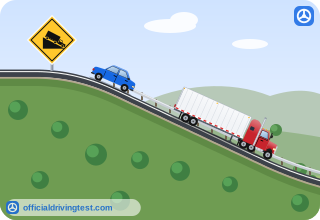
- Slower downhill and faster uphill
- At the same speed uphill and downhill
- Faster downhill and slower uphill
- Faster uphill and slower on flat ground
Show answer
Correct answer: Faster downhill and slower uphill
A truck's weight makes it speed up going downhill and slow down going uphill, so you may need to speed up to pass it downhill.
Source: Oklahoma Driver Manual (2025 (updated November 24, 2025)), page 54 · Open this page in the manual (Manual page 54)
-
How should you pass a truck with regard to staying beside it?
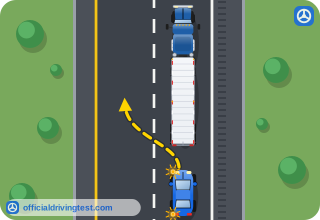
- Stay alongside at the same speed so the driver sees you
- Pass as quickly as possible and do not stay alongside
- Pass slowly to keep the wind turbulence low
- Hold your position beside the cab for a moment
Show answer
Correct answer: Pass as quickly as possible and do not stay alongside
Complete the pass quickly and do not stay alongside the truck.
Source: Oklahoma Driver Manual (2025 (updated November 24, 2025)), page 54 · Open this page in the manual (Manual page 54)
-
After you pass a truck, what should you do with your speed?
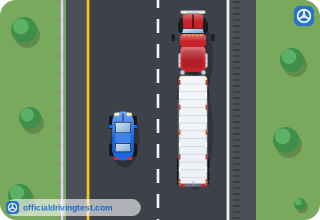
- Slow down at once to leave room for the truck
- Brake lightly so the truck can pass you again
- Drop below the speed limit to let traffic clear
- Maintain it so the truck driver does not have to brake
Show answer
Correct answer: Maintain it so the truck driver does not have to brake
Slowing down after passing, especially downhill, forces the truck driver to brake.
Source: Oklahoma Driver Manual (2025 (updated November 24, 2025)), page 54 · Open this page in the manual (Manual page 54)
-
After you pass a truck, what does it mean if the truck driver blinks the truck's lights?
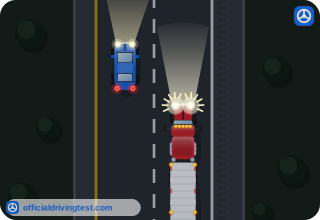
- You are cleared to pull back in front of the truck
- The driver wants you to slow down
- The driver is warning you of a hazard ahead
- The driver wants you to stay alongside
Show answer
Correct answer: You are cleared to pull back in front of the truck
A blink of the truck's lights after you pass signals that you may move back in front.
Source: Oklahoma Driver Manual (2025 (updated November 24, 2025)), page 54 · Open this page in the manual (Manual page 54)
-
When should you move back in front of a truck after passing it?
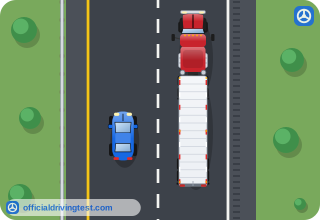
- As soon as your rear bumper has cleared the truck's front cab
- As soon as the truck driver slows down
- Only when you can see the front of the truck in your rearview mirror
- When you are a few feet past the truck's front bumper
Show answer
Correct answer: Only when you can see the front of the truck in your rearview mirror
Seeing the front of the truck in your rearview mirror shows you have enough room to pull back safely.
Source: Oklahoma Driver Manual (2025 (updated November 24, 2025)), page 54 · Open this page in the manual (Manual page 54)
-
When a truck is passing you, what can you do to help the driver?
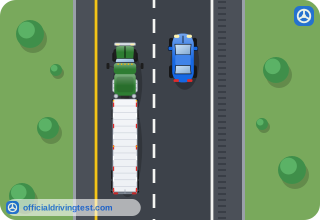
- Move toward the center line and hold your speed steady
- Keep to the far side of your lane and reduce your speed slightly
- Speed up slightly to shorten the time it takes the truck to pass
- Brake hard and stop in your lane right away
Show answer
Correct answer: Keep to the far side of your lane and reduce your speed slightly
Keeping to the far side of your lane and slowing slightly helps the driver; never speed up as a truck is passing.
Source: Oklahoma Driver Manual (2025 (updated November 24, 2025)), page 54 · Open this page in the manual (Manual page 54)
-
Where should you drive when you meet a truck coming from the opposite direction?
- Near the center line to give the truck room
- In the exact center of your lane
- On the shoulder at a reduced speed
- As far to the right side of the road as possible
Show answer
Correct answer: As far to the right side of the road as possible
Keeping as far right as possible avoids being sideswiped and reduces wind turbulence between you and the truck.
Source: Oklahoma Driver Manual (2025 (updated November 24, 2025)), page 54 · Open this page in the manual (Manual page 54)
-
What does the wind turbulence between you and an oncoming truck do?
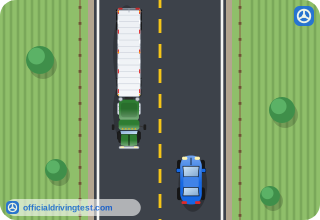
- Pushes vehicles apart
- Pulls vehicles together
- Pulls the smaller vehicle under the truck
- Lifts the smaller vehicle off the road
Show answer
Correct answer: Pushes vehicles apart
The manual states that the turbulence pushes vehicles apart rather than sucking them together.
Source: Oklahoma Driver Manual (2025 (updated November 24, 2025)), page 54 · Open this page in the manual (Manual page 54)
-
According to the manual, how safe are two-trailer trucks compared with single-trailer trucks?
- Less safe, because the second trailer often swerves
- Safe to pass only on downhill grades
- Just as safe as single-trailer trucks
- Safe only when passed on the left at night
Show answer
Correct answer: Just as safe as single-trailer trucks
Studies cited in the manual show two-trailer trucks are just as safe as single-trailer trucks, and you can pass them with care and skill.
Source: Oklahoma Driver Manual (2025 (updated November 24, 2025)), page 54 · Open this page in the manual (Manual page 54)
-
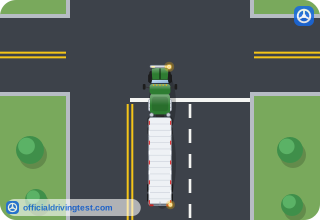
What should you do about the open space on the right side of a truck that might be making a right turn?
- Move into it to stay ahead of the turn
- Do not move into it or try to pass the truck
- Use it to pass if you stay close to the curb
- Move in if the truck driver signals you to pass
Show answer
Correct answer: Do not move into it or try to pass the truck
A car between the truck and the curb may be unseen by the driver and can be crunched or sideswiped.
Source: Oklahoma Driver Manual (2025 (updated November 24, 2025)), page 55 · Open this page in the manual (Manual page 55)
-
How do trucks usually make right turns?
- Tight turns that hug the curb
- Turns made only from the left lane
- Turns made only after the truck comes to a full stop
- Wide turns, often leaving an open space on the right
Show answer
Correct answer: Wide turns, often leaving an open space on the right
Trucks make wide right turns and often must leave open space on the right side.
Source: Oklahoma Driver Manual (2025 (updated November 24, 2025)), page 55 · Open this page in the manual (Manual page 55)
-
Why should you never try to cross behind a truck that is preparing to back up?
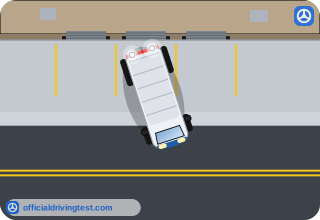
- You will be in the driver's blind spot
- The trailer door may swing open into your car
- The truck's exhaust can stall your engine
- The driver must stop for you first
Show answer
Correct answer: You will be in the driver's blind spot
Crossing behind a backing truck is a high-collision situation because the driver cannot see you.
Source: Oklahoma Driver Manual (2025 (updated November 24, 2025)), page 55 · Open this page in the manual (Manual page 55)
-
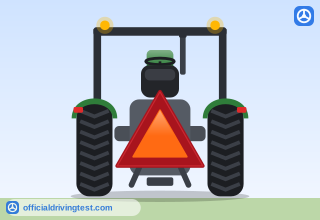
In most cases, farm equipment moving on public roads travels at less than what speed?
- 15 mph
- 35 mph
- 45 mph
- 25 mph
Show answer
Correct answer: 25 mph
The manual says slow-moving vehicles such as farm equipment usually travel at less than 25 mph.
Source: Oklahoma Driver Manual (2025 (updated November 24, 2025)), page 58 · Open this page in the manual (Manual page 58)
-
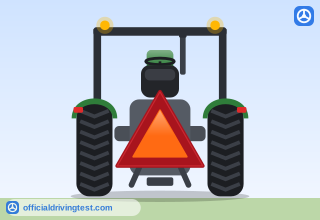
How much of the road can large farm equipment use on a state highway?
- More than one traffic lane
- Only the shoulder
- Only the right half of one lane
- Never more than one lane's width
Show answer
Correct answer: More than one traffic lane
Farm equipment can be very large and use more than one traffic lane.
Source: Oklahoma Driver Manual (2025 (updated November 24, 2025)), page 58 · Open this page in the manual (Manual page 58)
-
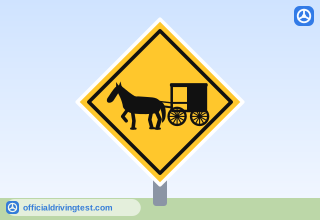
What rights do animal-drawn vehicles have to use the road?
- Fewer rights than a motor vehicle
- They may use only the shoulder
- The same rights as a motor vehicle
- They may use the road only in daylight
Show answer
Correct answer: The same rights as a motor vehicle
Animal-drawn vehicles have the same rights to use the road as a motor vehicle.
Source: Oklahoma Driver Manual (2025 (updated November 24, 2025)), page 58 · Open this page in the manual (Manual page 58)
-
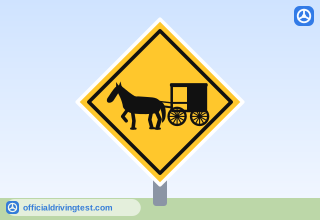
Which rules of the road must animal-drawn vehicles follow?
- Only the rules for bicycles
- The same rules of the road as motor vehicles
- No rules, because they are not motorized
- Only the rules posted on warning signs
Show answer
Correct answer: The same rules of the road as motor vehicles
They must follow the same rules of the road as motor vehicles.
Source: Oklahoma Driver Manual (2025 (updated November 24, 2025)), page 58 · Open this page in the manual (Manual page 58)
-
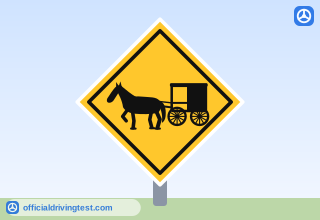
Where will warning signs be posted for animal-drawn vehicles?
- Only on interstate highways and four-lane roads
- At every rural intersection in the state
- Only on roads that have no paved shoulder
- Where you are likely to find animal-drawn vehicles
Show answer
Correct answer: Where you are likely to find animal-drawn vehicles
Warning signs are posted in areas where animal-drawn vehicles are likely to be found.
Source: Oklahoma Driver Manual (2025 (updated November 24, 2025)), page 58 · Open this page in the manual (Manual page 58)
-
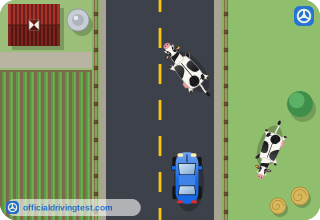
An animal suddenly runs in front of your vehicle. What does the manual say about swerving?
- Swerve into the next lane
- Swerve onto the shoulder
- Swerve only if you are driving slowly
- Do not swerve to avoid hitting the animal
Show answer
Correct answer: Do not swerve to avoid hitting the animal
Swerving may cause a more serious crash than hitting the animal.
Source: Oklahoma Driver Manual (2025 (updated November 24, 2025)), page 61 · Open this page in the manual (Manual page 61)
-
When are animals most active, so you should use extra caution while driving?
- At noon
- Late at night only
- At dawn or dusk
- In the middle of the afternoon
Show answer
Correct answer: At dawn or dusk
Dawn and dusk are when animals are most active.
Source: Oklahoma Driver Manual (2025 (updated November 24, 2025)), page 61 · Open this page in the manual (Manual page 61)
-
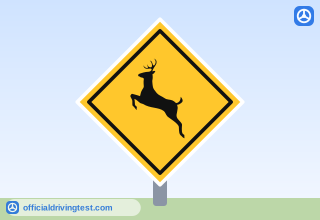
What should you do when driving on roadways marked with animal crossing signs?
- Drive faster to cross sooner
- Be extra alert
- Use your horn constantly
- Switch to your high beams
Show answer
Correct answer: Be extra alert
Roads with animal crossing signs call for extra alertness.
Source: Oklahoma Driver Manual (2025 (updated November 24, 2025)), page 61 · Open this page in the manual (Manual page 61)
-
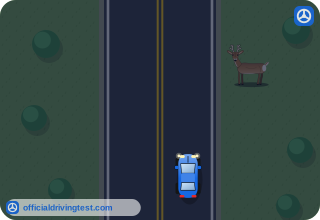
What should you watch for when scanning the sides of the road to spot animals at night?
- Their footprints on the pavement ahead
- Their shadows on the shoulder of the road
- The sound of their movement in the brush
- The reflection of your headlights in their eyes
Show answer
Correct answer: The reflection of your headlights in their eyes
Scanning the roadsides and watching for headlight reflections in animals' eyes helps you spot them.
Source: Oklahoma Driver Manual (2025 (updated November 24, 2025)), page 61 · Open this page in the manual (Manual page 61)
-
During which months do deer/vehicle crashes most often occur?
- October to December
- March to May
- June to August
- January to February
Show answer
Correct answer: October to December
The manual says deer/vehicle crashes most often occur from October to December.
Source: Oklahoma Driver Manual (2025 (updated November 24, 2025)), page 61 · Open this page in the manual (Manual page 61)
-
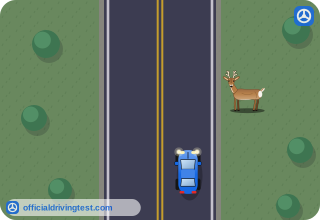
What should you do when approaching an animal standing near the roadway?
- Speed up to pass it quickly
- Honk and keep your speed
- Slow down
- Swerve toward the center line
Show answer
Correct answer: Slow down
The manual says to slow down when approaching an animal standing near the roadway.
Source: Oklahoma Driver Manual (2025 (updated November 24, 2025)), page 61 · Open this page in the manual (Manual page 61)