Oklahoma: Sharing the road — Part 3 Practice Test
Questions in this part include: “How much of its lane do motorcycle riders need to handle hazards such as potholes and strong winds?” · “How should you treat the lane of a motorcycle you are driving near?”
Independent educational site · not affiliated with any government agency or DMV
Ready? Test yourself
- Instant feedback with an explanation
- Every answer cites its source in the manual
- Your best score is saved on this device
- Keyboard: press 1 to 4 to answer and Enter for the next question
Questions are original and based on the official manual "Oklahoma Driver Manual" (2025 (updated November 24, 2025)), Service Oklahoma.
All 17 questions in this practice test
Take the test above first, then use this list to study. Tap “Show answer” to see the correct answer and explanation.
Show the questions and answersHide the questions
-
What must a cyclist do at a red traffic light before entering the intersection?
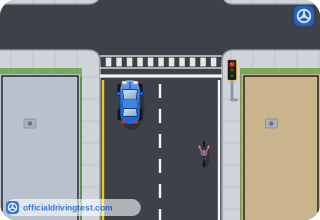
- Stop
- Slow down only
- Dismount and walk across
- Flash a hand signal and continue
Show answer
Correct answer: Stop
Cyclists must stop at a red light before entering the intersection.
Source: Oklahoma Driver Manual (2025 (updated November 24, 2025)), page 52 · Open this page in the manual (Manual page 52)
-
At a red light, which oncoming traffic must a cyclist yield to?
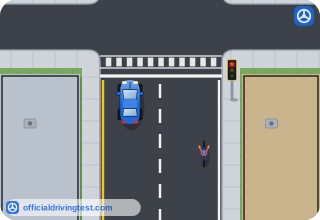
- Only vehicles that are turning
- Only vehicles traveling faster than the cyclist
- Traffic that poses an immediate hazard
- No oncoming traffic, once the cyclist has stopped
Show answer
Correct answer: Traffic that poses an immediate hazard
A cyclist must yield to oncoming traffic that poses an immediate hazard.
Source: Oklahoma Driver Manual (2025 (updated November 24, 2025)), page 52 · Open this page in the manual (Manual page 52)
-
After stopping at a red light, when can a cyclist proceed through it?
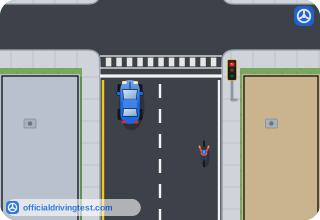
- Only after counting to ten
- If it is safe
- Only when the cyclist is wearing a front light
- Only when the cyclist has a flag on the bicycle
Show answer
Correct answer: If it is safe
The manual says that if it is safe, cyclists can proceed through the red light.
Source: Oklahoma Driver Manual (2025 (updated November 24, 2025)), page 52 · Open this page in the manual (Manual page 52)
-
What must a cyclist do before making a right turn on red?
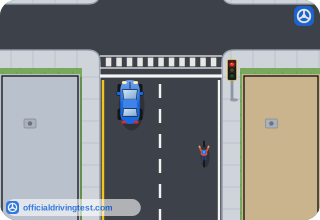
- Come to a complete stop and wait for a green arrow
- Dismount and walk across the intersection
- Stop and wait ten seconds
- Slow down and yield to traffic
Show answer
Correct answer: Slow down and yield to traffic
A cyclist can turn right on red after slowing down and yielding to traffic.
Source: Oklahoma Driver Manual (2025 (updated November 24, 2025)), page 52 · Open this page in the manual (Manual page 52)
-
Under what conditions can a cyclist make a left turn on red onto a one-way street?
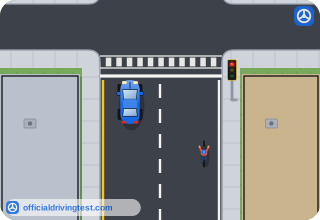
- After slowing down, with no need to yield
- Only when the street is a two-way street
- After stopping and yielding to oncoming traffic
- Only when no cars are waiting behind
Show answer
Correct answer: After stopping and yielding to oncoming traffic
A cyclist can turn left onto a one-way street on red after stopping and yielding to oncoming traffic.
Source: Oklahoma Driver Manual (2025 (updated November 24, 2025)), page 52 · Open this page in the manual (Manual page 52)
-
According to the manual, why is it hard for a driver to estimate a motorcycle's distance and speed?
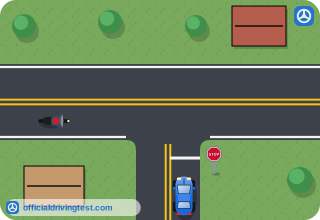
- Its profile is narrow and its body is short
- Motorcycles always travel faster than other traffic
- The engine noise hides where the motorcycle is
- Motorcycles ride only on the shoulder
Show answer
Correct answer: Its profile is narrow and its body is short
A motorcycle's narrow profile and short body make it harder to see and to judge how far away it is and how fast it is going.
Source: Oklahoma Driver Manual (2025 (updated November 24, 2025)), page 53 · Open this page in the manual (Manual page 53)
-
One reason drivers do not see motorcyclists is that motorists tend to look for what?
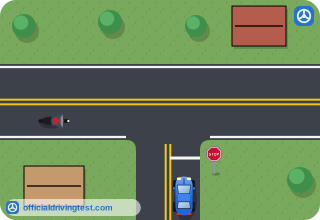
- Pedestrians and bicyclists only
- Large trucks and buses only
- Other cars rather than motorcycles
- Vehicles with flashing lights only
Show answer
Correct answer: Other cars rather than motorcycles
Drivers are used to scanning for cars, so a motorcycle can go unnoticed.
Source: Oklahoma Driver Manual (2025 (updated November 24, 2025)), page 53 · Open this page in the manual (Manual page 53)
-
How much of its lane do motorcycle riders need to handle hazards such as potholes and strong winds?
- Only the half nearest the shoulder
- The lane's full width
- Only a narrow strip in the center
- Only the width of one wheel track
Show answer
Correct answer: The lane's full width
Riders need the full width of the lane to respond to hazards, and a motorcycle has the right to use the lane.
Source: Oklahoma Driver Manual (2025 (updated November 24, 2025)), page 53 · Open this page in the manual (Manual page 53)
-
How should you treat the lane of a motorcycle you are driving near?
- Share the lane if you stay to one side of it
- Share the lane only when the rider is going slowly
- Share the lane only when you are at an intersection
- Do not try to share the lane; respect its space
Show answer
Correct answer: Do not try to share the lane; respect its space
The manual says you should not try to share a lane with a motorcycle and should respect its space and position in traffic.
Source: Oklahoma Driver Manual (2025 (updated November 24, 2025)), page 53 · Open this page in the manual (Manual page 53)
-
Why should you not pass a motorcycle too close or too fast?
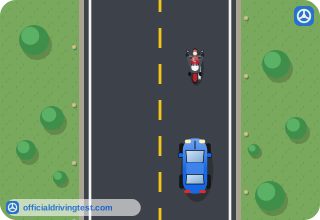
- The rider may not hear your horn
- The rider could be blinded by your headlights
- The blast of air can blow it out of control
- Motorcycles always speed up when passed
Show answer
Correct answer: The blast of air can blow it out of control
Passing a motorcycle too close or too fast creates a blast of air that can blow it out of control. Pass it as you would pass a car.
Source: Oklahoma Driver Manual (2025 (updated November 24, 2025)), page 53 · Open this page in the manual (Manual page 53)
-
What should you do when you make a left turn and a motorcycle may be approaching?
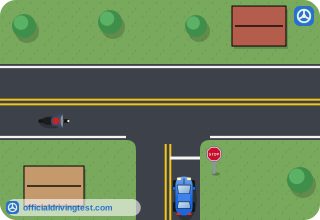
- Assume oncoming riders will stop for you
- Signal your intention and watch for oncoming motorcycles
- Turn quickly before the rider reaches the intersection
- Sound your horn instead of signaling
Show answer
Correct answer: Signal your intention and watch for oncoming motorcycles
For left turns the manual says to always signal and to watch for oncoming motorcycles.
Source: Oklahoma Driver Manual (2025 (updated November 24, 2025)), page 53 · Open this page in the manual (Manual page 53)
-
Why might a driver who changes lanes clip or hit a motorcycle?
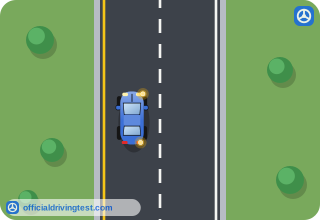
- Riders beside a lane of cars are often out of the driver's view
- Motorcycle riders almost never use their turn signals
- Motorcycles cannot be seen at all in daylight
- Motorcycles accelerate faster than any car on the road
Show answer
Correct answer: Riders beside a lane of cars are often out of the driver's view
Cyclists riding alongside a lane of cars are often out of the driver's view, so you must check your blind spots before changing lanes.
Source: Oklahoma Driver Manual (2025 (updated November 24, 2025)), page 53 · Open this page in the manual (Manual page 53)
-
Which of these is a reason a motorcyclist may change position within a lane?
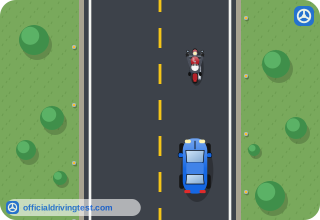
- To get closer to the vehicle ahead
- To warm up the engine
- To avoid windblast from other vehicles
- To save fuel on long rides
Show answer
Correct answer: To avoid windblast from other vehicles
The manual lists avoiding windblast from other vehicles among the reasons a rider changes lane position, along with avoiding hazards and being seen.
Source: Oklahoma Driver Manual (2025 (updated November 24, 2025)), page 53 · Open this page in the manual (Manual page 53)
-
At an intersection with a motorcycle nearby, when should you move into its path of travel?
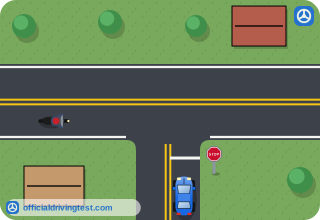
- As soon as the motorcycle slows down
- Only after the rider's intentions are absolutely clear
- Once the rider moves toward the edge of the lane
- Right away, because riders yield to cars
Show answer
Correct answer: Only after the rider's intentions are absolutely clear
Most collisions and injuries happen at intersections, so wait until you know whether the rider is turning or going straight.
Source: Oklahoma Driver Manual (2025 (updated November 24, 2025)), page 53 · Open this page in the manual (Manual page 53)
-
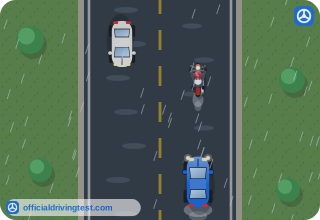
Why should you take extra care around motorcycles in rain, on wet roads, on ice, or in heavy winds?
- Motorcycles are not permitted to travel on wet or icy roads
- Motorcycle headlights are far less visible in bad weather
- Riders are required to pull over until the weather clears
- The motorcycle's braking and handling abilities are impaired
Show answer
Correct answer: The motorcycle's braking and handling abilities are impaired
Difficult conditions reduce a motorcycle's braking and handling abilities, so give riders more room and care.
Source: Oklahoma Driver Manual (2025 (updated November 24, 2025)), page 53 · Open this page in the manual (Manual page 53)
-
At night, why can you easily misjudge the distance to a motorcycle?
- Its one headlight and one taillight can blend into other vehicles' lights
- Motorcycles travel noticeably faster at night than other traffic does
- Riders often switch off their lights at night to save the battery
- Motorcycle lights are always much dimmer than a car's headlights are
Show answer
Correct answer: Its one headlight and one taillight can blend into other vehicles' lights
A motorcycle has only one headlight and one taillight, which can blend into the lights of other vehicles and make distance hard to judge.
Source: Oklahoma Driver Manual (2025 (updated November 24, 2025)), page 53 · Open this page in the manual (Manual page 53)
-
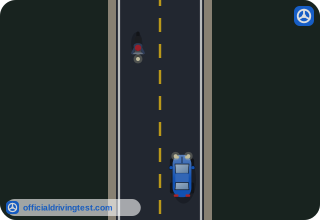
What should you do with your headlights near a motorcycle at night?
- Keep them on high beam so the rider sees you
- Turn them off briefly to signal the rider
- Dim them, as you would for cars and trucks
- Flash them to warn the rider of your position
Show answer
Correct answer: Dim them, as you would for cars and trucks
The manual says to always dim your headlights for motorcycles just as you do for cars and trucks.
Source: Oklahoma Driver Manual (2025 (updated November 24, 2025)), page 53 · Open this page in the manual (Manual page 53)