Oklahoma: Sharing the road — Part 4 Practice Test
Questions in this part include: “What must a motorcycle operator wear if the motorcycle has no windshield?” · “If you are stopped behind a truck on an uphill grade, where should you position your car in your lane?”
Independent educational site · not affiliated with any government agency or DMV
Ready? Test yourself
- Instant feedback with an explanation
- Every answer cites its source in the manual
- Your best score is saved on this device
- Keyboard: press 1 to 4 to answer and Enter for the next question
Questions are original and based on the official manual "Oklahoma Driver Manual" (2025 (updated November 24, 2025)), Service Oklahoma.
All 17 questions in this practice test
Take the test above first, then use this list to study. Tap “Show answer” to see the correct answer and explanation.
Show the questions and answersHide the questions
-
What must a motorcycle operator wear if the motorcycle has no windshield?
- Tinted sunglasses with attached side shields
- ANSI-approved goggles or face shield material
- A reflective vest and a pair of work gloves
- A visor clipped to the collar of a jacket
Show answer
Correct answer: ANSI-approved goggles or face shield material
State statutes require a windshield, or in its place the operator must wear ANSI-approved goggles or face shield material that protects against foreign objects.
Source: Oklahoma Driver Manual (2025 (updated November 24, 2025)), page 53 · Open this page in the manual (Manual page 53)
-
How far back should you stay when following a truck?
- Close enough to block other vehicles from cutting in
- Close enough to stay in the truck's draft
- Exactly one car length at any speed
- Far enough back to see the roadway ahead clearly
Show answer
Correct answer: Far enough back to see the roadway ahead clearly
Staying far enough back lets you see the roadway ahead clearly.
Source: Oklahoma Driver Manual (2025 (updated November 24, 2025)), page 54 · Open this page in the manual (Manual page 54)
-
What rule helps you tell whether a truck driver can see you?
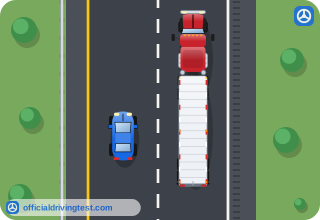
- If you can't see the truck's mirror, the driver can't see you
- If the truck's horn is silent, the driver can't see you
- If you can see the truck's tires, the driver can see you
- If the truck's turn signal is on, the driver can see you
Show answer
Correct answer: If you can't see the truck's mirror, the driver can't see you
A car that cannot see the truck's mirror is in a spot the driver cannot see, so move to where the mirror is visible.
Source: Oklahoma Driver Manual (2025 (updated November 24, 2025)), page 54 · Open this page in the manual (Manual page 54)
-
How far behind a truck can its rear blind spot extend?
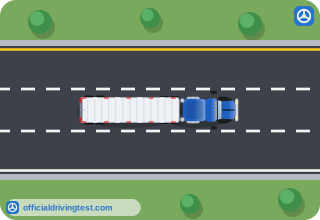
- Up to 50 feet
- Up to 100 feet
- Up to 200 feet
- Up to 400 feet
Show answer
Correct answer: Up to 200 feet
A truck's blind spots include the area up to 200 feet behind it, as well as the areas just in front on either side of the cab.
Source: Oklahoma Driver Manual (2025 (updated November 24, 2025)), page 54 · Open this page in the manual (Manual page 54)
-
If a tractor has a long hood, how much of the road in front of the bumper may the trucker be unable to see?
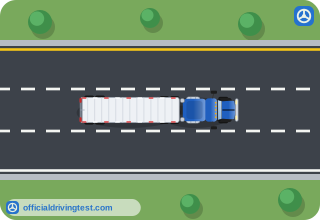
- The first 3-5 feet
- The first 10-20 feet
- The first 50-60 feet
- The first 100-110 feet
Show answer
Correct answer: The first 10-20 feet
With a long hood the trucker may not see the first 10-20 feet in front of the bumper, enough room for a car to slip in unnoticed.
Source: Oklahoma Driver Manual (2025 (updated November 24, 2025)), page 54 · Open this page in the manual (Manual page 54)
-
If you are stopped behind a truck on an uphill grade, where should you position your car in your lane?
- Toward the right side of your lane
- As close behind the truck as you can
- Centered right behind the truck's bumper
- Toward the left side of your lane
Show answer
Correct answer: Toward the left side of your lane
Staying to the left in your lane lets the truck driver see you.
Source: Oklahoma Driver Manual (2025 (updated November 24, 2025)), page 54 · Open this page in the manual (Manual page 54)
-
When stopped in a traffic lane behind a truck, why should you leave extra space in front of your car?
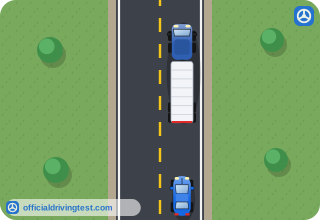
- The truck may roll back slightly when it starts to move
- The truck may need space to make a U-turn
- Trucks always accelerate faster than cars
- The truck driver may need to open the cab door
Show answer
Correct answer: The truck may roll back slightly when it starts to move
A truck can roll back a little when it starts moving, so extra space protects your car.
Source: Oklahoma Driver Manual (2025 (updated November 24, 2025)), page 54 · Open this page in the manual (Manual page 54)
-
Why should you dim your lights at night when you are following a truck?
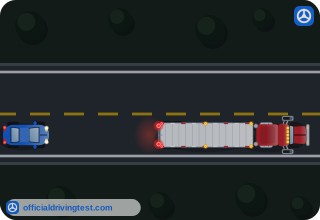
- Bright lights can overheat the truck's mirrors
- Dim lights tell the driver you plan to pass
- Bright lights reflected in the mirrors can blind the driver
- Trucks cannot be seen when your headlights are bright
Show answer
Correct answer: Bright lights reflected in the mirrors can blind the driver
Your bright lights reflect in the truck's mirrors and can blind the driver.
Source: Oklahoma Driver Manual (2025 (updated November 24, 2025)), page 54 · Open this page in the manual (Manual page 54)
-
Why should you stay back from a truck in rainy conditions?
- Truck brakes lose most of their stopping power on wet pavement
- Spray from the rear wheels can cover your windshield with water or mud
- The truck may drop part of its load on slippery roads
- Truck drivers cannot see cars at all when it is raining
Show answer
Correct answer: Spray from the rear wheels can cover your windshield with water or mud
Spray and splash from a truck's rear wheels can cover your windshield with sheets of water or mud, so keep your distance.
Source: Oklahoma Driver Manual (2025 (updated November 24, 2025)), page 54 · Open this page in the manual (Manual page 54)
-
When may you move into the passing lane to pass a truck?
- Whenever the truck is traveling uphill at slower speed
- Once the truck driver has sounded the horn
- Only after you slow to the truck's speed
- Only if it is clear and you are in a legal passing zone
Show answer
Correct answer: Only if it is clear and you are in a legal passing zone
Check to your front and rear first; pass only when the lane is clear and the passing zone is legal.
Source: Oklahoma Driver Manual (2025 (updated November 24, 2025)), page 54 · Open this page in the manual (Manual page 54)
-
How should you let a truck driver know you are passing?
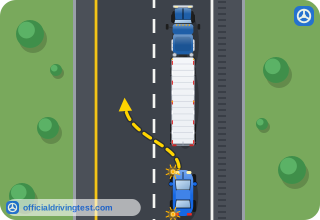
- Blink your headlights, especially at night
- Sound your horn for several seconds
- Flash your brake lights
- Turn on your hazard lights
Show answer
Correct answer: Blink your headlights, especially at night
Blinking your headlights tells the driver you are passing, and the driver will help by staying to the far side of the lane.
Source: Oklahoma Driver Manual (2025 (updated November 24, 2025)), page 54 · Open this page in the manual (Manual page 54)
-
Because of their weight, how do trucks travel on grades?
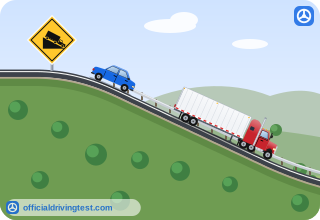
- Slower downhill and faster uphill
- At the same speed uphill and downhill
- Faster downhill and slower uphill
- Faster uphill and slower on flat ground
Show answer
Correct answer: Faster downhill and slower uphill
A truck's weight makes it speed up going downhill and slow down going uphill, so you may need to speed up to pass it downhill.
Source: Oklahoma Driver Manual (2025 (updated November 24, 2025)), page 54 · Open this page in the manual (Manual page 54)
-
How should you pass a truck with regard to staying beside it?
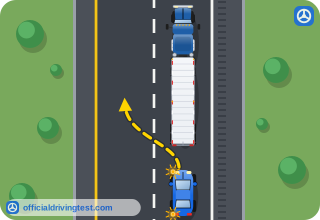
- Stay alongside at the same speed so the driver sees you
- Pass as quickly as possible and do not stay alongside
- Pass slowly to keep the wind turbulence low
- Hold your position beside the cab for a moment
Show answer
Correct answer: Pass as quickly as possible and do not stay alongside
Complete the pass quickly and do not stay alongside the truck.
Source: Oklahoma Driver Manual (2025 (updated November 24, 2025)), page 54 · Open this page in the manual (Manual page 54)
-
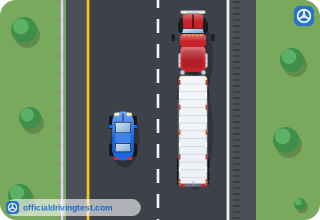
After you pass a truck, what should you do with your speed?
- Slow down at once to leave room for the truck
- Brake lightly so the truck can pass you again
- Drop below the speed limit to let traffic clear
- Maintain it so the truck driver does not have to brake
Show answer
Correct answer: Maintain it so the truck driver does not have to brake
Slowing down after passing, especially downhill, forces the truck driver to brake.
Source: Oklahoma Driver Manual (2025 (updated November 24, 2025)), page 54 · Open this page in the manual (Manual page 54)
-
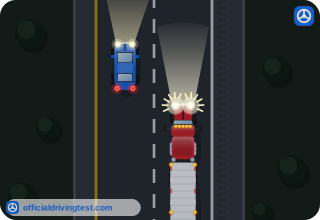
After you pass a truck, what does it mean if the truck driver blinks the truck's lights?
- You are cleared to pull back in front of the truck
- The driver wants you to slow down
- The driver is warning you of a hazard ahead
- The driver wants you to stay alongside
Show answer
Correct answer: You are cleared to pull back in front of the truck
A blink of the truck's lights after you pass signals that you may move back in front.
Source: Oklahoma Driver Manual (2025 (updated November 24, 2025)), page 54 · Open this page in the manual (Manual page 54)
-
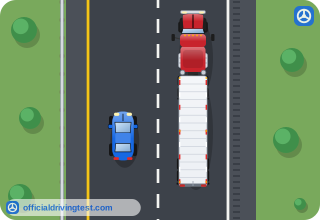
When should you move back in front of a truck after passing it?
- As soon as your rear bumper has cleared the truck's front cab
- As soon as the truck driver slows down
- Only when you can see the front of the truck in your rearview mirror
- When you are a few feet past the truck's front bumper
Show answer
Correct answer: Only when you can see the front of the truck in your rearview mirror
Seeing the front of the truck in your rearview mirror shows you have enough room to pull back safely.
Source: Oklahoma Driver Manual (2025 (updated November 24, 2025)), page 54 · Open this page in the manual (Manual page 54)
-
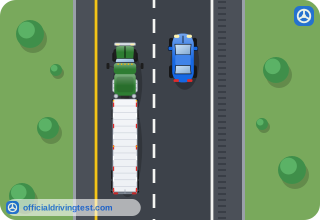
When a truck is passing you, what can you do to help the driver?
- Move toward the center line and hold your speed steady
- Keep to the far side of your lane and reduce your speed slightly
- Speed up slightly to shorten the time it takes the truck to pass
- Brake hard and stop in your lane right away
Show answer
Correct answer: Keep to the far side of your lane and reduce your speed slightly
Keeping to the far side of your lane and slowing slightly helps the driver; never speed up as a truck is passing.
Source: Oklahoma Driver Manual (2025 (updated November 24, 2025)), page 54 · Open this page in the manual (Manual page 54)