Pavement markings in New York
The New York State Driver's Manual shows or names everything on this page: 10 in all, on pages 31–33, 44, 50.
Independent educational site · not affiliated with any government agency or DMV
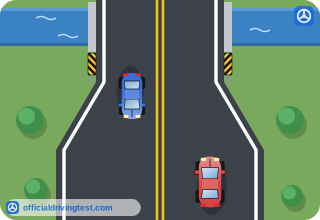
Edge line
Solid lines along the side of the road tell you where its edge is – where the travel lane ends and the shoulder begins. It is illegal to drive across the edge line, except when told to by a police officer or other authorized official or when allowed by an official sign. An edge line that angles towards the center of the road shows that the road is narrower ahead.
Manual page 31 · Open this page in the manual (Manual page 31)
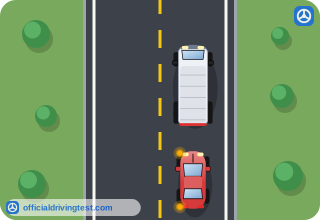
One broken line
You can pass other vehicles or change lanes if you can do so safely without interfering with traffic.
Manual page 32 · Open this page in the manual (Manual page 32)
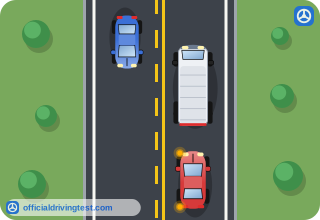
Solid line with broken line
If you are on the side with the solid line, you cannot pass other vehicles or go across the line except to make a left turn into a driveway. If you are on the side with the broken line, you can pass if it is safe to and you will not interfere with traffic.
Manual page 32 · Open this page in the manual (Manual page 32)
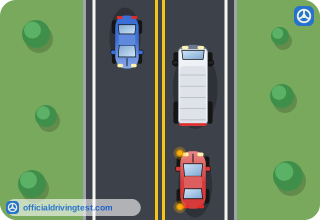
Double solid lines
You cannot pass or change lanes. You cannot go across the lines except to turn left to enter or leave the highway (e.g. to or from a driveway or to do a U-turn, see Chapter 5).
Manual page 32 · Open this page in the manual (Manual page 32)
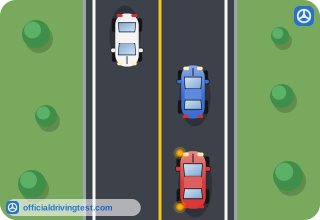
One solid line
You can pass other vehicles or change lanes, but you can only do so when obstructions in the road or traffic conditions make it necessary.
Manual page 32 · Open this page in the manual (Manual page 32)
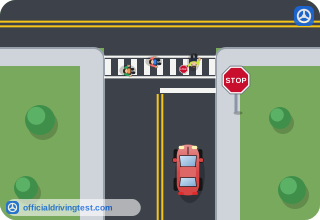
Stop line and crosswalk lines
At an intersection controlled by a STOP sign, YIELD sign or traffic light, there can be a white stop line painted across the lane, (called a Stop Line) and/or two parallel lines painted across the road (called a Crosswalk). When required to stop because of a sign or light, you must stop before you reach the stop line, if there is one, or the crosswalk.
Manual page 32 · Open this page in the manual (Manual page 32)
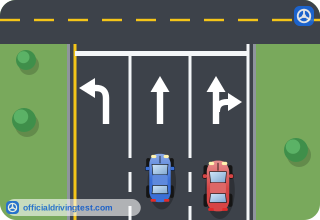
Arrows
Arrows show which lanes you must use. In this illustration, for example, you can turn right only from the right lane. To go straight, you must use the left lane. You must be in the correct lane before you reach the solid line that separates the lanes.
Manual page 32 · Open this page in the manual (Manual page 32)
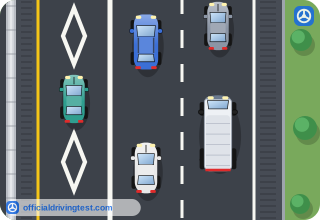
Diamond symbol
This symbol indicates the lane is reserved lanes for buses, HOV (High-Occupancy Vehicles) like car-pools and van-pools, bicycles or other special vehicles. You cannot enter and use these lanes unless your vehicle complies with the occupancy or other requirements indicated by signs for the times the special conditions are in effect.
Manual page 33 · Open this page in the manual (Manual page 33)
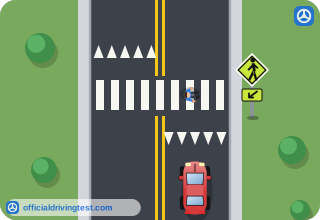
Yield line
Approach the yield line and enter the roundabout when there is an adequate gap in the circulating traffic flow.
Manual page 50 · Open this page in the manual (Manual page 50)
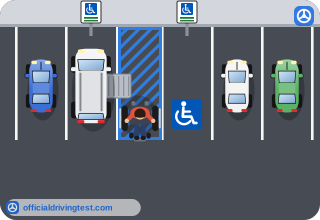
Striped access aisle
Do not park in the spaces with diagonal stripes next to reserved parking areas. These spaces are needed to give access to those with wheelchairs and vehicles with special equipment.
Manual page 44 · Open this page in the manual (Manual page 44)