New York: Pavement markings Practice Test
Yellow and white lane lines, yield lines, and what each one allows.
Independent educational site · not affiliated with any government agency or DMV
Ready? Test yourself
Answer to start, or tap Start below:
What is the purpose of the lines and symbols painted on the roadway (pavement markings)?
- Instant feedback with an explanation
- Every answer cites its source in the manual
- Your best score is saved on this device
- Keyboard: press 1 to 4 to answer and Enter for the next question
Questions are original and based on the official manual "New York State Driver's Manual" (Form MV-21), New York State Department of Motor Vehicles (DMV).
All 19 questions in this practice test
Take the test above first, then use this list to study. Tap “Show answer” to see the correct answer and explanation.
Show the questions and answersHide the questions
-
What is the purpose of the lines and symbols painted on the roadway (pavement markings)?
- They divide lanes and guide passing, turns and stops
- They are purely decorative
- They only indicate posted speed limits
- They only mark construction zones and detours
Show answer
Correct answer: They divide lanes and guide passing, turns and stops
Pavement markings divide lanes and tell you when you can pass or change lanes, which lanes to use for turns, and where you must stop for signs or signals.
Source: New York State Driver's Manual (Form MV-21), page 31 · Open this page in the manual (Manual page 31)
-
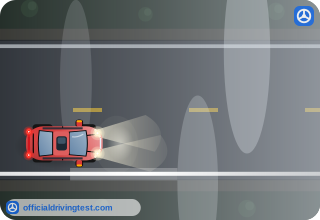
What do solid lines along the side of the road (edge lines) indicate?
- Where a passing zone begins
- Where the lane ends and the shoulder begins
- Where a school zone begins
- Where you must always come to a stop
Show answer
Correct answer: Where the lane ends and the shoulder begins
Solid edge lines show where the travel lane ends and the shoulder begins.
Source: New York State Driver's Manual (Form MV-21), page 31 · Open this page in the manual (Manual page 31)
-
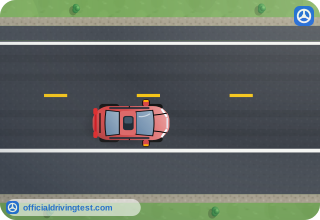
When is it legal to drive across an edge line?
- Never, under any circumstances
- Anytime you want to use the shoulder to pass
- When directed by an officer or allowed by a sign
- Only at night
Show answer
Correct answer: When directed by an officer or allowed by a sign
It is illegal to drive across the edge line, except when told to by a police officer or other authorized official, or when allowed by an official sign.
Source: New York State Driver's Manual (Form MV-21), page 31 · Open this page in the manual (Manual page 31)
-
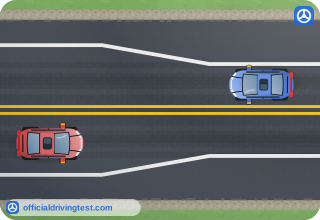
What does it mean if an edge line angles toward the center of the road?
- A passing zone is beginning
- A rest area is ahead
- The speed limit is increasing
- The road ahead is narrower
Show answer
Correct answer: The road ahead is narrower
An edge line that angles toward the center of the road shows that the road is narrower ahead.
Source: New York State Driver's Manual (Form MV-21), page 31 · Open this page in the manual (Manual page 31)
-
What color are lines that separate lanes of traffic moving in the same direction?
- White
- Yellow
- Orange
- Red
Show answer
Correct answer: White
Lines separating lanes of traffic moving in the same direction are white.
Source: New York State Driver's Manual (Form MV-21), page 32 · Open this page in the manual (Manual page 32)
-
What color are lines that separate traffic moving in opposite directions?
- White
- Yellow
- Orange
- Blue
Show answer
Correct answer: Yellow
Lines separating traffic moving in opposite directions are yellow.
Source: New York State Driver's Manual (Form MV-21), page 32 · Open this page in the manual (Manual page 32)
-
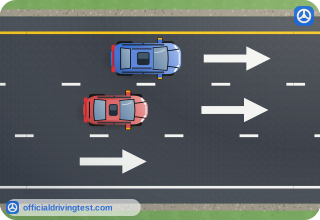
What does one broken line between lanes mean?
- You may never change lanes there
- It marks a bicycle lane only
- You can pass or change lanes when safe
- You must stop before crossing it
Show answer
Correct answer: You can pass or change lanes when safe
One broken line means you can pass other vehicles or change lanes if you can do so safely without interfering with traffic.
Source: New York State Driver's Manual (Form MV-21), page 32 · Open this page in the manual (Manual page 32)
-
If you are driving on the side of the solid line in a combined solid-and-broken line marking, what are you allowed to do?
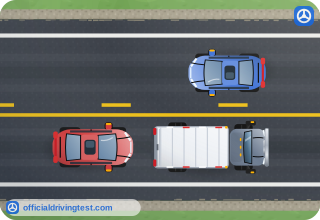
- Pass freely at any time
- Change lanes whenever convenient
- Cross the line only to make a right turn
- Cross the line only to turn left into a driveway
Show answer
Correct answer: Cross the line only to turn left into a driveway
On the solid-line side of a combined solid-and-broken line, you cannot pass or cross the line, except to make a left turn into a driveway.
Source: New York State Driver's Manual (Form MV-21), page 32 · Open this page in the manual (Manual page 32)
-
If you are driving on the broken-line side of a combined solid-and-broken line marking, what can you do?
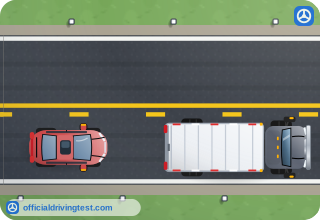
- You can pass if it is safe and will not interfere with traffic
- You may never pass, even when the road ahead is clear
- You must always stay behind the vehicle ahead
- You can only pass at intersections
Show answer
Correct answer: You can pass if it is safe and will not interfere with traffic
On the broken-line side of a combined solid-and-broken line, you can pass if it is safe and you will not interfere with traffic.
Source: New York State Driver's Manual (Form MV-21), page 32 · Open this page in the manual (Manual page 32)
-
What do double solid lines between lanes mean?
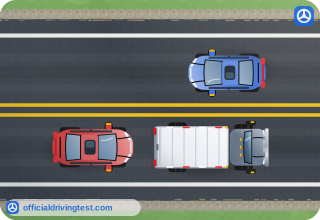
- You may pass whenever the road ahead is clear
- You cannot pass or change lanes
- You may cross freely to pass slower vehicles
- They mark a pedestrian crossing
Show answer
Correct answer: You cannot pass or change lanes
Double solid lines mean you cannot pass or change lanes, and cannot cross them except to turn left to enter or leave the highway, such as to or from a driveway, or to make a U-turn.
Source: New York State Driver's Manual (Form MV-21), page 32 · Open this page in the manual (Manual page 32)
-
When can you pass or change lanes across a single solid line?
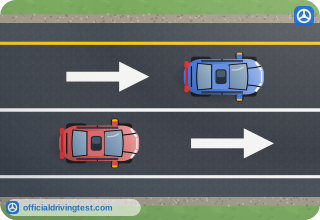
- At any time it is convenient for you to do so
- Only on highways with two or more lanes each way
- Only when road obstructions or traffic make it necessary
- Never, under any circumstances
Show answer
Correct answer: Only when road obstructions or traffic make it necessary
A single solid line means you can pass or change lanes only when obstructions in the road or traffic conditions make it necessary.
Source: New York State Driver's Manual (Form MV-21), page 32 · Open this page in the manual (Manual page 32)
-
At an intersection controlled by a STOP sign, YIELD sign, or traffic light, what pavement markings might you see?
- Yellow diagonal stripes across the lane
- A diamond symbol only
- Blue dashed lines across the road
- A white stop line and/or two crosswalk lines
Show answer
Correct answer: A white stop line and/or two crosswalk lines
At an intersection controlled by a STOP sign, YIELD sign, or traffic light, there can be a white stop line and/or two parallel lines forming a crosswalk.
Source: New York State Driver's Manual (Form MV-21), page 32 · Open this page in the manual (Manual page 32)
-
When are you required to stop at a stop line or crosswalk, according to the manual?
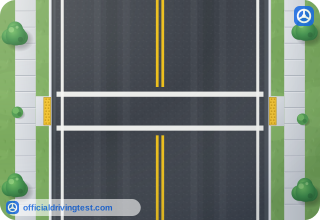
- When a light, sign or officer requires it, or to yield to people crossing
- Only during rush hour, when traffic is heaviest
- Only if another vehicle is already waiting at the intersection
- Every time you see any pavement marking, even with no traffic
Show answer
Correct answer: When a light, sign or officer requires it, or to yield to people crossing
You need only stop at a stop line or crosswalk if required by a light, sign, or traffic officer, or to yield to a pedestrian, in-line skater, or scooter at a marked or unmarked crosswalk.
Source: New York State Driver's Manual (Form MV-21), page 32 · Open this page in the manual (Manual page 32)
-
Why might a single stop line be placed at an intersection?
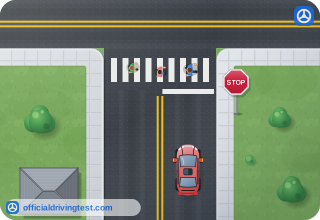
- To mark where a pedestrian-only zone begins
- To give large vehicles room to turn without traffic backing up
- To warn drivers that a school zone is ahead
- To show drivers where parking along the curb is allowed
Show answer
Correct answer: To give large vehicles room to turn without traffic backing up
A single stop line may be placed to allow room for larger vehicles, like tractor-trailers, buses, and trucks, to turn without forcing other traffic to back up.
Source: New York State Driver's Manual (Form MV-21), page 32 · Open this page in the manual (Manual page 32)
-
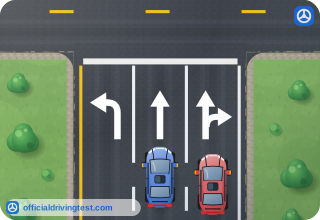
What do arrows painted on the pavement indicate?
- The speed limit for that lane
- Where pedestrians may cross
- Which lanes you must use
- Where the shoulder begins
Show answer
Correct answer: Which lanes you must use
Arrows painted on the pavement show which lanes you must use, and you must be in the correct lane before reaching the solid line that separates the lanes.
Source: New York State Driver's Manual (Form MV-21), page 32 · Open this page in the manual (Manual page 32)
-
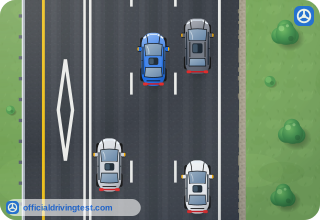
What does a diamond symbol painted in a lane indicate?
- A school crossing area where children may cross
- A no-passing zone for vehicles in that lane
- A speed-reduction zone for all vehicles
- A lane reserved for buses, HOV or other special vehicles
Show answer
Correct answer: A lane reserved for buses, HOV or other special vehicles
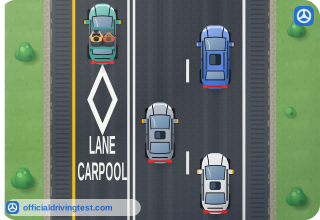
A diamond symbol indicates a lane reserved for buses, HOV vehicles (car-pools and van-pools), bicycles, or other special vehicles.
Source: New York State Driver's Manual (Form MV-21), page 33 · Open this page in the manual (Manual page 33)
-
Can any driver use a lane marked with a diamond symbol (an HOV lane)?
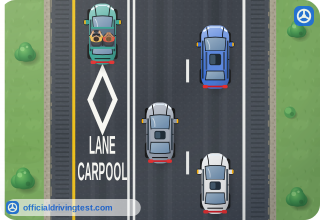
- No, only vehicles that meet the requirements on its signs
- Yes, any driver can use it at any time of day
- No, it is reserved for commercial trucks at all times
- Yes, any driver may use it to pass slower traffic
Show answer
Correct answer: No, only vehicles that meet the requirements on its signs
You cannot enter and use a diamond (HOV) lane unless your vehicle complies with the occupancy or other requirements in effect for that lane.
Source: New York State Driver's Manual (Form MV-21), page 33 · Open this page in the manual (Manual page 33)
-
On city streets, how can a diamond (HOV) lane sometimes be entered by a non-HOV vehicle?
- It can never be entered by a non-HOV vehicle, for any reason
- Through broken white lines, to turn right at the next intersection
- Any vehicle may enter it to pass slower traffic in the next lane
- Only emergency vehicles may enter it, with their lights on
Show answer
Correct answer: Through broken white lines, to turn right at the next intersection
On city streets, where the solid white line next to a diamond lane is replaced by broken white lines, a non-HOV vehicle can enter the lane if making a right turn at the next intersection.
Source: New York State Driver's Manual (Form MV-21), page 33 · Open this page in the manual (Manual page 33)
-
What is the purpose of bus lanes and HOV lanes, according to the manual?
- To reduce the number of traffic signals a road needs
- To provide additional parking spaces along the street
- To promote the most efficient use of limited road capacity
- To separate trucks from cars
Show answer
Correct answer: To promote the most efficient use of limited road capacity
Bus and HOV lanes are meant to promote the most efficient use of limited street and highway capacity.
Source: New York State Driver's Manual (Form MV-21), page 33 · Open this page in the manual (Manual page 33)