New York: Freeway driving Practice Test
Merging, exiting, passing, and carpool (HOV) lanes.
Independent educational site · not affiliated with any government agency or DMV
Ready? Test yourself
Answer to start, or tap Start below:
What does "expressway" mean, and how do you normally enter or exit one?
- Instant feedback with an explanation
- Every answer cites its source in the manual
- Your best score is saved on this device
- Keyboard: press 1 to 4 to answer and Enter for the next question
Questions are original and based on the official manual "New York State Driver's Manual" (Form MV-21), New York State Department of Motor Vehicles (DMV).
All 8 questions in this practice test
Take the test above first, then use this list to study. Tap “Show answer” to see the correct answer and explanation.
Show the questions and answersHide the questions
-
What does "expressway" mean, and how do you normally enter or exit one?
- Any divided highway with one-way traffic on two or more lanes; you normally use ramps
- Any road with a single lane in each direction; you enter through intersections
- A road only for local traffic with stop signs
- A road where pedestrians and cars share the same lane
Show answer
Correct answer: Any divided highway with one-way traffic on two or more lanes; you normally use ramps
"Expressway" means any divided highway where traffic moves in one direction on two or more lanes. You normally enter or exit the expressway on ramps (controlled-access).
Source: New York State Driver's Manual (Form MV-21), page 62 · Open this page in the manual (Manual page 62)
-
What is the normal expressway speed limit in New York, and how high can it be posted in some rural areas?
- Normally 45 mph, up to 55 mph in some rural areas
- Always exactly 70 mph everywhere
- Normally 60 mph, up to 75 mph in some rural areas
- Normally 55 mph, up to 65 mph in some rural areas
Show answer
Correct answer: Normally 55 mph, up to 65 mph in some rural areas
The expressway speed limit is normally 55 mph (88 km/h), but can be posted at 65 mph (100 km/h) in some rural areas.
Source: New York State Driver's Manual (Form MV-21), page 62 · Open this page in the manual (Manual page 62)
-
Which of these is given as an example of an expressway in New York?
- The New York State Thruway
- A residential side street
- A gravel farm road
- A shopping mall parking lot
Show answer
Correct answer: The New York State Thruway
Examples of expressways are the New York State Thruway, major interstate routes, and parkways.
Source: New York State Driver's Manual (Form MV-21), page 62 · Open this page in the manual (Manual page 62)
-
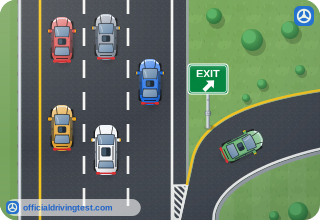
If you enter an expressway going the wrong direction or take the wrong exit, what should you do?
- Back up on the ramp to correct your mistake
- Cross the median to turn around
- Stay on the expressway until the next exit
- Stop your vehicle on the shoulder and wait for help
Show answer
Correct answer: Stay on the expressway until the next exit
If you enter an expressway going a different direction than you intended, or at the wrong exit, stay on the expressway until the next exit. It is dangerous to back up on an entrance or exit ramp, or to try to cross a median.
Source: New York State Driver's Manual (Form MV-21), page 62 · Open this page in the manual (Manual page 62)
-
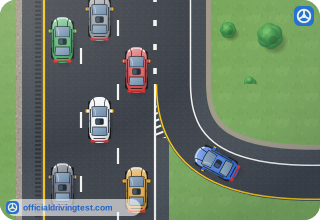
When there is no STOP or YIELD sign on an expressway entrance ramp, how should you merge?
- Stop completely before entering, regardless of traffic
- Enter at a very low, constant speed
- Flash your high beams at expressway traffic before entering
- Speed up on the ramp, signal, look over your shoulder, and blend in
Show answer
Correct answer: Speed up on the ramp, signal, look over your shoulder, and blend in
Unless there is a STOP or YIELD sign or traffic light on the entrance ramp, use the ramp to accelerate to expressway speed and blend with traffic. Signal, then look over your shoulder for traffic already on the expressway, slowing down if necessary to safely merge.
Source: New York State Driver's Manual (Form MV-21), page 62 · Open this page in the manual (Manual page 62)
-
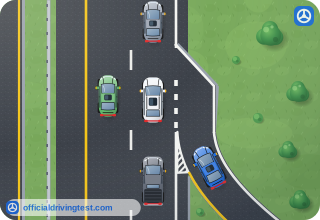
If an expressway entrance lane is too short to accelerate to expressway speed, what is the safest method to enter?
- Merge immediately regardless of gaps in traffic
- Drive on the shoulder until you find a gap
- Stop and wait for a large gap, then accelerate quickly
- Reverse back onto the local road
Show answer
Correct answer: Stop and wait for a large gap, then accelerate quickly
If the entrance lane is too short to allow acceleration to expressway speed, the safest method to enter is to stop and wait for a large space in traffic, then enter the expressway and accelerate quickly.
Source: New York State Driver's Manual (Form MV-21), page 62 · Open this page in the manual (Manual page 62)
-
How far before your exit should you signal, and what should you do on the exit ramp itself?
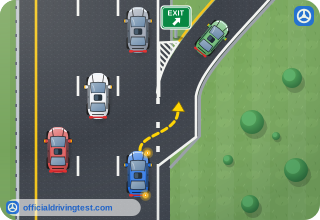
- Signal at least 100 feet before the exit; slow down on the ramp
- Signal only 10 feet before the exit and maintain full speed
- There is no need to signal on an expressway
- Signal after you are already on the ramp
Show answer
Correct answer: Signal at least 100 feet before the exit; slow down on the ramp
Signal your exit at least 100 feet (30 m) before you reach the exit ramp. When you are on the exit ramp, decrease your speed, since there is often a lower speed limit for the ramp.
Source: New York State Driver's Manual (Form MV-21), page 62 · Open this page in the manual (Manual page 62)
-
After you leave an expressway, what should you do?
- Continue at expressway speed since your speed is already set
- Turn off your headlights immediately
- Pull over and stop for a mandatory rest
- Look for speed limit signs and check your speedometer
Show answer
Correct answer: Look for speed limit signs and check your speedometer
After you leave an expressway, look for speed limit signs and check your speedometer to be sure you are within the posted limit. You are not likely to be on a 55 mph (88 km/h) road anymore.
Source: New York State Driver's Manual (Form MV-21), page 62 · Open this page in the manual (Manual page 62)