New York: Parking rules Practice Test
Parallel parking, hill parking, illegal parking, and colored curbs.
Independent educational site · not affiliated with any government agency or DMV
Ready? Test yourself
Answer to start, or tap Start below:
According to the manual, parallel parking is part of what?
- Instant feedback with an explanation
- Every answer cites its source in the manual
- Your best score is saved on this device
- Keyboard: press 1 to 4 to answer and Enter for the next question
Questions are original and based on the official manual "New York State Driver's Manual" (Form MV-21), New York State Department of Motor Vehicles (DMV).
All 18 questions in this practice test
Take the test above first, then use this list to study. Tap “Show answer” to see the correct answer and explanation.
Show the questions and answersHide the questions
-
According to the manual, parallel parking is part of what?
- Every road test
- Only the written knowledge test
- Highway driving only
- Defensive driving courses only
Show answer
Correct answer: Every road test
Parallel parking takes skill and is part of every road test.
Source: New York State Driver's Manual (Form MV-21), page 42 · Open this page in the manual (Manual page 42)
-
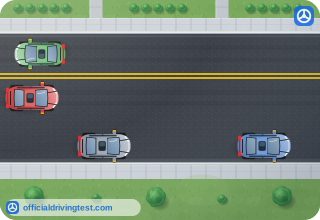
When you stop next to the vehicle in front of a parallel parking space (Step 1), about how much space should you leave between the two vehicles?
- One foot (30 cm)
- Two feet (60 cm)
- Five feet (1.5 m)
- No space is needed
Show answer
Correct answer: Two feet (60 cm)
Stop next to the vehicle in front of the space and leave about two feet between the other vehicle and your vehicle.
Source: New York State Driver's Manual (Form MV-21), page 42 · Open this page in the manual (Manual page 42)
-
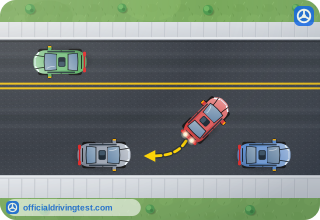
When backing up during parallel parking (Step 2), you should look through what, rather than relying on mirrors?
- The side mirror only
- The dashboard camera only
- The rear window
- The passenger window only
Show answer
Correct answer: The rear window
Look through the rear window, not the mirrors, when you back up.
Source: New York State Driver's Manual (Form MV-21), page 42 · Open this page in the manual (Manual page 42)
-
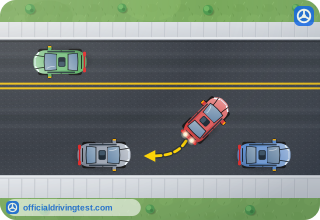
In your final parallel-parked position, your wheels must be no more than how far from the curb?
- Three feet (90 cm)
- Two feet (60 cm)
- Six inches (15 cm)
- One foot (30 cm)
Show answer
Correct answer: One foot (30 cm)
In your final parking position, your wheels must be no more than one foot (30 cm) from the curb.
Source: New York State Driver's Manual (Form MV-21), page 42 · Open this page in the manual (Manual page 42)
-
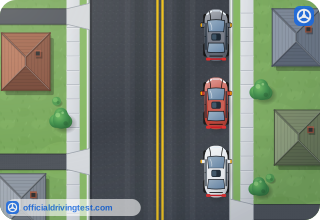
After parallel parking, you must not open the door on the road side if doing so will do what?
- Interfere with bicyclists and other traffic
- Let cold air or rain into the vehicle
- Set off the car alarm
- Block the sidewalk
Show answer
Correct answer: Interfere with bicyclists and other traffic
After parking, remember that you must not open the door on the road side if it will interfere with bicyclists and other traffic.
Source: New York State Driver's Manual (Form MV-21), page 42 · Open this page in the manual (Manual page 42)
-
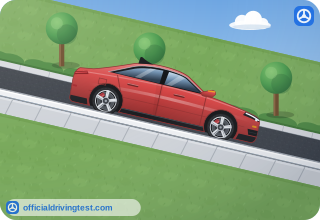
When you park on a hill, besides setting the parking brake, which way should you turn your wheels?
- Straight ahead
- Toward the curb or side of the road
- Away from the curb or side of the road
- It does not matter
Show answer
Correct answer: Toward the curb or side of the road
Turn the wheels toward the curb or side of the road, so they will keep your vehicle from heading into traffic.
Source: New York State Driver's Manual (Form MV-21), page 42 · Open this page in the manual (Manual page 42)
-
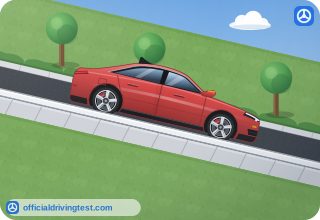
When parking on a hill in a vehicle with a manual transmission, you should put the transmission into what?
- Neutral
- Reverse
- 1st gear
- 5th gear
Show answer
Correct answer: 1st gear
If your vehicle has a manual transmission, put the transmission into 1st gear when you park on a hill.
Source: New York State Driver's Manual (Form MV-21), page 42 · Open this page in the manual (Manual page 42)
-
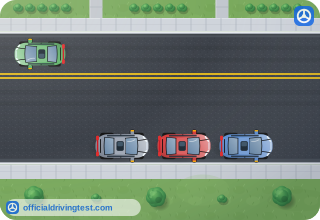
Before backing up to pull out of a parallel parking space, your wheels should be positioned how?
- Turned sharply toward the curb
- Turned sharply away from the curb
- Halfway turned
- Straight
Show answer
Correct answer: Straight
To pull away from a parallel parking space, make sure your wheels are straight, back up to the vehicle behind you, and turn your wheels away from the curb.
Source: New York State Driver's Manual (Form MV-21), page 42 · Open this page in the manual (Manual page 42)
-
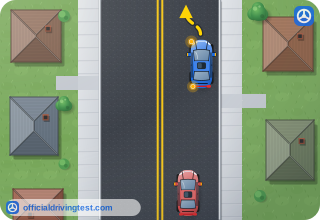
According to the manual's six steps to enter traffic from a parking space, what should you do first?
- Look over your right shoulder
- Immediately drive forward
- Honk your horn
- Turn on your headlights
Show answer
Correct answer: Look over your right shoulder
The first step is to turn your head to look over your right shoulder and check through the rear window for pedestrians, bicyclists, motorcyclists and other vehicles that can become a hazard.
Source: New York State Driver's Manual (Form MV-21), page 43 · Open this page in the manual (Manual page 43)
-
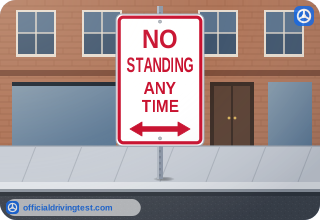
A NO STANDING sign means you may make only a temporary stop to load or discharge passengers, and what else?
- The driver may leave the vehicle unattended
- The driver cannot exit the vehicle
- You may park for up to one hour
- You may load or unload merchandise
Show answer
Correct answer: The driver cannot exit the vehicle
A NO STANDING sign means you can only make a temporary stop to load or discharge passengers. The driver cannot exit the vehicle.
Source: New York State Driver's Manual (Form MV-21), page 43 · Open this page in the manual (Manual page 43)
-
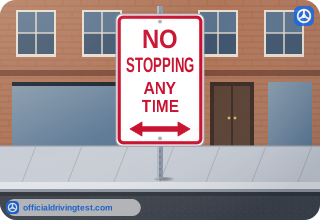
A NO STOPPING sign means you may stop only for what reason?
- To load merchandise
- To take a phone call
- To obey a sign, signal or officer, or prevent a conflict
- To wait up to 10 minutes for a passenger to arrive
Show answer
Correct answer: To obey a sign, signal or officer, or prevent a conflict
A NO STOPPING sign means you can stop only to obey a traffic sign, signal or officer, or to prevent conflicts with other vehicles.
Source: New York State Driver's Manual (Form MV-21), page 43 · Open this page in the manual (Manual page 43)
-
You cannot park, stop or stand within how many feet of a fire hydrant, unless a licensed driver remains in the vehicle to move it in an emergency?
- 5 feet (1.5 m)
- 10 feet (3 m)
- 20 feet (6 m)
- 15 feet (5 m)
Show answer
Correct answer: 15 feet (5 m)
You cannot park, stop or stand within 15 feet (5 m) of a fire hydrant, unless a licensed driver remains in the vehicle to move it in an emergency.
Source: New York State Driver's Manual (Form MV-21), page 43 · Open this page in the manual (Manual page 43)
-
Unless another distance is marked, you cannot park, stop or stand within how many feet of a pedestrian safety area?
- 30 feet (10 m)
- 10 feet (3 m)
- 50 feet (15 m)
- 75 feet (23 m)
Show answer
Correct answer: 30 feet (10 m)
You cannot park, stop or stand within 30 feet (10 m) of a pedestrian safety area, unless another distance is marked.
Source: New York State Driver's Manual (Form MV-21), page 43 · Open this page in the manual (Manual page 43)
-
Parking or standing is not allowed within how many feet of a crosswalk at an intersection?
- 15 feet (5 m)
- 20 feet (6 m)
- 30 feet (10 m)
- 50 feet (15 m)
Show answer
Correct answer: 20 feet (6 m)
Parking or standing is not allowed within 20 feet (6 m) of a crosswalk at an intersection.
Source: New York State Driver's Manual (Form MV-21), page 43 · Open this page in the manual (Manual page 43)
-
Parking or standing is not allowed within how many feet of a traffic light, STOP sign or YIELD sign?
- 15 feet (5 m)
- 20 feet (6 m)
- 30 feet (10 m)
- 50 feet (15 m)
Show answer
Correct answer: 30 feet (10 m)
Parking or standing is not allowed within 30 feet (10 m) of a traffic light, STOP sign or YIELD sign.
Source: New York State Driver's Manual (Form MV-21), page 43 · Open this page in the manual (Manual page 43)
-
You cannot park your vehicle within how many feet of a railroad crossing?
- 15 feet (5 m)
- 20 feet (6 m)
- 30 feet (10 m)
- 50 feet (15 m)
Show answer
Correct answer: 50 feet (15 m)
You cannot park your vehicle within 50 feet (15 m) of a railroad crossing.
Source: New York State Driver's Manual (Form MV-21), page 43 · Open this page in the manual (Manual page 43)
-
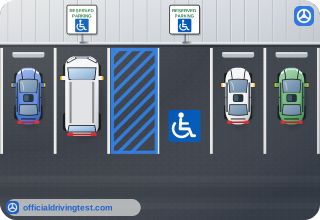
You may park in a space reserved for people with disabilities only if you have a permit or plates for persons with disabilities and what else is true?
- The person they were issued to is in the vehicle
- You display any handicap sign from any state
- You are parking for less than 5 minutes
- There is no other space available
Show answer
Correct answer: The person they were issued to is in the vehicle
You can park in reserved spaces only if you have a permit or vehicle plates for persons with disabilities and only when the person who received the permit or plates is in the vehicle.
Source: New York State Driver's Manual (Form MV-21), page 44 · Open this page in the manual (Manual page 44)
-
Unless a municipality sets higher penalties, what is the fine range for a first-offense parking violation in a shopping center?
- $25 to $50
- $50 to $75
- $100 to $150
- $150 to $200
Show answer
Correct answer: $50 to $75
Unless a municipality sets higher penalties, the fine for a shopping center violation is $50 to $75 for a first offense (plus a mandatory $30 surcharge).
Source: New York State Driver's Manual (Form MV-21), page 44 · Open this page in the manual (Manual page 44)