New Jersey: Speed & following distance
Speed limits, safe following distance and stopping distance. Split into 4 shorter tests so you're not stuck in one long quiz.
Independent educational site · not affiliated with any government agency or DMV
Choose a part
Speed & following distance — Part 1
Questions in this part include: “According to the New Jersey Driver Manual, what is the one point that is sure about stopping distance?”
StartSpeed & following distance — Part 2
Questions in this part include: “What happens to the force of impact in a crash as speed goes up?”
StartSpeed & following distance — Part 3
Questions in this part include: “When using the three-seconds-plus rule, what should you choose as your reference point?”
StartSpeed & following distance — Part 4
Questions in this part include: “What does "reaction distance" mean?”
StartAll 65 Speed & following distance questions with answers
Choose a part above to take a practice test, or study every question and answer here.
Show the questions and answersHide the questions
-
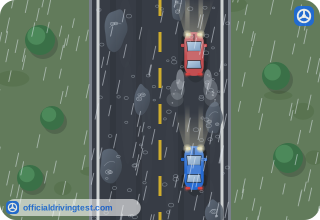
If your vehicle has ABS, what should you do in wet or slippery conditions?
- Follow more closely, since ABS shortens stops
- Drive at your normal speed, since ABS prevents all skids
- Pump the brakes early and often to stay safe
- Drive carefully, keep a safe distance and adjust speed
Show answer
Correct answer: Drive carefully, keep a safe distance and adjust speed
Even with ABS, in wet or slippery conditions you should drive carefully, keep a safe distance from the vehicle ahead and keep your speed consistent with road conditions.
Source: New Jersey Driver Manual (2026), page 45 · Open this page in the manual (Manual page 45)
-
According to the New Jersey Driver Manual, what is the one point that is sure about stopping distance?
- Stopping distance is the same at any speed on dry roads
- Anti-lock brakes always shorten stopping distance
- Heavier vehicles always stop in a shorter distance
- The faster you go, the longer it takes to stop
Show answer
Correct answer: The faster you go, the longer it takes to stop
There is no simple way to tell exactly how long a stop will take, but one point is sure: the faster a vehicle is going, the longer it takes to stop.
Source: New Jersey Driver Manual (2026), page 52 · Open this page in the manual (Manual page 52)
-
According to the stopping-distance table in the New Jersey Driver Manual, what is the total stopping distance at 30 mph?
- 53 feet
- 69 feet
- 102 feet
- 167 feet
Show answer
Correct answer: 102 feet
At 30 mph the table shows 33 feet of reaction distance plus 69 feet of braking distance, for a total of 102 feet.
Source: New Jersey Driver Manual (2026), page 53 · Open this page in the manual (Manual page 53)
-
According to the stopping-distance table in the New Jersey Driver Manual, what is the total stopping distance at 50 mph?
- 247 feet
- 167 feet
- 192 feet
- 343 feet
Show answer
Correct answer: 247 feet
At 50 mph the table shows 55 feet of reaction distance plus 192 feet of braking distance, for a total of 247 feet.
Source: New Jersey Driver Manual (2026), page 53 · Open this page in the manual (Manual page 53)
-
According to the stopping-distance table in the New Jersey Driver Manual, what is the total stopping distance at 60 mph?
- 277 feet
- 343 feet
- 453 feet
- 247 feet
Show answer
Correct answer: 343 feet
At 60 mph the table shows 66 feet of reaction distance plus 277 feet of braking distance, for a total of 343 feet.
Source: New Jersey Driver Manual (2026), page 53 · Open this page in the manual (Manual page 53)
-
According to the stopping-distance table in the New Jersey Driver Manual, what is the total stopping distance at 70 mph?
- 343 feet
- 550 feet
- 376 feet
- 453 feet
Show answer
Correct answer: 453 feet
At 70 mph the table shows 77 feet of reaction distance plus 376 feet of braking distance, for a total of 453 feet.
Source: New Jersey Driver Manual (2026), page 53 · Open this page in the manual (Manual page 53)
-
According to the New Jersey Driver Manual's table, how far does a vehicle travel at 60 mph during the driver's reaction time, before the brakes are applied?
- 277 feet
- 88 feet
- 66 feet
- 44 feet
Show answer
Correct answer: 66 feet
The table lists a reaction distance of 66 feet at 60 mph (braking distance is a further 277 feet).
Source: New Jersey Driver Manual (2026), page 53 · Open this page in the manual (Manual page 53)
-
How many feet per second does a vehicle travel at 60 mph, according to the New Jersey Driver Manual?
- 88 feet
- 44 feet
- 60 feet
- 120 feet
Show answer
Correct answer: 88 feet
The manual states that a vehicle travels 88 feet per second at 60 mph.
Source: New Jersey Driver Manual (2026), page 53 · Open this page in the manual (Manual page 53)
-
What typical reaction time does the New Jersey Driver Manual give for most motorists under most traffic conditions?
- 1/4 of a second
- 3/4 of a second
- 3 seconds
- 2 seconds
Show answer
Correct answer: 3/4 of a second
The manual says most motorists under most traffic conditions have a typical reaction time of 3/4 second.
Source: New Jersey Driver Manual (2026), page 53 · Open this page in the manual (Manual page 53)
-
In the New Jersey Driver Manual's notes on its stopping-distance table, deceleration is given as approximately how much?
- 4 feet per second
- 44 feet per second
- 14 feet per second
- 88 feet per second
Show answer
Correct answer: 14 feet per second
The notes under the stopping-distance table state that deceleration is approximately 14 feet per second.
Source: New Jersey Driver Manual (2026), page 53 · Open this page in the manual (Manual page 53)
-
In New Jersey, unless otherwise posted, what is the speed limit in school zones and in business or residential districts?
- 40 mph
- 20 mph
- 30 mph
- 25 mph
Show answer
Correct answer: 25 mph
New Jersey sets a 25 mph limit in school zones and in business or residential districts unless a different limit is posted.
Source: New Jersey Driver Manual (2026), page 62 · Open this page in the manual (Manual page 62)
-
In New Jersey, unless otherwise posted, what is the speed limit in suburban business and residential districts?
- 45 mph
- 35 mph
- 55 mph
- 30 mph
Show answer
Correct answer: 35 mph
The New Jersey limit for suburban business and residential districts is 35 mph unless otherwise posted.
Source: New Jersey Driver Manual (2026), page 62 · Open this page in the manual (Manual page 62)
-
In New Jersey, what is the speed limit on rural roadways where no speed limit is posted?
- 40 mph
- 45 mph
- 50 mph
- 60 mph
Show answer
Correct answer: 50 mph
Non-posted rural roadways in New Jersey have a 50 mph speed limit.
Source: New Jersey Driver Manual (2026), page 62 · Open this page in the manual (Manual page 62)
-
According to New Jersey's list of speed limits, where does a 55 mph limit apply?
- Rural roadways that have no posted limit
- Certain state highways and interstates
- Suburban business and residential districts
- School zones and residential districts
Show answer
Correct answer: Certain state highways and interstates
New Jersey lists 55 mph for certain state highways (as posted) and interstates.
Source: New Jersey Driver Manual (2026), page 62 · Open this page in the manual (Manual page 62)
-
What is the highest speed limit on New Jersey's list of limits, which applies on certain interstate highways where posted?
- 55 mph
- 75 mph
- 65 mph
- 70 mph
Show answer
Correct answer: 65 mph
New Jersey's list tops out at 65 mph, which applies on certain interstate highways as posted.
Source: New Jersey Driver Manual (2026), page 62 · Open this page in the manual (Manual page 62)
-
In New Jersey, what is the smallest amount over the 65 mph limit that means you pay double fines?
- 10 mph
- 15 mph
- 20 mph
- 5 mph
Show answer
Correct answer: 10 mph
Motorists pay double fines for going 10 mph or more over the 65 mph limit.
Source: New Jersey Driver Manual (2026), page 62 · Open this page in the manual (Manual page 62)
-
According to the New Jersey manual, how does excessive speed affect your ability to react?
- It gives you less time to respond to hazards
- It gives you more time to correct errors
- It keeps you more alert, so you react faster
- It changes only fuel use, not reaction
Show answer
Correct answer: It gives you less time to respond to hazards
Excessive speed reduces reaction time, giving drivers less opportunity to respond to hazards or correct errors.
Source: New Jersey Driver Manual (2026), page 62 · Open this page in the manual (Manual page 62)
-
What happens to the force of impact in a crash as speed goes up?
- It decreases, because the crash is shorter
- It increases, causing more damage and injury
- It stays the same at every speed
- It matters only for large trucks
Show answer
Correct answer: It increases, causing more damage and injury
Higher speeds increase the force of impact, resulting in more damage, serious injury, or death.
Source: New Jersey Driver Manual (2026), page 62 · Open this page in the manual (Manual page 62)
-
In New Jersey, you are driving at the posted speed limit, but faster than the weather and road conditions safely allow. What can happen?
- You can be cited only after a crash
- You can be cited only on highways
- You can get a moving violation
- Nothing, since you are within the limit
Show answer
Correct answer: You can get a moving violation
You must never drive faster than conditions safely allow, whatever the posted limit; failing to adjust can result in a moving violation.
Source: New Jersey Driver Manual (2026), page 63 · Open this page in the manual (Manual page 63)
-
According to the New Jersey manual, where should you always slow down?
- On a straight, dry road with a clear view
- When pulling away from a toll booth
- When leaving an acceleration lane
- At sharp or blind curves
Show answer
Correct answer: At sharp or blind curves
The manual lists sharp or blind curves among the places where you should always slow down.
Source: New Jersey Driver Manual (2026), page 63 · Open this page in the manual (Manual page 63)
-
Which road condition does the New Jersey manual list as a time to always slow down?
- When the road ahead is straight and level
- When the highway is empty at midday
- When the road is wet, icy, or slippery
- When the road is dry and traffic is light
Show answer
Correct answer: When the road is wet, icy, or slippery
You should always slow down when the road is wet, icy, or otherwise slippery.
Source: New Jersey Driver Manual (2026), page 63 · Open this page in the manual (Manual page 63)
-
Which of these places does the New Jersey manual name as one where you should always slow down?
- At intersections or railroad crossings
- In an acceleration lane before merging
- On a wide road with light traffic
- On a long, straight highway stretch
Show answer
Correct answer: At intersections or railroad crossings
Intersections and railroad crossings are on the list of places where you should always slow down.
Source: New Jersey Driver Manual (2026), page 63 · Open this page in the manual (Manual page 63)
-
What speed does the New Jersey manual say a motorist should always try to keep?
- Always about 5 mph under the posted limit
- Slightly above the flow when the road is clear
- As slow as needed to feel fully relaxed
- Up with traffic flow, but not over the limit
Show answer
Correct answer: Up with traffic flow, but not over the limit
A motorist should try to keep up with the normal flow of traffic while not exceeding the posted speed limit.
Source: New Jersey Driver Manual (2026), page 63 · Open this page in the manual (Manual page 63)
-
According to the New Jersey manual, what besides speeding can cause some crashes?
- Using the right-hand lane of a multi-lane road
- Signaling at least 100 feet before a turn
- Keeping up with the normal flow of traffic
- Driving too slowly or backing up in traffic
Show answer
Correct answer: Driving too slowly or backing up in traffic
The manual warns that some crashes are caused by driving too slowly or backing up in traffic.
Source: New Jersey Driver Manual (2026), page 63 · Open this page in the manual (Manual page 63)
-
When road surfaces and traffic are normal, what does New Jersey law say about slow driving?
- It permits any speed that is below the posted limit
- It prohibits blocking traffic by driving slowly
- It applies only to trucks and buses
- It requires driving 10 mph below the limit
Show answer
Correct answer: It prohibits blocking traffic by driving slowly
When road surfaces and traffic are normal, New Jersey law prohibits blocking traffic through slow driving.
Source: New Jersey Driver Manual (2026), page 63 · Open this page in the manual (Manual page 63)
-
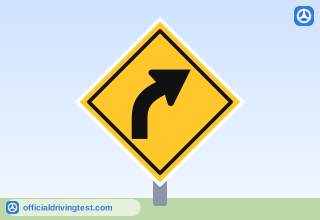
According to the New Jersey manual, what is the best way to enter a curve?
- Drift toward the center line to see farther
- Brake hard once you are in the middle of it
- Slow down before it and stay in your lane
- Speed up as you enter it to keep traction
Show answer
Correct answer: Slow down before it and stay in your lane
The best way to enter a curve is to slow down before entering and avoid drifting into another lane.
Source: New Jersey Driver Manual (2026), page 72 · Open this page in the manual (Manual page 72)
-
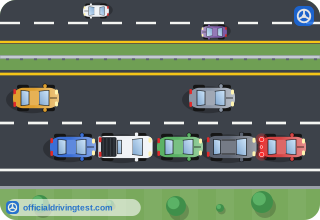
According to the New Jersey Driver Manual, what can tailgating cause when many vehicles are too close together?
- Rollover crashes on curves
- Side-impact crashes at intersections
- Head-on crashes with oncoming traffic
- A series of rear-end crashes
Show answer
Correct answer: A series of rear-end crashes
Tailgating means following too closely behind the vehicle directly in front, and it can cause a series of rear-end crashes when many vehicles are too close together.
Source: New Jersey Driver Manual (2026), page 94 · Open this page in the manual (Manual page 94)
-
Where does the New Jersey Driver Manual say a motorist should keep plenty of space around their vehicle?
- On all sides of the vehicle
- Only in front of the vehicle
- Only on the driver's side
- Only behind the vehicle
Show answer
Correct answer: On all sides of the vehicle
There should be plenty of space between a motorist's vehicle and others on all sides, with enough room ahead to stop or pass safely.
Source: New Jersey Driver Manual (2026), page 94 · Open this page in the manual (Manual page 94)
-
Which following-distance rule of thumb does the New Jersey Driver Manual say is most often used?
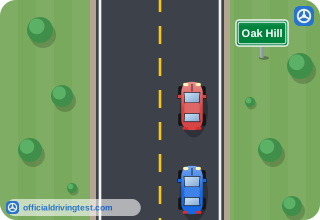
- One car length back for each 10 mph of speed
- One car length back for each 20 mph of speed
- Two car lengths back for each 5 mph of speed
- One car length back regardless of speed
Show answer
Correct answer: One car length back for each 10 mph of speed
The rule of thumb most often used is to keep one car length back (about 20 feet) for each 10 miles per hour of speed.
Source: New Jersey Driver Manual (2026), page 94 · Open this page in the manual (Manual page 94)
-
In the New Jersey Driver Manual's following-distance rule of thumb, about how long is one car length?
- About 50 feet
- About 20 feet
- About 10 feet
- About 35 feet
Show answer
Correct answer: About 20 feet
The manual's rule of thumb counts one car length as about 20 feet for each 10 mph of speed.
Source: New Jersey Driver Manual (2026), page 94 · Open this page in the manual (Manual page 94)
-
When does the New Jersey Driver Manual say following distances should be increased beyond one car length per 10 mph?
- Only when driving in a school zone
- Only when following a motorcycle
- Only when driving at night in a city
- At high speeds or in bad weather
Show answer
Correct answer: At high speeds or in bad weather
At high speeds or in bad weather, following distances should be increased.
Source: New Jersey Driver Manual (2026), page 94 · Open this page in the manual (Manual page 94)
-
According to the New Jersey Driver Manual, what does "tailgating" refer to?
- Passing another vehicle on the right side
- Driving with a trailer hitched to your vehicle
- Following too closely behind another vehicle
- Changing lanes without using a turn signal
Show answer
Correct answer: Following too closely behind another vehicle
Tailgating refers to following too closely behind the vehicle directly in front, and it is a common cause of crashes.
Source: New Jersey Driver Manual (2026), page 94 · Open this page in the manual (Manual page 94)
-
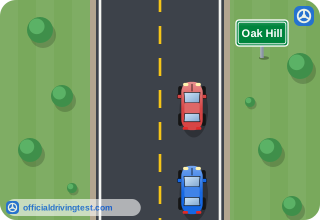
According to the New Jersey Driver Manual, at what speeds is the three-seconds-plus rule useful?
- Only in city traffic
- Only below 35 mph
- Only above 55 mph
- At any speed
Show answer
Correct answer: At any speed
Because many people have trouble judging distances, the three-seconds-plus rule may be easier to use, and it is useful at any speed.
Source: New Jersey Driver Manual (2026), page 95 · Open this page in the manual (Manual page 95)
-
When using the three-seconds-plus rule, what should you choose as your reference point?
- A moving vehicle in the lane next to yours
- A fixed object ahead, like a sign or tree
- The vehicle directly behind your own car
- The clock or timer on your dashboard
Show answer
Correct answer: A fixed object ahead, like a sign or tree
Choose some fixed object ahead of the vehicle in front, such as a sign or a tree, making sure it does not distract you from driving.
Source: New Jersey Driver Manual (2026), page 95 · Open this page in the manual (Manual page 95)
-
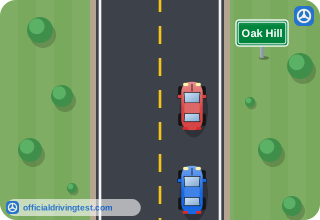
Under the three-seconds-plus rule, when do you begin counting seconds?
- When the vehicle in front brakes
- When your own vehicle passes the fixed object
- When the vehicle in front passes the fixed object
- When you first see the fixed object
Show answer
Correct answer: When the vehicle in front passes the fixed object
You begin counting (one thousand-one, one thousand-two, one thousand-three) as the vehicle in front passes the fixed object.
Source: New Jersey Driver Manual (2026), page 95 · Open this page in the manual (Manual page 95)
-
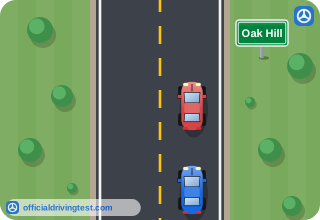
Under the three-seconds-plus rule, you should have enough distance for a sudden stop if it takes at least how long before your vehicle passes the object?
- Three seconds
- Half a second
- Two seconds
- One second
Show answer
Correct answer: Three seconds
If it takes at least three seconds before your vehicle passes the object, you should have enough distance for a sudden stop.
Source: New Jersey Driver Manual (2026), page 95 · Open this page in the manual (Manual page 95)
-
According to the New Jersey Driver Manual, stopping distance is equal to which of these?
- Reaction distance + braking distance + following distance
- Perception distance + reaction distance + braking distance
- Perception distance + following distance + skid distance
- Speed distance + reaction distance + coasting distance
Show answer
Correct answer: Perception distance + reaction distance + braking distance
The manual gives stopping distance as perception distance plus reaction distance plus braking distance.
Source: New Jersey Driver Manual (2026), page 95 · Open this page in the manual (Manual page 95)
-
How can a motorist reduce reaction distance, according to the New Jersey Driver Manual?
- By keeping a foot near the brake
- By pumping the brakes lightly at all times
- By holding the wheel with one hand
- By driving with the high beams on
Show answer
Correct answer: By keeping a foot near the brake
By keeping a foot near the brake, a motorist can reduce reaction distance.
Source: New Jersey Driver Manual (2026), page 95 · Open this page in the manual (Manual page 95)
-
What does the New Jersey Driver Manual note about heavier vehicles and stopping?
- They need no extra following distance
- They stop in the same distance as cars
- They may take longer to stop
- They always stop faster than cars
Show answer
Correct answer: They may take longer to stop
The manual notes that heavier vehicles may take longer to stop.
Source: New Jersey Driver Manual (2026), page 95 · Open this page in the manual (Manual page 95)
-
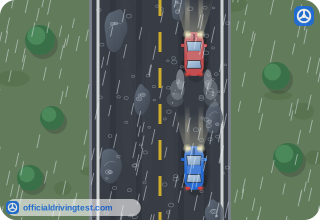
During bad weather, what does the New Jersey Driver Manual say the three-seconds-plus following interval should be increased to?
- Two seconds
- Three seconds, the same as normal
- One and a half seconds
- Four or more seconds
Show answer
Correct answer: Four or more seconds
During bad weather, the following-time interval should be increased to four or more seconds.
Source: New Jersey Driver Manual (2026), page 95 · Open this page in the manual (Manual page 95)
-
While keeping a proper following distance, what does the New Jersey Driver Manual say a motorist should always know and test often?
- The air pressure in the spare tire
- The condition of the vehicle's brakes
- The level of windshield washer fluid
- The age of the vehicle's battery
Show answer
Correct answer: The condition of the vehicle's brakes
A motorist should always know the condition of the vehicle's brakes and test them often, which is especially important on wet, snowy or icy roads.
Source: New Jersey Driver Manual (2026), page 95 · Open this page in the manual (Manual page 95)
-
The time and distance relationships used for following distance in the New Jersey Driver Manual are designed for what conditions?
- The best driving conditions
- Night driving conditions
- Heavy truck traffic conditions
- Wet or icy road conditions
Show answer
Correct answer: The best driving conditions
The manual notes that time and distance relationships are designed for the best driving conditions, so more room is needed when conditions are poor.
Source: New Jersey Driver Manual (2026), page 95 · Open this page in the manual (Manual page 95)
-
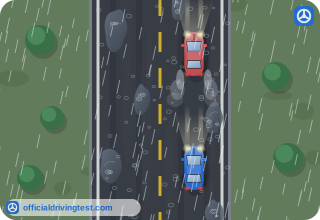
According to the New Jersey Driver Manual's minimum safe following distance table, how many car lengths should you keep on wet pavement at 40 mph?
- 4 car lengths
- 6 car lengths
- 12 car lengths
- 8 car lengths
Show answer
Correct answer: 8 car lengths
The table doubles the ideal-condition distances on wet pavement: 4 car lengths at 20 mph, 6 at 30 mph, 8 at 40 mph and 10 at 50 mph.
Source: New Jersey Driver Manual (2026), page 96 · Open this page in the manual (Manual page 96)
-
In the New Jersey Driver Manual's minimum safe following distance table, which road condition calls for the same following distances as wet pavement?
- Ideal
- Packed snow
- Gravel
- Ice
Show answer
Correct answer: Gravel
In the table, wet pavement and gravel have the same minimum following distances (for example, 4 car lengths at 20 mph), more than ideal conditions and less than packed snow or ice.
Source: New Jersey Driver Manual (2026), page 96 · Open this page in the manual (Manual page 96)
-
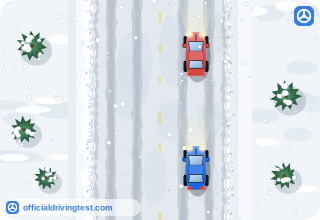
According to the New Jersey Driver Manual's minimum safe following distance table, how many car lengths should you keep on packed snow at 30 mph?
- 3 car lengths
- 9 car lengths
- 6 car lengths
- 18 car lengths
Show answer
Correct answer: 9 car lengths
The table lists 9 car lengths for packed snow at 30 mph (compared with 3 in ideal conditions and 18 on ice).
Source: New Jersey Driver Manual (2026), page 96 · Open this page in the manual (Manual page 96)
-
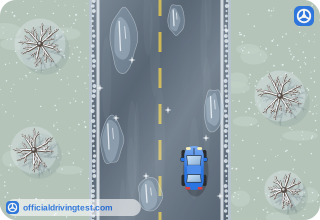
According to the New Jersey Driver Manual's minimum safe following distance table, how many car lengths should you keep on ice at just 20 mph?
- 12 car lengths
- 2 car lengths
- 6 car lengths
- 4 car lengths
Show answer
Correct answer: 12 car lengths
Ice needs by far the most room: the table lists 12 car lengths at 20 mph, six times the 2 car lengths needed in ideal conditions.
Source: New Jersey Driver Manual (2026), page 96 · Open this page in the manual (Manual page 96)
-
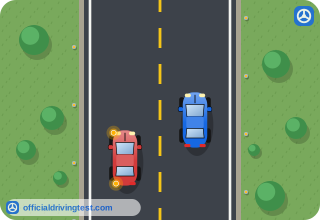
In New Jersey, what should you do when another vehicle is passing you?
- Pull onto the shoulder and stop
- Stay in your lane and slow down
- Speed up so the pass finishes sooner
- Move toward the center line
Show answer
Correct answer: Stay in your lane and slow down
When being passed, stay in the proper lane and slow down to make the pass easier for the other motorist (N.J.S.A. 39:4-87).
Source: New Jersey Driver Manual (2026), page 97 · Open this page in the manual (Manual page 97)
-
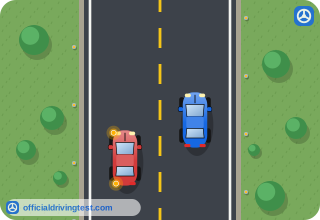
After another vehicle passes you, when should you return to your normal speed?
- After the passing vehicle is well ahead
- Only after the next intersection
- Immediately, before it finishes the pass
- As soon as the passing vehicle is beside you
Show answer
Correct answer: After the passing vehicle is well ahead
Return to normal speed after the passing vehicle is well ahead.
Source: New Jersey Driver Manual (2026), page 97 · Open this page in the manual (Manual page 97)
-
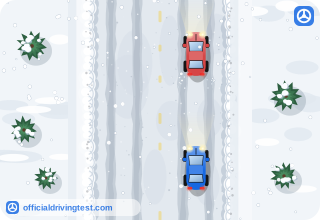
What following distance does the New Jersey Driver Manual call a good rule on snow-covered roads?
- One car length
- Two seconds
- Three seconds
- Six seconds or more
Show answer
Correct answer: Six seconds or more
Rough, wet or snow-covered roads may require more response time, and a good rule on snow-covered roads is a following distance of six seconds or more.
Source: New Jersey Driver Manual (2026), page 99 · Open this page in the manual (Manual page 99)
-
What does "reaction distance" mean?
- The space you should keep behind the vehicle ahead
- The distance your low beams light up the road
- The distance your vehicle travels before you hit the brake
- The distance needed to bring the vehicle to a complete stop
Show answer
Correct answer: The distance your vehicle travels before you hit the brake
Reaction distance is the distance traveled before you hit the brake; braking distance is the distance needed to stop after that.
Source: New Jersey Driver Manual (2026), page 100 · Open this page in the manual (Manual page 100)
-
What does "braking distance" mean?
- The distance needed to completely stop the vehicle
- The distance your low beams light up the road
- The distance traveled before you hit the brake
- The space you should keep behind the vehicle ahead
Show answer
Correct answer: The distance needed to completely stop the vehicle
The manual defines braking distance as the distance needed to completely stop the vehicle.
Source: New Jersey Driver Manual (2026), page 100 · Open this page in the manual (Manual page 100)
-
The New Jersey Driver Manual's table of night stopping distances is based on a nighttime reaction time of:
- 1 second
- 1.5 seconds
- 0.75 seconds
- 3 seconds
Show answer
Correct answer: 1.5 seconds
The table's numbers assume a motorist's nighttime reaction time of 1.5 seconds, with low beams.
Source: New Jersey Driver Manual (2026), page 100 · Open this page in the manual (Manual page 100)
-
According to the manual's night driving table (low beams), what is the total stopping distance at 60 mph?
- 277 feet
- 530 feet
- 409 feet
- 302 feet
Show answer
Correct answer: 409 feet
At 60 mph the table gives 132 feet of reaction distance plus 277 feet of braking distance, for a stopping distance of 409 feet.
Source: New Jersey Driver Manual (2026), page 100 · Open this page in the manual (Manual page 100)
-
According to the manual's night driving table (low beams), what is the total stopping distance at 30 mph?
- 66 feet
- 135 feet
- 211 feet
- 75 feet
Show answer
Correct answer: 135 feet
At 30 mph the table gives 66 feet of reaction distance plus 69 feet of braking distance, for a stopping distance of 135 feet.
Source: New Jersey Driver Manual (2026), page 100 · Open this page in the manual (Manual page 100)
-
According to the manual's night driving table, how far does a vehicle travel during the driver's reaction time at 60 mph?
- 132 feet
- 154 feet
- 110 feet
- 88 feet
Show answer
Correct answer: 132 feet
The table lists a reaction distance of 132 feet at 60 mph (88 feet per second for 1.5 seconds).
Source: New Jersey Driver Manual (2026), page 100 · Open this page in the manual (Manual page 100)
-
How far ahead should a motorist look while driving, according to the New Jersey Driver Manual?
- At least 12 seconds ahead
- At least 4 seconds ahead
- At least 20 seconds ahead
- At least 6 seconds ahead
Show answer
Correct answer: At least 12 seconds ahead
You should look at least 12 seconds ahead, meaning you can see an object far enough away that it takes at least 12 seconds to reach it.
Source: New Jersey Driver Manual (2026), page 101 · Open this page in the manual (Manual page 101)
-
When driving at 25 mph on a clear city road, about how far ahead should you be able to see?
- About three blocks
- About half a block
- About a quarter mile
- About a block
Show answer
Correct answer: About a block
At 25 mph on a clear city road, looking 12 seconds ahead means you should be able to see about a block ahead.
Source: New Jersey Driver Manual (2026), page 101 · Open this page in the manual (Manual page 101)
-
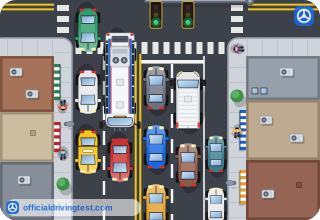
When city traffic is heavy and you need extra time to react, the manual says you should:
- Use your horn often to warn the drivers around you
- Drive more slowly, because reducing speed gains you time
- Change lanes often so you can find the fastest-moving lane
- Follow the vehicle ahead more closely to keep traffic moving
Show answer
Correct answer: Drive more slowly, because reducing speed gains you time
Heavy traffic calls for extra time to react, which means driving more slowly; by reducing speed a motorist gains time.
Source: New Jersey Driver Manual (2026), page 101 · Open this page in the manual (Manual page 101)
-
According to the New Jersey Driver Manual, one of the most prevalent factors contributing to traffic crashes is:
- Exceeding the speed limit or driving too fast for conditions
- Using cruise control on long trips through open country
- Driving with the windows open on cold, rainy or windy days
- Using the defroster to clear a fogged windshield
Show answer
Correct answer: Exceeding the speed limit or driving too fast for conditions
The manual names exceeding the posted speed limit or driving too fast for road conditions as one of the most prevalent factors in traffic crashes.
Source: New Jersey Driver Manual (2026), page 102 · Open this page in the manual (Manual page 102)
-
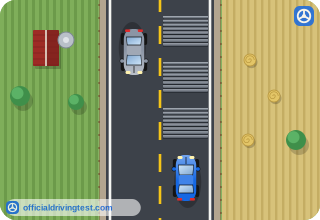
Why are rumble strips put on the highway or shoulder?
- To show where trucks must stop
- To alert you to a decision point ahead
- To mark the edge of a parking area or lot
- To drain water off the road
Show answer
Correct answer: To alert you to a decision point ahead
Rumble strips alert the motorist that there is a decision point ahead, such as a four-way intersection after miles of uninterrupted travel.
Source: New Jersey Driver Manual (2026), page 218 · Open this page in the manual (Manual page 218)
-
Which statement about rumble strips is true?
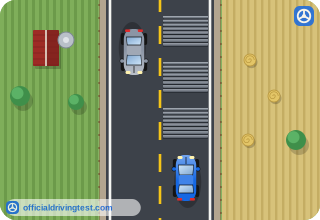
- They will not damage a vehicle
- They can damage tires at high speed
- They replace the need for warning signs
- They are used only on private roads
Show answer
Correct answer: They will not damage a vehicle
Rumble strips will not damage a vehicle; they are meant to get a motorist to drive more slowly.
Source: New Jersey Driver Manual (2026), page 218 · Open this page in the manual (Manual page 218)
-
Rumble strips are almost always used together with:
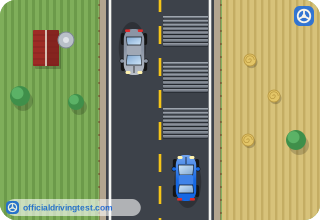
- A police officer
- A lowered railroad gate
- A traffic signal
- A cautionary sign
Show answer
Correct answer: A cautionary sign
The manual states that rumble strips are almost always used with a cautionary sign.
Source: New Jersey Driver Manual (2026), page 218 · Open this page in the manual (Manual page 218)
-
How does a speed hump differ from a speed bump?
- It is longer and flatter
- It is used only on highways
- It is shorter and sharper
- It is painted on, not raised
Show answer
Correct answer: It is longer and flatter
A speed hump is a longer, flatter version of a speed bump.
Source: New Jersey Driver Manual (2026), page 218 · Open this page in the manual (Manual page 218)
-
According to the New Jersey manual, rumble strips are meant to get a motorist to do what?
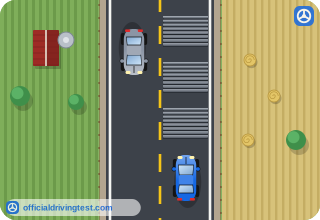
- Turn on the headlights
- Change to the left lane
- Drive more slowly
- Pull onto the shoulder
Show answer
Correct answer: Drive more slowly
Rumble strips will not damage a vehicle; they are meant to get a motorist to drive more slowly.
Source: New Jersey Driver Manual (2026), page 218 · Open this page in the manual (Manual page 218)
-
What is a speed bump?
- A raised island that divides two-way traffic
- A dip in the road that drains rainwater
- A painted stripe that marks a school zone
- A low ridge across a street to slow cars
Show answer
Correct answer: A low ridge across a street to slow cars
A speed bump is a low ridge that runs across a street and is designed to slow down cars.
Source: New Jersey Driver Manual (2026), page 218 · Open this page in the manual (Manual page 218)