New Jersey: Speed & following distance — Part 1 Practice Test
Questions in this part include: “According to the New Jersey Driver Manual, what is the one point that is sure about stopping distance?” · “What typical reaction time does the New Jersey Driver Manual give for most motorists under most traffic conditions?”
Independent educational site · not affiliated with any government agency or DMV
Ready? Test yourself
- Instant feedback with an explanation
- Every answer cites its source in the manual
- Your best score is saved on this device
Questions are original and based on the official manual "New Jersey Driver Manual" (2026), New Jersey Motor Vehicle Commission (MVC).
All 17 questions in this practice test
Take the test above first, then use this list to study. Tap “Show answer” to see the correct answer and explanation.
Show the questions and answersHide the questions
-
If your vehicle has ABS, what should you do in wet or slippery conditions?
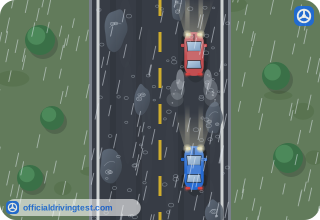
- Follow more closely, since ABS shortens stops
- Drive at your normal speed, since ABS prevents all skids
- Pump the brakes early and often to stay safe
- Drive carefully, keep a safe distance and adjust speed
Show answer
Correct answer: Drive carefully, keep a safe distance and adjust speed
Even with ABS, in wet or slippery conditions you should drive carefully, keep a safe distance from the vehicle ahead and keep your speed consistent with road conditions.
Source: New Jersey Driver Manual (2026), page 45 · Open this page in the manual (Manual page 45)
-
According to the New Jersey Driver Manual, what is the one point that is sure about stopping distance?
- Stopping distance is the same at any speed on dry roads
- Anti-lock brakes always shorten stopping distance
- Heavier vehicles always stop in a shorter distance
- The faster you go, the longer it takes to stop
Show answer
Correct answer: The faster you go, the longer it takes to stop
There is no simple way to tell exactly how long a stop will take, but one point is sure: the faster a vehicle is going, the longer it takes to stop.
Source: New Jersey Driver Manual (2026), page 52 · Open this page in the manual (Manual page 52)
-
According to the stopping-distance table in the New Jersey Driver Manual, what is the total stopping distance at 30 mph?
- 53 feet
- 69 feet
- 102 feet
- 167 feet
Show answer
Correct answer: 102 feet
At 30 mph the table shows 33 feet of reaction distance plus 69 feet of braking distance, for a total of 102 feet.
Source: New Jersey Driver Manual (2026), page 53 · Open this page in the manual (Manual page 53)
-
According to the stopping-distance table in the New Jersey Driver Manual, what is the total stopping distance at 50 mph?
- 247 feet
- 167 feet
- 192 feet
- 343 feet
Show answer
Correct answer: 247 feet
At 50 mph the table shows 55 feet of reaction distance plus 192 feet of braking distance, for a total of 247 feet.
Source: New Jersey Driver Manual (2026), page 53 · Open this page in the manual (Manual page 53)
-
According to the stopping-distance table in the New Jersey Driver Manual, what is the total stopping distance at 60 mph?
- 277 feet
- 343 feet
- 453 feet
- 247 feet
Show answer
Correct answer: 343 feet
At 60 mph the table shows 66 feet of reaction distance plus 277 feet of braking distance, for a total of 343 feet.
Source: New Jersey Driver Manual (2026), page 53 · Open this page in the manual (Manual page 53)
-
According to the stopping-distance table in the New Jersey Driver Manual, what is the total stopping distance at 70 mph?
- 343 feet
- 550 feet
- 376 feet
- 453 feet
Show answer
Correct answer: 453 feet
At 70 mph the table shows 77 feet of reaction distance plus 376 feet of braking distance, for a total of 453 feet.
Source: New Jersey Driver Manual (2026), page 53 · Open this page in the manual (Manual page 53)
-
According to the New Jersey Driver Manual's table, how far does a vehicle travel at 60 mph during the driver's reaction time, before the brakes are applied?
- 277 feet
- 88 feet
- 66 feet
- 44 feet
Show answer
Correct answer: 66 feet
The table lists a reaction distance of 66 feet at 60 mph (braking distance is a further 277 feet).
Source: New Jersey Driver Manual (2026), page 53 · Open this page in the manual (Manual page 53)
-
How many feet per second does a vehicle travel at 60 mph, according to the New Jersey Driver Manual?
- 88 feet
- 44 feet
- 60 feet
- 120 feet
Show answer
Correct answer: 88 feet
The manual states that a vehicle travels 88 feet per second at 60 mph.
Source: New Jersey Driver Manual (2026), page 53 · Open this page in the manual (Manual page 53)
-
What typical reaction time does the New Jersey Driver Manual give for most motorists under most traffic conditions?
- 1/4 of a second
- 3/4 of a second
- 3 seconds
- 2 seconds
Show answer
Correct answer: 3/4 of a second
The manual says most motorists under most traffic conditions have a typical reaction time of 3/4 second.
Source: New Jersey Driver Manual (2026), page 53 · Open this page in the manual (Manual page 53)
-
In the New Jersey Driver Manual's notes on its stopping-distance table, deceleration is given as approximately how much?
- 4 feet per second
- 44 feet per second
- 14 feet per second
- 88 feet per second
Show answer
Correct answer: 14 feet per second
The notes under the stopping-distance table state that deceleration is approximately 14 feet per second.
Source: New Jersey Driver Manual (2026), page 53 · Open this page in the manual (Manual page 53)
-
In New Jersey, unless otherwise posted, what is the speed limit in school zones and in business or residential districts?
- 40 mph
- 20 mph
- 30 mph
- 25 mph
Show answer
Correct answer: 25 mph
New Jersey sets a 25 mph limit in school zones and in business or residential districts unless a different limit is posted.
Source: New Jersey Driver Manual (2026), page 62 · Open this page in the manual (Manual page 62)
-
In New Jersey, unless otherwise posted, what is the speed limit in suburban business and residential districts?
- 45 mph
- 35 mph
- 55 mph
- 30 mph
Show answer
Correct answer: 35 mph
The New Jersey limit for suburban business and residential districts is 35 mph unless otherwise posted.
Source: New Jersey Driver Manual (2026), page 62 · Open this page in the manual (Manual page 62)
-
In New Jersey, what is the speed limit on rural roadways where no speed limit is posted?
- 40 mph
- 45 mph
- 50 mph
- 60 mph
Show answer
Correct answer: 50 mph
Non-posted rural roadways in New Jersey have a 50 mph speed limit.
Source: New Jersey Driver Manual (2026), page 62 · Open this page in the manual (Manual page 62)
-
According to New Jersey's list of speed limits, where does a 55 mph limit apply?
- Rural roadways that have no posted limit
- Certain state highways and interstates
- Suburban business and residential districts
- School zones and residential districts
Show answer
Correct answer: Certain state highways and interstates
New Jersey lists 55 mph for certain state highways (as posted) and interstates.
Source: New Jersey Driver Manual (2026), page 62 · Open this page in the manual (Manual page 62)
-
What is the highest speed limit on New Jersey's list of limits, which applies on certain interstate highways where posted?
- 55 mph
- 75 mph
- 65 mph
- 70 mph
Show answer
Correct answer: 65 mph
New Jersey's list tops out at 65 mph, which applies on certain interstate highways as posted.
Source: New Jersey Driver Manual (2026), page 62 · Open this page in the manual (Manual page 62)
-
In New Jersey, what is the smallest amount over the 65 mph limit that means you pay double fines?
- 10 mph
- 15 mph
- 20 mph
- 5 mph
Show answer
Correct answer: 10 mph
Motorists pay double fines for going 10 mph or more over the 65 mph limit.
Source: New Jersey Driver Manual (2026), page 62 · Open this page in the manual (Manual page 62)
-
According to the New Jersey manual, how does excessive speed affect your ability to react?
- It gives you less time to respond to hazards
- It gives you more time to correct errors
- It keeps you more alert, so you react faster
- It changes only fuel use, not reaction
Show answer
Correct answer: It gives you less time to respond to hazards
Excessive speed reduces reaction time, giving drivers less opportunity to respond to hazards or correct errors.
Source: New Jersey Driver Manual (2026), page 62 · Open this page in the manual (Manual page 62)