New Jersey: Speed & following distance — Part 4 Practice Test
Questions in this part include: “What does "reaction distance" mean?” · “How far ahead should a motorist look while driving, according to the New Jersey Driver Manual?”
Independent educational site · not affiliated with any government agency or DMV
Ready? Test yourself
- Instant feedback with an explanation
- Every answer cites its source in the manual
- Your best score is saved on this device
Questions are original and based on the official manual "New Jersey Driver Manual" (2026), New Jersey Motor Vehicle Commission (MVC).
All 16 questions in this practice test
Take the test above first, then use this list to study. Tap “Show answer” to see the correct answer and explanation.
Show the questions and answersHide the questions
-
What does "reaction distance" mean?
- The space you should keep behind the vehicle ahead
- The distance your low beams light up the road
- The distance your vehicle travels before you hit the brake
- The distance needed to bring the vehicle to a complete stop
Show answer
Correct answer: The distance your vehicle travels before you hit the brake
Reaction distance is the distance traveled before you hit the brake; braking distance is the distance needed to stop after that.
Source: New Jersey Driver Manual (2026), page 100 · Open this page in the manual (Manual page 100)
-
What does "braking distance" mean?
- The distance needed to completely stop the vehicle
- The distance your low beams light up the road
- The distance traveled before you hit the brake
- The space you should keep behind the vehicle ahead
Show answer
Correct answer: The distance needed to completely stop the vehicle
The manual defines braking distance as the distance needed to completely stop the vehicle.
Source: New Jersey Driver Manual (2026), page 100 · Open this page in the manual (Manual page 100)
-
The New Jersey Driver Manual's table of night stopping distances is based on a nighttime reaction time of:
- 1 second
- 1.5 seconds
- 0.75 seconds
- 3 seconds
Show answer
Correct answer: 1.5 seconds
The table's numbers assume a motorist's nighttime reaction time of 1.5 seconds, with low beams.
Source: New Jersey Driver Manual (2026), page 100 · Open this page in the manual (Manual page 100)
-
According to the manual's night driving table (low beams), what is the total stopping distance at 60 mph?
- 277 feet
- 530 feet
- 409 feet
- 302 feet
Show answer
Correct answer: 409 feet
At 60 mph the table gives 132 feet of reaction distance plus 277 feet of braking distance, for a stopping distance of 409 feet.
Source: New Jersey Driver Manual (2026), page 100 · Open this page in the manual (Manual page 100)
-
According to the manual's night driving table (low beams), what is the total stopping distance at 30 mph?
- 66 feet
- 135 feet
- 211 feet
- 75 feet
Show answer
Correct answer: 135 feet
At 30 mph the table gives 66 feet of reaction distance plus 69 feet of braking distance, for a stopping distance of 135 feet.
Source: New Jersey Driver Manual (2026), page 100 · Open this page in the manual (Manual page 100)
-
According to the manual's night driving table, how far does a vehicle travel during the driver's reaction time at 60 mph?
- 132 feet
- 154 feet
- 110 feet
- 88 feet
Show answer
Correct answer: 132 feet
The table lists a reaction distance of 132 feet at 60 mph (88 feet per second for 1.5 seconds).
Source: New Jersey Driver Manual (2026), page 100 · Open this page in the manual (Manual page 100)
-
How far ahead should a motorist look while driving, according to the New Jersey Driver Manual?
- At least 12 seconds ahead
- At least 4 seconds ahead
- At least 20 seconds ahead
- At least 6 seconds ahead
Show answer
Correct answer: At least 12 seconds ahead
You should look at least 12 seconds ahead, meaning you can see an object far enough away that it takes at least 12 seconds to reach it.
Source: New Jersey Driver Manual (2026), page 101 · Open this page in the manual (Manual page 101)
-
When driving at 25 mph on a clear city road, about how far ahead should you be able to see?
- About three blocks
- About half a block
- About a quarter mile
- About a block
Show answer
Correct answer: About a block
At 25 mph on a clear city road, looking 12 seconds ahead means you should be able to see about a block ahead.
Source: New Jersey Driver Manual (2026), page 101 · Open this page in the manual (Manual page 101)
-
When city traffic is heavy and you need extra time to react, the manual says you should:
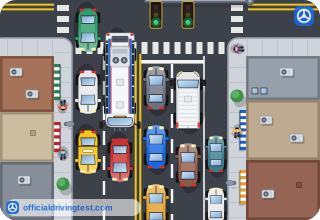
- Use your horn often to warn the drivers around you
- Drive more slowly, because reducing speed gains you time
- Change lanes often so you can find the fastest-moving lane
- Follow the vehicle ahead more closely to keep traffic moving
Show answer
Correct answer: Drive more slowly, because reducing speed gains you time
Heavy traffic calls for extra time to react, which means driving more slowly; by reducing speed a motorist gains time.
Source: New Jersey Driver Manual (2026), page 101 · Open this page in the manual (Manual page 101)
-
According to the New Jersey Driver Manual, one of the most prevalent factors contributing to traffic crashes is:
- Exceeding the speed limit or driving too fast for conditions
- Using cruise control on long trips through open country
- Driving with the windows open on cold, rainy or windy days
- Using the defroster to clear a fogged windshield
Show answer
Correct answer: Exceeding the speed limit or driving too fast for conditions
The manual names exceeding the posted speed limit or driving too fast for road conditions as one of the most prevalent factors in traffic crashes.
Source: New Jersey Driver Manual (2026), page 102 · Open this page in the manual (Manual page 102)
-
Why are rumble strips put on the highway or shoulder?
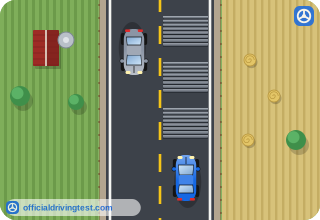
- To show where trucks must stop
- To alert you to a decision point ahead
- To mark the edge of a parking area or lot
- To drain water off the road
Show answer
Correct answer: To alert you to a decision point ahead
Rumble strips alert the motorist that there is a decision point ahead, such as a four-way intersection after miles of uninterrupted travel.
Source: New Jersey Driver Manual (2026), page 218 · Open this page in the manual (Manual page 218)
-
Which statement about rumble strips is true?
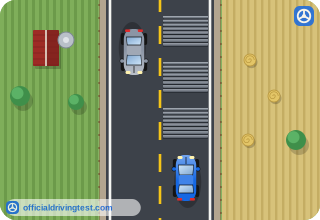
- They will not damage a vehicle
- They can damage tires at high speed
- They replace the need for warning signs
- They are used only on private roads
Show answer
Correct answer: They will not damage a vehicle
Rumble strips will not damage a vehicle; they are meant to get a motorist to drive more slowly.
Source: New Jersey Driver Manual (2026), page 218 · Open this page in the manual (Manual page 218)
-
Rumble strips are almost always used together with:
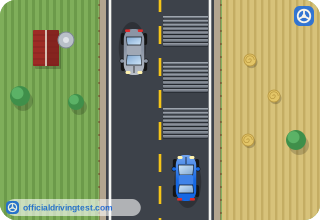
- A police officer
- A lowered railroad gate
- A traffic signal
- A cautionary sign
Show answer
Correct answer: A cautionary sign
The manual states that rumble strips are almost always used with a cautionary sign.
Source: New Jersey Driver Manual (2026), page 218 · Open this page in the manual (Manual page 218)
-
How does a speed hump differ from a speed bump?
- It is longer and flatter
- It is used only on highways
- It is shorter and sharper
- It is painted on, not raised
Show answer
Correct answer: It is longer and flatter
A speed hump is a longer, flatter version of a speed bump.
Source: New Jersey Driver Manual (2026), page 218 · Open this page in the manual (Manual page 218)
-
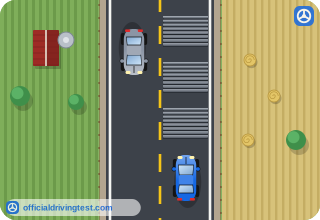
According to the New Jersey manual, rumble strips are meant to get a motorist to do what?
- Turn on the headlights
- Change to the left lane
- Drive more slowly
- Pull onto the shoulder
Show answer
Correct answer: Drive more slowly
Rumble strips will not damage a vehicle; they are meant to get a motorist to drive more slowly.
Source: New Jersey Driver Manual (2026), page 218 · Open this page in the manual (Manual page 218)
-
What is a speed bump?
- A raised island that divides two-way traffic
- A dip in the road that drains rainwater
- A painted stripe that marks a school zone
- A low ridge across a street to slow cars
Show answer
Correct answer: A low ridge across a street to slow cars
A speed bump is a low ridge that runs across a street and is designed to slow down cars.
Source: New Jersey Driver Manual (2026), page 218 · Open this page in the manual (Manual page 218)