New Jersey: Speed & following distance — Part 2 Practice Test
Questions in this part include: “What happens to the force of impact in a crash as speed goes up?” · “According to the New Jersey manual, what besides speeding can cause some crashes?”
Independent educational site · not affiliated with any government agency or DMV
Ready? Test yourself
- Instant feedback with an explanation
- Every answer cites its source in the manual
- Your best score is saved on this device
Questions are original and based on the official manual "New Jersey Driver Manual" (2026), New Jersey Motor Vehicle Commission (MVC).
All 16 questions in this practice test
Take the test above first, then use this list to study. Tap “Show answer” to see the correct answer and explanation.
Show the questions and answersHide the questions
-
What happens to the force of impact in a crash as speed goes up?
- It decreases, because the crash is shorter
- It increases, causing more damage and injury
- It stays the same at every speed
- It matters only for large trucks
Show answer
Correct answer: It increases, causing more damage and injury
Higher speeds increase the force of impact, resulting in more damage, serious injury, or death.
Source: New Jersey Driver Manual (2026), page 62 · Open this page in the manual (Manual page 62)
-
In New Jersey, you are driving at the posted speed limit, but faster than the weather and road conditions safely allow. What can happen?
- You can be cited only after a crash
- You can be cited only on highways
- You can get a moving violation
- Nothing, since you are within the limit
Show answer
Correct answer: You can get a moving violation
You must never drive faster than conditions safely allow, whatever the posted limit; failing to adjust can result in a moving violation.
Source: New Jersey Driver Manual (2026), page 63 · Open this page in the manual (Manual page 63)
-
According to the New Jersey manual, where should you always slow down?
- On a straight, dry road with a clear view
- When pulling away from a toll booth
- When leaving an acceleration lane
- At sharp or blind curves
Show answer
Correct answer: At sharp or blind curves
The manual lists sharp or blind curves among the places where you should always slow down.
Source: New Jersey Driver Manual (2026), page 63 · Open this page in the manual (Manual page 63)
-
Which road condition does the New Jersey manual list as a time to always slow down?
- When the road ahead is straight and level
- When the highway is empty at midday
- When the road is wet, icy, or slippery
- When the road is dry and traffic is light
Show answer
Correct answer: When the road is wet, icy, or slippery
You should always slow down when the road is wet, icy, or otherwise slippery.
Source: New Jersey Driver Manual (2026), page 63 · Open this page in the manual (Manual page 63)
-
Which of these places does the New Jersey manual name as one where you should always slow down?
- At intersections or railroad crossings
- In an acceleration lane before merging
- On a wide road with light traffic
- On a long, straight highway stretch
Show answer
Correct answer: At intersections or railroad crossings
Intersections and railroad crossings are on the list of places where you should always slow down.
Source: New Jersey Driver Manual (2026), page 63 · Open this page in the manual (Manual page 63)
-
What speed does the New Jersey manual say a motorist should always try to keep?
- Always about 5 mph under the posted limit
- Slightly above the flow when the road is clear
- As slow as needed to feel fully relaxed
- Up with traffic flow, but not over the limit
Show answer
Correct answer: Up with traffic flow, but not over the limit
A motorist should try to keep up with the normal flow of traffic while not exceeding the posted speed limit.
Source: New Jersey Driver Manual (2026), page 63 · Open this page in the manual (Manual page 63)
-
According to the New Jersey manual, what besides speeding can cause some crashes?
- Using the right-hand lane of a multi-lane road
- Signaling at least 100 feet before a turn
- Keeping up with the normal flow of traffic
- Driving too slowly or backing up in traffic
Show answer
Correct answer: Driving too slowly or backing up in traffic
The manual warns that some crashes are caused by driving too slowly or backing up in traffic.
Source: New Jersey Driver Manual (2026), page 63 · Open this page in the manual (Manual page 63)
-
When road surfaces and traffic are normal, what does New Jersey law say about slow driving?
- It permits any speed that is below the posted limit
- It prohibits blocking traffic by driving slowly
- It applies only to trucks and buses
- It requires driving 10 mph below the limit
Show answer
Correct answer: It prohibits blocking traffic by driving slowly
When road surfaces and traffic are normal, New Jersey law prohibits blocking traffic through slow driving.
Source: New Jersey Driver Manual (2026), page 63 · Open this page in the manual (Manual page 63)
-
According to the New Jersey manual, what is the best way to enter a curve?
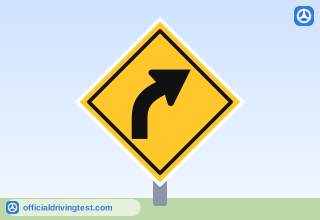
- Drift toward the center line to see farther
- Brake hard once you are in the middle of it
- Slow down before it and stay in your lane
- Speed up as you enter it to keep traction
Show answer
Correct answer: Slow down before it and stay in your lane
The best way to enter a curve is to slow down before entering and avoid drifting into another lane.
Source: New Jersey Driver Manual (2026), page 72 · Open this page in the manual (Manual page 72)
-
According to the New Jersey Driver Manual, what can tailgating cause when many vehicles are too close together?
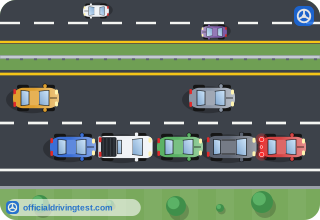
- Rollover crashes on curves
- Side-impact crashes at intersections
- Head-on crashes with oncoming traffic
- A series of rear-end crashes
Show answer
Correct answer: A series of rear-end crashes
Tailgating means following too closely behind the vehicle directly in front, and it can cause a series of rear-end crashes when many vehicles are too close together.
Source: New Jersey Driver Manual (2026), page 94 · Open this page in the manual (Manual page 94)
-
Where does the New Jersey Driver Manual say a motorist should keep plenty of space around their vehicle?
- On all sides of the vehicle
- Only in front of the vehicle
- Only on the driver's side
- Only behind the vehicle
Show answer
Correct answer: On all sides of the vehicle
There should be plenty of space between a motorist's vehicle and others on all sides, with enough room ahead to stop or pass safely.
Source: New Jersey Driver Manual (2026), page 94 · Open this page in the manual (Manual page 94)
-
Which following-distance rule of thumb does the New Jersey Driver Manual say is most often used?
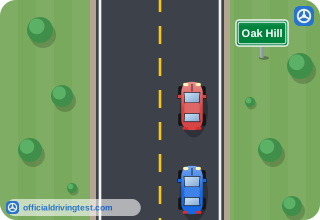
- One car length back for each 10 mph of speed
- One car length back for each 20 mph of speed
- Two car lengths back for each 5 mph of speed
- One car length back regardless of speed
Show answer
Correct answer: One car length back for each 10 mph of speed
The rule of thumb most often used is to keep one car length back (about 20 feet) for each 10 miles per hour of speed.
Source: New Jersey Driver Manual (2026), page 94 · Open this page in the manual (Manual page 94)
-
In the New Jersey Driver Manual's following-distance rule of thumb, about how long is one car length?
- About 50 feet
- About 20 feet
- About 10 feet
- About 35 feet
Show answer
Correct answer: About 20 feet
The manual's rule of thumb counts one car length as about 20 feet for each 10 mph of speed.
Source: New Jersey Driver Manual (2026), page 94 · Open this page in the manual (Manual page 94)
-
When does the New Jersey Driver Manual say following distances should be increased beyond one car length per 10 mph?
- Only when driving in a school zone
- Only when following a motorcycle
- Only when driving at night in a city
- At high speeds or in bad weather
Show answer
Correct answer: At high speeds or in bad weather
At high speeds or in bad weather, following distances should be increased.
Source: New Jersey Driver Manual (2026), page 94 · Open this page in the manual (Manual page 94)
-
According to the New Jersey Driver Manual, what does "tailgating" refer to?
- Passing another vehicle on the right side
- Driving with a trailer hitched to your vehicle
- Following too closely behind another vehicle
- Changing lanes without using a turn signal
Show answer
Correct answer: Following too closely behind another vehicle
Tailgating refers to following too closely behind the vehicle directly in front, and it is a common cause of crashes.
Source: New Jersey Driver Manual (2026), page 94 · Open this page in the manual (Manual page 94)
-
According to the New Jersey Driver Manual, at what speeds is the three-seconds-plus rule useful?
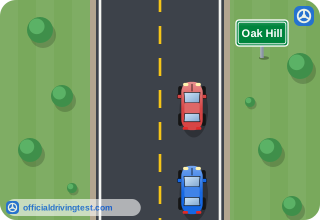
- Only in city traffic
- Only below 35 mph
- Only above 55 mph
- At any speed
Show answer
Correct answer: At any speed
Because many people have trouble judging distances, the three-seconds-plus rule may be easier to use, and it is useful at any speed.
Source: New Jersey Driver Manual (2026), page 95 · Open this page in the manual (Manual page 95)