New Jersey: Speed & following distance — Part 3 Practice Test
Questions in this part include: “When using the three-seconds-plus rule, what should you choose as your reference point?” · “How can a motorist reduce reaction distance, according to the New Jersey Driver Manual?”
Independent educational site · not affiliated with any government agency or DMV
Ready? Test yourself
- Instant feedback with an explanation
- Every answer cites its source in the manual
- Your best score is saved on this device
Questions are original and based on the official manual "New Jersey Driver Manual" (2026), New Jersey Motor Vehicle Commission (MVC).
All 16 questions in this practice test
Take the test above first, then use this list to study. Tap “Show answer” to see the correct answer and explanation.
Show the questions and answersHide the questions
-
When using the three-seconds-plus rule, what should you choose as your reference point?
- A moving vehicle in the lane next to yours
- A fixed object ahead, like a sign or tree
- The vehicle directly behind your own car
- The clock or timer on your dashboard
Show answer
Correct answer: A fixed object ahead, like a sign or tree
Choose some fixed object ahead of the vehicle in front, such as a sign or a tree, making sure it does not distract you from driving.
Source: New Jersey Driver Manual (2026), page 95 · Open this page in the manual (Manual page 95)
-
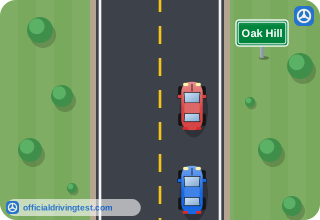
Under the three-seconds-plus rule, when do you begin counting seconds?
- When the vehicle in front brakes
- When your own vehicle passes the fixed object
- When the vehicle in front passes the fixed object
- When you first see the fixed object
Show answer
Correct answer: When the vehicle in front passes the fixed object
You begin counting (one thousand-one, one thousand-two, one thousand-three) as the vehicle in front passes the fixed object.
Source: New Jersey Driver Manual (2026), page 95 · Open this page in the manual (Manual page 95)
-
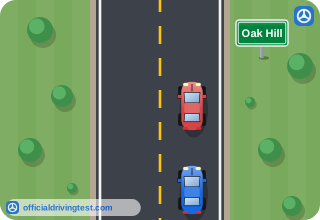
Under the three-seconds-plus rule, you should have enough distance for a sudden stop if it takes at least how long before your vehicle passes the object?
- Three seconds
- Half a second
- Two seconds
- One second
Show answer
Correct answer: Three seconds
If it takes at least three seconds before your vehicle passes the object, you should have enough distance for a sudden stop.
Source: New Jersey Driver Manual (2026), page 95 · Open this page in the manual (Manual page 95)
-
According to the New Jersey Driver Manual, stopping distance is equal to which of these?
- Reaction distance + braking distance + following distance
- Perception distance + reaction distance + braking distance
- Perception distance + following distance + skid distance
- Speed distance + reaction distance + coasting distance
Show answer
Correct answer: Perception distance + reaction distance + braking distance
The manual gives stopping distance as perception distance plus reaction distance plus braking distance.
Source: New Jersey Driver Manual (2026), page 95 · Open this page in the manual (Manual page 95)
-
How can a motorist reduce reaction distance, according to the New Jersey Driver Manual?
- By keeping a foot near the brake
- By pumping the brakes lightly at all times
- By holding the wheel with one hand
- By driving with the high beams on
Show answer
Correct answer: By keeping a foot near the brake
By keeping a foot near the brake, a motorist can reduce reaction distance.
Source: New Jersey Driver Manual (2026), page 95 · Open this page in the manual (Manual page 95)
-
What does the New Jersey Driver Manual note about heavier vehicles and stopping?
- They need no extra following distance
- They stop in the same distance as cars
- They may take longer to stop
- They always stop faster than cars
Show answer
Correct answer: They may take longer to stop
The manual notes that heavier vehicles may take longer to stop.
Source: New Jersey Driver Manual (2026), page 95 · Open this page in the manual (Manual page 95)
-
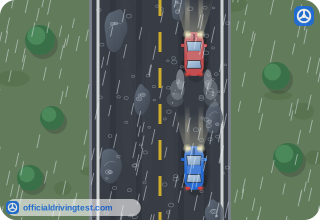
During bad weather, what does the New Jersey Driver Manual say the three-seconds-plus following interval should be increased to?
- Two seconds
- Three seconds, the same as normal
- One and a half seconds
- Four or more seconds
Show answer
Correct answer: Four or more seconds
During bad weather, the following-time interval should be increased to four or more seconds.
Source: New Jersey Driver Manual (2026), page 95 · Open this page in the manual (Manual page 95)
-
While keeping a proper following distance, what does the New Jersey Driver Manual say a motorist should always know and test often?
- The air pressure in the spare tire
- The condition of the vehicle's brakes
- The level of windshield washer fluid
- The age of the vehicle's battery
Show answer
Correct answer: The condition of the vehicle's brakes
A motorist should always know the condition of the vehicle's brakes and test them often, which is especially important on wet, snowy or icy roads.
Source: New Jersey Driver Manual (2026), page 95 · Open this page in the manual (Manual page 95)
-
The time and distance relationships used for following distance in the New Jersey Driver Manual are designed for what conditions?
- The best driving conditions
- Night driving conditions
- Heavy truck traffic conditions
- Wet or icy road conditions
Show answer
Correct answer: The best driving conditions
The manual notes that time and distance relationships are designed for the best driving conditions, so more room is needed when conditions are poor.
Source: New Jersey Driver Manual (2026), page 95 · Open this page in the manual (Manual page 95)
-
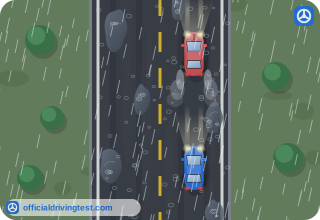
According to the New Jersey Driver Manual's minimum safe following distance table, how many car lengths should you keep on wet pavement at 40 mph?
- 4 car lengths
- 6 car lengths
- 12 car lengths
- 8 car lengths
Show answer
Correct answer: 8 car lengths
The table doubles the ideal-condition distances on wet pavement: 4 car lengths at 20 mph, 6 at 30 mph, 8 at 40 mph and 10 at 50 mph.
Source: New Jersey Driver Manual (2026), page 96 · Open this page in the manual (Manual page 96)
-
In the New Jersey Driver Manual's minimum safe following distance table, which road condition calls for the same following distances as wet pavement?
- Ideal
- Packed snow
- Gravel
- Ice
Show answer
Correct answer: Gravel
In the table, wet pavement and gravel have the same minimum following distances (for example, 4 car lengths at 20 mph), more than ideal conditions and less than packed snow or ice.
Source: New Jersey Driver Manual (2026), page 96 · Open this page in the manual (Manual page 96)
-
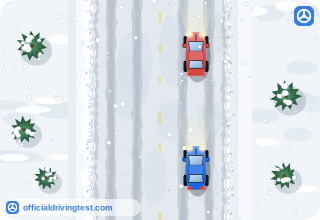
According to the New Jersey Driver Manual's minimum safe following distance table, how many car lengths should you keep on packed snow at 30 mph?
- 3 car lengths
- 9 car lengths
- 6 car lengths
- 18 car lengths
Show answer
Correct answer: 9 car lengths
The table lists 9 car lengths for packed snow at 30 mph (compared with 3 in ideal conditions and 18 on ice).
Source: New Jersey Driver Manual (2026), page 96 · Open this page in the manual (Manual page 96)
-
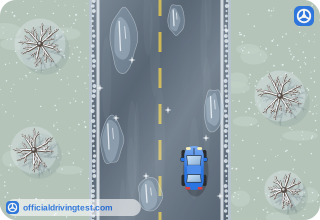
According to the New Jersey Driver Manual's minimum safe following distance table, how many car lengths should you keep on ice at just 20 mph?
- 12 car lengths
- 2 car lengths
- 6 car lengths
- 4 car lengths
Show answer
Correct answer: 12 car lengths
Ice needs by far the most room: the table lists 12 car lengths at 20 mph, six times the 2 car lengths needed in ideal conditions.
Source: New Jersey Driver Manual (2026), page 96 · Open this page in the manual (Manual page 96)
-
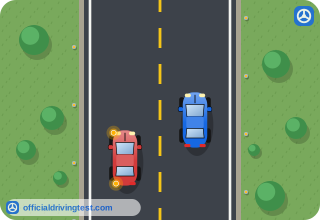
In New Jersey, what should you do when another vehicle is passing you?
- Pull onto the shoulder and stop
- Stay in your lane and slow down
- Speed up so the pass finishes sooner
- Move toward the center line
Show answer
Correct answer: Stay in your lane and slow down
When being passed, stay in the proper lane and slow down to make the pass easier for the other motorist (N.J.S.A. 39:4-87).
Source: New Jersey Driver Manual (2026), page 97 · Open this page in the manual (Manual page 97)
-
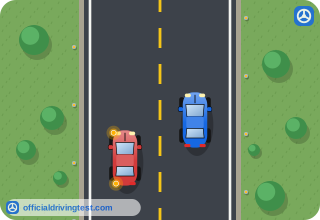
After another vehicle passes you, when should you return to your normal speed?
- After the passing vehicle is well ahead
- Only after the next intersection
- Immediately, before it finishes the pass
- As soon as the passing vehicle is beside you
Show answer
Correct answer: After the passing vehicle is well ahead
Return to normal speed after the passing vehicle is well ahead.
Source: New Jersey Driver Manual (2026), page 97 · Open this page in the manual (Manual page 97)
-
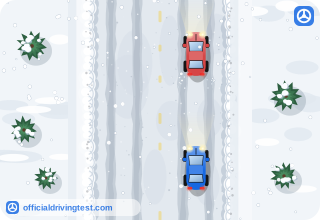
What following distance does the New Jersey Driver Manual call a good rule on snow-covered roads?
- One car length
- Two seconds
- Three seconds
- Six seconds or more
Show answer
Correct answer: Six seconds or more
Rough, wet or snow-covered roads may require more response time, and a good rule on snow-covered roads is a following distance of six seconds or more.
Source: New Jersey Driver Manual (2026), page 99 · Open this page in the manual (Manual page 99)