New Hampshire: Right-of-way and turning — Part 2 Practice Test
Questions in this part include: “Before turning, which lane position should a driver take?” · “From which part of the lane should drivers always turn right?”
Independent educational site · not affiliated with any government agency or DMV
Ready? Test yourself
- Instant feedback with an explanation
- Every answer cites its source in the manual
- Your best score is saved on this device
- Keyboard: press 1 to 4 to answer and Enter for the next question
Questions are original and based on the official manual "New Hampshire Driver’s Manual" (DSMV 360 (Rev. 11/25)), New Hampshire Division of Motor Vehicles (DMV).
All 17 questions in this practice test
Take the test above first, then use this list to study. Tap “Show answer” to see the correct answer and explanation.
Show the questions and answersHide the questions
-
What should a driver do when approaching an uncontrolled rural intersection that has no yield or stop signs?
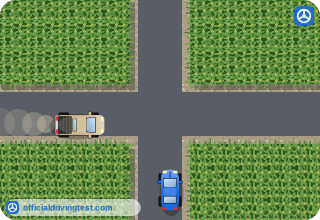
- Slow down and be ready to stop for crossing or oncoming traffic
- Maintain speed, since no sign requires a stop at the intersection
- Speed up to clear the intersection before other traffic arrives
- Honk the horn and proceed without slowing down or stopping
Show answer
Correct answer: Slow down and be ready to stop for crossing or oncoming traffic
When approaching an uncontrolled rural intersection, drivers should slow down and be prepared to stop for crossing or oncoming traffic.
Source: New Hampshire Driver’s Manual (DSMV 360 (Rev. 11/25)), page 18 · Open this page in the manual (Manual page 18)
-
Before turning, which lane position should a driver take?
- The center lane of the road in every case
- The lane closest to the direction they want to go
- The lane with the least traffic
- Whichever lane lets them turn fastest
Show answer
Correct answer: The lane closest to the direction they want to go
Drivers should enter and maintain proper position in the lane that is closest to the direction they want to go.
Source: New Hampshire Driver’s Manual (DSMV 360 (Rev. 11/25)), page 25 · Open this page in the manual (Manual page 25)
-
While making a turn, where should drivers look?
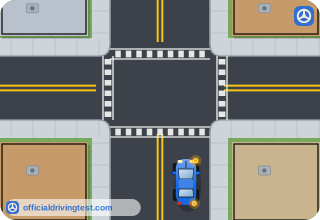
- Through the turn to the farthest point on the intended path
- At the front bumper of the vehicle directly in front of them
- At the curb right beside the vehicle door
- At the turn signal indicator on the dashboard
Show answer
Correct answer: Through the turn to the farthest point on the intended path
Drivers should look through the turn to the farthest point possible along the intended path.
Source: New Hampshire Driver’s Manual (DSMV 360 (Rev. 11/25)), page 25 · Open this page in the manual (Manual page 25)
-
After completing a turn, what should a driver make sure of while accelerating smoothly and checking traffic to the rear?
- That the hazard lights are on
- That the headlights are on high beam
- That the turn signal is cancelled
- That the parking brake is set
Show answer
Correct answer: That the turn signal is cancelled
After the turn the driver should accelerate smoothly, make sure the turn signal is cancelled and check traffic to the rear.
Source: New Hampshire Driver’s Manual (DSMV 360 (Rev. 11/25)), page 25 · Open this page in the manual (Manual page 25)
-
From which part of the lane should drivers always turn right?
- The center of the lane
- The right-most portion of the lane
- Whichever part has the least traffic
- Any part of the lane that is open
Show answer
Correct answer: The right-most portion of the lane
Drivers should always turn right from the right-most portion of the lane.
Source: New Hampshire Driver’s Manual (DSMV 360 (Rev. 11/25)), page 25 · Open this page in the manual (Manual page 25)
-
What should drivers avoid doing before making a right turn?
- Signaling their intention
- Checking traffic to the rear
- Staying in the right-most portion of the lane
- Swinging wide to the left
Show answer
Correct answer: Swinging wide to the left
Drivers should avoid swinging wide to the left before making a right turn.
Source: New Hampshire Driver’s Manual (DSMV 360 (Rev. 11/25)), page 25 · Open this page in the manual (Manual page 25)
-
When making a left turn, what must a driver yield to?
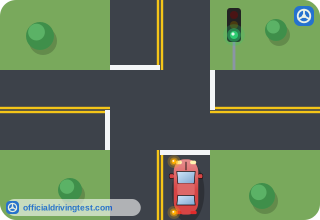
- Traffic behind the vehicle
- Vehicles parked at the curb
- Oncoming traffic
- Only vehicles turning right
Show answer
Correct answer: Oncoming traffic
When making a left turn a driver should yield to oncoming traffic.
Source: New Hampshire Driver’s Manual (DSMV 360 (Rev. 11/25)), page 25 · Open this page in the manual (Manual page 25)
-
From which part of the lane should drivers always turn left?
- The left-most portion of the lane
- Whichever part has the least traffic
- The center of the lane
- Any part of the lane that is open
Show answer
Correct answer: The left-most portion of the lane
Drivers should always turn left from the left-most portion of the lane.
Source: New Hampshire Driver’s Manual (DSMV 360 (Rev. 11/25)), page 25 · Open this page in the manual (Manual page 25)
-
When turning from one of several turning lanes, what should a driver do after entering the lane?
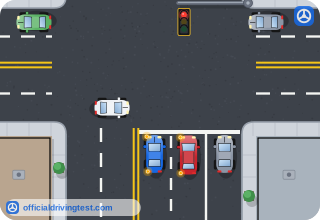
- Change lanes to avoid slower vehicles
- Move to the center of the intersection
- Switch to the nearest open lane after the turn begins
- Stay in that lane until the turn is completed
Show answer
Correct answer: Stay in that lane until the turn is completed
Where several lanes turn, the driver should identify the lane, enter it and stay in it until the turn is completed.
Source: New Hampshire Driver’s Manual (DSMV 360 (Rev. 11/25)), page 25 · Open this page in the manual (Manual page 25)
-
What does the manual say about U-turns?
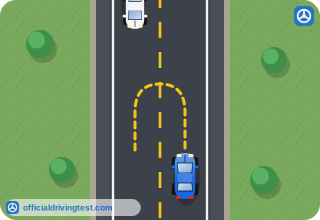
- They can be extremely dangerous and are not legal everywhere
- They are illegal on every roadway in the whole state
- They are legal everywhere as long as the driver signals
- They are completely safe on any two-lane road
Show answer
Correct answer: They can be extremely dangerous and are not legal everywhere
U-turns can be extremely dangerous and are not legal everywhere.
Source: New Hampshire Driver’s Manual (DSMV 360 (Rev. 11/25)), page 25 · Open this page in the manual (Manual page 25)
-
If a driver must reverse direction with a U-turn, what should the driver first check?
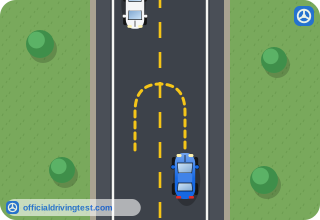
- Whether the road has a painted center line
- Whether the nearest intersection has a traffic signal
- Whether any signs indicate that U-turns are prohibited
- Whether the shoulder is wider than a lane
Show answer
Correct answer: Whether any signs indicate that U-turns are prohibited
Before a U-turn the driver should first check for signs indicating that U-turns are prohibited.
Source: New Hampshire Driver’s Manual (DSMV 360 (Rev. 11/25)), page 25 · Open this page in the manual (Manual page 25)
-
For a U-turn, where does the manual say a driver should pull over, using the turn signal, and wait for the road to be clear?
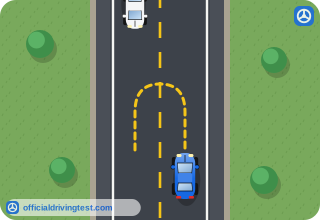
- The left lane next to the center line
- The shoulder of the road on the right
- The nearest driveway on the left
- The middle of the intersection
Show answer
Correct answer: The shoulder of the road on the right
The driver should pull over to the shoulder on the right using the turn signal and wait for the road to be clear of vehicles.
Source: New Hampshire Driver’s Manual (DSMV 360 (Rev. 11/25)), page 26 · Open this page in the manual (Manual page 26)
-
When is a two-point turn used to reverse direction?
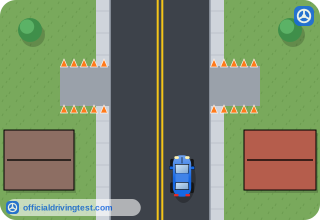
- When the road has four or more lanes
- When the driver wants to turn around on a divided highway
- When police direct traffic at the intersection
- When it is not practical or possible to drive around a block
Show answer
Correct answer: When it is not practical or possible to drive around a block
A two-point turn uses a street, alley or driveway to reverse direction when it is not practical or possible to drive around a block.
Source: New Hampshire Driver’s Manual (DSMV 360 (Rev. 11/25)), page 26 · Open this page in the manual (Manual page 26)
-
In a reverse two-point turn, how far back does the driver move before steering?
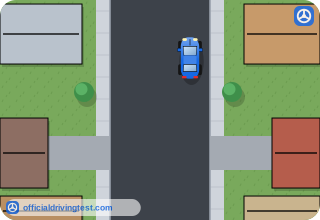
- Until the whole vehicle is inside the driveway
- Until the front bumper clears the curb
- Until the rear bumper reaches the near edge of the driveway
- Until the rear wheels reach the far side of the driveway
Show answer
Correct answer: Until the rear bumper reaches the near edge of the driveway
In a reverse two-point turn the driver moves back until the rear bumper reaches the near edge of the driveway.
Source: New Hampshire Driver’s Manual (DSMV 360 (Rev. 11/25)), page 26 · Open this page in the manual (Manual page 26)
-
In a reverse two-point turn, how should the driver steer while backing slowly into the driveway?
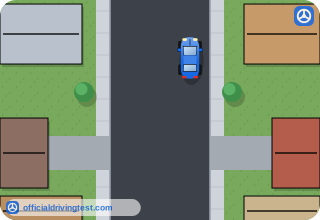
- Rapidly all the way to the right
- Gently toward the left
- Slowly a quarter turn to the right
- Rapidly all the way to the left
Show answer
Correct answer: Rapidly all the way to the right
While backing slowly in a reverse two-point turn the driver steers rapidly all the way to the right.
Source: New Hampshire Driver’s Manual (DSMV 360 (Rev. 11/25)), page 26 · Open this page in the manual (Manual page 26)
-
In a forward two-point turn, where does the driver move before turning into the driveway or alley?
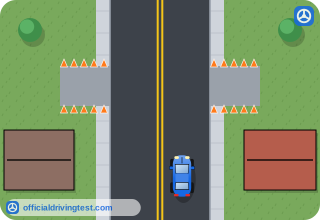
- Close to the right edge of the road
- As far onto the shoulder as possible
- Into the oncoming lane at full speed
- Close to the center of the road
Show answer
Correct answer: Close to the center of the road
In a forward two-point turn the driver moves close to the center of the road and turns into the driveway or alley as near as possible to the right side.
Source: New Hampshire Driver’s Manual (DSMV 360 (Rev. 11/25)), page 26 · Open this page in the manual (Manual page 26)
-
In a forward two-point turn, when does the driver stop after turning into the driveway or alley?
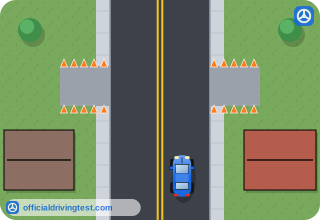
- As the front bumper reaches the end of the driveway
- As the rear of the vehicle clears the curb or driveway edge
- As the vehicle reaches the middle of the road
- As soon as the front wheels leave the road
Show answer
Correct answer: As the rear of the vehicle clears the curb or driveway edge
The driver stops as the rear of the vehicle clears the curb or edge of the driveway.
Source: New Hampshire Driver’s Manual (DSMV 360 (Rev. 11/25)), page 26 · Open this page in the manual (Manual page 26)