New Hampshire: Right-of-way and turning — Part 1 Practice Test
Questions in this part include: “What does the manual say about assuming the right-of-way?” · “Where should a driver not attempt to pass?”
Independent educational site · not affiliated with any government agency or DMV
Ready? Test yourself
- Instant feedback with an explanation
- Every answer cites its source in the manual
- Your best score is saved on this device
- Keyboard: press 1 to 4 to answer and Enter for the next question
Questions are original and based on the official manual "New Hampshire Driver’s Manual" (DSMV 360 (Rev. 11/25)), New Hampshire Division of Motor Vehicles (DMV).
All 18 questions in this practice test
Take the test above first, then use this list to study. Tap “Show answer” to see the correct answer and explanation.
Show the questions and answersHide the questions
-
Under New Hampshire law, when no traffic control device or police officer directs otherwise, which driver yields at an intersection?
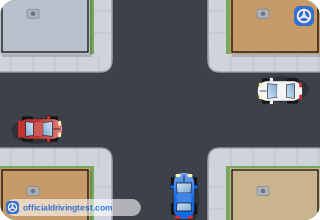
- The driver approaching or entering on the right yields to the vehicle on the left
- The driver in the larger vehicle yields to the smaller vehicle
- The faster driver yields to the slower driver
- The driver approaching or entering on the left yields to the vehicle on the right
Show answer
Correct answer: The driver approaching or entering on the left yields to the vehicle on the right
RSA 265:28 says the driver approaching or entering an intersection on the left must yield to the vehicle on the right, unless a traffic control device or police officer directs otherwise.
Source: New Hampshire Driver’s Manual (DSMV 360 (Rev. 11/25)), page 14 · Open this page in the manual (Manual page 14)
-
A driver intends to turn left within an intersection or into a driveway. Which vehicles must the driver yield to?
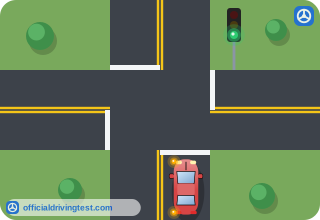
- Oncoming vehicles in the intersection or so close as to be an immediate hazard
- Only vehicles that are stopped and waiting to enter the intersection from a side road
- Vehicles from behind that are travelling in the same direction in the same lane
- None, because a driver turning left always has the right-of-way
Show answer
Correct answer: Oncoming vehicles in the intersection or so close as to be an immediate hazard
RSA 265:29 requires a driver turning left to yield to any vehicle approaching from the opposite direction that is within the intersection or so close as to constitute an immediate hazard.
Source: New Hampshire Driver’s Manual (DSMV 360 (Rev. 11/25)), page 14 · Open this page in the manual (Manual page 14)
-
What does the manual say about assuming the right-of-way?
- A driver on a through road may always assume the right-of-way
- The driver of the larger vehicle may assume the right-of-way
- No one should assume they automatically have the right-of-way
- A driver who is going faster may assume the right-of-way
Show answer
Correct answer: No one should assume they automatically have the right-of-way
Right-of-way rules are only a guide: no one should assume they automatically have the right-of-way, and the situation at the intersection must always be considered.
Source: New Hampshire Driver’s Manual (DSMV 360 (Rev. 11/25)), page 14 · Open this page in the manual (Manual page 14)
-
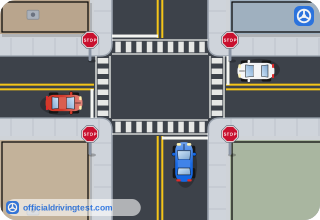
Two drivers arrive at the same time at a four-way intersection controlled by stop signs. Which driver should be given the right-of-way?
- The driver on the left
- The driver on the right
- The driver in the bigger vehicle
- The driver who is going faster
Show answer
Correct answer: The driver on the right
Drivers should yield the right-of-way to the driver on the right at a four-way intersection controlled by stop signs if both drivers arrive at the same time.
Source: New Hampshire Driver’s Manual (DSMV 360 (Rev. 11/25)), page 14 · Open this page in the manual (Manual page 14)
-
According to the manual, drivers should yield the right-of-way to which of these?
- A driver entering a public highway from a private road
- A driver merging from an acceleration ramp onto an interstate highway
- The driver of the largest vehicle at the intersection
- The driver who is at or arrives at the intersection first
Show answer
Correct answer: The driver who is at or arrives at the intersection first
The manual lists the driver who is at or arrives at the intersection first among those who should be given the right-of-way. Drivers entering from private roads and drivers on acceleration ramps yield instead.
Source: New Hampshire Driver’s Manual (DSMV 360 (Rev. 11/25)), page 14 · Open this page in the manual (Manual page 14)
-
A driver is entering a public highway from a driveway or a private road. Who should the driver yield the right-of-way to?
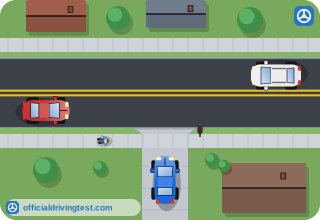
- Drivers on the public highway
- Only pedestrians in the roadway
- Drivers who are also entering the highway behind the driver
- No one, if no sign is posted
Show answer
Correct answer: Drivers on the public highway
Drivers should yield the right-of-way to drivers on a public highway when entering the highway from a driveway or a private road.
Source: New Hampshire Driver’s Manual (DSMV 360 (Rev. 11/25)), page 14 · Open this page in the manual (Manual page 14)
-
Pedestrians, bicyclists and other drivers are still in an intersection when a driver arrives at it. What should the arriving driver do?
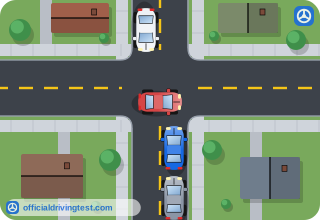
- Proceed if the driver has a green light
- Yield the right-of-way to them
- Proceed if the driver arrived at the intersection first
- Sound the horn and go ahead
Show answer
Correct answer: Yield the right-of-way to them
Drivers should yield the right-of-way to pedestrians, bicyclists and other drivers who are still in the intersection.
Source: New Hampshire Driver’s Manual (DSMV 360 (Rev. 11/25)), page 14 · Open this page in the manual (Manual page 14)
-
What should drivers do about vehicles with their headlights on that are following a hearse in a funeral procession?
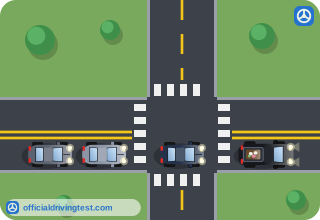
- Pass between them one vehicle at a time
- Merge into the line and follow the hearse
- Sound the horn to ask them to pull over
- Allow them to pass as a group
Show answer
Correct answer: Allow them to pass as a group
Drivers should allow vehicles that have their headlights on while following a hearse to pass as a group.
Source: New Hampshire Driver’s Manual (DSMV 360 (Rev. 11/25)), page 14 · Open this page in the manual (Manual page 14)
-
When should a driver pass another vehicle?
- Whenever the vehicle ahead is travelling slower than the driver wants to go
- Whenever the driver has a clear view of the road ahead of the other vehicle
- Only when signs or road markings permit it and road conditions are favorable
- Whenever the driver is following another vehicle too closely to see ahead
Show answer
Correct answer: Only when signs or road markings permit it and road conditions are favorable
Drivers should only pass when signage or road markings permit it and only when road conditions are favorable.
Source: New Hampshire Driver’s Manual (DSMV 360 (Rev. 11/25)), page 17 · Open this page in the manual (Manual page 17)
-
Where should a driver not attempt to pass?
- In the left-most lane of a multi-lane road
- At intersections
- On a straight road with favorable conditions
- Where signs or road markings permit passing
Show answer
Correct answer: At intersections
Drivers should not attempt to pass when an oncoming vehicle is approaching, when the view is blocked by a curve or a hill, at intersections, or before a highway-railroad crossing or bridge.
Source: New Hampshire Driver’s Manual (DSMV 360 (Rev. 11/25)), page 17 · Open this page in the manual (Manual page 17)
-
In which situation should a driver not attempt to pass?
- On a straight, dry road with no oncoming vehicle in sight
- When signs and road markings permit passing on a clear road
- In the left-most lane of a multi-lane road with no traffic ahead
- When the view is blocked by a curve or a hill
Show answer
Correct answer: When the view is blocked by a curve or a hill
Drivers should not attempt to pass when the view is blocked by a curve or a hill.
Source: New Hampshire Driver’s Manual (DSMV 360 (Rev. 11/25)), page 17 · Open this page in the manual (Manual page 17)
-
Which place should a driver not pass before?
- A highway-railroad crossing or a bridge
- A long, straight, clear stretch of road
- A lane marked for passing
- A multi-lane road with a left-most lane
Show answer
Correct answer: A highway-railroad crossing or a bridge
Drivers should not attempt to pass before a highway-railroad crossing or bridge.
Source: New Hampshire Driver’s Manual (DSMV 360 (Rev. 11/25)), page 17 · Open this page in the manual (Manual page 17)
-
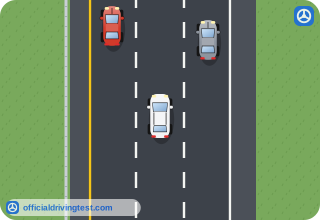
On multi-lane roads, what is the left-most lane intended to be used for?
- Driving at the minimum speed
- Slow-moving vehicles
- Passing slower vehicles
- Entering and exiting traffic
Show answer
Correct answer: Passing slower vehicles
On multi-lane roads, the left-most lane is intended to be used for passing slower vehicles.
Source: New Hampshire Driver’s Manual (DSMV 360 (Rev. 11/25)), page 17 · Open this page in the manual (Manual page 17)
-
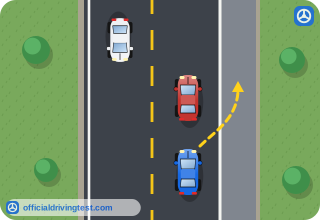
May a driver pass on the shoulder if the shoulder is paved?
- Yes, if the shoulder is paved
- No, never pass on the shoulder, paved or not
- Yes, if no vehicle is following
- Yes, but only when the vehicle ahead is turning left
Show answer
Correct answer: No, never pass on the shoulder, paved or not
Drivers should never pass on the shoulder, whether it is paved or not.
Source: New Hampshire Driver’s Manual (DSMV 360 (Rev. 11/25)), page 17 · Open this page in the manual (Manual page 17)
-
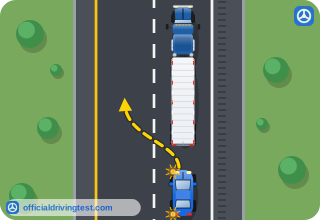
Before passing, what should drivers estimate?
- The speed of every vehicle on the road
- The distance to the next exit
- The weight of the vehicle ahead
- The time and space necessary to pass
Show answer
Correct answer: The time and space necessary to pass
Prior to passing, drivers should estimate the time and space necessary to pass and do so without interfering with any other vehicle.
Source: New Hampshire Driver’s Manual (DSMV 360 (Rev. 11/25)), page 17 · Open this page in the manual (Manual page 17)
-
How long should a driver continue to pass before returning to the lane?
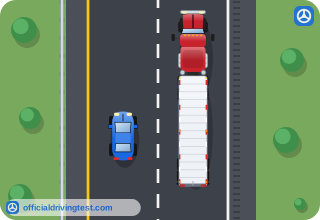
- Until the complete front of the passed vehicle is visible in the rearview mirror
- Until the headlights of the passed vehicle are visible in the left side mirror
- Until the driver has travelled at least one full second ahead of the passed vehicle
- Until the passed vehicle begins to slow down or moves to the shoulder
Show answer
Correct answer: Until the complete front of the passed vehicle is visible in the rearview mirror
A passing driver should continue to pass until the complete front of the passed vehicle is visible in the rearview mirror, then signal and return to the lane.
Source: New Hampshire Driver’s Manual (DSMV 360 (Rev. 11/25)), page 17 · Open this page in the manual (Manual page 17)
-
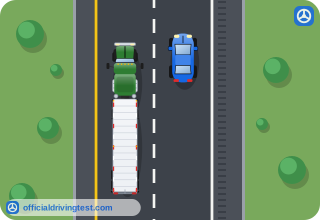
What should a driver do with speed when another driver is passing?
- Speed up briefly to keep the other driver from passing
- Slow down to a stop in the travel lane
- Maintain a constant speed to allow the driver to pass
- Move onto the shoulder and brake to let it pass
Show answer
Correct answer: Maintain a constant speed to allow the driver to pass
When being passed, drivers should stay in their lane and maintain a constant speed to allow the driver to pass, and never increase speed to prevent someone from passing.
Source: New Hampshire Driver’s Manual (DSMV 360 (Rev. 11/25)), page 17 · Open this page in the manual (Manual page 17)
-
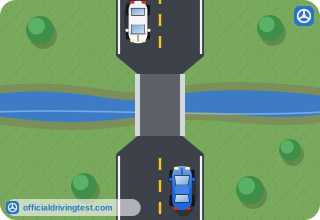
At a narrow or single lane bridge, who generally has the right-of-way?
- The driver of the larger vehicle
- The driver travelling uphill
- The first driver to the bridge
- The driver with the headlights on
Show answer
Correct answer: The first driver to the bridge
Drivers should take turns crossing a narrow or single lane bridge; generally the first driver to the bridge has the right-of-way.
Source: New Hampshire Driver’s Manual (DSMV 360 (Rev. 11/25)), page 18 · Open this page in the manual (Manual page 18)