Nevada: Right-of-way, turning and passing — Part 4 Practice Test
Questions in this part include: “On a two-lane road, where must you not pass because of the marking on the highway?” · “When may you pass on the right?”
Independent educational site · not affiliated with any government agency or DMV
Ready? Test yourself
- Instant feedback with an explanation
- Every answer cites its source in the manual
- Your best score is saved on this device
- Keyboard: press 1 to 4 to answer and Enter for the next question
Questions are original and based on the official manual "Nevada Driver's Handbook" (March 2024 (DMV 700)), Nevada Department of Motor Vehicles.
All 20 questions in this practice test
Take the test above first, then use this list to study. Tap “Show answer” to see the correct answer and explanation.
Show the questions and answersHide the questions
-
On a two-lane road, you must not pass:
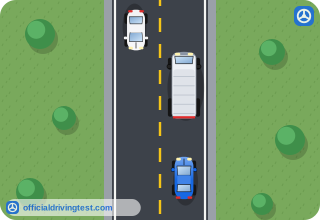
- Where there is a broken yellow line in your lane
- On a straight road with clear view and no oncoming traffic
- Within 50 feet of a driveway
- At or within 100 feet of a railroad crossing
Show answer
Correct answer: At or within 100 feet of a railroad crossing
You must not pass at or within 100 feet of a railroad crossing.
Source: Nevada Driver's Handbook (March 2024 (DMV 700)), page 47 · Open this page in the manual (Manual page 47)
-
On a two-lane road, you must not pass at or within how far of a street crossing?
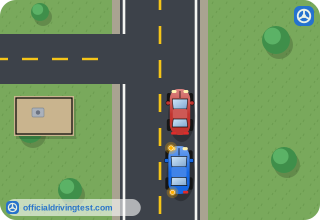
- 100 feet
- 50 feet
- 200 feet
- 300 feet
Show answer
Correct answer: 100 feet
You must not pass at or within 100 feet of a street crossing.
Source: Nevada Driver's Handbook (March 2024 (DMV 700)), page 47 · Open this page in the manual (Manual page 47)
-
On a two-lane road, where must you not pass because of the marking on the highway?
- Where there is a broken yellow line in your lane
- Where there is a broken white line
- Where there is a double solid yellow line
- Where there is a solid white edge line
Show answer
Correct answer: Where there is a double solid yellow line
You must not pass where there is a double solid yellow line on the highway.
Source: Nevada Driver's Handbook (March 2024 (DMV 700)), page 47 · Open this page in the manual (Manual page 47)
-
On a two-lane road, when must you not pass because of the road shape ahead?
- When the road ahead is straight and level for a long way
- When coming to a curve or hilltop where you cannot see far enough ahead
- When you can see clearly ahead and there is no oncoming traffic
- When the vehicle ahead is signaling a right turn
Show answer
Correct answer: When coming to a curve or hilltop where you cannot see far enough ahead
You must not pass when coming to a curve or the top of a hill where you cannot see far enough ahead to be sure it is safe.
Source: Nevada Driver's Handbook (March 2024 (DMV 700)), page 47 · Open this page in the manual (Manual page 47)
-
What should you do when another vehicle comes up behind yours and signals to pass on a two-lane road?
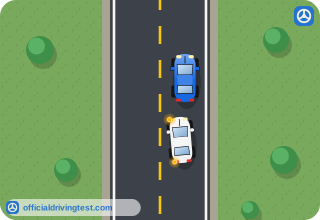
- Speed up to stay ahead of it
- Move onto the left shoulder
- Stay at the same speed in the center of your lane
- Move to the right in your travel lane and let it pass
Show answer
Correct answer: Move to the right in your travel lane and let it pass
When another vehicle signals to pass, move to the right in your travel lane and let it pass, and never speed up.
Source: Nevada Driver's Handbook (March 2024 (DMV 700)), page 47 · Open this page in the manual (Manual page 47)
-
When another vehicle is passing you, what should you never do?
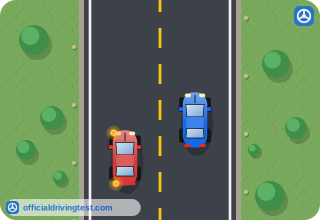
- Speed up
- Move to the right in your lane
- Keep a steady speed
- Check your mirrors
Show answer
Correct answer: Speed up
Never speed up when another vehicle is passing you.
Source: Nevada Driver's Handbook (March 2024 (DMV 700)), page 47 · Open this page in the manual (Manual page 47)
-
On multi-lane streets and highways, when may you pass vehicles traveling in the same direction on the left?
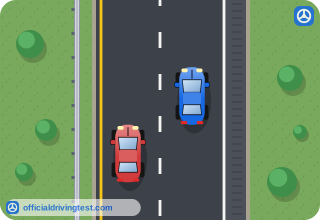
- Whenever the vehicle ahead is slower than the speed limit
- Only when you use the shoulder
- If no signs or markings prohibit it and it can be done safely
- Only on freeways
Show answer
Correct answer: If no signs or markings prohibit it and it can be done safely
You may pass on the left if there are no signs or highway markings that indicate passing is not allowed and it can be done safely.
Source: Nevada Driver's Handbook (March 2024 (DMV 700)), page 47 · Open this page in the manual (Manual page 47)
-
Which driver must you never pass on the left?
- A driver who is driving below the speed limit
- A driver who is making or signaling a left turn
- A driver in the far left lane
- A driver in a business district
Show answer
Correct answer: A driver who is making or signaling a left turn
Never pass to the left of a driver who is making or signaling a left turn.
Source: Nevada Driver's Handbook (March 2024 (DMV 700)), page 47 · Open this page in the manual (Manual page 47)
-
On a highway with two lanes in the same direction, when is it illegal to travel in the far left lane?
- When you are driving within a city or town at a low speed
- When you are preparing for a left turn at an intersection ahead
- When you are overtaking another vehicle in the same direction
- When you drive below the posted limit and a faster vehicle overtakes you
Show answer
Correct answer: When you drive below the posted limit and a faster vehicle overtakes you
It is illegal to travel in the far left lane below the posted speed limit while being overtaken from the rear by a faster vehicle.
Source: Nevada Driver's Handbook (March 2024 (DMV 700)), page 47 · Open this page in the manual (Manual page 47)
-
Which situation is an exception to the far-left-lane rule on highways with two lanes in one direction?
- Preparing for a left turn at an intersection
- Driving on a highway outside a city or town in light traffic
- Driving slowly because you are in no hurry
- Driving a passenger car with no passengers
Show answer
Correct answer: Preparing for a left turn at an intersection
The rule does not apply when preparing for a left turn at an intersection.
Source: Nevada Driver's Handbook (March 2024 (DMV 700)), page 47 · Open this page in the manual (Manual page 47)
-
When may you pass on the right?
- On any road at all when the vehicle ahead is driving slowly
- On a two-lane road with traffic in both directions, if clear
- On a road marked for two or more lanes in your direction, when safe
- Whenever you can use the shoulder to get around a slow vehicle
Show answer
Correct answer: On a road marked for two or more lanes in your direction, when safe
You may pass on the right if the road is clearly marked for two or more lanes in your direction, but only when passing is safe.
Source: Nevada Driver's Handbook (March 2024 (DMV 700)), page 47 · Open this page in the manual (Manual page 47)
-
Why is passing on the right described as very dangerous?
- The right lane is always narrower than the left lane
- The other driver may not see you and change lanes
- Other drivers never signal before changing lanes
- The speed limit is lower on the right side
Show answer
Correct answer: The other driver may not see you and change lanes
Passing on the right is very dangerous if the other driver does not see you and decides to change lanes.
Source: Nevada Driver's Handbook (March 2024 (DMV 700)), page 47 · Open this page in the manual (Manual page 47)
-
When must you never pass on the right?
- When another vehicle is in the left lane
- When the road has two or more lanes in your direction
- When you have signaled and checked your blind spots
- When it would put you off the paved part of the highway
Show answer
Correct answer: When it would put you off the paved part of the highway
Never pass on the right when doing so would result in driving off the paved portion of the highway.
Source: Nevada Driver's Handbook (March 2024 (DMV 700)), page 47 · Open this page in the manual (Manual page 47)
-
When a vehicle with a trailer cannot make a right turn without swinging into another lane, how should the driver complete the turn?
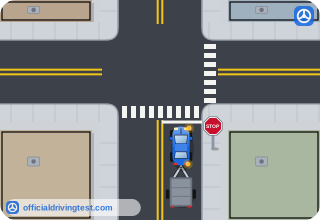
- Turn wide at the start of the turn and keep the trailer away from the curb
- Turn sharply and keep the rear of the trailer near the center line
- Turn wide as you complete the turn and keep the rear of the trailer close to the curb
- Turn as quickly as possible and keep the trailer in the middle
Show answer
Correct answer: Turn wide as you complete the turn and keep the rear of the trailer close to the curb
Turning wide as you complete the turn while keeping the rear of the trailer close to the curb stops other drivers from passing you on the right.
Source: Nevada Driver's Handbook (March 2024 (DMV 700)), page 71 · Open this page in the manual (Manual page 71)
-
Why should you not turn wide to the left as you start a right turn with a trailer?
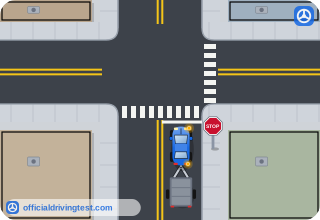
- Oncoming drivers may think you are about to stop and then pull out in front of you
- A following driver may think you are turning left and try to pass you on the right
- The trailer will be pulled up over the curb and the wheels may be damaged
- Pedestrians will not see your turn signal and may step out into your path
Show answer
Correct answer: A following driver may think you are turning left and try to pass you on the right
A following driver may think you are turning left and try to pass you on the right, and you could crash into the other vehicle as you complete the turn.
Source: Nevada Driver's Handbook (March 2024 (DMV 700)), page 71 · Open this page in the manual (Manual page 71)
-
If you must cross into oncoming traffic to make a turn with a trailer, what should you not do for the vehicles coming toward you?
- Give them room to go by
- Stop to let them pass
- Watch out for them
- Back up for them
Show answer
Correct answer: Back up for them
Do not back up for oncoming vehicles because you might hit someone behind you.
Source: Nevada Driver's Handbook (March 2024 (DMV 700)), page 71 · Open this page in the manual (Manual page 71)
-
How should you turn when making a right turn with a trailer, to give yourself and others time to avoid problems?
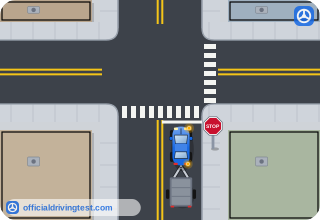
- Slowly
- As fast as possible
- At normal highway speed
- At any speed you like
Show answer
Correct answer: Slowly
Turning slowly gives yourself and others more time to avoid problems.
Source: Nevada Driver's Handbook (March 2024 (DMV 700)), page 71 · Open this page in the manual (Manual page 71)
-
On a left turn with a trailer, when should you start the turn?
- As soon as you enter the intersection
- Before reaching the crosswalk
- After you have reached the center of the intersection
- While you are still short of the intersection
Show answer
Correct answer: After you have reached the center of the intersection
On a left turn make sure you have reached the center of the intersection before you start, or the left side of your vehicle may hit another vehicle due to off-tracking.
Source: Nevada Driver's Handbook (March 2024 (DMV 700)), page 72 · Open this page in the manual (Manual page 72)
-
What is off-tracking?
- When a vehicle stops on a railroad track and gets hung up on it
- When a vehicle or trailer drifts into another lane unintentionally
- When a trailer is hitched without the safety chains being attached
- When a driver turns from the wrong lane on purpose to save time
Show answer
Correct answer: When a vehicle or trailer drifts into another lane unintentionally
Off-tracking is when a vehicle or trailer drifts into another lane unintentionally.
Source: Nevada Driver's Handbook (March 2024 (DMV 700)), page 72 · Open this page in the manual (Manual page 72)
-
If there are two turning lanes for a left turn and you are towing a trailer, which lane should you use?
- The inside lane
- Either lane, starting from the inside
- The left-hand turn lane
- The right-hand turn lane
Show answer
Correct answer: The right-hand turn lane
Always take the right-hand turn lane, and do not start in the inside lane because you may have to swing right to make the turn.
Source: Nevada Driver's Handbook (March 2024 (DMV 700)), page 72 · Open this page in the manual (Manual page 72)