Nevada: Right-of-way, turning and passing — Part 3 Practice Test
Questions in this part include: “In Nevada, where are U-turns generally allowed?” · “What does the handbook say about using a fire station driveway?”
Independent educational site · not affiliated with any government agency or DMV
Ready? Test yourself
- Instant feedback with an explanation
- Every answer cites its source in the manual
- Your best score is saved on this device
- Keyboard: press 1 to 4 to answer and Enter for the next question
Questions are original and based on the official manual "Nevada Driver's Handbook" (March 2024 (DMV 700)), Nevada Department of Motor Vehicles.
All 20 questions in this practice test
Take the test above first, then use this list to study. Tap “Show answer” to see the correct answer and explanation.
Show the questions and answersHide the questions
-
When turning left on a two-way road, which lane should you use to start the turn?
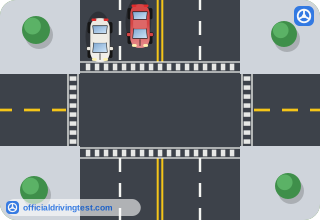
- The lane just to the right of the center line
- The lane at the far right edge of the road
- The center line of the road itself
- Any lane that is clear of other traffic
Show answer
Correct answer: The lane just to the right of the center line
On a two-way road, use the lane just to the right of the center line for a left turn.
Source: Nevada Driver's Handbook (March 2024 (DMV 700)), page 45 · Open this page in the manual (Manual page 45)
-
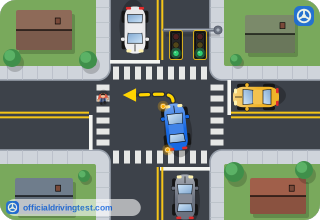
When turning left on a two-way road, into which lane do you complete the turn?
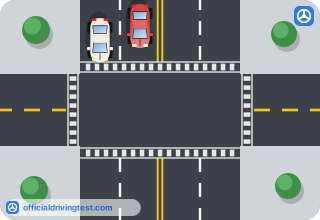
- The lane farthest from you going in your intended direction
- The lane for oncoming traffic
- The traffic lane closest to you going in your intended direction
- The shoulder of the road you are entering
Show answer
Correct answer: The traffic lane closest to you going in your intended direction
You complete the left turn into the traffic lane closest to you going in your intended direction.
Source: Nevada Driver's Handbook (March 2024 (DMV 700)), page 45 · Open this page in the manual (Manual page 45)
-
According to the handbook, what should you do before making your turn?
- Sound your horn
- Look one more time in each direction
- Shift into a lower gear
- Flash your headlights at other drivers
Show answer
Correct answer: Look one more time in each direction
Many crashes are caused by drivers making turns, so look one more time in each direction before turning.
Source: Nevada Driver's Handbook (March 2024 (DMV 700)), page 45 · Open this page in the manual (Manual page 45)
-
In Nevada, where are U-turns generally allowed?
- On any road when they can be made safely
- Only at intersections with traffic signals
- Only on divided highways
- Only on residential streets
Show answer
Correct answer: On any road when they can be made safely
U-turns are generally allowed on any road when they can be made safely.
Source: Nevada Driver's Handbook (March 2024 (DMV 700)), page 46 · Open this page in the manual (Manual page 46)
-
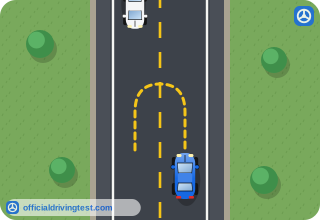
To make a U-turn, which lane should you use after you signal?
- The far right lane
- The shoulder on the right side of the road
- The far left lane or the center left turn lane
- Any lane, as long as the road is a divided highway
Show answer
Correct answer: The far left lane or the center left turn lane
To make a U-turn, signal and use the far left lane or the center left turn lane.
Source: Nevada Driver's Handbook (March 2024 (DMV 700)), page 46 · Open this page in the manual (Manual page 46)
-
You may make a legal U-turn across a double yellow line when:
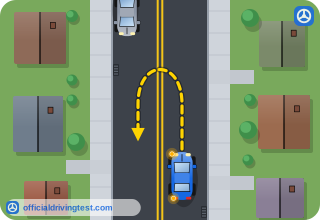
- No other vehicle is within 500 feet
- It is safe and legal
- You are driving in a school zone
- You have signaled at least 300 feet ahead
Show answer
Correct answer: It is safe and legal
A legal U-turn is allowed across a double yellow line when it is safe and legal.
Source: Nevada Driver's Handbook (March 2024 (DMV 700)), page 46 · Open this page in the manual (Manual page 46)
-
A U-turn at an intersection on a green traffic signal light or green arrow is legal unless what?
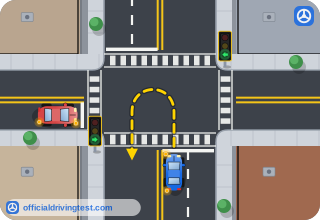
- You are in the left lane of the intersection
- The intersection has a marked crosswalk
- It is during daytime hours
- A "No U-turn" sign is posted
Show answer
Correct answer: A "No U-turn" sign is posted
A U-turn at an intersection on a green light or green arrow is legal unless a "No U-turn" sign is posted.
Source: Nevada Driver's Handbook (March 2024 (DMV 700)), page 46 · Open this page in the manual (Manual page 46)
-
On a divided highway, when may you legally make a U-turn?
- Only if an opening is provided in the center divider
- Anywhere that you can see 200 feet in each direction
- By crossing the dividing curb or strip of land when no traffic is near
- By crossing two sets of double yellow lines
Show answer
Correct answer: Only if an opening is provided in the center divider
On a divided highway a U-turn is legal only if an opening is provided in the center divider.
Source: Nevada Driver's Handbook (March 2024 (DMV 700)), page 46 · Open this page in the manual (Manual page 46)
-
Which is an illegal place to make a U-turn?
- Across a double yellow line when it is safe and legal
- At an intersection on a green arrow with no "No U-turn" sign
- At or on a railroad crossing
- In a residential district protected by a traffic signal
Show answer
Correct answer: At or on a railroad crossing
Never make a U-turn at or on a railroad crossing.
Source: Nevada Driver's Handbook (March 2024 (DMV 700)), page 46 · Open this page in the manual (Manual page 46)
-
You must not make a U-turn where you cannot see clearly in each direction for how far, because of a curve, hill, rain, fog or other reason?
- 100 feet
- 200 feet
- 300 feet
- 400 feet
Show answer
Correct answer: 200 feet
Never make a U-turn where you cannot see clearly 200 feet in each direction.
Source: Nevada Driver's Handbook (March 2024 (DMV 700)), page 46 · Open this page in the manual (Manual page 46)
-
On which type of street must you never make a U-turn?
- A two-way street with a center left turn lane
- A residential street
- A street with a double yellow line
- A one-way street
Show answer
Correct answer: A one-way street
The handbook lists a one-way street as a place where you must never make a U-turn.
Source: Nevada Driver's Handbook (March 2024 (DMV 700)), page 46 · Open this page in the manual (Manual page 46)
-
What does the handbook say about using a fire station driveway?
- Never use it to turn your vehicle around
- It may be used for a U-turn when no fire trucks are present
- It may be used only for a right turn
- It may be used when the fire station is closed
Show answer
Correct answer: Never use it to turn your vehicle around
Never make a U-turn in front of a fire station, and never use a fire station driveway to turn your vehicle around.
Source: Nevada Driver's Handbook (March 2024 (DMV 700)), page 46 · Open this page in the manual (Manual page 46)
-
In a business district, where should you turn your vehicle around?
- Anywhere on the block when no vehicles are close by
- Only by backing into a driveway on the same side
- Only at an intersection, or where openings are provided
- Anywhere there is a double yellow line to cross
Show answer
Correct answer: Only at an intersection, or where openings are provided
U-turns are illegal in business districts; turn only at an intersection, unless a sign prohibits it, or where openings are provided.
Source: Nevada Driver's Handbook (March 2024 (DMV 700)), page 46 · Open this page in the manual (Manual page 46)
-
Which areas does the handbook say are also considered to be business districts?
- Areas with single-family homes only along the road
- Areas with churches, apartments and public buildings
- Areas next to a railroad crossing or fire station
- Areas that have a school zone nearby
Show answer
Correct answer: Areas with churches, apartments and public buildings
Areas with churches, apartments, multifamily housing units, and public buildings are also considered to be business districts.
Source: Nevada Driver's Handbook (March 2024 (DMV 700)), page 46 · Open this page in the manual (Manual page 46)
-
Near a grade, you must not make a U-turn if there is less than how much visibility in both directions?
- 100 feet
- 50 feet
- 300 feet
- 500 feet
Show answer
Correct answer: 500 feet
Never make a U-turn near a grade where there is less than 500 feet of visibility in both directions.
Source: Nevada Driver's Handbook (March 2024 (DMV 700)), page 46 · Open this page in the manual (Manual page 46)
-
Who may prohibit U-turns at any location within their jurisdictions?
- Local authorities and the Nevada Department of Transportation
- Only the Nevada Highway Patrol and the insurance companies
- Only the driver's insurance company
- No one, because U-turns are allowed on any road
Show answer
Correct answer: Local authorities and the Nevada Department of Transportation
Local authorities and the Nevada Department of Transportation may prohibit U-turns at any location within their jurisdictions.
Source: Nevada Driver's Handbook (March 2024 (DMV 700)), page 46 · Open this page in the manual (Manual page 46)
-
What does the handbook say about speed when passing another vehicle?
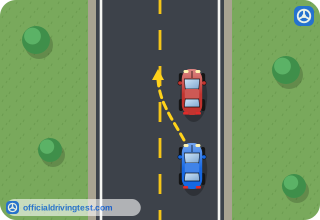
- You may exceed the speed limit by up to 10 mph
- You may exceed the speed limit when the other driver is slow
- You should never exceed the speed limit to pass
- You should speed up as soon as you begin to pass
Show answer
Correct answer: You should never exceed the speed limit to pass
You should never exceed the speed limit to pass.
Source: Nevada Driver's Handbook (March 2024 (DMV 700)), page 47 · Open this page in the manual (Manual page 47)
-
May you use the shoulder of the road to pass another vehicle?
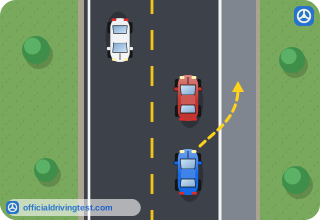
- Yes, if the vehicle ahead is moving slowly
- No, you may never use the shoulder to pass
- Yes, if you signal first
- Yes, if the shoulder is paved
Show answer
Correct answer: No, you may never use the shoulder to pass
You may never use the shoulder of the road to pass.
Source: Nevada Driver's Handbook (March 2024 (DMV 700)), page 47 · Open this page in the manual (Manual page 47)
-
On a two-lane road with traffic in opposite directions, which line marking is one of the conditions for passing on the left?
- A double solid yellow line
- A solid yellow line on your side of the road
- A solid white line on the right edge
- A broken yellow line on the highway or in your lane
Show answer
Correct answer: A broken yellow line on the highway or in your lane
You may pass on the left only when you can see clearly ahead, there is a broken yellow line on the highway or in your lane, and it is safe.
Source: Nevada Driver's Handbook (March 2024 (DMV 700)), page 47 · Open this page in the manual (Manual page 47)
-
After you pass a vehicle on a two-lane road, when should you pull back into your lane?
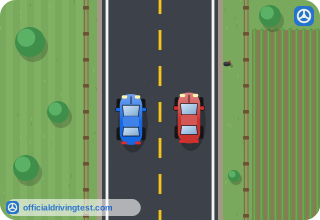
- As soon as your front bumper is even with the other vehicle
- When you can see the vehicle you passed in your rear-view mirror
- After you have driven 300 feet beyond it
- When the other driver signals you back in
Show answer
Correct answer: When you can see the vehicle you passed in your rear-view mirror
After passing, pull back into your lane when you can see the vehicle you passed in your rear-view mirror.
Source: Nevada Driver's Handbook (March 2024 (DMV 700)), page 47 · Open this page in the manual (Manual page 47)