Nevada: Right-of-way, turning and passing — Part 1 Practice Test
Questions in this part include: “When may a driver make a left turn at a red light?” · “Which of these do right-of-way rules emphasize, according to the handbook?”
Independent educational site · not affiliated with any government agency or DMV
Ready? Test yourself
- Instant feedback with an explanation
- Every answer cites its source in the manual
- Your best score is saved on this device
- Keyboard: press 1 to 4 to answer and Enter for the next question
Questions are original and based on the official manual "Nevada Driver's Handbook" (March 2024 (DMV 700)), Nevada Department of Motor Vehicles.
All 20 questions in this practice test
Take the test above first, then use this list to study. Tap “Show answer” to see the correct answer and explanation.
Show the questions and answersHide the questions
-
Before moving forward from a stop sign, to whom must you give right-of-way?
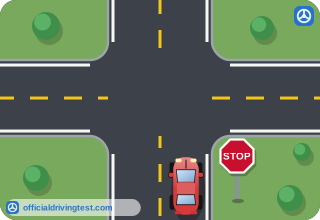
- Only vehicles approaching from the left
- Pedestrians and any cross traffic
- Only large trucks and buses
- Only vehicles on your right
Show answer
Correct answer: Pedestrians and any cross traffic
Stop signs mean you must give right-of-way to pedestrians and to any cross traffic before moving forward.
Source: Nevada Driver's Handbook (March 2024 (DMV 700)), page 29 · Open this page in the manual (Manual page 29)
-
At a four-way stop, who should go first?
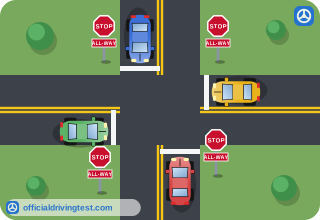
- The largest vehicle at the intersection
- The vehicle on the left, no matter who arrived first
- The vehicle with the heavier load or the faster speed
- Vehicles that reach the intersection before you
Show answer
Correct answer: Vehicles that reach the intersection before you
At a four-way stop, allow vehicles that reach the intersection before you to go first.
Source: Nevada Driver's Handbook (March 2024 (DMV 700)), page 29 · Open this page in the manual (Manual page 29)
-
How do yield signs differ from stop signs?
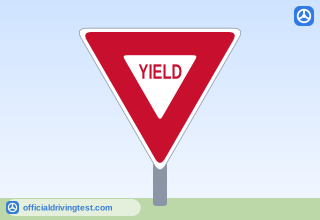
- You may proceed without coming to a full stop if it is safe to do so
- You must stop only when the intersection has a crosswalk
- You never have to give the right-of-way to pedestrians or cross traffic
- You must stop for pedestrians but never for other vehicles
Show answer
Correct answer: You may proceed without coming to a full stop if it is safe to do so
Yield signs mean the same as stop signs except you may proceed without coming to a full stop if it is safe to do so.
Source: Nevada Driver's Handbook (March 2024 (DMV 700)), page 29 · Open this page in the manual (Manual page 29)
-
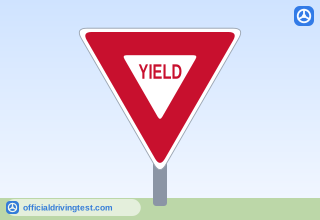
What must you do as you approach an intersection with a yield sign?
- Always come to a full stop
- Speed up to clear it
- Slow down
- Sound the horn
Show answer
Correct answer: Slow down
At a yield sign you must slow down upon approaching the intersection.
Source: Nevada Driver's Handbook (March 2024 (DMV 700)), page 29 · Open this page in the manual (Manual page 29)
-
At a yield sign, you must yield the right-of-way to vehicles that are doing what?
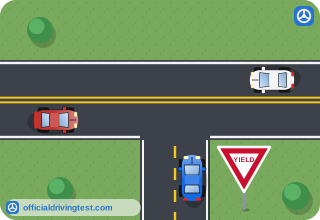
- Parked at the curb on your right
- Waiting to turn behind you
- Passing you on the left
- Making a U-turn from an intersection
Show answer
Correct answer: Making a U-turn from an intersection
At a yield sign you must yield the right-of-way to vehicles making a U-turn from an intersection.
Source: Nevada Driver's Handbook (March 2024 (DMV 700)), page 29 · Open this page in the manual (Manual page 29)
-
Before entering an intersection with a yield sign, in which directions must you check for cross traffic?
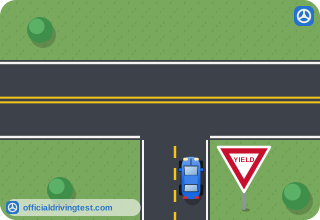
- Only to the left
- In all directions
- Only to the right
- Only straight ahead
Show answer
Correct answer: In all directions
At a yield sign, check in all directions for cross traffic before entering the intersection to avoid a collision.
Source: Nevada Driver's Handbook (March 2024 (DMV 700)), page 29 · Open this page in the manual (Manual page 29)
-
When may a driver turn right on a red light?
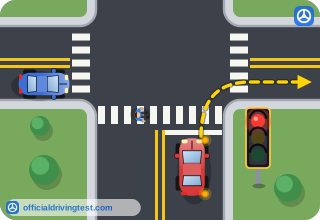
- After coming to a complete stop, where signs do not prohibit it
- Only when no other vehicle is visible, even without stopping
- Only when a police officer directs traffic at the intersection
- Never, unless a green arrow is lit with the red light
Show answer
Correct answer: After coming to a complete stop, where signs do not prohibit it
Where signs do not prohibit it, a right turn may be made on a red light after coming to a complete stop.
Source: Nevada Driver's Handbook (March 2024 (DMV 700)), page 30 · Open this page in the manual (Manual page 30)
-
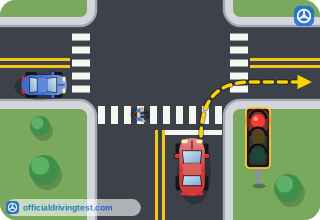
After stopping for a red light and before turning right, what should a driver do?
- Honk the horn, then turn when the cross traffic is slowing
- Wait for the light to turn yellow, then turn right at once
- Signal, then turn when motor and pedestrian traffic is clear
- Turn at once, since pedestrians must yield to turning vehicles
Show answer
Correct answer: Signal, then turn when motor and pedestrian traffic is clear
The driver signals for the right turn and turns only when motor and pedestrian traffic is clear and it is safe to proceed.
Source: Nevada Driver's Handbook (March 2024 (DMV 700)), page 30 · Open this page in the manual (Manual page 30)
-
When may a driver make a left turn at a red light?
- When turning from a two-way street onto another two-way street and no traffic is visible
- When turning from a two-way street onto a one-way street with traffic moving to the left
- When turning from a one-way street onto another one-way street with traffic moving to the left
- When turning from any street if no police officer is present and no pedestrians are crossing
Show answer
Correct answer: When turning from a one-way street onto another one-way street with traffic moving to the left
A left turn at a red light is allowed only from a one-way street onto another one-way street that has traffic moving to the left.
Source: Nevada Driver's Handbook (March 2024 (DMV 700)), page 30 · Open this page in the manual (Manual page 30)
-
Where a left turn on red is allowed, what must the driver do?
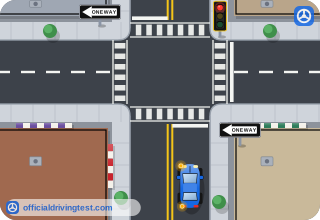
- Signal, slow down, and yield only to pedestrians in the crosswalk
- Signal, stop completely, and yield to pedestrians and all other traffic
- Stop completely, then proceed first, since cross traffic must yield
- Slow down and proceed without signaling, since the road is one-way
Show answer
Correct answer: Signal, stop completely, and yield to pedestrians and all other traffic
Drivers must signal, come to a complete stop, and yield right-of-way to pedestrians and all other traffic moving as directed by the signal.
Source: Nevada Driver's Handbook (March 2024 (DMV 700)), page 30 · Open this page in the manual (Manual page 30)
-
When are turns on a red light not allowed?
- When the intersection has more than two lanes in each direction
- When it is dark outside and no pedestrians are in sight
- When another vehicle is waiting close behind your vehicle
- When a sign, arrow signal or police officer directs drivers not to turn
Show answer
Correct answer: When a sign, arrow signal or police officer directs drivers not to turn
Drivers may make these turns unless a sign, arrow signal or police officer directs them not to turn.
Source: Nevada Driver's Handbook (March 2024 (DMV 700)), page 30 · Open this page in the manual (Manual page 30)
-
In a school zone, when does Nevada law allow a driver to make a U-turn?
- When the driver signals and checks the mirrors
- Only when school is in session and a crossing guard waves the driver on
- When driving below 10 mph in the school zone
- When there are no children present
Show answer
Correct answer: When there are no children present
Nevada law prohibits U-turns in a school zone except when there are no children present, on days with no school, outside the school-day period, or when the signs or lights say the zone is not in effect.
Source: Nevada Driver's Handbook (March 2024 (DMV 700)), page 33 · Open this page in the manual (Manual page 33)
-
On a school day, a U-turn in a school zone is allowed starting when?
- Half an hour after school ends
- Immediately after school ends
- One hour after school ends
- Fifteen minutes after school ends
Show answer
Correct answer: Half an hour after school ends
On school days a U-turn in a school zone is allowed from half an hour after school ends until a half hour before the next school session begins.
Source: Nevada Driver's Handbook (March 2024 (DMV 700)), page 33 · Open this page in the manual (Manual page 33)
-
According to the handbook, what is the leading cause of crashes in Nevada?
- Failure to yield the right-of-way
- Driving too slowly in the left lane
- Following another vehicle too closely
- Driving without headlights at night
Show answer
Correct answer: Failure to yield the right-of-way
The handbook names failure to yield the right-of-way as the leading cause of crashes in Nevada.
Source: Nevada Driver's Handbook (March 2024 (DMV 700)), page 34 · Open this page in the manual (Manual page 34)
-
Which of these do right-of-way rules emphasize, according to the handbook?
- Vehicle size, driver age, and speed
- Priority, position, and power
- Courtesy, common sense, and cooperation
- Caution, patience, and silence
Show answer
Correct answer: Courtesy, common sense, and cooperation
Right-of-way rules help traffic move smoothly through intersections and emphasize courtesy, common sense, and cooperation.
Source: Nevada Driver's Handbook (March 2024 (DMV 700)), page 34 · Open this page in the manual (Manual page 34)
-
Generally, what does right-of-way mean?
- The right to drive faster than other vehicles
- The right of one vehicle to go before another one
- The right to use any lane on a road
- The right to park in front of any building
Show answer
Correct answer: The right of one vehicle to go before another one
Generally, right-of-way means the right of one vehicle to go before another one, and the term also applies to pedestrians and bicycle riders.
Source: Nevada Driver's Handbook (March 2024 (DMV 700)), page 34 · Open this page in the manual (Manual page 34)
-
What does Nevada law say about the right-of-way?
- It always gives the right-of-way to the larger of two vehicles
- It always gives the right-of-way to the vehicle on the left
- It gives the right-of-way to whichever driver is traveling faster
- It does not give anyone the right-of-way; it only says who must yield
Show answer
Correct answer: It does not give anyone the right-of-way; it only says who must yield
Nevada law does not give anyone the right-of-way; it only says who must yield.
Source: Nevada Driver's Handbook (March 2024 (DMV 700)), page 34 · Open this page in the manual (Manual page 34)
-
If you legally have the right-of-way, what must you still do?
- Do everything possible to avoid a crash
- Keep your speed so traffic keeps moving
- Sound your horn to warn other drivers
- Nothing, since the other drivers must yield
Show answer
Correct answer: Do everything possible to avoid a crash
Even when you may legally have the right-of-way, you must do everything possible to avoid a crash.
Source: Nevada Driver's Handbook (March 2024 (DMV 700)), page 34 · Open this page in the manual (Manual page 34)
-
At an intersection with no traffic signs or signals, which vehicle should usually go first?
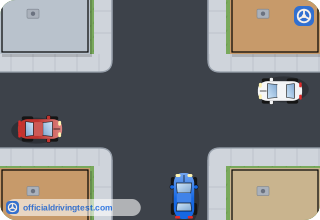
- The vehicle on your left
- The larger of the two vehicles
- The vehicle on your right
- The vehicle traveling faster
Show answer
Correct answer: The vehicle on your right
Where there are no signs or signals, the vehicle on your right should usually go first.
Source: Nevada Driver's Handbook (March 2024 (DMV 700)), page 34 · Open this page in the manual (Manual page 34)
-
A vehicle is already in an intersection while other vehicles are just getting there. Which has the right-of-way?
- The larger vehicle
- The vehicle already in the intersection
- The vehicle that is traveling faster
- The vehicle that is just getting there
Show answer
Correct answer: The vehicle already in the intersection
A vehicle already in the intersection has the right-of-way over others just getting there.
Source: Nevada Driver's Handbook (March 2024 (DMV 700)), page 34 · Open this page in the manual (Manual page 34)