Nevada: Right-of-way, turning and passing — Part 2 Practice Test
Questions in this part include: “At least how far ahead should you signal your turn on city streets?” · “When turning right, which lane must you be in?”
Independent educational site · not affiliated with any government agency or DMV
Ready? Test yourself
- Instant feedback with an explanation
- Every answer cites its source in the manual
- Your best score is saved on this device
- Keyboard: press 1 to 4 to answer and Enter for the next question
Questions are original and based on the official manual "Nevada Driver's Handbook" (March 2024 (DMV 700)), Nevada Department of Motor Vehicles.
All 20 questions in this practice test
Take the test above first, then use this list to study. Tap “Show answer” to see the correct answer and explanation.
Show the questions and answersHide the questions
-
A vehicle going straight ahead is already in the intersection, and another driver wants to turn left. Which driver goes first?
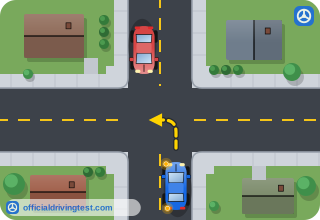
- The driver turning left
- The driver with the larger vehicle
- Whichever driver signals first
- The driver going straight ahead
Show answer
Correct answer: The driver going straight ahead
A vehicle going straight ahead that is already in the intersection has the right-of-way over one turning left. After yielding, the left-turning vehicle then has the right-of-way.
Source: Nevada Driver's Handbook (March 2024 (DMV 700)), page 34 · Open this page in the manual (Manual page 34)
-
What must you do when entering a main road from a minor road, private road or driveway?
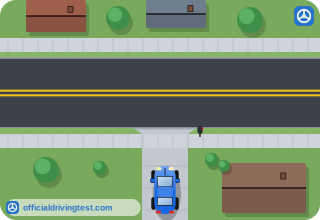
- Yield the right-of-way to all traffic on the main road and to pedestrians
- Yield only to traffic that is approaching from your left side
- Yield only to vehicles that are larger than your own vehicle
- Proceed first if you are the first to signal your intention to enter
Show answer
Correct answer: Yield the right-of-way to all traffic on the main road and to pedestrians
Vehicles entering a main road from a minor road, private road or driveway must yield the right-of-way to all traffic on the main road and to pedestrians.
Source: Nevada Driver's Handbook (March 2024 (DMV 700)), page 34 · Open this page in the manual (Manual page 34)
-
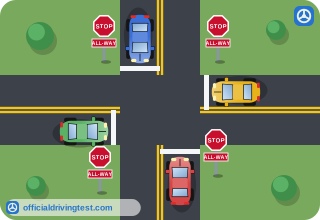
At a four-way stop, who goes first?
- The driver who is traveling at the highest speed when arriving
- The driver who reaches the intersection first, after stopping completely
- The driver of the largest vehicle at the intersection
- The driver who signals first, after stopping completely
Show answer
Correct answer: The driver who reaches the intersection first, after stopping completely
At a four-way stop, the driver reaching the intersection first gets to go first, after stopping completely.
Source: Nevada Driver's Handbook (March 2024 (DMV 700)), page 34 · Open this page in the manual (Manual page 34)
-
A bicyclist is riding on a bike path or lane. Who must yield the right-of-way?
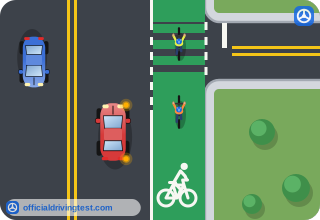
- You must yield to the bicyclist
- The bicyclist must yield to you
- Neither, because bicyclists have no right-of-way
- Whichever of you is moving more slowly
Show answer
Correct answer: You must yield to the bicyclist
The handbook says to yield right-of-way to bicyclists riding on a bike path or lane.
Source: Nevada Driver's Handbook (March 2024 (DMV 700)), page 34 · Open this page in the manual (Manual page 34)
-
How should you act when you meet a funeral procession?
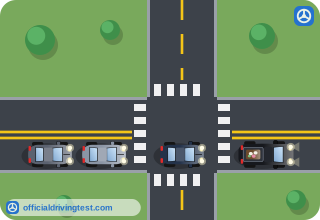
- Pass the procession as quickly as you can, before it grows longer
- Join the line of vehicles with your headlights on to keep it together
- Yield and let the vehicles with their headlights on pass as a group
- Yield only to the first vehicle in the line, then continue through
Show answer
Correct answer: Yield and let the vehicles with their headlights on pass as a group
You must yield to funeral processions and let the vehicles with headlights on pass as a group.
Source: Nevada Driver's Handbook (March 2024 (DMV 700)), page 34 · Open this page in the manual (Manual page 34)
-
What should you do just before entering an intersection?
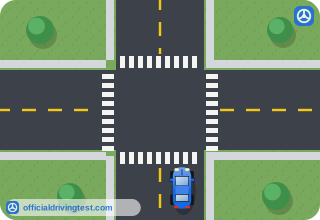
- Look right, left, and right again
- Look left, right, and left again
- Look straight ahead and honk
- Look left and right once, then speed up
Show answer
Correct answer: Look left, right, and left again
When approaching an intersection, you should look left, right, and left again just before entering it.
Source: Nevada Driver's Handbook (March 2024 (DMV 700)), page 42 · Open this page in the manual (Manual page 42)
-
At a roundabout, which traffic must yield the right-of-way?
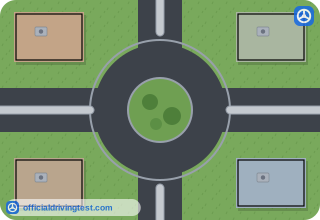
- Traffic entering the roundabout, to traffic already circulating in it
- Traffic already circulating in the roundabout, to traffic entering it
- Traffic on the left, to traffic on the right
- The smaller vehicle, to the larger vehicle
Show answer
Correct answer: Traffic entering the roundabout, to traffic already circulating in it
Entering traffic must yield to the traffic circulating within the roundabout, which has the right-of-way.
Source: Nevada Driver's Handbook (March 2024 (DMV 700)), page 44 · Open this page in the manual (Manual page 44)
-
In which direction does all traffic move around a roundabout?
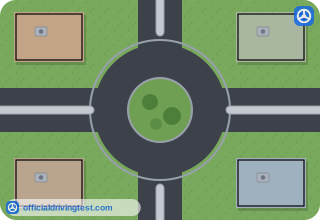
- Clockwise
- Whichever direction is shorter to your exit
- Counterclockwise
- Clockwise in the right lane and counterclockwise in the left lane
Show answer
Correct answer: Counterclockwise
All traffic in a roundabout moves in one direction, counterclockwise.
Source: Nevada Driver's Handbook (March 2024 (DMV 700)), page 44 · Open this page in the manual (Manual page 44)
-
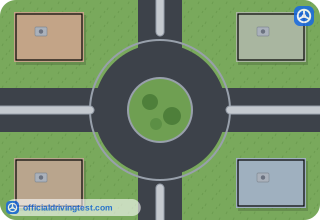
What is a roundabout meant to do?
- Slow every vehicle to a full stop before entering the intersection
- Control right-of-way and move traffic through without signals
- Replace stop signs on two-lane rural roads only
- Give trucks a separate place to park near an intersection
Show answer
Correct answer: Control right-of-way and move traffic through without signals
A roundabout is a traffic management tool that controls right-of-way and moves traffic through an intersection without the aid of traffic signals.
Source: Nevada Driver's Handbook (March 2024 (DMV 700)), page 44 · Open this page in the manual (Manual page 44)
-
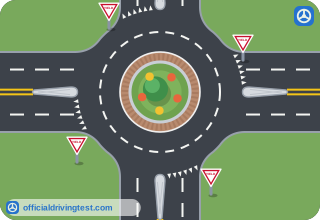
When approaching a roundabout, which lane may you use to complete a U-turn?
- The right lane
- Either lane, whichever has less traffic
- The truck apron
- The left lane
Show answer
Correct answer: The left lane
The left lane is used to turn left, complete a U-turn, or go straight; the right lane is for turning right or going straight.
Source: Nevada Driver's Handbook (March 2024 (DMV 700)), page 44 · Open this page in the manual (Manual page 44)
-
When approaching a roundabout, which movement is the right lane used for?
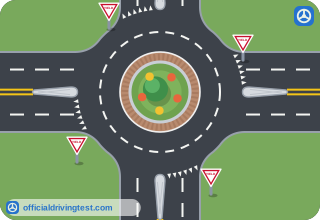
- Turning right
- Turning left
- Completing a U-turn
- Stopping to let circulating traffic pass
Show answer
Correct answer: Turning right
The right lane is used to turn right or to go straight.
Source: Nevada Driver's Handbook (March 2024 (DMV 700)), page 44 · Open this page in the manual (Manual page 44)
-
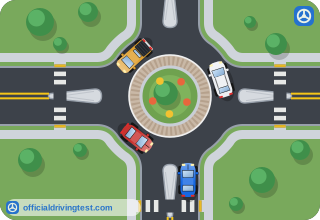
What should you do as you drive into a roundabout where other vehicles are already circulating?
- Speed up to merge ahead of the circulating traffic
- Stop inside the circle until the other vehicles have left
- Decrease your speed to match the circulating traffic
- Stay in your lane and keep your entry speed
Show answer
Correct answer: Decrease your speed to match the circulating traffic
The handbook says to decrease your speed to travel with the traffic already in the roundabout.
Source: Nevada Driver's Handbook (March 2024 (DMV 700)), page 44 · Open this page in the manual (Manual page 44)
-
At least how far ahead should you signal your turn on city streets?
- 50 feet (about 5 car lengths)
- 200 feet (about 20 car lengths)
- 300 feet (about 30 car lengths)
- 100 feet (about 10 car lengths)
Show answer
Correct answer: 100 feet (about 10 car lengths)
The handbook says to signal your turn at least 100 feet ahead on city streets.
Source: Nevada Driver's Handbook (March 2024 (DMV 700)), page 45 · Open this page in the manual (Manual page 45)
-
At least how far ahead should you signal your turn on open highways?
- 300 feet (30 car lengths)
- 100 feet (10 car lengths)
- 200 feet (20 car lengths)
- 500 feet (50 car lengths)
Show answer
Correct answer: 300 feet (30 car lengths)
On open highways the handbook says to signal your turn at least 300 feet (30 car lengths) ahead.
Source: Nevada Driver's Handbook (March 2024 (DMV 700)), page 45 · Open this page in the manual (Manual page 45)
-
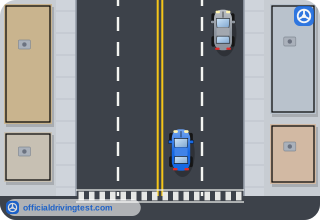
After you steer through a turn, what should you do?
- Stop and check the intersection again
- Accelerate to the speed of traffic
- Stay at the slower turning speed for the rest of the block
- Change lanes right away
Show answer
Correct answer: Accelerate to the speed of traffic
Drivers making safe and legal turns steer through the turn and accelerate to the speed of traffic.
Source: Nevada Driver's Handbook (March 2024 (DMV 700)), page 45 · Open this page in the manual (Manual page 45)
-
When turning right, which lane must you be in?
- Any lane, as long as you signal
- The lane just to the right of the center line
- The lane closest to the center of the roadway
- The extreme right-hand lane or a right-turn lane
Show answer
Correct answer: The extreme right-hand lane or a right-turn lane
When turning right you must be in the extreme right-hand travel lane or a lane designated for right turns.
Source: Nevada Driver's Handbook (March 2024 (DMV 700)), page 45 · Open this page in the manual (Manual page 45)
-
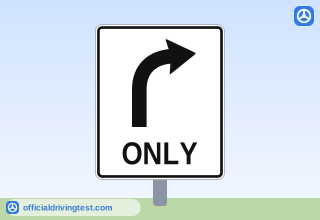
When turning right, a single lane is provided to be used only for turning. When may you enter this lane?
- Only if you are making a right turn
- Whenever the other lanes are crowded
- If you plan to go straight through the intersection
- If you signal at least 300 feet ahead
Show answer
Correct answer: Only if you are making a right turn
You may only enter a turn-only lane if you are making a right turn, and may not travel through an intersection while in the right-turn lane.
Source: Nevada Driver's Handbook (March 2024 (DMV 700)), page 45 · Open this page in the manual (Manual page 45)
-
Into which lane should you turn when making a right turn onto the roadway you are entering?
- The lane nearest the center line of that roadway
- Whichever lane happens to be empty
- The right-hand lane of that roadway or the designated lane
- The left-hand lane, to be ready for the next turn
Show answer
Correct answer: The right-hand lane of that roadway or the designated lane
You turn into the right-hand lane of the roadway you are entering or the lane designated for the turn.
Source: Nevada Driver's Handbook (March 2024 (DMV 700)), page 45 · Open this page in the manual (Manual page 45)
-
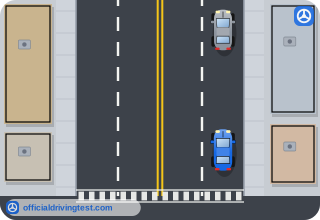
After a right turn, if you then need to change lanes, when should you do it?
- Immediately, while still inside the intersection
- When you are well away from the intersection
- Before you complete the turn
- Only after you have stopped on the shoulder
Show answer
Correct answer: When you are well away from the intersection
After the turn, signal and proceed carefully to the next lane when you are well away from the intersection.
Source: Nevada Driver's Handbook (March 2024 (DMV 700)), page 45 · Open this page in the manual (Manual page 45)
-
When turning left, where should your wheels point until you begin to actually complete the turn?
- Toward the left
- Toward the center line
- Toward the lane you plan to enter
- Straight ahead
Show answer
Correct answer: Straight ahead
When turning left, you keep your wheels pointed straight ahead until you begin to actually complete the turn.
Source: Nevada Driver's Handbook (March 2024 (DMV 700)), page 45 · Open this page in the manual (Manual page 45)