Minnesota: Right-of-way and turning
Who yields at intersections and stop signs, turns and turn lanes, turning on red, roundabouts, J-turns, U-turns, passing and crossing divided highways. Split into 5 shorter tests so you're not stuck in one long quiz.
Independent educational site · not affiliated with any government agency or DMV
Choose a part
Right-of-way and turning — Part 1
Questions in this part include: “On a wide road, the rule that you must drive on the right side does not apply when the road has how many marked lanes?”
StartRight-of-way and turning — Part 2
Questions in this part include: “Under certain situations, from which kind of street can you make a left turn while the traffic light is red?”
StartRight-of-way and turning — Part 3
Questions in this part include: “What is the area in the middle of a roundabout called?”
StartRight-of-way and turning — Part 4
Questions in this part include: “What does the manual say about making U-turns on interstate freeways?”
StartRight-of-way and turning — Part 5
Questions in this part include: “How does a funeral procession identify itself so that you must yield to the entire procession?”
StartAll 81 Right-of-way and turning questions with answers
Choose a part above to take a practice test, or study every question and answer here.
Show the questions and answersHide the questions
-
On a wide road, the rule that you must drive on the right side does not apply when the road has how many marked lanes?
- Three
- Two
- Four
- Five
Show answer
Correct answer: Three
The manual lists a road with three marked lanes as an exception to driving on the right side of a wide road.
Source: Minnesota Driver’s Manual (June 2026), page 26
-
On a wide road, which of these lets you drive on the left side of the road?
- The right side of the road has heavy traffic and you want to keep moving
- The right lane has a wet surface and you want to avoid it
- The right side of the road is closed for construction or repair
- You are driving a wider vehicle than most traffic on the road
Show answer
Correct answer: The right side of the road is closed for construction or repair
A right side that is closed for construction or repair is one of the exceptions to driving on the right side of a wide road.
Source: Minnesota Driver’s Manual (June 2026), page 26
-
In accordance with the Move Over Law, when may you leave the right side of a wide road?
- When you need to move over for a pedestrian waiting beside the road
- When you need to move over for an authorized vehicle parked or stopped on the road
- When you need to move over for a vehicle that has signaled a right turn
- When you need to move over for a mailbox on the side of the road
Show answer
Correct answer: When you need to move over for an authorized vehicle parked or stopped on the road
Moving over for an authorized vehicle parked or stopped on the road under the Move Over Law is an exception to driving on the right side of a wide road.
Source: Minnesota Driver’s Manual (June 2026), page 26
-
On a wide road, which sign-based situation lets you drive on the left side of the road?
- Signs indicate a speed limit of 55 mph
- Signs indicate a school zone ahead
- Signs indicate a railroad crossing ahead
- Signs indicate that the road is one-way
Show answer
Correct answer: Signs indicate that the road is one-way
When signs indicate the road is one-way, you do not have to keep to the right side of a wide road.
Source: Minnesota Driver’s Manual (June 2026), page 26
-
On a wide road, which of these allows you to drive on the left side of the road?
- You are following another vehicle going in the same direction
- You are meeting another vehicle coming toward you
- You are passing another vehicle going in the same direction
- You are preparing to turn right at the next corner
Show answer
Correct answer: You are passing another vehicle going in the same direction
Passing another vehicle going in the same direction is one of the exceptions to driving on the right side of a wide road.
Source: Minnesota Driver’s Manual (June 2026), page 26
-
What happens if you approach an intersection at an unlawful speed?
- You keep the right-of-way but are given a fine
- Your right-of-way is shared equally with the other drivers at the intersection
- You lose the right-of-way privilege that goes with driving at a lawful speed
- You keep the right-of-way if no other vehicles are nearby
Show answer
Correct answer: You lose the right-of-way privilege that goes with driving at a lawful speed
Approaching an intersection at an unlawful speed means losing the right-of-way privilege associated with a lawful speed.
Source: Minnesota Driver’s Manual (June 2026), page 26
-
What is true about traffic lanes that are not marked?
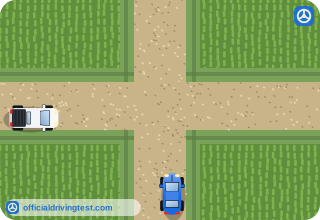
- The lanes still exist whether they are marked or not
- There are no lanes, so you may drive anywhere on the road
- Lanes exist only on roads with a posted speed limit
- Lanes exist only on roads with more than two lanes
Show answer
Correct answer: The lanes still exist whether they are marked or not
Lanes may not always be marked, but they exist whether marked or not, and you are in a traffic lane whenever you drive on a street or highway.
Source: Minnesota Driver’s Manual (June 2026), page 27
-
What must you do when driving in a traffic lane?
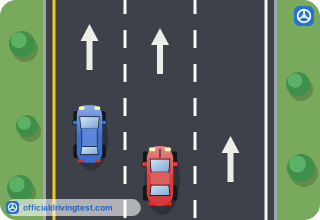
- Move from lane to lane to find the lane that has the least traffic
- Straddle the lane markings to keep clear of parked cars
- Weave only when the road is clear of other vehicles
- Stay within a single lane without weaving or straddling the lane markings
Show answer
Correct answer: Stay within a single lane without weaving or straddling the lane markings
You must stay within a single traffic lane without weaving or straddling the lane markings.
Source: Minnesota Driver’s Manual (June 2026), page 27
-
Besides using your mirrors, what should you do before moving into another lane?
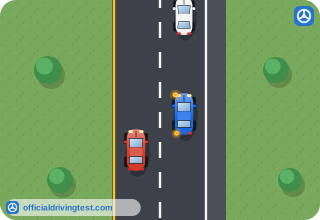
- Honk your horn to warn the vehicles in that lane
- Turn your head to check the lane you are moving into for vehicles
- Flash your headlights to tell the vehicles in that lane to slow down
- Slow to a stop and wait for the lane to clear
Show answer
Correct answer: Turn your head to check the lane you are moving into for vehicles
The manual says to turn your head to check the lane and not to rely solely on mirrors, because you may miss vehicles in your blind spots.
Source: Minnesota Driver’s Manual (June 2026), page 28
-
Before moving into another lane, what must you make sure you have?
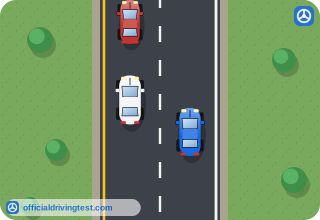
- Space to the side, behind and ahead of your vehicle
- Space ahead of your vehicle only
- A clear lane for at least a quarter mile ahead of you
- Space to the side of your vehicle only
Show answer
Correct answer: Space to the side, behind and ahead of your vehicle
To stay safe, make sure you have space to the side, behind and ahead of your vehicle before moving into another lane.
Source: Minnesota Driver’s Manual (June 2026), page 28
-
When should you move into the correct lane for a turn?
- Right at the intersection, as soon as the light turns green
- Just after you begin the turn
- As you enter the intersection
- Well ahead of the place where you will make the actual turn
Show answer
Correct answer: Well ahead of the place where you will make the actual turn
The manual says to move safely into the correct lane well ahead of the place where you will make the actual turn.
Source: Minnesota Driver’s Manual (June 2026), page 28
-
While waiting to make a turn, how should you hold your wheels and your foot?
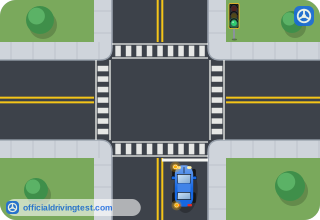
- Wheels turned toward the turn and foot off the brake
- Wheels straight and foot on the brake
- Wheels turned toward the turn and foot on the brake
- Wheels straight and foot off the brake
Show answer
Correct answer: Wheels straight and foot on the brake
Keeping your wheels straight and your foot on the brake means you are less likely to be pushed into oncoming traffic if your vehicle is struck from behind.
Source: Minnesota Driver’s Manual (June 2026), page 28
-
What does the manual say about making a sudden turn from the wrong lane?
- You should not make sudden turns from the wrong lane
- It is allowed if you signal first
- It is allowed if no vehicle is following behind you
- It is allowed on one-way streets
Show answer
Correct answer: You should not make sudden turns from the wrong lane
The manual says not to make sudden turns from the wrong lane.
Source: Minnesota Driver’s Manual (June 2026), page 28
-
What should you do if the car ahead of you is signaling for a left turn?
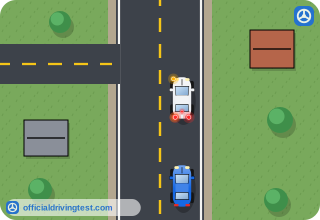
- Pass it on the left
- Honk to tell the driver to hurry
- Slow down and prepare to stop
- Move up close behind its bumper
Show answer
Correct answer: Slow down and prepare to stop
If the car ahead of you is signaling for a left turn, slow down and prepare to stop.
Source: Minnesota Driver’s Manual (June 2026), page 28
-
When waiting to make a left turn at a green light with oncoming traffic, where should you position your car?
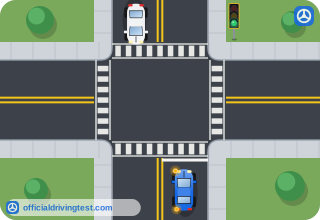
- Behind the crosswalk, with your wheels turned to the left
- Into the intersection, where your body is even with the curb line
- Well back from the intersection to leave room for traffic behind
- In the crosswalk, with your wheels turned to the left
Show answer
Correct answer: Into the intersection, where your body is even with the curb line
You position your car into the intersection where your body is even with the curb line while waiting to turn left at a green light with oncoming traffic.
Source: Minnesota Driver’s Manual (June 2026), page 28
-
When waiting to turn left at a green light with oncoming traffic, when may you only be able to make the turn?
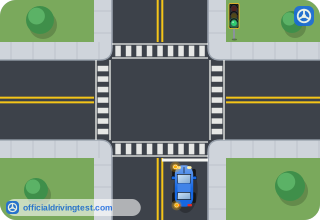
- When the light changes to red
- When the oncoming traffic stops for you
- When the light changes to a green arrow
- When the light changes to yellow
Show answer
Correct answer: When the light changes to yellow
With oncoming traffic you may only be able to make the turn when the light changes to yellow.
Source: Minnesota Driver’s Manual (June 2026), page 28
-
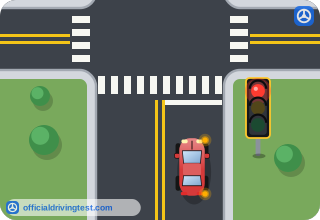
What must you do before making a right turn on a red light?
- Slow down and turn without stopping if no vehicle is near
- Stop only if pedestrians are crossing
- Come to a complete stop in the correct lane
- Honk to warn the traffic that has a green light
Show answer
Correct answer: Come to a complete stop in the correct lane
To turn right on red you must be in the correct lane and come to a complete stop.
Source: Minnesota Driver’s Manual (June 2026), page 28
-
Before turning right on a red light, what must you check for?
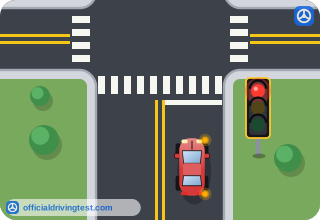
- Pedestrians and traffic in all directions
- Traffic coming from the left only
- Pedestrians crossing in front of you only
- Oncoming traffic only
Show answer
Correct answer: Pedestrians and traffic in all directions
Before turning right on red, check for pedestrians and traffic in all directions to make sure your path is clear.
Source: Minnesota Driver’s Manual (June 2026), page 28
-
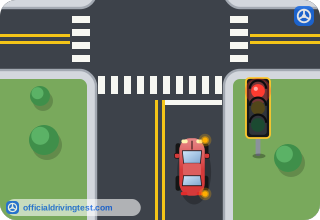
When you turn right on red, what might oncoming traffic have before your light turns green?
- A flashing red light
- A pedestrian signal
- A stop sign
- A green arrow
Show answer
Correct answer: A green arrow
Oncoming traffic will sometimes have a green arrow before your light turns green, so watch for oncoming cars making left turns in front of you.
Source: Minnesota Driver’s Manual (June 2026), page 28
-
Under certain situations, from which kind of street can you make a left turn while the traffic light is red?
- A two-way street onto another two-way street
- A one-way street onto another one-way street
- A two-way street onto a one-way street
- A one-way street onto a two-way street
Show answer
Correct answer: A one-way street onto another one-way street
You can make a left turn on red from a one-way street onto another one-way street in certain situations.
Source: Minnesota Driver’s Manual (June 2026), page 28
-
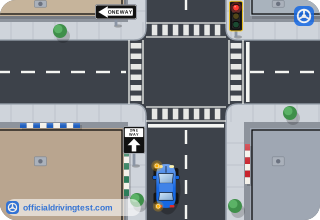
Before turning left on a red light from a one-way street onto another one-way street, what must you do first?
- Come to a complete stop
- Slow to 10 mph and turn
- Flash your headlights
- Sound your horn
Show answer
Correct answer: Come to a complete stop
Before turning left on red you must come to a complete stop and make sure the intersection is clear.
Source: Minnesota Driver’s Manual (June 2026), page 28
-
After checking traffic behind you and signaling for a left turn, into which lane should you move?
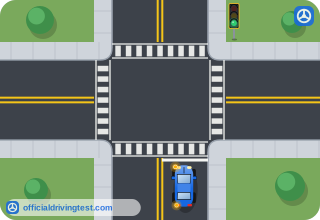
- The lane closest to the right curb
- The lane farthest from the center line
- The lane closest to the center line
- The center of the intersection
Show answer
Correct answer: The lane closest to the center line
For a left turn, after checking traffic and signaling, move into the lane closest to the center line.
Source: Minnesota Driver’s Manual (June 2026), page 29
-
You are making a left turn on a road with no lines marking the lanes. Where should you move your vehicle?
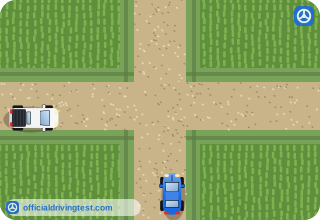
- To the left of the center of the road
- To the right of the center of the road
- On the center of the road
- To the right curb of the road
Show answer
Correct answer: To the right of the center of the road
If there are no lines marking the lanes, move your vehicle to the right of the center of the road before a left turn.
Source: Minnesota Driver’s Manual (June 2026), page 29
-
In which lane should you complete a left turn?
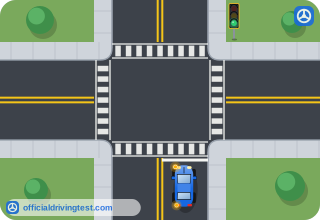
- The lane closest to the right curb
- The first lane left of the center line
- Any lane that is clear
- The first lane right of the center line
Show answer
Correct answer: The first lane right of the center line
You complete a left turn in the first lane right of the center line.
Source: Minnesota Driver’s Manual (June 2026), page 29
-
After checking traffic behind you and signaling for a right turn, where should you move?
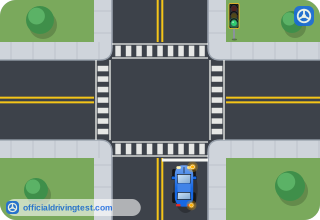
- Toward the center line
- To the middle of the lane
- Close to the right curb
- Into the lane farthest from the curb
Show answer
Correct answer: Close to the right curb
For a right turn, after checking traffic and signaling, move close to the right curb.
Source: Minnesota Driver’s Manual (June 2026), page 29
-
In which lane should you complete a right turn?
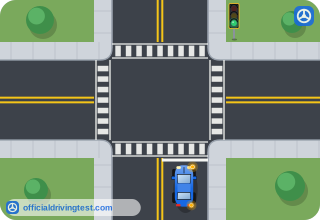
- The lane next to the curb
- The lane closest to the center line
- The first lane left of the center line
- Any lane that is clear
Show answer
Correct answer: The lane next to the curb
You complete a right turn in the lane next to the curb.
Source: Minnesota Driver’s Manual (June 2026), page 29
-
How should you turn the steering wheel when making a left or right turn?
- With one hand at the top of the wheel
- Letting the wheel slide through your hands
- With both hands held still at the top
- Hand-over-hand
Show answer
Correct answer: Hand-over-hand
The manual says to turn the steering wheel hand-over-hand for left and right turns.
Source: Minnesota Driver’s Manual (June 2026), page 29
-
Before starting a left or right turn, which way should you look?
- Left only
- Right and left
- Right only
- Straight ahead only
Show answer
Correct answer: Right and left
Look right and left before starting the turn, and yield right of way if necessary.
Source: Minnesota Driver’s Manual (June 2026), page 29
-
If there are signs or lane markings for two or more turning lanes, what should you do during the turn?
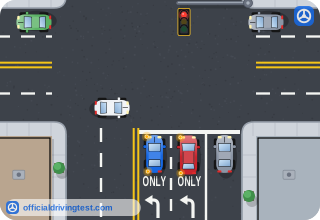
- Stay in your lane during the turn
- Move to the lane with fewer vehicles
- Change lanes to reach the outside lane
- Stop in your lane until traffic clears
Show answer
Correct answer: Stay in your lane during the turn
With two or more turning lanes, you stay in your lane during the turn.
Source: Minnesota Driver’s Manual (June 2026), page 30
-
When turning on a red light, what must you do?
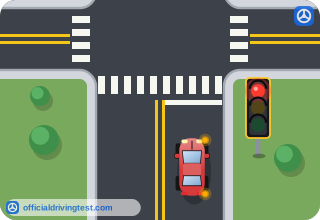
- Speed up to clear the intersection before cross traffic
- Turn only if no other vehicle is in sight
- Yield to traffic and pedestrians
- Sound your horn before turning
Show answer
Correct answer: Yield to traffic and pedestrians
When turning on a red light you must yield to traffic and pedestrians.
Source: Minnesota Driver’s Manual (June 2026), page 30
-
If a “No Turn on Red” sign is posted, when may you turn?
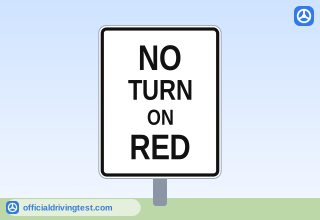
- After coming to a complete stop
- When the light is green
- After yielding to traffic and pedestrians
- After checking that your path is clear
Show answer
Correct answer: When the light is green
If a “No Turn on Red” sign is posted, you must wait until the light is green to turn.
Source: Minnesota Driver’s Manual (June 2026), page 30
-
What are roundabouts designed to provide compared with normal four-way stops?
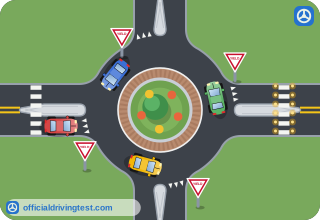
- Faster speeds for all vehicles
- More stops at each entrance
- Separate lanes for large vehicles only
- Better traffic flow and safer intersections
Show answer
Correct answer: Better traffic flow and safer intersections
Roundabouts are designed to improve traffic flow and provide safer intersections than normal four-way stops.
Source: Minnesota Driver’s Manual (June 2026), page 30
-
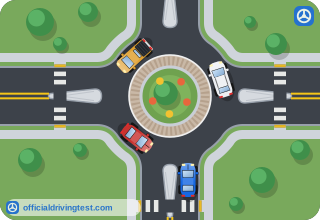
As you approach a roundabout, what should you do?
- Speed up so you can merge into traffic
- Turn on your hazard lights
- Slow down
- Move into the left lane no matter which exit you want
Show answer
Correct answer: Slow down
When approaching a roundabout, slow down as you approach.
Source: Minnesota Driver’s Manual (June 2026), page 30
-
When should you choose the correct lane at a multi-lane roundabout?
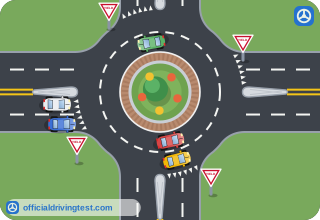
- Before entering the roundabout
- After entering the roundabout
- Once you are beside your exit
- While you are inside the roundabout
Show answer
Correct answer: Before entering the roundabout
At multi-lane roundabouts you choose the correct lane before entering.
Source: Minnesota Driver’s Manual (June 2026), page 30
-
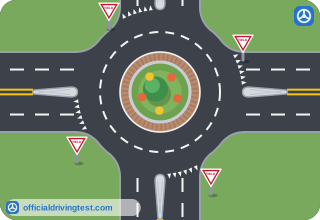
When approaching a roundabout, to whom must you yield?
- Only vehicles that are behind you
- Only pedestrians in marked crosswalks on the left
- Drivers who entered the roundabout after you
- Pedestrians and bicyclists crossing the road
Show answer
Correct answer: Pedestrians and bicyclists crossing the road
When approaching a roundabout, yield to pedestrians and bicyclists crossing the road.
Source: Minnesota Driver’s Manual (June 2026), page 30
-
When approaching a roundabout, what should you watch for?
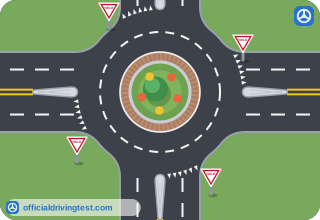
- Signs telling you to stop in the roundabout
- Signs or markings that require or prohibit certain movements
- Markings that allow you to pass other vehicles inside it
- Signs that let you change lanes inside it
Show answer
Correct answer: Signs or markings that require or prohibit certain movements
When approaching a roundabout, watch for signs or markings that require or prohibit certain movements.
Source: Minnesota Driver’s Manual (June 2026), page 30
-
When entering a roundabout, to whom must you yield?
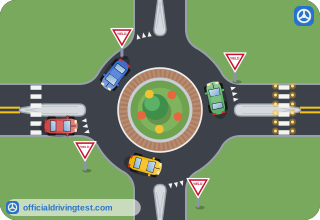
- Vehicles already in the roundabout
- Vehicles that are behind you at the entrance
- Only vehicles in the lane next to yours
- Only vehicles that are larger than yours
Show answer
Correct answer: Vehicles already in the roundabout
You must yield to vehicles already in the roundabout.
Source: Minnesota Driver’s Manual (June 2026), page 30
-
Traffic from which direction must clear before you enter a roundabout?
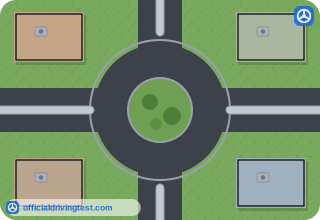
- From the right
- From straight ahead
- From the left
- From behind you
Show answer
Correct answer: From the left
Do not enter a roundabout until all traffic from the left has cleared.
Source: Minnesota Driver’s Manual (June 2026), page 30
-
In which direction do you drive in a roundabout until you reach your exit?
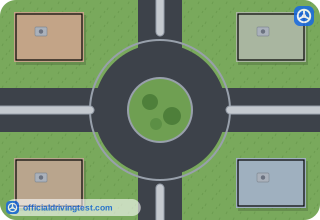
- Clockwise
- Counterclockwise
- Whichever way is shorter to your exit
- Straight across the central island
Show answer
Correct answer: Counterclockwise
In a roundabout you drive counterclockwise until you reach your exit.
Source: Minnesota Driver’s Manual (June 2026), page 30
-
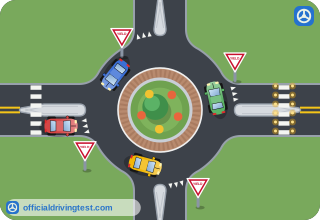
Which of these must you not do within a roundabout?
- Drive counterclockwise to your exit
- Slow down as you approach it
- Choose the correct lane before entering
- Pass another vehicle
Show answer
Correct answer: Pass another vehicle
Do not stop, pass or change lanes within the roundabout.
Source: Minnesota Driver’s Manual (June 2026), page 30
-
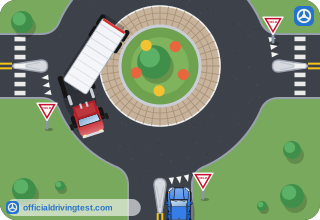
Which vehicle may deviate from the lane as needed to drive through a roundabout?
- A vehicle longer than 40 feet or wider than 10 feet
- A vehicle longer than 25 feet or wider than 6 feet
- A vehicle longer than 20 feet or wider than 8 feet
- Any vehicle with its hazard lights on
Show answer
Correct answer: A vehicle longer than 40 feet or wider than 10 feet
A vehicle longer than 40 feet or wider than 10 feet, or any combination vehicle, may deviate from the lane while being cautious of other traffic.
Source: Minnesota Driver’s Manual (June 2026), page 30
-
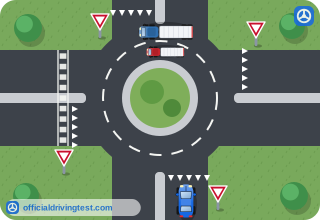
In a multi-lane roundabout, two large vehicles approach and drive through at the same time. Which driver must yield?
- The driver on the left
- The driver of the longer vehicle
- The driver who entered the roundabout first
- The driver on the right
Show answer
Correct answer: The driver on the right
The driver on the right must yield to the vehicle on the left, reducing speed or stopping if necessary.
Source: Minnesota Driver’s Manual (June 2026), page 30
-
What is the area in the middle of a roundabout called?
- The median
- The central island
- The pivot point
- The yield zone
Show answer
Correct answer: The central island
The area in the middle of a roundabout is the central island.
Source: Minnesota Driver’s Manual (June 2026), page 31
-
On what kind of road are J-turns used to decrease fatalities and injuries from broadside crashes?
- Four-lane divided highways
- Two-lane undivided roads
- Freeway entrance ramps
- Residential streets
Show answer
Correct answer: Four-lane divided highways
J-turns are used on four-lane divided highways to decrease fatalities and injuries caused by broadside crashes.
Source: Minnesota Driver’s Manual (June 2026), page 32
-
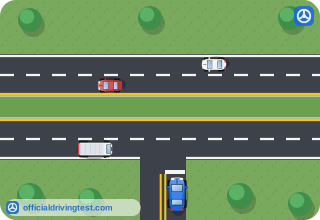
At a J-turn, which turn do drivers on the side street approaching the divided highway always make?
- A left turn
- A U-turn
- A right turn
- A turn straight across
Show answer
Correct answer: A right turn
At a J-turn, drivers on the side street approaching the divided highway always make a right turn.
Source: Minnesota Driver’s Manual (June 2026), page 32
-
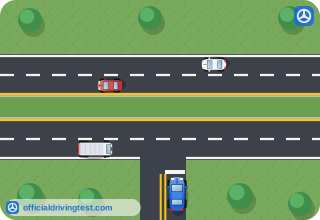
To cross the highway or make a left turn from the side street at a J-turn, what do you do first?
- Turn left into the median opening
- Come to a complete stop
- Cross both lanes straight across
- Turn right onto the highway without stopping
Show answer
Correct answer: Come to a complete stop
The first step at a J-turn is to come to a complete stop, then turn right onto the highway.
Source: Minnesota Driver’s Manual (June 2026), page 32
-
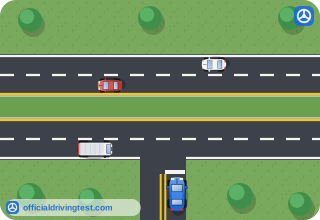
At a J-turn, after you turn right onto the highway, what do you do next?
- Stop on the shoulder of the highway and wait for a gap in the through traffic
- Continue straight and use the next intersection
- Turn left across the median at the side street
- Enter the left-turn lane that leads to the median opening and complete a U-turn
Show answer
Correct answer: Enter the left-turn lane that leads to the median opening and complete a U-turn
After turning right, you enter the designated left-turn lane that leads to the median opening and complete a U-turn.
Source: Minnesota Driver’s Manual (June 2026), page 32
-
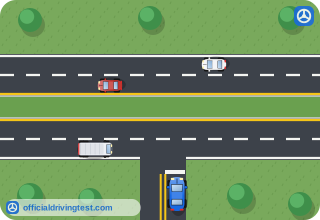
When making the right turn at a J-turn, what can you do when it is safe?
- Stop in the right lane and wait for a gap in the through lanes
- Drive on the shoulder to reach the left-turn lane
- Cross both lanes and move into the left-turn lane in one motion
- Cross the median directly to the other roadway
Show answer
Correct answer: Cross both lanes and move into the left-turn lane in one motion
When it is safe, you can cross both lanes and move into the left-turn lane in one motion, which minimizes the time spent in the through lanes.
Source: Minnesota Driver’s Manual (June 2026), page 32
-
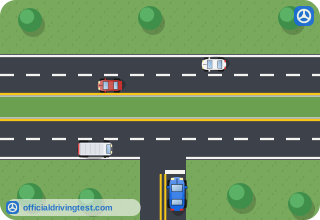
When completing the U-turn at a J-turn, what must you do before entering the through lanes of the divided highway?
- Yield to oncoming traffic and stop if necessary
- Stop completely and flash your headlights
- Speed up to merge ahead of oncoming traffic
- Sound your horn and then enter the through lanes
Show answer
Correct answer: Yield to oncoming traffic and stop if necessary
When completing the U-turn, you must yield to oncoming traffic and stop if necessary before entering the through lanes.
Source: Minnesota Driver’s Manual (June 2026), page 32
-
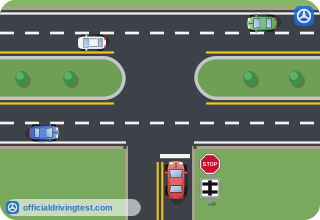
When crossing a rural divided highway with enough space between the two roadways, what can you do?
- Stop in the through lanes of the first roadway until the second one clears
- Cross both roadways at the same speed without stopping
- Wait on the shoulder until a police officer helps you
- Cross one half and wait in the middle until it is safe to cross the second half
Show answer
Correct answer: Cross one half and wait in the middle until it is safe to cross the second half
If there is enough space between the two roadways, you can cross one half and wait in the middle until it is safe to cross the second half.
Source: Minnesota Driver’s Manual (June 2026), page 32
-
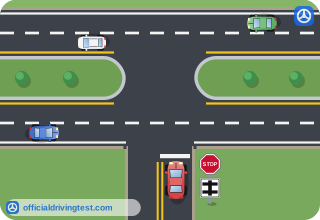
When can you cross both roadways of a rural divided highway without waiting in the middle?
- When the speed limit on both roadways is 55 mph or higher
- When there is no traffic from either direction and it is safe
- When the median is wider than a vehicle
- When you have signaled for at least 100 feet
Show answer
Correct answer: When there is no traffic from either direction and it is safe
If there is no traffic from either direction, you can cross both roadways if it is safe.
Source: Minnesota Driver’s Manual (June 2026), page 32
-
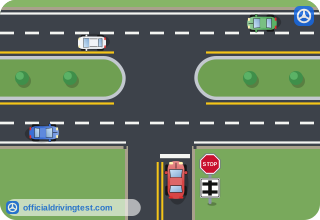
Where should you stay when waiting between the roadways of a divided highway?
- To the right of the center
- To the left of the center
- On the center line of the median
- As close to the left roadway as possible
Show answer
Correct answer: To the right of the center
When waiting between the roadways, stay to the right of the center.
Source: Minnesota Driver’s Manual (June 2026), page 32
-
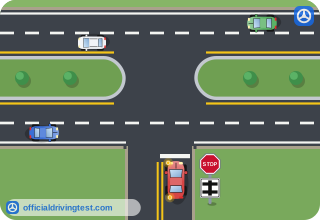
What procedure do you use when turning left onto a divided highway?
- The procedure for a U-turn on a two-lane road
- The procedure for turning right at a red light
- The same procedure as crossing straight across
- Stopping in the left lane of the first roadway
Show answer
Correct answer: The same procedure as crossing straight across
When turning left onto a divided highway, use the same procedure as crossing straight across.
Source: Minnesota Driver’s Manual (June 2026), page 32
-
When turning left onto a divided highway, why must you make sure there is enough space from oncoming traffic?
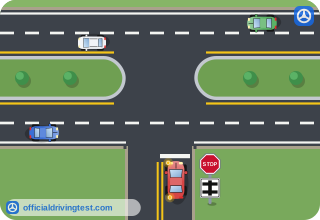
- So you can stop in the median if needed
- So you do not impede it as you get up to speed after completing your turn
- So you can make the turn without signaling
- So you can stay in the left lane of the roadway until it is clear
Show answer
Correct answer: So you do not impede it as you get up to speed after completing your turn
Ensure there is enough space from oncoming traffic so you do not impede them as you get up to speed after completing your turn.
Source: Minnesota Driver’s Manual (June 2026), page 32
-
What does the manual say about making U-turns on interstate freeways?
- You must not make them
- Make them only from the far right lane
- Make them only when no vehicle is near you
- Make them only by using the shoulder
Show answer
Correct answer: You must not make them
U-turns are not allowed on interstate freeways.
Source: Minnesota Driver’s Manual (June 2026), page 33
-
U-turns are illegal on curves where other drivers cannot see you from what distance?
- 300 feet
- 500 feet
- 1,000 feet
- 100 feet
Show answer
Correct answer: 1,000 feet
They are also illegal near the tops of hills and on curves where other drivers cannot see you from 1,000 feet away.
Source: Minnesota Driver’s Manual (June 2026), page 33
-
A driver should not make a U-turn unless they can do so in what way?
- Only after signaling for 200 feet
- Without disrupting other traffic
- Only after coming to a complete stop
- Only from the far left lane
Show answer
Correct answer: Without disrupting other traffic
A U-turn must not disrupt other traffic.
Source: Minnesota Driver’s Manual (June 2026), page 33
-
On a roadway with two or more lanes in the same direction, how may a driver make a U-turn when necessary?
- Turn from the center lane and drive across the median
- Stop in the left lane and back around to reverse
- Turn from the right lane across all lanes at once
- Turn into the farthest lane and temporarily use the shoulder
Show answer
Correct answer: Turn into the farthest lane and temporarily use the shoulder
When necessary, a driver may turn into the farthest lane and temporarily use the shoulder to make a U-turn on a roadway with two or more lanes in the same direction.
Source: Minnesota Driver’s Manual (June 2026), page 33
-
At a stop sign with a marked stop line, where must you stop?
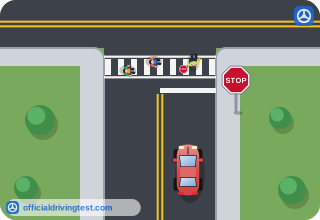
- Behind the line
- Past the line, so you can see traffic
- With your front wheels on the line
- Within 10 feet of the line
Show answer
Correct answer: Behind the line
A marked stop line tells you where to stop: before the line.
Source: Minnesota Driver’s Manual (June 2026), page 41
-
After stopping at a stop sign, what must you do before proceeding?
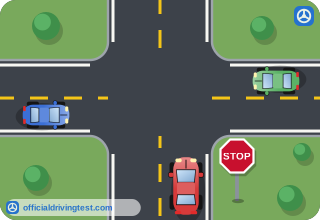
- Sound your horn to warn cross traffic and then proceed
- Wait for the driver behind you to signal you on
- Yield the right-of-way to pedestrians, bicyclists and traffic
- Wait for a gap in traffic only if a pedestrian is present
Show answer
Correct answer: Yield the right-of-way to pedestrians, bicyclists and traffic
At a stop sign you must give right-of-way to pedestrians, bicyclists and traffic before you go.
Source: Minnesota Driver’s Manual (June 2026), page 41
-
At a stop sign where there is a pedestrian crosswalk, where must you stop?
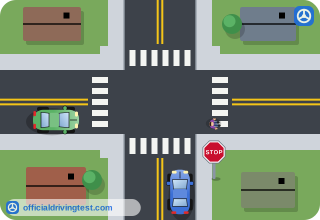
- In the middle of the crosswalk
- Before entering the crosswalk
- Just past the crosswalk
- Only if a pedestrian is waiting
Show answer
Correct answer: Before entering the crosswalk
With a pedestrian crosswalk at the stop sign, stop before you enter the crosswalk.
Source: Minnesota Driver’s Manual (June 2026), page 41
-
If your view of an intersection is obstructed, what should you be prepared to do?
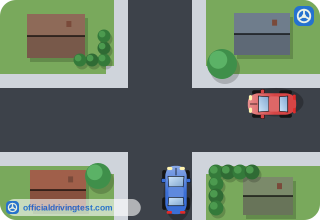
- Speed up to clear the intersection quickly
- Sound your horn and continue through slowly
- Pull onto the shoulder and wait for a signal
- Stop again for traffic or pedestrians in your path
Show answer
Correct answer: Stop again for traffic or pedestrians in your path
With an obstructed view, you must be ready to stop again for traffic or pedestrians in your path.
Source: Minnesota Driver’s Manual (June 2026), page 41
-
You are entering a road from an alley, private driveway, parking lot or parking ramp. What must you do before crossing the sidewalk?
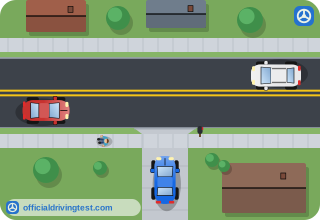
- Come to a complete stop
- Slow down and sound your horn
- Slow down and proceed if no one is in sight
- Stop only if a pedestrian is on the sidewalk
Show answer
Correct answer: Come to a complete stop
You must come to a complete stop before entering a road from these places, and always before crossing a sidewalk or crosswalk.
Source: Minnesota Driver’s Manual (June 2026), page 41
-
A pedestrian or bicyclist is crossing the road at an intersection or crosswalk, marked or unmarked. How long must you stay stopped?
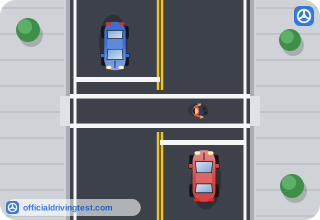
- Until they reach the middle of the road
- Until they have passed your lane
- Until they have crossed the whole road
- For three seconds
Show answer
Correct answer: Until they have passed your lane
You must stop for a pedestrian or bicyclist crossing and stay stopped until they have passed your lane.
Source: Minnesota Driver’s Manual (June 2026), page 41
-
You must come to a complete stop at a bridge that
- is narrower than the road leading to it
- has a posted weight limit
- has been raised to open a path for boats
- crosses over a railroad track
Show answer
Correct answer: has been raised to open a path for boats
A bridge raised to let boats through requires a complete stop.
Source: Minnesota Driver’s Manual (June 2026), page 41
-
Two drivers reach an all-way stop or a flashing red traffic light at the same time. Which driver must yield?
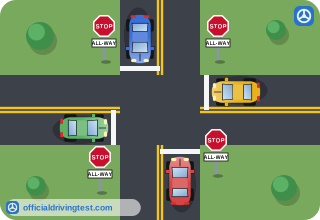
- The driver on the left
- The driver on the right
- The driver in the larger vehicle
- The driver going straight
Show answer
Correct answer: The driver on the left
At all-way stops or flashing red lights, the driver on the left must yield to the one on the right.
Source: Minnesota Driver’s Manual (June 2026), page 43
-
When you want to make a left turn, you must yield to
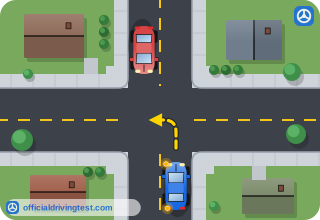
- only vehicles that are stopped in the opposite direction at the intersection
- only vehicles that are traveling faster than the speed limit
- oncoming vehicles in the intersection or close enough to be a crash risk
- vehicles behind you that want to go straight through the intersection
Show answer
Correct answer: oncoming vehicles in the intersection or close enough to be a crash risk
A left turn requires yielding to oncoming vehicles that are in the intersection or close enough to cause a crash.
Source: Minnesota Driver’s Manual (June 2026), page 43
-
A green arrow signals that you may turn left. Whom must you yield to before continuing?
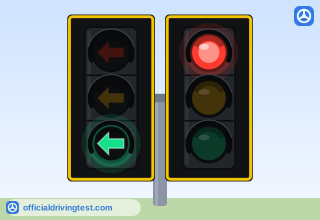
- Only oncoming vehicles that are speeding
- Other vehicles or pedestrians already in the intersection
- Nobody, because the arrow gives you the right-of-way
- Pedestrians on the far corner only
Show answer
Correct answer: Other vehicles or pedestrians already in the intersection
On a green left-turn arrow you must yield to vehicles or pedestrians already in the intersection, then continue.
Source: Minnesota Driver’s Manual (June 2026), page 43
-
At an uncontrolled "T" intersection, who must yield to all cross traffic?
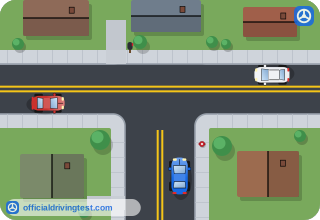
- The driver going straight
- The driver on the right
- The driver in the faster vehicle
- The driver who is turning
Show answer
Correct answer: The driver who is turning
At an uncontrolled "T" intersection you must yield to all cross traffic if you are the one turning.
Source: Minnesota Driver’s Manual (June 2026), page 43
-
When driving in the right lane, you must yield to transit and metro mobility buses that are
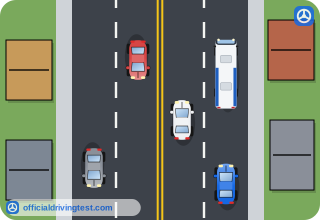
- merging from a bus stop or shoulder
- passing you on the left
- stopped at a red light
- turning left from the left lane
Show answer
Correct answer: merging from a bus stop or shoulder
The manual requires yielding to transit and metro mobility buses merging from a bus stop or shoulder.
Source: Minnesota Driver’s Manual (June 2026), page 43
-
How does a funeral procession identify itself so that you must yield to the entire procession?
- With a flashing red light on the lead car
- With headlights or hazard warning lights
- With a police escort only
- With a flag on each car
Show answer
Correct answer: With headlights or hazard warning lights
When a procession identifies itself with headlights or hazard warning lights, you must yield to all of it.
Source: Minnesota Driver’s Manual (June 2026), page 43
-
A multilane roundabout lane sign shows the left lane for turning left or going straight and the right lane for turning right or going straight. Which lane must you use to turn left?
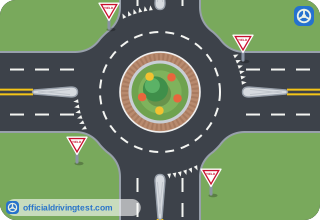
- The right lane only
- The left lane only
- Either lane
- The lane that has the fewest vehicles
Show answer
Correct answer: The left lane only
Roundabout lane signs show which lanes to use for different turns; when the left lane is marked for left or straight and the right lane for right or straight, you turn left from the left lane only.
Source: Minnesota Driver’s Manual (June 2026), page 58
-
A multilane roundabout lane sign shows the left lane for turning left or going straight and the right lane for turning right or going straight. From which lane can you go straight?
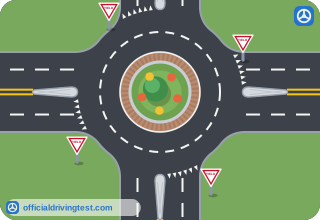
- Either lane
- The left lane only
- The right lane only
- Neither lane, because you must turn
Show answer
Correct answer: Either lane
When a roundabout lane sign marks the left lane for left or straight and the right lane for right or straight, you can go straight from either lane.
Source: Minnesota Driver’s Manual (June 2026), page 58
-
When approaching a multilane roundabout, when should you get into the appropriate lane?
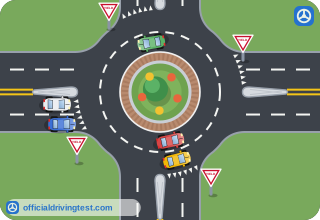
- Just before your exit
- After you enter the roundabout
- Well in advance
- Only when other vehicles allow it
Show answer
Correct answer: Well in advance
The manual says to get into the appropriate lane well in advance when approaching a multilane roundabout.
Source: Minnesota Driver’s Manual (June 2026), page 58
-
When may you make a right turn on a steady red light?
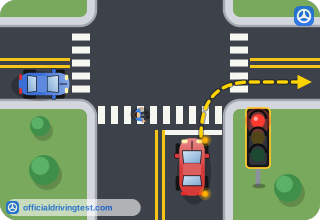
- Without stopping, whenever no pedestrian is crossing in front of you
- After stopping, but only when cross traffic has a red light too
- Only after the light has changed to yellow for cross traffic
- After stopping, when the intersection is clear and traffic may travel that way
Show answer
Correct answer: After stopping, when the intersection is clear and traffic may travel that way
After stopping, you may turn right on red when the intersection is clear, if traffic is permitted to travel in that direction.
Source: Minnesota Driver’s Manual (June 2026), page 66
-
Before you turn left on a red light, what must you make sure of?
- Cross traffic has a green arrow pointing in your direction
- The cross street has at least two lanes in each direction
- Traffic is permitted to travel only in the direction you are turning
- No pedestrians have a Walk signal anywhere near the corner
Show answer
Correct answer: Traffic is permitted to travel only in the direction you are turning
One condition for a left turn on red is to ensure traffic is permitted to travel only in the direction you are turning.
Source: Minnesota Driver’s Manual (June 2026), page 66
-
You are waiting in the intersection to make a turn and the signal changes from yellow to red. What should you do?
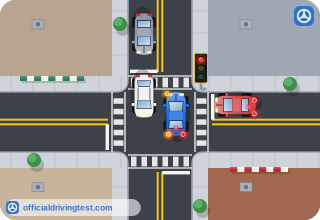
- Back up behind the stop line until the light turns green
- Complete the turn as soon as it is safe
- Stay where you are until the light turns green again
- Turn right away, even if cross traffic has begun to move
Show answer
Correct answer: Complete the turn as soon as it is safe
If the signal turns red while you are waiting in the intersection to turn, complete the turn as soon as it is safe, and do not back up.
Source: Minnesota Driver’s Manual (June 2026), page 66
-
At a flashing yellow light, what must you yield to when you are turning left or making a U-turn?
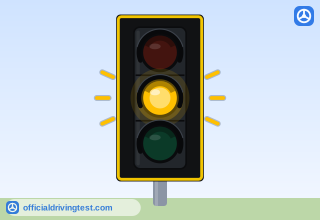
- Oncoming vehicles close enough to be an immediate hazard
- Only pedestrians who are in the crosswalk
- Vehicles that are approaching from behind you
- Only vehicles that are stopped in the intersection
Show answer
Correct answer: Oncoming vehicles close enough to be an immediate hazard
When turning left or making a U-turn at a flashing yellow light, you must yield to oncoming vehicles that are close enough to be an immediate hazard.
Source: Minnesota Driver’s Manual (June 2026), page 67
-
You are turning left at a green light. What must you yield to?
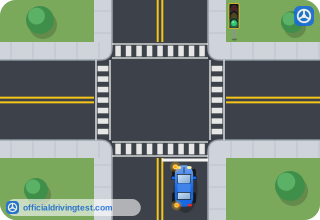
- Traffic approaching from behind
- Vehicles parked at the curb
- Oncoming traffic
- Only pedestrians waiting on the corner
Show answer
Correct answer: Oncoming traffic
On a green light, when turning left you must yield to oncoming traffic.
Source: Minnesota Driver’s Manual (June 2026), page 67
-
At a green light, who must you yield to when turning right or left?
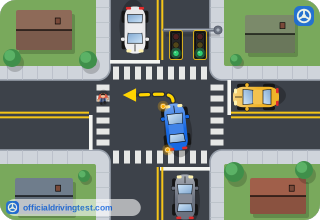
- Pedestrians who have already crossed behind your vehicle
- Pedestrians crossing in front of your vehicle
- No one, because you have a green light
- Only vehicles, because pedestrians must wait
Show answer
Correct answer: Pedestrians crossing in front of your vehicle
On a green light, when turning right or left you must yield to pedestrians crossing in front of your vehicle.
Source: Minnesota Driver’s Manual (June 2026), page 67
-
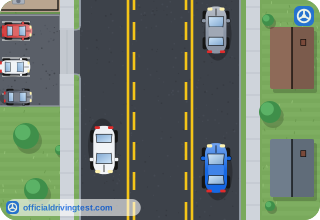
Who may use a center lane between lanes of traffic traveling in opposite directions that is designated for left turns?
- Only vehicles traveling in the direction of the arrows
- Only vehicles that are passing slower traffic
- Only emergency vehicles
- Vehicles traveling in either direction, to turn left
Show answer
Correct answer: Vehicles traveling in either direction, to turn left
Vehicles traveling in either direction can use a center turn lane to make left turns onto another roadway or a driveway.
Source: Minnesota Driver’s Manual (June 2026), page 71