Minnesota: Right-of-way and turning — Part 3 Practice Test
Questions in this part include: “What is the area in the middle of a roundabout called?” · “On what kind of road are J-turns used to decrease fatalities and injuries from broadside crashes?”
Independent educational site · not affiliated with any government agency or DMV
Ready? Test yourself
- Instant feedback with an explanation
- Every answer cites its source in the manual
- Your best score is saved on this device
Questions are original and based on the official manual "Minnesota Driver’s Manual" (June 2026), Minnesota Driver and Vehicle Services.
All 16 questions in this practice test
Take the test above first, then use this list to study. Tap “Show answer” to see the correct answer and explanation.
Show the questions and answersHide the questions
-
When should you choose the correct lane at a multi-lane roundabout?
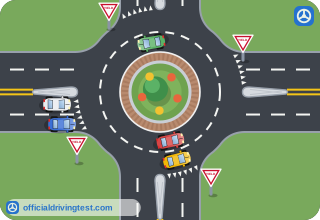
- Before entering the roundabout
- After entering the roundabout
- Once you are beside your exit
- While you are inside the roundabout
Show answer
Correct answer: Before entering the roundabout
At multi-lane roundabouts you choose the correct lane before entering.
Source: Minnesota Driver’s Manual (June 2026), page 30
-
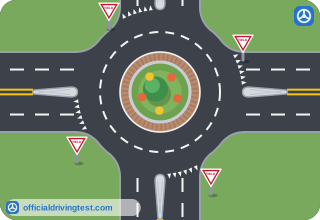
When approaching a roundabout, to whom must you yield?
- Only vehicles that are behind you
- Only pedestrians in marked crosswalks on the left
- Drivers who entered the roundabout after you
- Pedestrians and bicyclists crossing the road
Show answer
Correct answer: Pedestrians and bicyclists crossing the road
When approaching a roundabout, yield to pedestrians and bicyclists crossing the road.
Source: Minnesota Driver’s Manual (June 2026), page 30
-
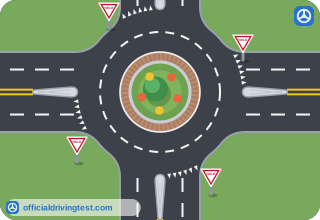
When approaching a roundabout, what should you watch for?
- Signs telling you to stop in the roundabout
- Signs or markings that require or prohibit certain movements
- Markings that allow you to pass other vehicles inside it
- Signs that let you change lanes inside it
Show answer
Correct answer: Signs or markings that require or prohibit certain movements
When approaching a roundabout, watch for signs or markings that require or prohibit certain movements.
Source: Minnesota Driver’s Manual (June 2026), page 30
-
When entering a roundabout, to whom must you yield?
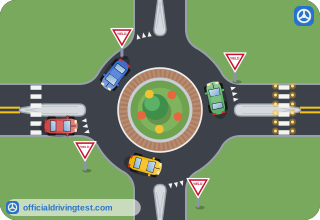
- Vehicles already in the roundabout
- Vehicles that are behind you at the entrance
- Only vehicles in the lane next to yours
- Only vehicles that are larger than yours
Show answer
Correct answer: Vehicles already in the roundabout
You must yield to vehicles already in the roundabout.
Source: Minnesota Driver’s Manual (June 2026), page 30
-
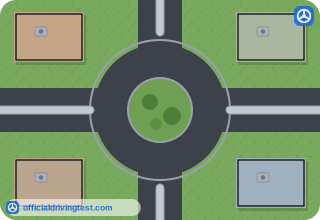
Traffic from which direction must clear before you enter a roundabout?
- From the right
- From straight ahead
- From the left
- From behind you
Show answer
Correct answer: From the left
Do not enter a roundabout until all traffic from the left has cleared.
Source: Minnesota Driver’s Manual (June 2026), page 30
-
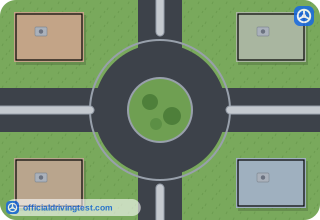
In which direction do you drive in a roundabout until you reach your exit?
- Clockwise
- Counterclockwise
- Whichever way is shorter to your exit
- Straight across the central island
Show answer
Correct answer: Counterclockwise
In a roundabout you drive counterclockwise until you reach your exit.
Source: Minnesota Driver’s Manual (June 2026), page 30
-
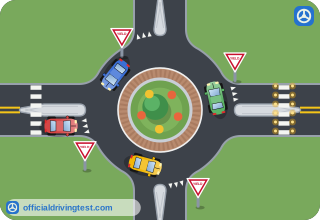
Which of these must you not do within a roundabout?
- Drive counterclockwise to your exit
- Slow down as you approach it
- Choose the correct lane before entering
- Pass another vehicle
Show answer
Correct answer: Pass another vehicle
Do not stop, pass or change lanes within the roundabout.
Source: Minnesota Driver’s Manual (June 2026), page 30
-
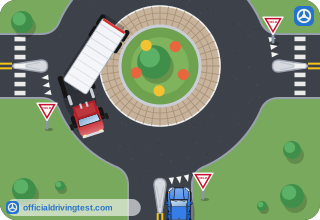
Which vehicle may deviate from the lane as needed to drive through a roundabout?
- A vehicle longer than 40 feet or wider than 10 feet
- A vehicle longer than 25 feet or wider than 6 feet
- A vehicle longer than 20 feet or wider than 8 feet
- Any vehicle with its hazard lights on
Show answer
Correct answer: A vehicle longer than 40 feet or wider than 10 feet
A vehicle longer than 40 feet or wider than 10 feet, or any combination vehicle, may deviate from the lane while being cautious of other traffic.
Source: Minnesota Driver’s Manual (June 2026), page 30
-
In a multi-lane roundabout, two large vehicles approach and drive through at the same time. Which driver must yield?
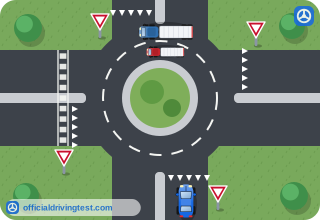
- The driver on the left
- The driver of the longer vehicle
- The driver who entered the roundabout first
- The driver on the right
Show answer
Correct answer: The driver on the right
The driver on the right must yield to the vehicle on the left, reducing speed or stopping if necessary.
Source: Minnesota Driver’s Manual (June 2026), page 30
-
What is the area in the middle of a roundabout called?
- The median
- The central island
- The pivot point
- The yield zone
Show answer
Correct answer: The central island
The area in the middle of a roundabout is the central island.
Source: Minnesota Driver’s Manual (June 2026), page 31
-
On what kind of road are J-turns used to decrease fatalities and injuries from broadside crashes?
- Four-lane divided highways
- Two-lane undivided roads
- Freeway entrance ramps
- Residential streets
Show answer
Correct answer: Four-lane divided highways
J-turns are used on four-lane divided highways to decrease fatalities and injuries caused by broadside crashes.
Source: Minnesota Driver’s Manual (June 2026), page 32
-
At a J-turn, which turn do drivers on the side street approaching the divided highway always make?
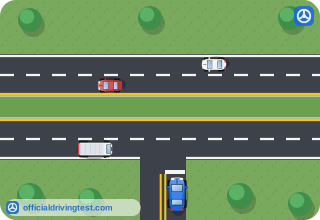
- A left turn
- A U-turn
- A right turn
- A turn straight across
Show answer
Correct answer: A right turn
At a J-turn, drivers on the side street approaching the divided highway always make a right turn.
Source: Minnesota Driver’s Manual (June 2026), page 32
-
To cross the highway or make a left turn from the side street at a J-turn, what do you do first?
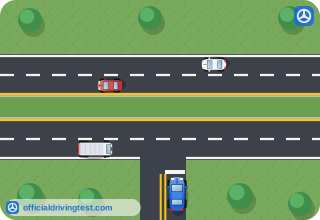
- Turn left into the median opening
- Come to a complete stop
- Cross both lanes straight across
- Turn right onto the highway without stopping
Show answer
Correct answer: Come to a complete stop
The first step at a J-turn is to come to a complete stop, then turn right onto the highway.
Source: Minnesota Driver’s Manual (June 2026), page 32
-
At a J-turn, after you turn right onto the highway, what do you do next?
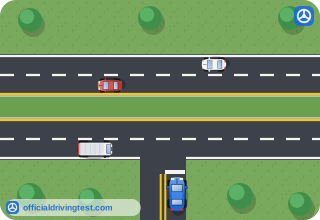
- Stop on the shoulder of the highway and wait for a gap in the through traffic
- Continue straight and use the next intersection
- Turn left across the median at the side street
- Enter the left-turn lane that leads to the median opening and complete a U-turn
Show answer
Correct answer: Enter the left-turn lane that leads to the median opening and complete a U-turn
After turning right, you enter the designated left-turn lane that leads to the median opening and complete a U-turn.
Source: Minnesota Driver’s Manual (June 2026), page 32
-
When making the right turn at a J-turn, what can you do when it is safe?
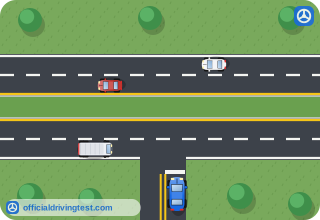
- Stop in the right lane and wait for a gap in the through lanes
- Drive on the shoulder to reach the left-turn lane
- Cross both lanes and move into the left-turn lane in one motion
- Cross the median directly to the other roadway
Show answer
Correct answer: Cross both lanes and move into the left-turn lane in one motion
When it is safe, you can cross both lanes and move into the left-turn lane in one motion, which minimizes the time spent in the through lanes.
Source: Minnesota Driver’s Manual (June 2026), page 32
-
When completing the U-turn at a J-turn, what must you do before entering the through lanes of the divided highway?
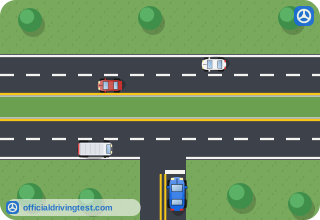
- Yield to oncoming traffic and stop if necessary
- Stop completely and flash your headlights
- Speed up to merge ahead of oncoming traffic
- Sound your horn and then enter the through lanes
Show answer
Correct answer: Yield to oncoming traffic and stop if necessary
When completing the U-turn, you must yield to oncoming traffic and stop if necessary before entering the through lanes.
Source: Minnesota Driver’s Manual (June 2026), page 32