Minnesota: Right-of-way and turning — Part 4 Practice Test
Questions in this part include: “What does the manual say about making U-turns on interstate freeways?” · “A driver should not make a U-turn unless they can do so in what way?”
Independent educational site · not affiliated with any government agency or DMV
Ready? Test yourself
- Instant feedback with an explanation
- Every answer cites its source in the manual
- Your best score is saved on this device
Questions are original and based on the official manual "Minnesota Driver’s Manual" (June 2026), Minnesota Driver and Vehicle Services.
All 16 questions in this practice test
Take the test above first, then use this list to study. Tap “Show answer” to see the correct answer and explanation.
Show the questions and answersHide the questions
-
When crossing a rural divided highway with enough space between the two roadways, what can you do?
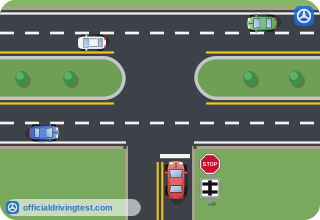
- Stop in the through lanes of the first roadway until the second one clears
- Cross both roadways at the same speed without stopping
- Wait on the shoulder until a police officer helps you
- Cross one half and wait in the middle until it is safe to cross the second half
Show answer
Correct answer: Cross one half and wait in the middle until it is safe to cross the second half
If there is enough space between the two roadways, you can cross one half and wait in the middle until it is safe to cross the second half.
Source: Minnesota Driver’s Manual (June 2026), page 32
-
When can you cross both roadways of a rural divided highway without waiting in the middle?
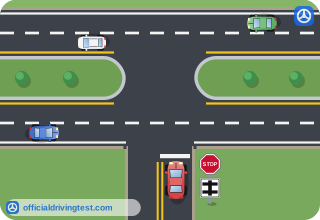
- When the speed limit on both roadways is 55 mph or higher
- When there is no traffic from either direction and it is safe
- When the median is wider than a vehicle
- When you have signaled for at least 100 feet
Show answer
Correct answer: When there is no traffic from either direction and it is safe
If there is no traffic from either direction, you can cross both roadways if it is safe.
Source: Minnesota Driver’s Manual (June 2026), page 32
-
Where should you stay when waiting between the roadways of a divided highway?
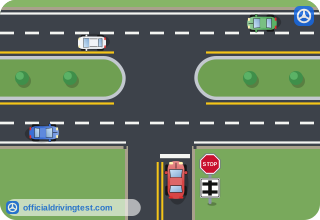
- To the right of the center
- To the left of the center
- On the center line of the median
- As close to the left roadway as possible
Show answer
Correct answer: To the right of the center
When waiting between the roadways, stay to the right of the center.
Source: Minnesota Driver’s Manual (June 2026), page 32
-
What procedure do you use when turning left onto a divided highway?
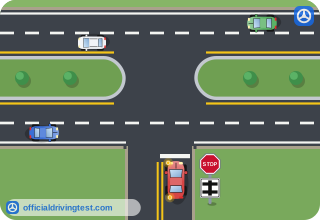
- The procedure for a U-turn on a two-lane road
- The procedure for turning right at a red light
- The same procedure as crossing straight across
- Stopping in the left lane of the first roadway
Show answer
Correct answer: The same procedure as crossing straight across
When turning left onto a divided highway, use the same procedure as crossing straight across.
Source: Minnesota Driver’s Manual (June 2026), page 32
-
When turning left onto a divided highway, why must you make sure there is enough space from oncoming traffic?
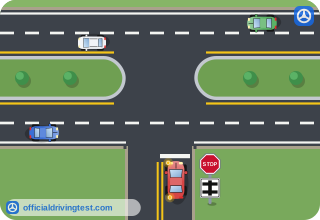
- So you can stop in the median if needed
- So you do not impede it as you get up to speed after completing your turn
- So you can make the turn without signaling
- So you can stay in the left lane of the roadway until it is clear
Show answer
Correct answer: So you do not impede it as you get up to speed after completing your turn
Ensure there is enough space from oncoming traffic so you do not impede them as you get up to speed after completing your turn.
Source: Minnesota Driver’s Manual (June 2026), page 32
-
What does the manual say about making U-turns on interstate freeways?
- You must not make them
- Make them only from the far right lane
- Make them only when no vehicle is near you
- Make them only by using the shoulder
Show answer
Correct answer: You must not make them
U-turns are not allowed on interstate freeways.
Source: Minnesota Driver’s Manual (June 2026), page 33
-
U-turns are illegal on curves where other drivers cannot see you from what distance?
- 300 feet
- 500 feet
- 1,000 feet
- 100 feet
Show answer
Correct answer: 1,000 feet
They are also illegal near the tops of hills and on curves where other drivers cannot see you from 1,000 feet away.
Source: Minnesota Driver’s Manual (June 2026), page 33
-
A driver should not make a U-turn unless they can do so in what way?
- Only after signaling for 200 feet
- Without disrupting other traffic
- Only after coming to a complete stop
- Only from the far left lane
Show answer
Correct answer: Without disrupting other traffic
A U-turn must not disrupt other traffic.
Source: Minnesota Driver’s Manual (June 2026), page 33
-
On a roadway with two or more lanes in the same direction, how may a driver make a U-turn when necessary?
- Turn from the center lane and drive across the median
- Stop in the left lane and back around to reverse
- Turn from the right lane across all lanes at once
- Turn into the farthest lane and temporarily use the shoulder
Show answer
Correct answer: Turn into the farthest lane and temporarily use the shoulder
When necessary, a driver may turn into the farthest lane and temporarily use the shoulder to make a U-turn on a roadway with two or more lanes in the same direction.
Source: Minnesota Driver’s Manual (June 2026), page 33
-
At a stop sign with a marked stop line, where must you stop?
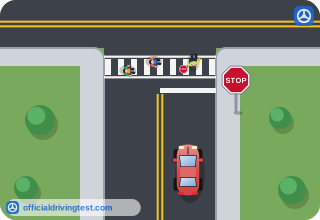
- Behind the line
- Past the line, so you can see traffic
- With your front wheels on the line
- Within 10 feet of the line
Show answer
Correct answer: Behind the line
A marked stop line tells you where to stop: before the line.
Source: Minnesota Driver’s Manual (June 2026), page 41
-
After stopping at a stop sign, what must you do before proceeding?
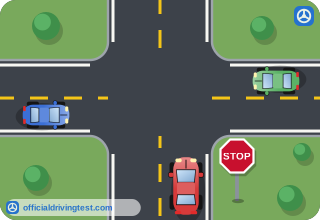
- Sound your horn to warn cross traffic and then proceed
- Wait for the driver behind you to signal you on
- Yield the right-of-way to pedestrians, bicyclists and traffic
- Wait for a gap in traffic only if a pedestrian is present
Show answer
Correct answer: Yield the right-of-way to pedestrians, bicyclists and traffic
At a stop sign you must give right-of-way to pedestrians, bicyclists and traffic before you go.
Source: Minnesota Driver’s Manual (June 2026), page 41
-
At a stop sign where there is a pedestrian crosswalk, where must you stop?
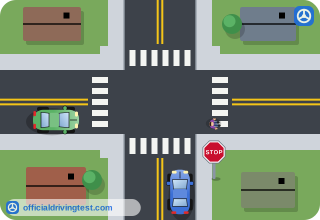
- In the middle of the crosswalk
- Before entering the crosswalk
- Just past the crosswalk
- Only if a pedestrian is waiting
Show answer
Correct answer: Before entering the crosswalk
With a pedestrian crosswalk at the stop sign, stop before you enter the crosswalk.
Source: Minnesota Driver’s Manual (June 2026), page 41
-
If your view of an intersection is obstructed, what should you be prepared to do?
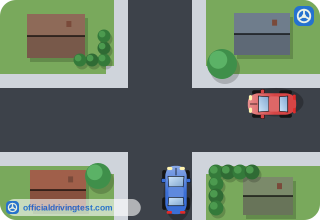
- Speed up to clear the intersection quickly
- Sound your horn and continue through slowly
- Pull onto the shoulder and wait for a signal
- Stop again for traffic or pedestrians in your path
Show answer
Correct answer: Stop again for traffic or pedestrians in your path
With an obstructed view, you must be ready to stop again for traffic or pedestrians in your path.
Source: Minnesota Driver’s Manual (June 2026), page 41
-
You are entering a road from an alley, private driveway, parking lot or parking ramp. What must you do before crossing the sidewalk?
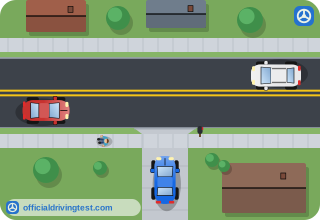
- Come to a complete stop
- Slow down and sound your horn
- Slow down and proceed if no one is in sight
- Stop only if a pedestrian is on the sidewalk
Show answer
Correct answer: Come to a complete stop
You must come to a complete stop before entering a road from these places, and always before crossing a sidewalk or crosswalk.
Source: Minnesota Driver’s Manual (June 2026), page 41
-
A pedestrian or bicyclist is crossing the road at an intersection or crosswalk, marked or unmarked. How long must you stay stopped?
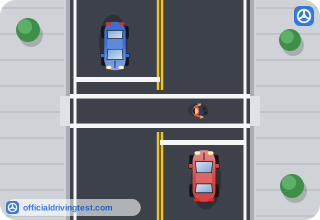
- Until they reach the middle of the road
- Until they have passed your lane
- Until they have crossed the whole road
- For three seconds
Show answer
Correct answer: Until they have passed your lane
You must stop for a pedestrian or bicyclist crossing and stay stopped until they have passed your lane.
Source: Minnesota Driver’s Manual (June 2026), page 41
-
You must come to a complete stop at a bridge that
- is narrower than the road leading to it
- has a posted weight limit
- has been raised to open a path for boats
- crosses over a railroad track
Show answer
Correct answer: has been raised to open a path for boats
A bridge raised to let boats through requires a complete stop.
Source: Minnesota Driver’s Manual (June 2026), page 41