Minnesota: Right-of-way and turning — Part 1 Practice Test
Questions in this part include: “On a wide road, the rule that you must drive on the right side does not apply when the road has how many marked lanes?” · “On a wide road, which of these allows you to drive on the left side of the road?”
Independent educational site · not affiliated with any government agency or DMV
Ready? Test yourself
- Instant feedback with an explanation
- Every answer cites its source in the manual
- Your best score is saved on this device
Questions are original and based on the official manual "Minnesota Driver’s Manual" (June 2026), Minnesota Driver and Vehicle Services.
All 17 questions in this practice test
Take the test above first, then use this list to study. Tap “Show answer” to see the correct answer and explanation.
Show the questions and answersHide the questions
-
On a wide road, the rule that you must drive on the right side does not apply when the road has how many marked lanes?
- Three
- Two
- Four
- Five
Show answer
Correct answer: Three
The manual lists a road with three marked lanes as an exception to driving on the right side of a wide road.
Source: Minnesota Driver’s Manual (June 2026), page 26
-
On a wide road, which of these lets you drive on the left side of the road?
- The right side of the road has heavy traffic and you want to keep moving
- The right lane has a wet surface and you want to avoid it
- The right side of the road is closed for construction or repair
- You are driving a wider vehicle than most traffic on the road
Show answer
Correct answer: The right side of the road is closed for construction or repair
A right side that is closed for construction or repair is one of the exceptions to driving on the right side of a wide road.
Source: Minnesota Driver’s Manual (June 2026), page 26
-
In accordance with the Move Over Law, when may you leave the right side of a wide road?
- When you need to move over for a pedestrian waiting beside the road
- When you need to move over for an authorized vehicle parked or stopped on the road
- When you need to move over for a vehicle that has signaled a right turn
- When you need to move over for a mailbox on the side of the road
Show answer
Correct answer: When you need to move over for an authorized vehicle parked or stopped on the road
Moving over for an authorized vehicle parked or stopped on the road under the Move Over Law is an exception to driving on the right side of a wide road.
Source: Minnesota Driver’s Manual (June 2026), page 26
-
On a wide road, which sign-based situation lets you drive on the left side of the road?
- Signs indicate a speed limit of 55 mph
- Signs indicate a school zone ahead
- Signs indicate a railroad crossing ahead
- Signs indicate that the road is one-way
Show answer
Correct answer: Signs indicate that the road is one-way
When signs indicate the road is one-way, you do not have to keep to the right side of a wide road.
Source: Minnesota Driver’s Manual (June 2026), page 26
-
On a wide road, which of these allows you to drive on the left side of the road?
- You are following another vehicle going in the same direction
- You are meeting another vehicle coming toward you
- You are passing another vehicle going in the same direction
- You are preparing to turn right at the next corner
Show answer
Correct answer: You are passing another vehicle going in the same direction
Passing another vehicle going in the same direction is one of the exceptions to driving on the right side of a wide road.
Source: Minnesota Driver’s Manual (June 2026), page 26
-
What happens if you approach an intersection at an unlawful speed?
- You keep the right-of-way but are given a fine
- Your right-of-way is shared equally with the other drivers at the intersection
- You lose the right-of-way privilege that goes with driving at a lawful speed
- You keep the right-of-way if no other vehicles are nearby
Show answer
Correct answer: You lose the right-of-way privilege that goes with driving at a lawful speed
Approaching an intersection at an unlawful speed means losing the right-of-way privilege associated with a lawful speed.
Source: Minnesota Driver’s Manual (June 2026), page 26
-
What is true about traffic lanes that are not marked?
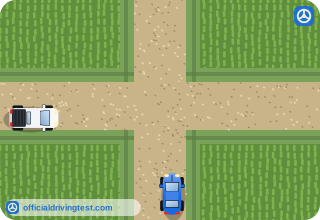
- The lanes still exist whether they are marked or not
- There are no lanes, so you may drive anywhere on the road
- Lanes exist only on roads with a posted speed limit
- Lanes exist only on roads with more than two lanes
Show answer
Correct answer: The lanes still exist whether they are marked or not
Lanes may not always be marked, but they exist whether marked or not, and you are in a traffic lane whenever you drive on a street or highway.
Source: Minnesota Driver’s Manual (June 2026), page 27
-
What must you do when driving in a traffic lane?
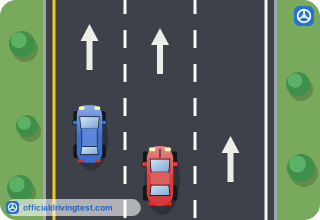
- Move from lane to lane to find the lane that has the least traffic
- Straddle the lane markings to keep clear of parked cars
- Weave only when the road is clear of other vehicles
- Stay within a single lane without weaving or straddling the lane markings
Show answer
Correct answer: Stay within a single lane without weaving or straddling the lane markings
You must stay within a single traffic lane without weaving or straddling the lane markings.
Source: Minnesota Driver’s Manual (June 2026), page 27
-
Besides using your mirrors, what should you do before moving into another lane?
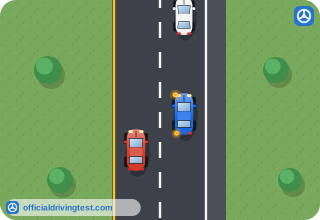
- Honk your horn to warn the vehicles in that lane
- Turn your head to check the lane you are moving into for vehicles
- Flash your headlights to tell the vehicles in that lane to slow down
- Slow to a stop and wait for the lane to clear
Show answer
Correct answer: Turn your head to check the lane you are moving into for vehicles
The manual says to turn your head to check the lane and not to rely solely on mirrors, because you may miss vehicles in your blind spots.
Source: Minnesota Driver’s Manual (June 2026), page 28
-
Before moving into another lane, what must you make sure you have?
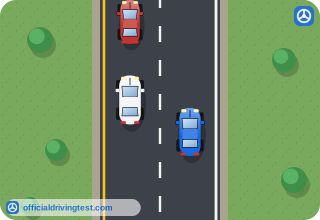
- Space to the side, behind and ahead of your vehicle
- Space ahead of your vehicle only
- A clear lane for at least a quarter mile ahead of you
- Space to the side of your vehicle only
Show answer
Correct answer: Space to the side, behind and ahead of your vehicle
To stay safe, make sure you have space to the side, behind and ahead of your vehicle before moving into another lane.
Source: Minnesota Driver’s Manual (June 2026), page 28
-
When should you move into the correct lane for a turn?
- Right at the intersection, as soon as the light turns green
- Just after you begin the turn
- As you enter the intersection
- Well ahead of the place where you will make the actual turn
Show answer
Correct answer: Well ahead of the place where you will make the actual turn
The manual says to move safely into the correct lane well ahead of the place where you will make the actual turn.
Source: Minnesota Driver’s Manual (June 2026), page 28
-
While waiting to make a turn, how should you hold your wheels and your foot?
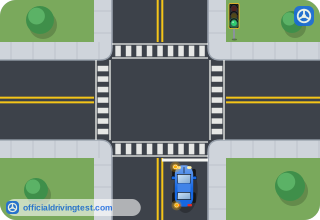
- Wheels turned toward the turn and foot off the brake
- Wheels straight and foot on the brake
- Wheels turned toward the turn and foot on the brake
- Wheels straight and foot off the brake
Show answer
Correct answer: Wheels straight and foot on the brake
Keeping your wheels straight and your foot on the brake means you are less likely to be pushed into oncoming traffic if your vehicle is struck from behind.
Source: Minnesota Driver’s Manual (June 2026), page 28
-
What does the manual say about making a sudden turn from the wrong lane?
- You should not make sudden turns from the wrong lane
- It is allowed if you signal first
- It is allowed if no vehicle is following behind you
- It is allowed on one-way streets
Show answer
Correct answer: You should not make sudden turns from the wrong lane
The manual says not to make sudden turns from the wrong lane.
Source: Minnesota Driver’s Manual (June 2026), page 28
-
What should you do if the car ahead of you is signaling for a left turn?
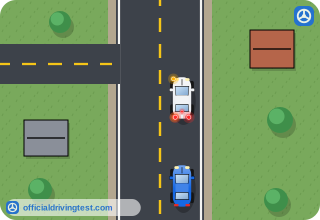
- Pass it on the left
- Honk to tell the driver to hurry
- Slow down and prepare to stop
- Move up close behind its bumper
Show answer
Correct answer: Slow down and prepare to stop
If the car ahead of you is signaling for a left turn, slow down and prepare to stop.
Source: Minnesota Driver’s Manual (June 2026), page 28
-
When waiting to make a left turn at a green light with oncoming traffic, where should you position your car?
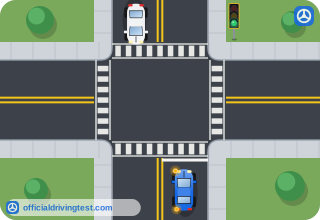
- Behind the crosswalk, with your wheels turned to the left
- Into the intersection, where your body is even with the curb line
- Well back from the intersection to leave room for traffic behind
- In the crosswalk, with your wheels turned to the left
Show answer
Correct answer: Into the intersection, where your body is even with the curb line
You position your car into the intersection where your body is even with the curb line while waiting to turn left at a green light with oncoming traffic.
Source: Minnesota Driver’s Manual (June 2026), page 28
-
When waiting to turn left at a green light with oncoming traffic, when may you only be able to make the turn?
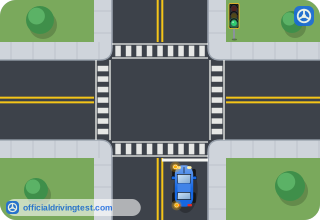
- When the light changes to red
- When the oncoming traffic stops for you
- When the light changes to a green arrow
- When the light changes to yellow
Show answer
Correct answer: When the light changes to yellow
With oncoming traffic you may only be able to make the turn when the light changes to yellow.
Source: Minnesota Driver’s Manual (June 2026), page 28
-
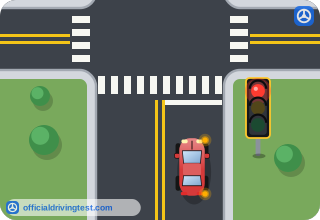
What must you do before making a right turn on a red light?
- Slow down and turn without stopping if no vehicle is near
- Stop only if pedestrians are crossing
- Come to a complete stop in the correct lane
- Honk to warn the traffic that has a green light
Show answer
Correct answer: Come to a complete stop in the correct lane
To turn right on red you must be in the correct lane and come to a complete stop.
Source: Minnesota Driver’s Manual (June 2026), page 28