Pavement markings in Michigan
The What Every Driver Must Know shows or names everything on this page: 17 in all, on pages 38, 45–49, 57.
Independent educational site · not affiliated with any government agency or DMV
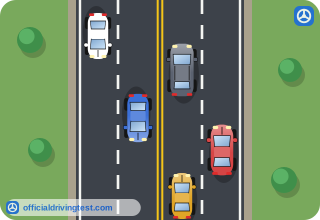
Four-lane road: double yellow centre line
White lines separate traffic lanes moving in the same direction. ... On roads that have more than one lane moving in one direction, broken white lines separate traffic lanes. Do not straddle the broken white lines or cross the double yellow line. See Figure 5.1.
Manual page 45 · Open this page in the manual (Manual page 45)
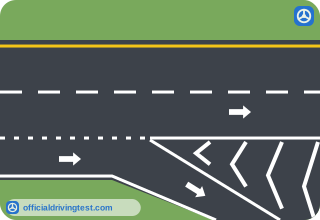
Freeway exit: gore and exit-lane markings
Solid white lines mark the right edge of the road. Often called fog lines, these lines help you stay on the road at night or in bad weather. It is illegal to cross solid white lines when passing. Solid white lines also are used to separate lanes of traffic moving in the same direction. Do not cross a solid white line. These white lines may designate sharp curves, freeway acceleration and deceleration lanes, and other parts of the road where lane changes are considered dangerous. See Figure 5.2.
Manual page 46 · Open this page in the manual (Manual page 46)
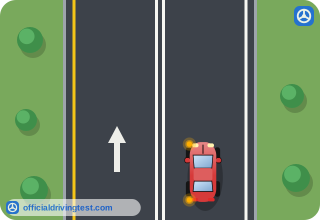
Double solid white lines (one-way road)
A double solid white line is used to show a travel path where driving in the same direction is permitted on both sides of the line but crossing the line is prohibited. See Figure 5.3. Do not cross double solid white lines.
Manual page 46 · Open this page in the manual (Manual page 46)
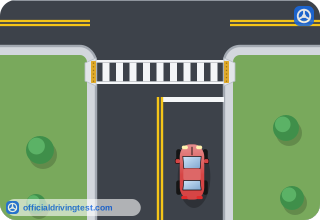
Bar (ladder) crosswalk with stop line
Solid white lines mark many pedestrian crosswalks. They are painted all the way across the pavement. Crosswalks are also indicated by white stripes placed on the road in the direction of traffic. Crosswalks are placed at intersections and sometimes between intersections. Stop your vehicle behind the crosswalk line. See Figure 5.4.
Manual page 46 · Open this page in the manual (Manual page 46)
STOP LINE (wide white line)
[p46: "Stop lines are wide white lines painted across a traffic lane that mark where you must stop your vehicle at intersections. This keeps the vehicle out of the way of pedestrians and cross traffic. If there are no stop lines or crosswalks, stop the vehicle before entering the intersection. Whether or not there is a stop line, make sure you are able to see traffic from all directions before proceeding."] [p53: "The white stopping lines on the pavement are there for a reason. If you stop past the line, a commercial vehicle may not be able to complete its turn without hitting you."] [p55: "Michigan law also requires drivers to stop at the marked crosswalk limit line or before entering the intersection if no limit line exists."]
Manual page 46 · Open this page in the manual (Manual page 46)
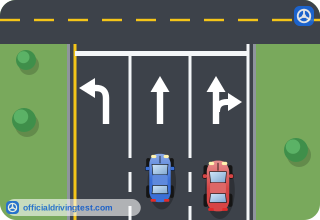
Lane-use arrows (straight-right, right-turn)
Directional arrows are wide white arrows painted down the center of the traffic lane. For example, in Figure 5.5, only right turns are permitted in the lane farthest to the right. The next lane permits either right turns or straight travel through the intersection. It is illegal to make a right turn from the remaining two lanes. Always check for traffic and pedestrians before proceeding or completing your turn.
Manual page 47 · Open this page in the manual (Manual page 47)
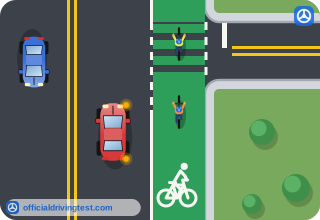
Green-coloured bike lane
A bicycle lane is labeled with special pavement markings and signs and is reserved exclusively for bicyclists. A green bicycle lane indicates a potential point of conflict between cars and bicycles, usually intersections and driveways. Watch for bicyclists and take extra care when turning at green bicycle lanes. It is illegal to use these lanes for driving, passing, making right turns, parking, or as a pull-over to wait for someone or make a delivery.
Manual page 47 · Open this page in the manual (Manual page 47)
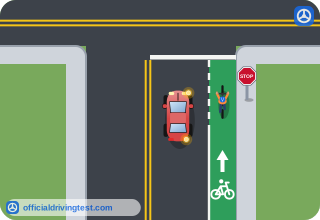
Bike lane with car turning right
Look for bicyclists riding from behind on the road shoulder or in a bike lane before turning right at an intersection, into a driveway or pulling off the road. As appropriate, yield and allow them to pass before turning. Do not use the bicycle lane as a right-turn lane. Do not overtake a bicyclist and turn right unless it is safe to do so.
Manual page 57 · Open this page in the manual (Manual page 57)
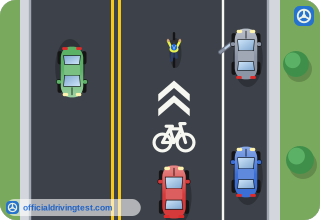
Bike symbol, sharrow and turn arrow
Shared lane markings (figure to the right) alert road users about the proper lane positioning and traffic flow to ensure safety. If you see a shared lane marking, watch for bicyclists and give them the space, courtesy and respect they deserve as legal road users.
Manual page 47 · Open this page in the manual (Manual page 47)
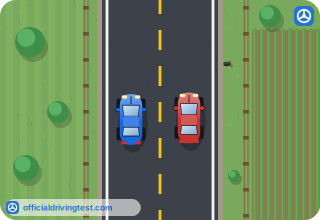
Two-lane road: broken yellow centre, solid white edge lines
[Yellow lines: "Yellow lines separate traffic lanes moving in opposite directions. They include solid, broken and center-lane lines."] [Broken yellow lines: "A single broken yellow line usually marks the center line of a two-way roadway where a vehicle may pass if it is safe to do so."]
Manual page 47 · Open this page in the manual (Manual page 47)
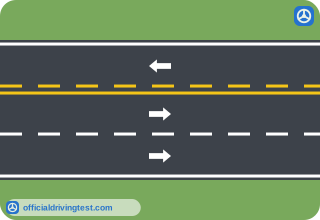
Three-lane road: passing allowed in single-lane direction
If a solid yellow line is on your side of the center line, do not cross it to pass. See Figure 5.6. On a four-lane divided roadway or a one-way road, a solid yellow line usually marks the left edge of the pavement.
Manual page 47 · Open this page in the manual (Manual page 47)
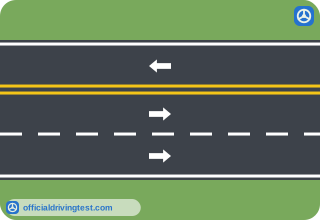
Three-lane road: no passing in single-lane direction
A double solid yellow line down the middle of a two-lane roadway means that passing is not allowed for vehicles traveling in either direction. There are some situations in which crossing a double yellow line is permitted, such as when turning into a driveway, onto a crossroad, or accessing a parking spot. [p45: "Do not straddle the broken white lines or cross the double yellow line."]
Manual page 47 · Open this page in the manual (Manual page 47)
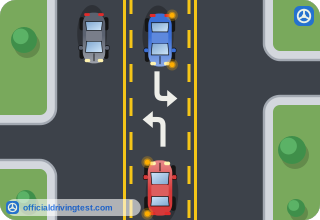
Two-way left-turn centre lane
A left turn only center lane helps traffic flow smoothly by providing a designated lane for left turns. Each outside edge of the left turn only center lane is marked with a solid yellow line with broken yellow lines on the inside edges. See Figure 5.7.
Manual page 48 · Open this page in the manual (Manual page 48)
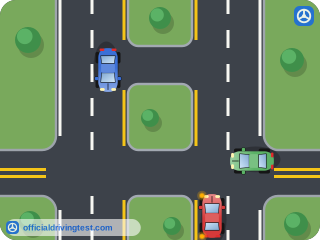
Median crossover (Michigan left) diagram
A multi-lane Michigan Left is designed for two vehicles to turn at a time. Pavement markings, such as arrows, ONLY lettering, and white solid lines, indicate that both lanes may be used to turn. An unmarked median crossover should always be treated as a single-lane crossover.
Manual page 48 · Open this page in the manual (Manual page 48)
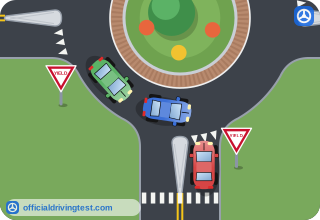
Yield triangles (shark teeth)
[Yield lines: "Yield lines are typically found at roundabout intersections and mid-block crosswalks to help regulate the flow of traffic. When yielding to traffic or pedestrians, make sure to stop behind the yield lines. There are two types of yield lines."] [White triangular symbols: "White triangles painted across a traffic lane indicate you should be ready to stop and yield to pedestrians. See Figure 5.9."] [p55: "A yield line is sometimes used to indicate the location where drivers should stop for pedestrians in the crosswalk. See Figure 6.1."]
Manual page 49 · Open this page in the manual (Manual page 49)
Roundabout entry: dashes, yield triangles, arrow
Dashed white lines painted across a traffic lane in a roundabout indicate the edge of the roundabout’s circular lane. See Figure 5.10.
Manual page 49 · Open this page in the manual (Manual page 49)
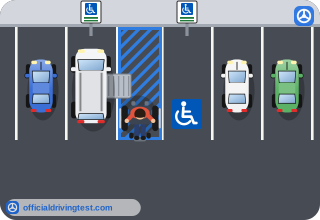
Accessible parking: blue lines and striped aisle
Van-accessible parking spaces are wider than standard parking spaces. This provides room for the van’s wheelchair lift and ramp, allowing the person with a disability to easily exit and enter the vehicle. For this reason, it is extremely important not to park on the blue-striped area of the van-accessible parking space. Doing so may prevent the person with a disability from getting in or out of the vehicle. It is also important to not block the ramp or curb cuts used by people with disabilities.
Manual page 38 · Open this page in the manual (Manual page 38)