Michigan: Pavement markings Practice Test
White and yellow lines, bike lanes, turn lanes and Michigan Lefts.
Independent educational site · not affiliated with any government agency or DMV
Ready? Test yourself
- Instant feedback with an explanation
- Every answer cites its source in the manual
- Your best score is saved on this device
- Keyboard: press 1 to 4 to answer and Enter for the next question
Questions are original and based on the official manual "What Every Driver Must Know" (October 2025), Michigan Secretary of State.
Did you know?
- In 1915, the first stop sign was used in Detroit.
- In 1917, Michigan painted the first center line on a state highway, the Marquette-to-Negaunee Road.
- In 1920, the first four-way traffic signal with red, yellow and green lights was used at Woodward Avenue and Fort Street in Detroit.
More background reading from the manual →
All 14 questions in this practice test
Take the test above first, then use this list to study. Tap “Show answer” to see the correct answer and explanation.
Show the questions and answersHide the questions
-
What do broken white lines separate?
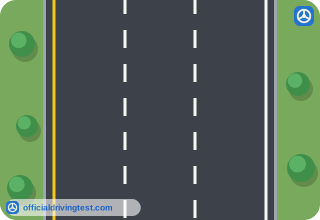
- Lanes moving in opposite directions
- Lanes moving in the same direction
- A bicycle lane from a crosswalk
- The road from the shoulder
Show answer
Correct answer: Lanes moving in the same direction
Broken white lines separate lanes of traffic moving in the same direction.
Source: What Every Driver Must Know (October 2025), page 45 · Open this page in the manual (Manual page 45)
-
A solid white line along the right edge of the road (a fog line) helps you:
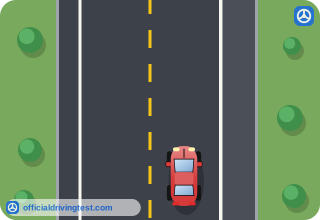
- Find the next exit along the freeway
- Know where you may cross the line to pass
- Stay on the road at night or in bad weather
- Locate legal parking along the roadside
Show answer
Correct answer: Stay on the road at night or in bad weather
Fog lines help you stay on the road at night or in bad weather.
Source: What Every Driver Must Know (October 2025), page 46 · Open this page in the manual (Manual page 46)
-
What does a double solid white line mean?
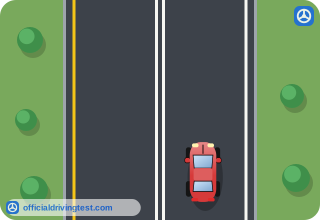
- You may cross it to pass slower traffic when safe
- Traffic on each side moves in opposite directions
- Same-direction travel on both sides; do not cross
- A bicycle lane begins just ahead
Show answer
Correct answer: Same-direction travel on both sides; do not cross
Do not cross double solid white lines.
Source: What Every Driver Must Know (October 2025), page 46 · Open this page in the manual (Manual page 46)
-
You reach a stop sign with no stop line and no crosswalk. Where must you stop?
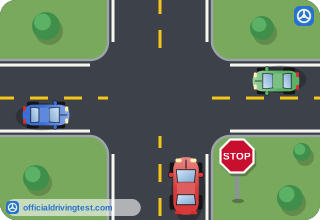
- In the middle of the intersection
- Just past the intersection
- Only if other cars are present
- Before entering the intersection
Show answer
Correct answer: Before entering the intersection
If there are no stop lines or crosswalks, stop before entering the intersection, and make sure you can see traffic from all directions before going.
Source: What Every Driver Must Know (October 2025), page 46 · Open this page in the manual (Manual page 46)
-
A single broken yellow line in the center of a two-way road means:
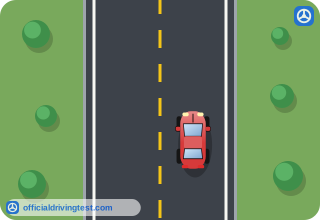
- Passing is never allowed
- You may pass if it is safe
- The road is one way
- Only left turns are allowed
Show answer
Correct answer: You may pass if it is safe
A single broken yellow line usually marks a center line where you may pass if it is safe.
Source: What Every Driver Must Know (October 2025), page 47 · Open this page in the manual (Manual page 47)
-
A double solid yellow line down the middle of a two-lane road means:
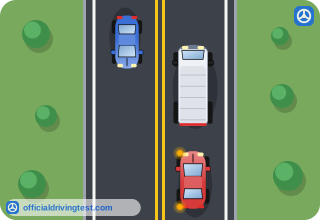
- Passing is not allowed in either direction
- Passing is allowed for vehicles on the right
- Passing is allowed when no traffic is coming
- It is a bicycle lane
Show answer
Correct answer: Passing is not allowed in either direction
A double solid yellow line means no passing for traffic in either direction.
Source: What Every Driver Must Know (October 2025), page 47 · Open this page in the manual (Manual page 47)
-
When may you cross a double solid yellow line?
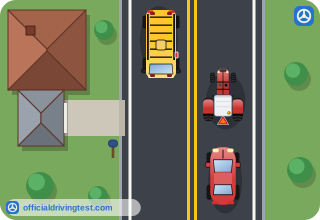
- To pass a slow vehicle when the road is clear
- To get around a stopped school bus
- Never, under any circumstances
- To turn into a driveway, crossroad or parking spot
Show answer
Correct answer: To turn into a driveway, crossroad or parking spot
Crossing is permitted for turns into a driveway, onto a crossroad, or to reach a parking spot, but not for passing.
Source: What Every Driver Must Know (October 2025), page 47 · Open this page in the manual (Manual page 47)
-
There is a solid yellow line on your side of the center line. What must you do?
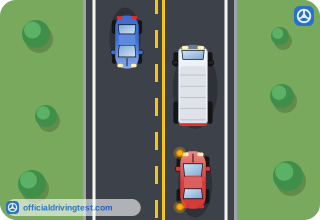
- Cross it to pass if the road ahead looks clear
- Not cross it to pass
- Slow down and honk before passing
- Cross it only to pass trucks
Show answer
Correct answer: Not cross it to pass
If a solid yellow line is on your side, do not cross it to pass.
Source: What Every Driver Must Know (October 2025), page 47 · Open this page in the manual (Manual page 47)
-
What must drivers do at a green bicycle lane?
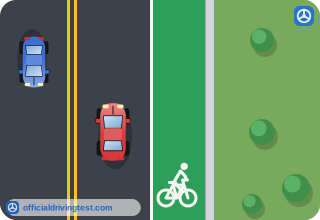
- Drive in it whenever traffic ahead is heavy
- Use it to pass slow traffic on the right
- Watch for bicyclists; take extra care when turning
- Pull over in it briefly to wait for someone
Show answer
Correct answer: Watch for bicyclists; take extra care when turning
A green bicycle lane marks a potential point of conflict between cars and bicycles. It is illegal to use bicycle lanes for driving, passing, right turns, parking, or waiting.
Source: What Every Driver Must Know (October 2025), page 47 · Open this page in the manual (Manual page 47)
-
What should you do when you see a shared lane marking on the road?
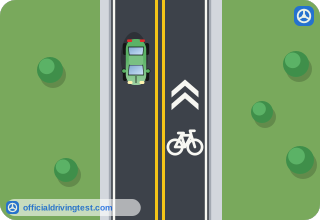
- Treat it as a lane reserved for parking
- Watch for bicyclists and give them space
- Treat it as a lane reserved for carpools
- Ignore it, since it applies only to bicyclists
Show answer
Correct answer: Watch for bicyclists and give them space
Bicyclists are legal road users and deserve space, courtesy and respect.
Source: What Every Driver Must Know (October 2025), page 47 · Open this page in the manual (Manual page 47)
-
Which statement about a left-turn-only center lane is correct?
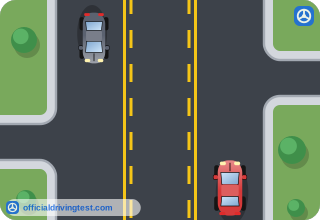
- You may use it to pass slower cars
- You may use it as a merge lane
- Left turns are made from inside it, from either direction
- It may be used only by traffic from one direction
Show answer
Correct answer: Left turns are made from inside it, from either direction
Left turns must be made from within the lane. Using it to pass or merge is illegal and dangerous.
Source: What Every Driver Must Know (October 2025), page 48 · Open this page in the manual (Manual page 48)
-
At an intersection with a "Michigan Left", how do you turn left?
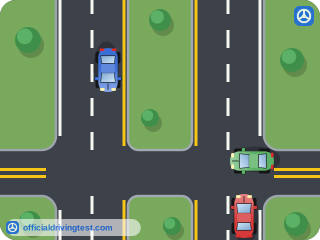
- Turn left directly from the left lane
- Stop in the intersection and wait for a gap in oncoming traffic
- Turn left from the far-right lane
- Go straight (or turn right), then U-turn at the median crossover
Show answer
Correct answer: Go straight (or turn right), then U-turn at the median crossover
Michigan Lefts do not allow traditional left-turn movements. To turn left, drive straight through the intersection, or turn right, then make a U-turn at a median crossover.
Source: What Every Driver Must Know (October 2025), page 48 · Open this page in the manual (Manual page 48)
-
How should you treat an unmarked median crossover at a Michigan Left?
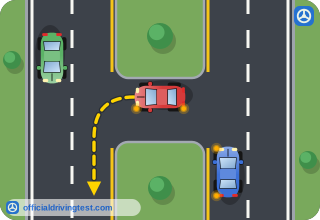
- As a two-lane crossover
- As a passing lane
- As a single-lane crossover
- As a parking area
Show answer
Correct answer: As a single-lane crossover
An unmarked median crossover should always be treated as a single-lane crossover.
Source: What Every Driver Must Know (October 2025), page 48 · Open this page in the manual (Manual page 48)
-
White triangles painted across a traffic lane mean:
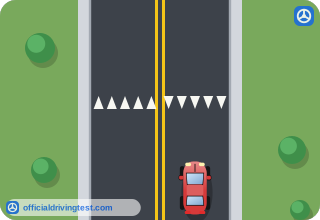
- A speed limit change
- A bicycle lane begins
- The freeway ends
- Yield to pedestrians
Show answer
Correct answer: Yield to pedestrians
Stop behind the yield line when yielding to pedestrians or traffic.
Source: What Every Driver Must Know (October 2025), page 49 · Open this page in the manual (Manual page 49)