Massachusetts: Emergency vehicles and work zones
Yielding to emergency vehicles, the move-over law, what to do when a police officer stops you, and driving through work zones. Split into 3 shorter tests so you're not stuck in one long quiz.
Independent educational site · not affiliated with any government agency or DMV
Choose a part
Emergency vehicles and work zones — Part 1
Questions in this part include: “Why should you avoid loud noise levels in your vehicle?”
StartEmergency vehicles and work zones — Part 2
Questions in this part include: “Where are portable arrow boards located?”
StartEmergency vehicles and work zones — Part 3
Questions in this part include: “What is the closest you may legally drive by or park to a fire?”
StartAll 56 Emergency vehicles and work zones questions with answers
Choose a part above to take a practice test, or study every question and answer here.
Show the questions and answersHide the questions
-
Why should you avoid loud noise levels in your vehicle?
- To protect your own hearing
- To avoid distracting your passengers
- To keep the horn audible to others
- So you can hear emergency vehicle sirens
Show answer
Correct answer: So you can hear emergency vehicle sirens
The manual says to avoid loud noise levels so you can hear emergency vehicle sirens.
Source: Massachusetts Driver's Manual (Revised April 2026), page 39 · Open this page in the manual (Manual page 39)
-
If you are caught speeding in a posted work zone, what happens to the speeding fine?
- It is waived for a first offense
- It is doubled
- It is reduced by half
- It stays the same
Show answer
Correct answer: It is doubled
The manual says that speeding in a posted work zone doubles the speeding fine.
Source: Massachusetts Driver's Manual (Revised April 2026), page 57 · Open this page in the manual (Manual page 57)
-
What do warning signs and traffic control devices do in a roadway work zone?
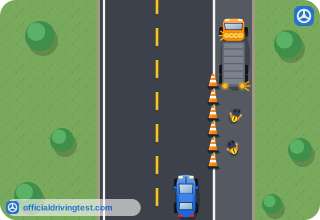
- They permit you to ignore the posted speed limit there
- They replace the need to obey police officers on site
- They show where parking is allowed
- They mark and protect the work zone and guide you through it
Show answer
Correct answer: They mark and protect the work zone and guide you through it
Work zone sections are designated and protected by warning signs and traffic control devices that help guide you safely through.
Source: Massachusetts Driver's Manual (Revised April 2026), page 87 · Open this page in the manual (Manual page 87)
-
What should you do when approaching a work zone?
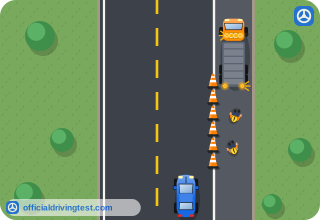
- Maintain your speed
- Change lanes at once
- Reduce your speed
- Stop and wait for directions
Show answer
Correct answer: Reduce your speed
When approaching a work zone, reduce your speed.
Source: Massachusetts Driver's Manual (Revised April 2026), page 87 · Open this page in the manual (Manual page 87)
-
If a police officer or civil flagger is present in a work zone, what must you do?
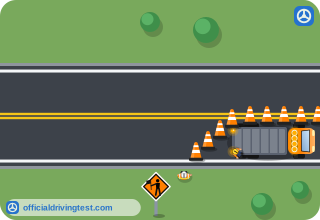
- Follow and obey their directions
- Follow the signs instead
- Ignore them if the road looks clear
- Stop and wait for permission to proceed
Show answer
Correct answer: Follow and obey their directions
If a police officer or civil flagger is present, follow and obey their directions.
Source: Massachusetts Driver's Manual (Revised April 2026), page 87 · Open this page in the manual (Manual page 87)
-
What must you always do about the directions of a traffic officer?
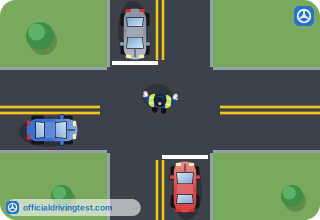
- Obey them only when signals are not working
- Obey them, even when they overrule signs or signals
- Obey them only in work zones
- Obey signs and signals first
Show answer
Correct answer: Obey them, even when they overrule signs or signals
You must always obey directions of a traffic officer, even when they overrule signs, signals, or pavement markings.
Source: Massachusetts Driver's Manual (Revised April 2026), page 87 · Open this page in the manual (Manual page 87)
-
What does the manual say about being distracted by what is happening within a work zone?
- It is fine to look at work crews
- It is fine if you slow down
- It matters only at night
- Do not be distracted by it
Show answer
Correct answer: Do not be distracted by it
The manual says not to be distracted by what is happening within a work zone.
Source: Massachusetts Driver's Manual (Revised April 2026), page 87 · Open this page in the manual (Manual page 87)
-
How is the start of a work zone indicated?
- With a warning sign or electronic message sign
- With a green guide sign beside the road
- With a painted stop line across the road
- With a police officer and no signs at all
Show answer
Correct answer: With a warning sign or electronic message sign
The start of a work zone is indicated with a warning sign or electronic message sign.
Source: Massachusetts Driver's Manual (Revised April 2026), page 87 · Open this page in the manual (Manual page 87)
-
Where are civil flaggers typically used?
- On high-speed, high-volume highways
- On low-speed, low-volume roadways
- Only on interstate freeways
- Only at railroad crossings
Show answer
Correct answer: On low-speed, low-volume roadways
Civil flaggers are typically used on low-speed, low-volume roadways to control traffic movement around the work area.
Source: Massachusetts Driver's Manual (Revised April 2026), page 87 · Open this page in the manual (Manual page 87)
-
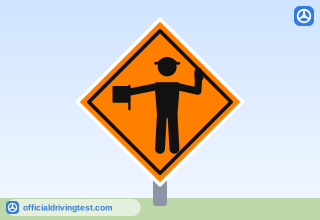
An orange diamond sign shows a person holding a flag. What does it mean?
- Pedestrian crossing ahead
- School crossing ahead
- Road closed ahead
- Flagger Ahead
Show answer
Correct answer: Flagger Ahead
An orange diamond with a flagger figure warns that a flagger is ahead.
Source: Massachusetts Driver's Manual (Revised April 2026), page 87 · Open this page in the manual (Manual page 87)
-
What do upcoming warning signs in a work zone tell you?
- How much longer the work will take to finish
- Which nearby streets are closed permanently
- Where work is taking place and how to get through it
- Where the workers' vehicles are parked today
Show answer
Correct answer: Where work is taking place and how to get through it
Upcoming warning signs inform you of where work is taking place and how you should maneuver through the work area.
Source: Massachusetts Driver's Manual (Revised April 2026), page 87 · Open this page in the manual (Manual page 87)
-
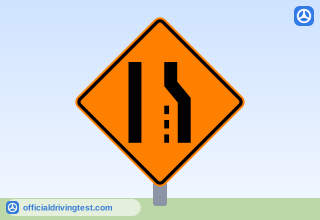
An orange diamond sign shows two lanes with the right lane ending. What does it mean?
- The lanes are shifting to the right
- The right lane is closed; merge left
- A lane is added on the right
- The road ends at a junction ahead
Show answer
Correct answer: The right lane is closed; merge left
An orange diamond showing the right lane ending means the right lane is closed and traffic should move to the left.
Source: Massachusetts Driver's Manual (Revised April 2026), page 88 · Open this page in the manual (Manual page 88)
-
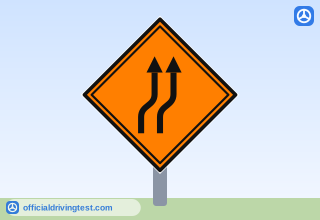
An orange diamond sign shows two arrows bending to the right. What does it mean?
- The right lane is closed; merge left
- Road turns right ahead
- The lanes are shifting to the right
- A flagger is ahead in the right lane
Show answer
Correct answer: The lanes are shifting to the right
An orange diamond with arrows bending right means the lanes are shifting to the right.
Source: Massachusetts Driver's Manual (Revised April 2026), page 88 · Open this page in the manual (Manual page 88)
-
What are drums, cones, and tubular markers used for in a work zone?
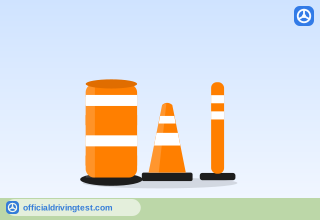
- To show drivers where parking is allowed
- To mark the speed limit inside the work area
- To show where the workers' vehicles are parked
- To direct traffic away from a closed shoulder or lane
Show answer
Correct answer: To direct traffic away from a closed shoulder or lane
Devices such as drums, cones, and tubular markers direct traffic away from a work area where the shoulder or travel lane is closed.
Source: Massachusetts Driver's Manual (Revised April 2026), page 88 · Open this page in the manual (Manual page 88)
-
How are drums, cones, and tubular markers usually lined up?
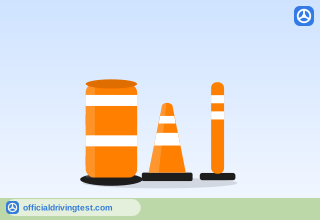
- In an angular fashion to shift traffic left or right
- In a straight line down the center of the road
- In a circle around the entire work area
- In a single row along the shoulder only
Show answer
Correct answer: In an angular fashion to shift traffic left or right
They are usually lined up in an angular fashion to shift traffic from the beginning of a travel lane to the left or right.
Source: Massachusetts Driver's Manual (Revised April 2026), page 88 · Open this page in the manual (Manual page 88)
-
What should you do when you see drums, cones, or tubular markers in the roadway?
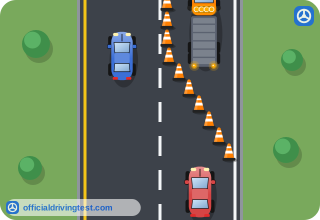
- Drive through the gaps between them slowly
- Stop and wait for a flagger to wave you
- Carefully merge into the adjacent travel lane
- Merge at the last possible moment ahead
Show answer
Correct answer: Carefully merge into the adjacent travel lane
You should carefully merge into the adjacent travel lane when you see these devices in the roadway.
Source: Massachusetts Driver's Manual (Revised April 2026), page 88 · Open this page in the manual (Manual page 88)
-
What is often used to block off access to a lane that is closed to traffic?
- A drum
- A barricade
- A tubular marker
- A detour sign
Show answer
Correct answer: A barricade
When a lane is closed to traffic, a barricade is often used to block off access to that area.
Source: Massachusetts Driver's Manual (Revised April 2026), page 88 · Open this page in the manual (Manual page 88)
-
What do detour signs provide?
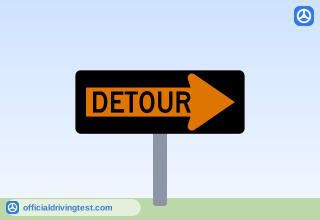
- The reduced speed limit inside the work zone
- The total length of the work zone in miles
- The location of the nearest flagger or officer on duty
- Directions to bypass the work zone and return to the road
Show answer
Correct answer: Directions to bypass the work zone and return to the road
Detour signs provide direction on bypassing the work zone and then getting back on the original road.
Source: Massachusetts Driver's Manual (Revised April 2026), page 88 · Open this page in the manual (Manual page 88)
-
When are detour signs posted?
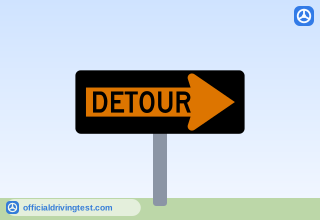
- When road work fully closes lanes in one direction or the whole road
- When road work takes place only on the shoulder of the road
- When one lane is narrowed but still open
- When no workers are present at the work site
Show answer
Correct answer: When road work fully closes lanes in one direction or the whole road
Detour signs are posted when road work requires full closure of travel lanes in one direction, or an entire road closure.
Source: Massachusetts Driver's Manual (Revised April 2026), page 88 · Open this page in the manual (Manual page 88)
-
What are portable arrow boards used for on multiple lane roadways?
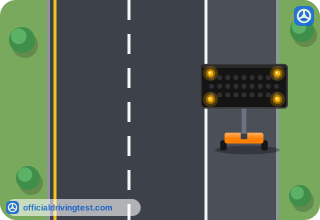
- To show the speed limit that applies in the work zone
- To mark where the work zone ends ahead
- To show a closed lane or shoulder and which lane is open
- To show where the workers are currently present
Show answer
Correct answer: To show a closed lane or shoulder and which lane is open
On multiple lane roadways, portable arrow boards notify drivers that the shoulder or lane is closed and which lane is open for travel.
Source: Massachusetts Driver's Manual (Revised April 2026), page 88 · Open this page in the manual (Manual page 88)
-
Where are portable arrow boards located?
- Beside the work area on the shoulder
- Before the work area, within the closed lane
- After the work area, beyond the closed lane
- On the center median only
Show answer
Correct answer: Before the work area, within the closed lane
Arrow boards are located before the work area within the closed lane to give you notice to merge your vehicle when it is safe.
Source: Massachusetts Driver's Manual (Revised April 2026), page 88 · Open this page in the manual (Manual page 88)
-
According to the manual, what is the FIRST thing you must do when approaching a work zone?
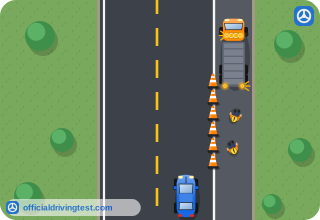
- Slow down and look for guidance on how to travel safely through it
- Speed up to clear the work zone as quickly as you can
- Move into the far left lane to stay away from the workers
- Stop completely until a worker waves you forward
Show answer
Correct answer: Slow down and look for guidance on how to travel safely through it
The manual says the first thing to do when approaching a work zone is to slow down and look for guidance on how to travel safely through the area.
Source: Massachusetts Driver's Manual (Revised April 2026), page 89 · Open this page in the manual (Manual page 89)
-
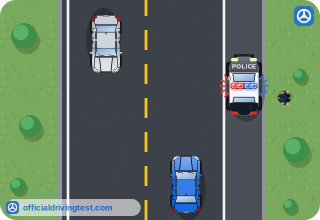
You approach a stationary emergency vehicle displaying its flashing lights. What does the move-over law require you to do?
- Stop completely until the emergency vehicle leaves
- Proceed with caution and reduce your speed
- Slow to 20 miles per hour and keep in the same lane
- Pass at your normal speed in the lane next to it
Show answer
Correct answer: Proceed with caution and reduce your speed
The move-over law requires you to proceed with caution and reduce your speed to a reasonable and safe speed for the road conditions.
Source: Massachusetts Driver's Manual (Revised April 2026), page 104 · Open this page in the manual (Manual page 104)
-
On a highway with at least four lanes, how do you yield to a stationary emergency vehicle with flashing lights under the move-over law?
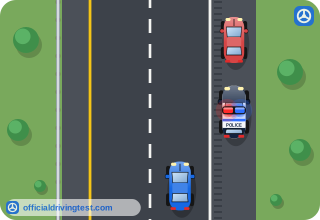
- Stop behind the emergency vehicle
- Slow down in the lane next to the emergency vehicle
- Move onto the shoulder and stop
- Safely move over to a lane not next to its lane
Show answer
Correct answer: Safely move over to a lane not next to its lane
The manual says to yield the right-of-way by safely moving over to a lane that is not next to the lane the emergency, highway, or recovery vehicle is occupying.
Source: Massachusetts Driver's Manual (Revised April 2026), page 104 · Open this page in the manual (Manual page 104)
-
Under the move-over law, what must you do if moving over is not possible?
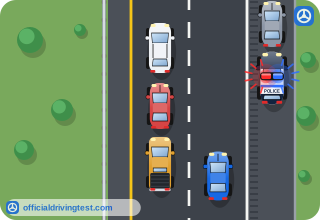
- Still proceed with caution and reduce your speed
- Stop until the emergency vehicle leaves
- Keep your speed because the law then does not apply
- Sound your horn and pass quickly
Show answer
Correct answer: Still proceed with caution and reduce your speed
The manual says that if moving over is not possible, you must still proceed with caution and reduce your speed to a reasonable and safe speed for the road conditions.
Source: Massachusetts Driver's Manual (Revised April 2026), page 104 · Open this page in the manual (Manual page 104)
-
What do orange warning signs and work equipment usually mean on a road?
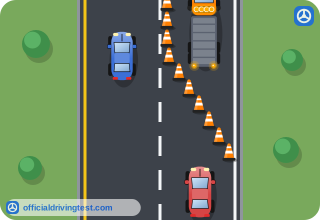
- That people are on foot nearby
- That the road is closed ahead
- That a detour is required
- That a school zone begins
Show answer
Correct answer: That people are on foot nearby
The manual says orange warning signs and work equipment usually mean that people are on foot nearby.
Source: Massachusetts Driver's Manual (Revised April 2026), page 108 · Open this page in the manual (Manual page 108)
-
Near road workers and repair crews, what should you look for?
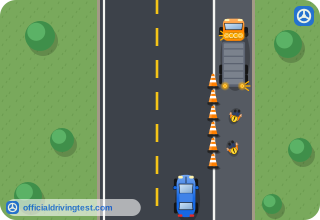
- Wider lanes than the rest of the roadway
- Higher posted speed limits than normal
- Sudden changes in road direction or condition
- Fewer warning signs than on other roads
Show answer
Correct answer: Sudden changes in road direction or condition
The manual says to look for sudden changes in road direction or condition and be prepared to stop.
Source: Massachusetts Driver's Manual (Revised April 2026), page 108 · Open this page in the manual (Manual page 108)
-
When must you yield the right-of-way to fire engines, ambulances and police cars?
- When they are using a siren and/or emergency flashing lights
- Only when they are traveling in the same lane that you are in
- Only when a police officer is also directing traffic at the scene
- Only when they are traveling above the posted speed limit
Show answer
Correct answer: When they are using a siren and/or emergency flashing lights
The manual says to always yield the right-of-way to emergency vehicles that are using a siren and/or emergency flashing lights.
Source: Massachusetts Driver's Manual (Revised April 2026), page 120 · Open this page in the manual (Manual page 120)
-
An emergency vehicle is coming toward you from any direction. What must you do?
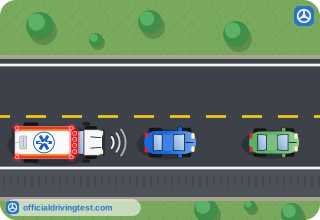
- Slow down and keep rolling toward the right edge of the road without stopping
- Pull over to the left side of the road and stop until the vehicle has passed
- Pull as close as possible to the right side of the road and stop until it has passed
- Stop immediately where you are, in your lane, until the vehicle has passed
Show answer
Correct answer: Pull as close as possible to the right side of the road and stop until it has passed
You must pull as close as possible to the right side of the road and stop until the vehicle has passed; slowly rolling is not acceptable.
Source: Massachusetts Driver's Manual (Revised April 2026), page 120 · Open this page in the manual (Manual page 120)
-
When you pull over for an approaching emergency vehicle, which turn signal should you use?
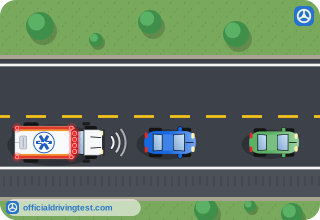
- Your left turn signal
- Your right turn signal
- Your hazard flashers
- No signal, because you are slowing down
Show answer
Correct answer: Your right turn signal
The manual says to check your mirrors, find a safe place to pull over to the right, and use your right turn signal.
Source: Massachusetts Driver's Manual (Revised April 2026), page 120 · Open this page in the manual (Manual page 120)
-
An emergency vehicle approaches while you are in the middle of an intersection. What should you do?
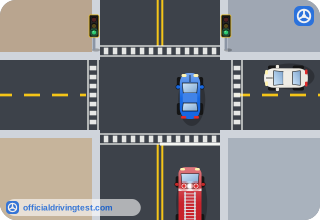
- Stop where you are in the intersection until the vehicle has passed
- Back up out of the intersection and then pull over to the right
- Pull over to the left inside the intersection and wait for it to pass
- Drive through the intersection and pull over as soon as it is safe
Show answer
Correct answer: Drive through the intersection and pull over as soon as it is safe
The manual says never to stop in the middle of an intersection; drive through it and pull over as soon as it is safe.
Source: Massachusetts Driver's Manual (Revised April 2026), page 120 · Open this page in the manual (Manual page 120)
-
After an emergency vehicle has passed you, which signal do you use before merging back into traffic?
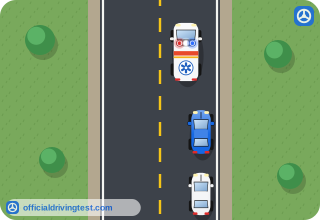
- Your left turn signal
- Your right turn signal
- Your hazard flashers
- No signal is needed
Show answer
Correct answer: Your left turn signal
After the emergency vehicle has passed, you use your left turn signal and make sure the lane is clear before merging back.
Source: Massachusetts Driver's Manual (Revised April 2026), page 120 · Open this page in the manual (Manual page 120)
-
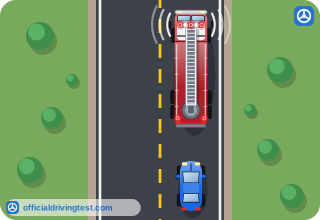
What is the closest you may legally follow behind an emergency vehicle that is responding to an alarm?
- 100 feet
- 200 feet
- 300 feet
- 500 feet
Show answer
Correct answer: 300 feet
It is illegal to follow closer than 300 feet behind an emergency vehicle responding to an alarm.
Source: Massachusetts Driver's Manual (Revised April 2026), page 120 · Open this page in the manual (Manual page 120)
-
Besides fire trucks, police cars and ambulances, for which stopped vehicle with flashing emergency lights must you slow down and stay alert?
- A delivery van that has its turn signal on and is parked at the curb
- A highway maintenance or recovery vehicle, such as a tow truck
- A taxi that is stopped to pick up a passenger at the roadside
- A bicycle with a flashing rear light stopped on the shoulder
Show answer
Correct answer: A highway maintenance or recovery vehicle, such as a tow truck
The manual says the rule also covers highway maintenance vehicles or recovery vehicles (tow truck, ramp truck, etc.) with flashing emergency lights.
Source: Massachusetts Driver's Manual (Revised April 2026), page 120 · Open this page in the manual (Manual page 120)
-
If you cannot safely move over for a stationary emergency vehicle with flashing lights, what must you still do?
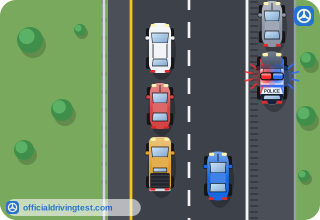
- Be cautious and reduce your speed to a reasonable and safe speed
- Keep your speed and sound your horn to warn the emergency crew
- Stop your vehicle until the emergency vehicle drives away
- Change lanes quickly toward the shoulder and keep your speed
Show answer
Correct answer: Be cautious and reduce your speed to a reasonable and safe speed
If moving over is not possible, you must still be cautious and reduce your speed to a reasonable and safe speed.
Source: Massachusetts Driver's Manual (Revised April 2026), page 120 · Open this page in the manual (Manual page 120)
-
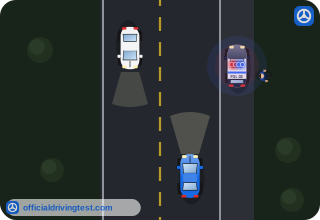
At night, what should you do when passing an emergency vehicle that is stopped?
- Turn off your headlights
- Flash your high beams at it
- Dim your high beams
- Switch on your high beams to see better
Show answer
Correct answer: Dim your high beams
The manual says that at night you should be sure to dim your high beams when passing an emergency vehicle.
Source: Massachusetts Driver's Manual (Revised April 2026), page 120 · Open this page in the manual (Manual page 120)
-
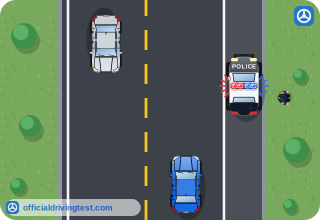
If you need help and a police cruiser is stopped on the roadside, where should you pull your vehicle?
- Behind the police cruiser
- In front of the police cruiser
- Beside the cruiser, in the travel lane
- On the opposite side of the road
Show answer
Correct answer: In front of the police cruiser
The manual says to pull in front of the police cruiser and ask for help, and never to stop behind it.
Source: Massachusetts Driver's Manual (Revised April 2026), page 120 · Open this page in the manual (Manual page 120)
-
A police officer is dealing with another stopped motorist and you need help. What does the manual tell you to do?
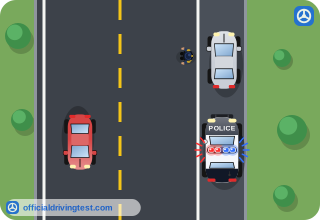
- Walk up to the officer and wait beside the other stopped motorist
- Stay in the driver's seat and sound your horn until the officer comes
- Stand in the travel lane to get the officer's attention
- Stand next to your vehicle on the shoulder until the officer is finished
Show answer
Correct answer: Stand next to your vehicle on the shoulder until the officer is finished
The manual says not to approach an officer who is dealing with a stopped motorist and to stand next to your vehicle on the shoulder until the officer is finished.
Source: Massachusetts Driver's Manual (Revised April 2026), page 121 · Open this page in the manual (Manual page 121)
-
What is the closest you may legally drive by or park to a fire?
- 800 feet
- 100 feet
- 200 feet
- 500 feet
Show answer
Correct answer: 800 feet
It is illegal to drive by or park within 800 feet of a fire.
Source: Massachusetts Driver's Manual (Revised April 2026), page 121 · Open this page in the manual (Manual page 121)
-
When may you drive over an unprotected fire hose?
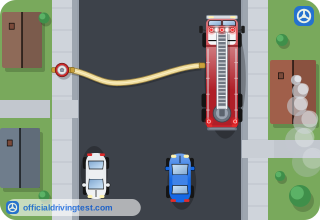
- Whenever no water is flowing through the hose at that time
- Whenever you drive slowly and carefully over the hose
- Only when a firefighter or public safety official directs you to
- Whenever there is no firefighter in sight at the scene
Show answer
Correct answer: Only when a firefighter or public safety official directs you to
The manual says not to drive over an unprotected fire hose unless directed to by a firefighter or public safety official.
Source: Massachusetts Driver's Manual (Revised April 2026), page 121 · Open this page in the manual (Manual page 121)
-
A police officer signals you to stop. In which case must you pull over?
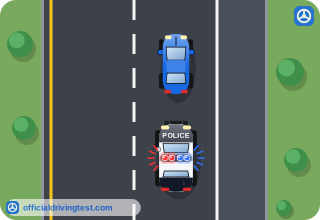
- Only if the officer is in a marked police car
- Whether the officer is in a police car or on foot
- Only if the officer is using a siren
- Only if you know why you are being stopped
Show answer
Correct answer: Whether the officer is in a police car or on foot
State law requires you to pull over and stop when signaled by a police officer, whether the officer is in a police car or on foot.
Source: Massachusetts Driver's Manual (Revised April 2026), page 121 · Open this page in the manual (Manual page 121)
-
Which action during a traffic stop may increase the police officer's anxiety?
- Rolling down your window as the officer walks toward you
- Keeping your hands in plain sight
- Turning off the engine and the radio
- Suddenly reaching under the seat or into unseen areas
Show answer
Correct answer: Suddenly reaching under the seat or into unseen areas
The manual lists suddenly reaching under the seat or into unseen areas as not appropriate because it may increase the officer's anxiety.
Source: Massachusetts Driver's Manual (Revised April 2026), page 121 · Open this page in the manual (Manual page 121)
-
When a police officer signals you to stop, where should you pull your vehicle?
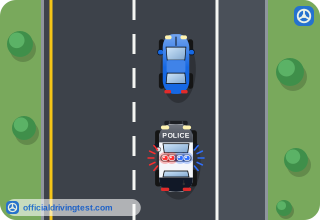
- Completely to the right side of the road
- Over to the left side of the road to stop
- Into the nearest intersection to stop there
- To a complete stop in the travel lane
Show answer
Correct answer: Completely to the right side of the road
The manual says to move your vehicle completely to the right side of the road and not to pull over to the left.
Source: Massachusetts Driver's Manual (Revised April 2026), page 121 · Open this page in the manual (Manual page 121)
-
A police officer's vehicle drives past you and does not stop. What should you do?
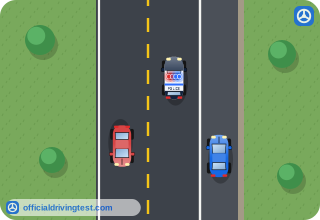
- Remain stopped on the roadside until the officer returns
- Follow the officer and flash your lights
- Return to the travel lane when it is safe
- Drive onto the shoulder and wait for a signal
Show answer
Correct answer: Return to the travel lane when it is safe
The manual says that if the officer drives by and does not stop, you return to the travel lane when it is safe.
Source: Massachusetts Driver's Manual (Revised April 2026), page 121 · Open this page in the manual (Manual page 121)
-
Which of these is a place where you should not stop your vehicle when pulling over for a police officer?
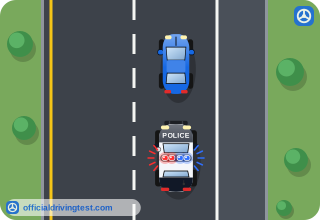
- Out of the travel lane, on the right side of the road
- In front of a driveway
- At the place where the officer directs you to pull over
- Completely off the road to the right
Show answer
Correct answer: In front of a driveway
The manual says not to stop in an intersection, in front of a driveway, or in a travel lane, unless the officer directs you to a certain place.
Source: Massachusetts Driver's Manual (Revised April 2026), page 122 · Open this page in the manual (Manual page 122)
-
During a traffic stop, if your vehicle has a standard transmission, how should you leave it?
- In first gear with the engine running
- In reverse with the clutch pressed
- In neutral with the parking brake off
- In neutral with the parking brake on
Show answer
Correct answer: In neutral with the parking brake on
The manual says to put a standard transmission in neutral with the parking brake on, and to turn off the engine and radio.
Source: Massachusetts Driver's Manual (Revised April 2026), page 122 · Open this page in the manual (Manual page 122)
-
During a traffic stop, what should you and your passengers do?
- Stay in the vehicle and get out only if instructed by the officer
- Get out and stand beside the vehicle to wait for the officer
- Get out and walk toward the police car to meet the officer
- Move to the back seat and wait outside the car
Show answer
Correct answer: Stay in the vehicle and get out only if instructed by the officer
The manual says to stay in the vehicle, both you and your passengers, and only get out if instructed by the officer.
Source: Massachusetts Driver's Manual (Revised April 2026), page 122 · Open this page in the manual (Manual page 122)
-
If an officer asks you to get out of your vehicle during a traffic stop, what should you do?
- Reach back inside to get your documents first
- Walk to the police car with your hands in your pockets
- Stay safely away from traffic and keep your hands in plain view
- Stand behind your vehicle with your back to the officer
Show answer
Correct answer: Stay safely away from traffic and keep your hands in plain view
The manual says that if asked to get out, you stay safely away from traffic and keep your hands in plain view.
Source: Massachusetts Driver's Manual (Revised April 2026), page 122 · Open this page in the manual (Manual page 122)
-
You are stopped by a police officer after dark. What should you do with your lights?
- Turn off your headlights and leave the interior dark
- Leave your headlights on and put the interior overhead light on
- Turn off the headlights and put on your high beams
- Leave the headlights on and keep the interior light off
Show answer
Correct answer: Leave your headlights on and put the interior overhead light on
The manual says that if it is dark you leave your headlights on and put the interior overhead light on.
Source: Massachusetts Driver's Manual (Revised April 2026), page 122 · Open this page in the manual (Manual page 122)
-
During a traffic stop, when should you roll down your window?
- Only after the officer taps on the window twice
- After the officer returns your license
- Only when the officer asks for your registration
- As the officer walks toward you
Show answer
Correct answer: As the officer walks toward you
The manual says to roll down your window as the officer walks toward you.
Source: Massachusetts Driver's Manual (Revised April 2026), page 122 · Open this page in the manual (Manual page 122)
-
When should you reach into the glove compartment for your license and registration during a traffic stop?
- As soon as you stop, before the officer arrives
- While the officer is walking toward your car
- After the officer asks for them
- Only after the officer returns to the police car
Show answer
Correct answer: After the officer asks for them
The manual says to wait until the officer asks for your license and registration before you or a passenger reach into the glove compartment.
Source: Massachusetts Driver's Manual (Revised April 2026), page 122 · Open this page in the manual (Manual page 122)
-
During a traffic stop, what should you do with your hands and your passengers' hands?
- Rest them under the seat
- Keep them in your pockets
- Hold them below the dashboard
- Keep them in plain sight
Show answer
Correct answer: Keep them in plain sight
The manual says to keep your hands in plain sight and tell your passengers to do the same.
Source: Massachusetts Driver's Manual (Revised April 2026), page 122 · Open this page in the manual (Manual page 122)
-
What does the manual say about using a cell phone during a traffic stop?
- Do not use it; give your full attention to the officer
- Use it to record the officer if you feel unsafe
- Use it to call someone while waiting for the officer
- Use it only if the officer is slow to arrive
Show answer
Correct answer: Do not use it; give your full attention to the officer
The manual says to give your full attention to the officer and not use a cell phone during the stop.
Source: Massachusetts Driver's Manual (Revised April 2026), page 122 · Open this page in the manual (Manual page 122)
-
During a traffic stop, what should you do when the officer goes back to the police car?
- Get out and follow the officer
- Step out and wait at the rear bumper
- Stay in your vehicle
- Pull back into traffic slowly
Show answer
Correct answer: Stay in your vehicle
The manual says to stay in your vehicle when the officer goes back to the police car.
Source: Massachusetts Driver's Manual (Revised April 2026), page 122 · Open this page in the manual (Manual page 122)
-
During a traffic stop you find something the officer requested while the officer is at the police car. What should you do?
- Get out and carry it to the police car to hand it over
- Hold it out the window and wait for the officer to return
- Place it on the roof of your car
- Drive to the officer and hand it over
Show answer
Correct answer: Hold it out the window and wait for the officer to return
The manual says to hold the item out the window and wait for the officer to return.
Source: Massachusetts Driver's Manual (Revised April 2026), page 123 · Open this page in the manual (Manual page 123)
-
When the officer tells you that you can go and you are on a highway, what should you do before merging into traffic?
- Merge at once at the speed you were stopped
- Wait for the officer to clear the lane for you
- Merge at low speed with your hazard flashers on
- Accelerate to a safe speed in the breakdown lane
Show answer
Correct answer: Accelerate to a safe speed in the breakdown lane
The manual says that on a highway you accelerate to a safe speed in the breakdown lane before merging into traffic.
Source: Massachusetts Driver's Manual (Revised April 2026), page 123 · Open this page in the manual (Manual page 123)