Massachusetts: Emergency vehicles and work zones — Part 3 Practice Test
Questions in this part include: “What is the closest you may legally drive by or park to a fire?” · “During a traffic stop, when should you roll down your window?”
Independent educational site · not affiliated with any government agency or DMV
Ready? Test yourself
- Instant feedback with an explanation
- Every answer cites its source in the manual
- Your best score is saved on this device
Questions are original and based on the official manual "Massachusetts Driver's Manual" (Revised April 2026), Massachusetts Registry of Motor Vehicles.
All 18 questions in this practice test
Take the test above first, then use this list to study. Tap “Show answer” to see the correct answer and explanation.
Show the questions and answersHide the questions
-
What is the closest you may legally drive by or park to a fire?
- 800 feet
- 100 feet
- 200 feet
- 500 feet
Show answer
Correct answer: 800 feet
It is illegal to drive by or park within 800 feet of a fire.
Source: Massachusetts Driver's Manual (Revised April 2026), page 121 · Open this page in the manual (Manual page 121)
-
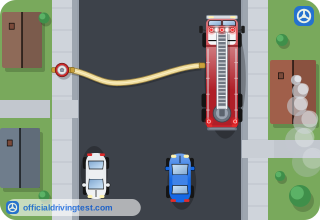
When may you drive over an unprotected fire hose?
- Whenever no water is flowing through the hose at that time
- Whenever you drive slowly and carefully over the hose
- Only when a firefighter or public safety official directs you to
- Whenever there is no firefighter in sight at the scene
Show answer
Correct answer: Only when a firefighter or public safety official directs you to
The manual says not to drive over an unprotected fire hose unless directed to by a firefighter or public safety official.
Source: Massachusetts Driver's Manual (Revised April 2026), page 121 · Open this page in the manual (Manual page 121)
-
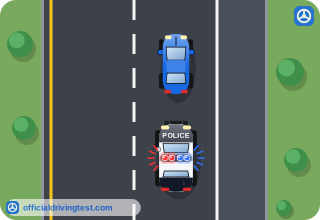
A police officer signals you to stop. In which case must you pull over?
- Only if the officer is in a marked police car
- Whether the officer is in a police car or on foot
- Only if the officer is using a siren
- Only if you know why you are being stopped
Show answer
Correct answer: Whether the officer is in a police car or on foot
State law requires you to pull over and stop when signaled by a police officer, whether the officer is in a police car or on foot.
Source: Massachusetts Driver's Manual (Revised April 2026), page 121 · Open this page in the manual (Manual page 121)
-
Which action during a traffic stop may increase the police officer's anxiety?
- Rolling down your window as the officer walks toward you
- Keeping your hands in plain sight
- Turning off the engine and the radio
- Suddenly reaching under the seat or into unseen areas
Show answer
Correct answer: Suddenly reaching under the seat or into unseen areas
The manual lists suddenly reaching under the seat or into unseen areas as not appropriate because it may increase the officer's anxiety.
Source: Massachusetts Driver's Manual (Revised April 2026), page 121 · Open this page in the manual (Manual page 121)
-
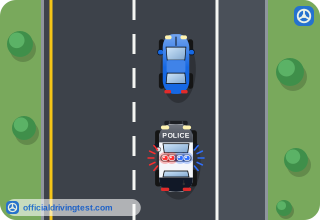
When a police officer signals you to stop, where should you pull your vehicle?
- Completely to the right side of the road
- Over to the left side of the road to stop
- Into the nearest intersection to stop there
- To a complete stop in the travel lane
Show answer
Correct answer: Completely to the right side of the road
The manual says to move your vehicle completely to the right side of the road and not to pull over to the left.
Source: Massachusetts Driver's Manual (Revised April 2026), page 121 · Open this page in the manual (Manual page 121)
-
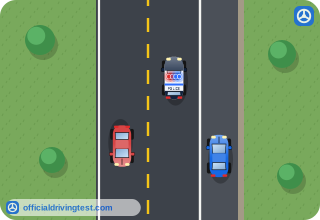
A police officer's vehicle drives past you and does not stop. What should you do?
- Remain stopped on the roadside until the officer returns
- Follow the officer and flash your lights
- Return to the travel lane when it is safe
- Drive onto the shoulder and wait for a signal
Show answer
Correct answer: Return to the travel lane when it is safe
The manual says that if the officer drives by and does not stop, you return to the travel lane when it is safe.
Source: Massachusetts Driver's Manual (Revised April 2026), page 121 · Open this page in the manual (Manual page 121)
-
Which of these is a place where you should not stop your vehicle when pulling over for a police officer?
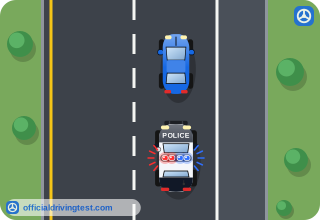
- Out of the travel lane, on the right side of the road
- In front of a driveway
- At the place where the officer directs you to pull over
- Completely off the road to the right
Show answer
Correct answer: In front of a driveway
The manual says not to stop in an intersection, in front of a driveway, or in a travel lane, unless the officer directs you to a certain place.
Source: Massachusetts Driver's Manual (Revised April 2026), page 122 · Open this page in the manual (Manual page 122)
-
During a traffic stop, if your vehicle has a standard transmission, how should you leave it?
- In first gear with the engine running
- In reverse with the clutch pressed
- In neutral with the parking brake off
- In neutral with the parking brake on
Show answer
Correct answer: In neutral with the parking brake on
The manual says to put a standard transmission in neutral with the parking brake on, and to turn off the engine and radio.
Source: Massachusetts Driver's Manual (Revised April 2026), page 122 · Open this page in the manual (Manual page 122)
-
During a traffic stop, what should you and your passengers do?
- Stay in the vehicle and get out only if instructed by the officer
- Get out and stand beside the vehicle to wait for the officer
- Get out and walk toward the police car to meet the officer
- Move to the back seat and wait outside the car
Show answer
Correct answer: Stay in the vehicle and get out only if instructed by the officer
The manual says to stay in the vehicle, both you and your passengers, and only get out if instructed by the officer.
Source: Massachusetts Driver's Manual (Revised April 2026), page 122 · Open this page in the manual (Manual page 122)
-
If an officer asks you to get out of your vehicle during a traffic stop, what should you do?
- Reach back inside to get your documents first
- Walk to the police car with your hands in your pockets
- Stay safely away from traffic and keep your hands in plain view
- Stand behind your vehicle with your back to the officer
Show answer
Correct answer: Stay safely away from traffic and keep your hands in plain view
The manual says that if asked to get out, you stay safely away from traffic and keep your hands in plain view.
Source: Massachusetts Driver's Manual (Revised April 2026), page 122 · Open this page in the manual (Manual page 122)
-
You are stopped by a police officer after dark. What should you do with your lights?
- Turn off your headlights and leave the interior dark
- Leave your headlights on and put the interior overhead light on
- Turn off the headlights and put on your high beams
- Leave the headlights on and keep the interior light off
Show answer
Correct answer: Leave your headlights on and put the interior overhead light on
The manual says that if it is dark you leave your headlights on and put the interior overhead light on.
Source: Massachusetts Driver's Manual (Revised April 2026), page 122 · Open this page in the manual (Manual page 122)
-
During a traffic stop, when should you roll down your window?
- Only after the officer taps on the window twice
- After the officer returns your license
- Only when the officer asks for your registration
- As the officer walks toward you
Show answer
Correct answer: As the officer walks toward you
The manual says to roll down your window as the officer walks toward you.
Source: Massachusetts Driver's Manual (Revised April 2026), page 122 · Open this page in the manual (Manual page 122)
-
When should you reach into the glove compartment for your license and registration during a traffic stop?
- As soon as you stop, before the officer arrives
- While the officer is walking toward your car
- After the officer asks for them
- Only after the officer returns to the police car
Show answer
Correct answer: After the officer asks for them
The manual says to wait until the officer asks for your license and registration before you or a passenger reach into the glove compartment.
Source: Massachusetts Driver's Manual (Revised April 2026), page 122 · Open this page in the manual (Manual page 122)
-
During a traffic stop, what should you do with your hands and your passengers' hands?
- Rest them under the seat
- Keep them in your pockets
- Hold them below the dashboard
- Keep them in plain sight
Show answer
Correct answer: Keep them in plain sight
The manual says to keep your hands in plain sight and tell your passengers to do the same.
Source: Massachusetts Driver's Manual (Revised April 2026), page 122 · Open this page in the manual (Manual page 122)
-
What does the manual say about using a cell phone during a traffic stop?
- Do not use it; give your full attention to the officer
- Use it to record the officer if you feel unsafe
- Use it to call someone while waiting for the officer
- Use it only if the officer is slow to arrive
Show answer
Correct answer: Do not use it; give your full attention to the officer
The manual says to give your full attention to the officer and not use a cell phone during the stop.
Source: Massachusetts Driver's Manual (Revised April 2026), page 122 · Open this page in the manual (Manual page 122)
-
During a traffic stop, what should you do when the officer goes back to the police car?
- Get out and follow the officer
- Step out and wait at the rear bumper
- Stay in your vehicle
- Pull back into traffic slowly
Show answer
Correct answer: Stay in your vehicle
The manual says to stay in your vehicle when the officer goes back to the police car.
Source: Massachusetts Driver's Manual (Revised April 2026), page 122 · Open this page in the manual (Manual page 122)
-
During a traffic stop you find something the officer requested while the officer is at the police car. What should you do?
- Get out and carry it to the police car to hand it over
- Hold it out the window and wait for the officer to return
- Place it on the roof of your car
- Drive to the officer and hand it over
Show answer
Correct answer: Hold it out the window and wait for the officer to return
The manual says to hold the item out the window and wait for the officer to return.
Source: Massachusetts Driver's Manual (Revised April 2026), page 123 · Open this page in the manual (Manual page 123)
-
When the officer tells you that you can go and you are on a highway, what should you do before merging into traffic?
- Merge at once at the speed you were stopped
- Wait for the officer to clear the lane for you
- Merge at low speed with your hazard flashers on
- Accelerate to a safe speed in the breakdown lane
Show answer
Correct answer: Accelerate to a safe speed in the breakdown lane
The manual says that on a highway you accelerate to a safe speed in the breakdown lane before merging into traffic.
Source: Massachusetts Driver's Manual (Revised April 2026), page 123 · Open this page in the manual (Manual page 123)