Massachusetts: Emergency vehicles and work zones — Part 1 Practice Test
Questions in this part include: “Why should you avoid loud noise levels in your vehicle?” · “Where are civil flaggers typically used?”
Independent educational site · not affiliated with any government agency or DMV
Ready? Test yourself
- Instant feedback with an explanation
- Every answer cites its source in the manual
- Your best score is saved on this device
Questions are original and based on the official manual "Massachusetts Driver's Manual" (Revised April 2026), Massachusetts Registry of Motor Vehicles.
All 19 questions in this practice test
Take the test above first, then use this list to study. Tap “Show answer” to see the correct answer and explanation.
Show the questions and answersHide the questions
-
Why should you avoid loud noise levels in your vehicle?
- To protect your own hearing
- To avoid distracting your passengers
- To keep the horn audible to others
- So you can hear emergency vehicle sirens
Show answer
Correct answer: So you can hear emergency vehicle sirens
The manual says to avoid loud noise levels so you can hear emergency vehicle sirens.
Source: Massachusetts Driver's Manual (Revised April 2026), page 39 · Open this page in the manual (Manual page 39)
-
If you are caught speeding in a posted work zone, what happens to the speeding fine?
- It is waived for a first offense
- It is doubled
- It is reduced by half
- It stays the same
Show answer
Correct answer: It is doubled
The manual says that speeding in a posted work zone doubles the speeding fine.
Source: Massachusetts Driver's Manual (Revised April 2026), page 57 · Open this page in the manual (Manual page 57)
-
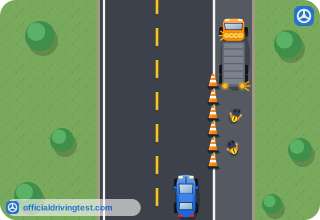
What do warning signs and traffic control devices do in a roadway work zone?
- They permit you to ignore the posted speed limit there
- They replace the need to obey police officers on site
- They show where parking is allowed
- They mark and protect the work zone and guide you through it
Show answer
Correct answer: They mark and protect the work zone and guide you through it
Work zone sections are designated and protected by warning signs and traffic control devices that help guide you safely through.
Source: Massachusetts Driver's Manual (Revised April 2026), page 87 · Open this page in the manual (Manual page 87)
-
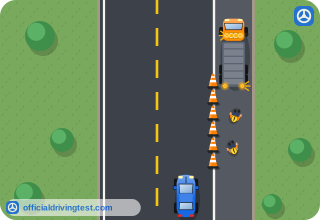
What should you do when approaching a work zone?
- Maintain your speed
- Change lanes at once
- Reduce your speed
- Stop and wait for directions
Show answer
Correct answer: Reduce your speed
When approaching a work zone, reduce your speed.
Source: Massachusetts Driver's Manual (Revised April 2026), page 87 · Open this page in the manual (Manual page 87)
-
If a police officer or civil flagger is present in a work zone, what must you do?
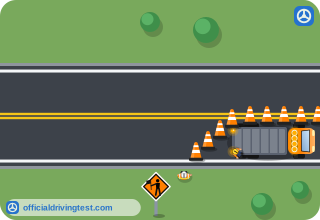
- Follow and obey their directions
- Follow the signs instead
- Ignore them if the road looks clear
- Stop and wait for permission to proceed
Show answer
Correct answer: Follow and obey their directions
If a police officer or civil flagger is present, follow and obey their directions.
Source: Massachusetts Driver's Manual (Revised April 2026), page 87 · Open this page in the manual (Manual page 87)
-
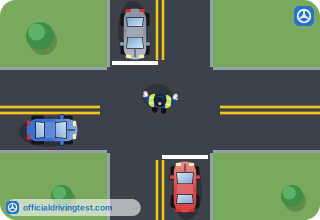
What must you always do about the directions of a traffic officer?
- Obey them only when signals are not working
- Obey them, even when they overrule signs or signals
- Obey them only in work zones
- Obey signs and signals first
Show answer
Correct answer: Obey them, even when they overrule signs or signals
You must always obey directions of a traffic officer, even when they overrule signs, signals, or pavement markings.
Source: Massachusetts Driver's Manual (Revised April 2026), page 87 · Open this page in the manual (Manual page 87)
-
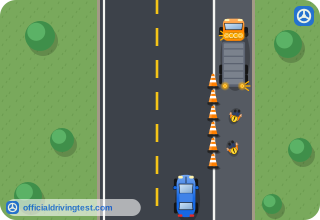
What does the manual say about being distracted by what is happening within a work zone?
- It is fine to look at work crews
- It is fine if you slow down
- It matters only at night
- Do not be distracted by it
Show answer
Correct answer: Do not be distracted by it
The manual says not to be distracted by what is happening within a work zone.
Source: Massachusetts Driver's Manual (Revised April 2026), page 87 · Open this page in the manual (Manual page 87)
-
How is the start of a work zone indicated?
- With a warning sign or electronic message sign
- With a green guide sign beside the road
- With a painted stop line across the road
- With a police officer and no signs at all
Show answer
Correct answer: With a warning sign or electronic message sign
The start of a work zone is indicated with a warning sign or electronic message sign.
Source: Massachusetts Driver's Manual (Revised April 2026), page 87 · Open this page in the manual (Manual page 87)
-
Where are civil flaggers typically used?
- On high-speed, high-volume highways
- On low-speed, low-volume roadways
- Only on interstate freeways
- Only at railroad crossings
Show answer
Correct answer: On low-speed, low-volume roadways
Civil flaggers are typically used on low-speed, low-volume roadways to control traffic movement around the work area.
Source: Massachusetts Driver's Manual (Revised April 2026), page 87 · Open this page in the manual (Manual page 87)
-
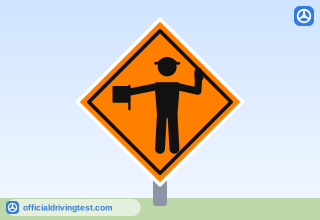
An orange diamond sign shows a person holding a flag. What does it mean?
- Pedestrian crossing ahead
- School crossing ahead
- Road closed ahead
- Flagger Ahead
Show answer
Correct answer: Flagger Ahead
An orange diamond with a flagger figure warns that a flagger is ahead.
Source: Massachusetts Driver's Manual (Revised April 2026), page 87 · Open this page in the manual (Manual page 87)
-
What do upcoming warning signs in a work zone tell you?
- How much longer the work will take to finish
- Which nearby streets are closed permanently
- Where work is taking place and how to get through it
- Where the workers' vehicles are parked today
Show answer
Correct answer: Where work is taking place and how to get through it
Upcoming warning signs inform you of where work is taking place and how you should maneuver through the work area.
Source: Massachusetts Driver's Manual (Revised April 2026), page 87 · Open this page in the manual (Manual page 87)
-
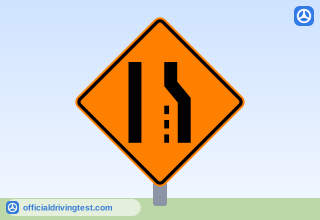
An orange diamond sign shows two lanes with the right lane ending. What does it mean?
- The lanes are shifting to the right
- The right lane is closed; merge left
- A lane is added on the right
- The road ends at a junction ahead
Show answer
Correct answer: The right lane is closed; merge left
An orange diamond showing the right lane ending means the right lane is closed and traffic should move to the left.
Source: Massachusetts Driver's Manual (Revised April 2026), page 88 · Open this page in the manual (Manual page 88)
-
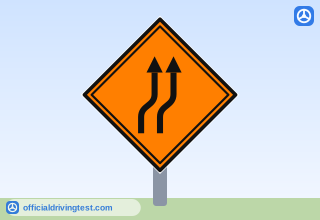
An orange diamond sign shows two arrows bending to the right. What does it mean?
- The right lane is closed; merge left
- Road turns right ahead
- The lanes are shifting to the right
- A flagger is ahead in the right lane
Show answer
Correct answer: The lanes are shifting to the right
An orange diamond with arrows bending right means the lanes are shifting to the right.
Source: Massachusetts Driver's Manual (Revised April 2026), page 88 · Open this page in the manual (Manual page 88)
-
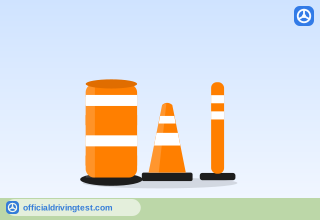
What are drums, cones, and tubular markers used for in a work zone?
- To show drivers where parking is allowed
- To mark the speed limit inside the work area
- To show where the workers' vehicles are parked
- To direct traffic away from a closed shoulder or lane
Show answer
Correct answer: To direct traffic away from a closed shoulder or lane
Devices such as drums, cones, and tubular markers direct traffic away from a work area where the shoulder or travel lane is closed.
Source: Massachusetts Driver's Manual (Revised April 2026), page 88 · Open this page in the manual (Manual page 88)
-
How are drums, cones, and tubular markers usually lined up?
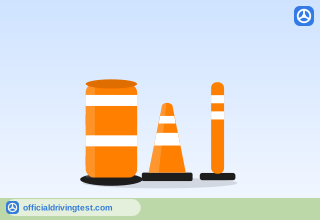
- In an angular fashion to shift traffic left or right
- In a straight line down the center of the road
- In a circle around the entire work area
- In a single row along the shoulder only
Show answer
Correct answer: In an angular fashion to shift traffic left or right
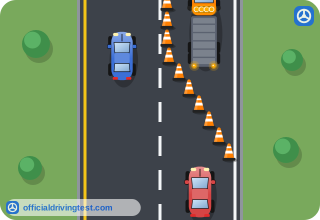
They are usually lined up in an angular fashion to shift traffic from the beginning of a travel lane to the left or right.
Source: Massachusetts Driver's Manual (Revised April 2026), page 88 · Open this page in the manual (Manual page 88)
-
What should you do when you see drums, cones, or tubular markers in the roadway?
- Drive through the gaps between them slowly
- Stop and wait for a flagger to wave you
- Carefully merge into the adjacent travel lane
- Merge at the last possible moment ahead
Show answer
Correct answer: Carefully merge into the adjacent travel lane
You should carefully merge into the adjacent travel lane when you see these devices in the roadway.
Source: Massachusetts Driver's Manual (Revised April 2026), page 88 · Open this page in the manual (Manual page 88)
-
What is often used to block off access to a lane that is closed to traffic?
- A drum
- A barricade
- A tubular marker
- A detour sign
Show answer
Correct answer: A barricade
When a lane is closed to traffic, a barricade is often used to block off access to that area.
Source: Massachusetts Driver's Manual (Revised April 2026), page 88 · Open this page in the manual (Manual page 88)
-
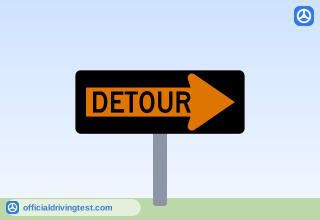
What do detour signs provide?
- The reduced speed limit inside the work zone
- The total length of the work zone in miles
- The location of the nearest flagger or officer on duty
- Directions to bypass the work zone and return to the road
Show answer
Correct answer: Directions to bypass the work zone and return to the road
Detour signs provide direction on bypassing the work zone and then getting back on the original road.
Source: Massachusetts Driver's Manual (Revised April 2026), page 88 · Open this page in the manual (Manual page 88)
-
When are detour signs posted?
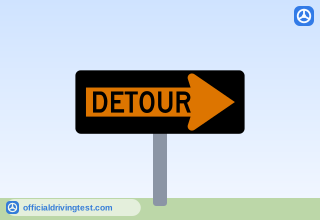
- When road work fully closes lanes in one direction or the whole road
- When road work takes place only on the shoulder of the road
- When one lane is narrowed but still open
- When no workers are present at the work site
Show answer
Correct answer: When road work fully closes lanes in one direction or the whole road
Detour signs are posted when road work requires full closure of travel lanes in one direction, or an entire road closure.
Source: Massachusetts Driver's Manual (Revised April 2026), page 88 · Open this page in the manual (Manual page 88)