Massachusetts: Emergency vehicles and work zones — Part 2 Practice Test
Questions in this part include: “Where are portable arrow boards located?” · “When must you yield the right-of-way to fire engines, ambulances and police cars?”
Independent educational site · not affiliated with any government agency or DMV
Ready? Test yourself
- Instant feedback with an explanation
- Every answer cites its source in the manual
- Your best score is saved on this device
Questions are original and based on the official manual "Massachusetts Driver's Manual" (Revised April 2026), Massachusetts Registry of Motor Vehicles.
All 19 questions in this practice test
Take the test above first, then use this list to study. Tap “Show answer” to see the correct answer and explanation.
Show the questions and answersHide the questions
-
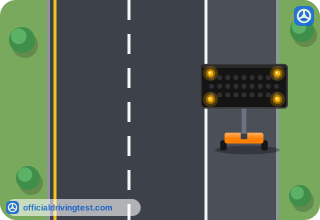
What are portable arrow boards used for on multiple lane roadways?
- To show the speed limit that applies in the work zone
- To mark where the work zone ends ahead
- To show a closed lane or shoulder and which lane is open
- To show where the workers are currently present
Show answer
Correct answer: To show a closed lane or shoulder and which lane is open
On multiple lane roadways, portable arrow boards notify drivers that the shoulder or lane is closed and which lane is open for travel.
Source: Massachusetts Driver's Manual (Revised April 2026), page 88 · Open this page in the manual (Manual page 88)
-
Where are portable arrow boards located?
- Beside the work area on the shoulder
- Before the work area, within the closed lane
- After the work area, beyond the closed lane
- On the center median only
Show answer
Correct answer: Before the work area, within the closed lane
Arrow boards are located before the work area within the closed lane to give you notice to merge your vehicle when it is safe.
Source: Massachusetts Driver's Manual (Revised April 2026), page 88 · Open this page in the manual (Manual page 88)
-
According to the manual, what is the FIRST thing you must do when approaching a work zone?
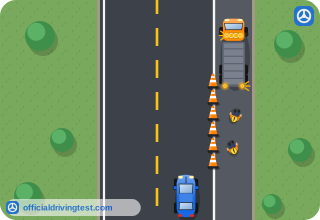
- Slow down and look for guidance on how to travel safely through it
- Speed up to clear the work zone as quickly as you can
- Move into the far left lane to stay away from the workers
- Stop completely until a worker waves you forward
Show answer
Correct answer: Slow down and look for guidance on how to travel safely through it
The manual says the first thing to do when approaching a work zone is to slow down and look for guidance on how to travel safely through the area.
Source: Massachusetts Driver's Manual (Revised April 2026), page 89 · Open this page in the manual (Manual page 89)
-
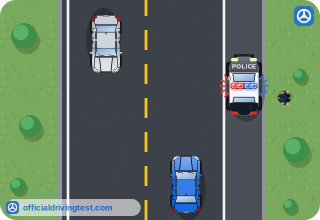
You approach a stationary emergency vehicle displaying its flashing lights. What does the move-over law require you to do?
- Stop completely until the emergency vehicle leaves
- Proceed with caution and reduce your speed
- Slow to 20 miles per hour and keep in the same lane
- Pass at your normal speed in the lane next to it
Show answer
Correct answer: Proceed with caution and reduce your speed
The move-over law requires you to proceed with caution and reduce your speed to a reasonable and safe speed for the road conditions.
Source: Massachusetts Driver's Manual (Revised April 2026), page 104 · Open this page in the manual (Manual page 104)
-
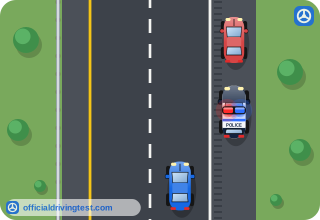
On a highway with at least four lanes, how do you yield to a stationary emergency vehicle with flashing lights under the move-over law?
- Stop behind the emergency vehicle
- Slow down in the lane next to the emergency vehicle
- Move onto the shoulder and stop
- Safely move over to a lane not next to its lane
Show answer
Correct answer: Safely move over to a lane not next to its lane
The manual says to yield the right-of-way by safely moving over to a lane that is not next to the lane the emergency, highway, or recovery vehicle is occupying.
Source: Massachusetts Driver's Manual (Revised April 2026), page 104 · Open this page in the manual (Manual page 104)
-
Under the move-over law, what must you do if moving over is not possible?
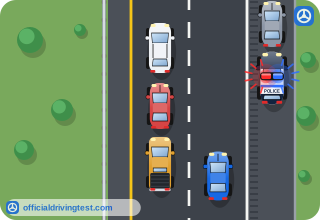
- Still proceed with caution and reduce your speed
- Stop until the emergency vehicle leaves
- Keep your speed because the law then does not apply
- Sound your horn and pass quickly
Show answer
Correct answer: Still proceed with caution and reduce your speed
The manual says that if moving over is not possible, you must still proceed with caution and reduce your speed to a reasonable and safe speed for the road conditions.
Source: Massachusetts Driver's Manual (Revised April 2026), page 104 · Open this page in the manual (Manual page 104)
-
What do orange warning signs and work equipment usually mean on a road?
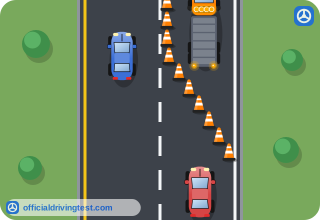
- That people are on foot nearby
- That the road is closed ahead
- That a detour is required
- That a school zone begins
Show answer
Correct answer: That people are on foot nearby
The manual says orange warning signs and work equipment usually mean that people are on foot nearby.
Source: Massachusetts Driver's Manual (Revised April 2026), page 108 · Open this page in the manual (Manual page 108)
-
Near road workers and repair crews, what should you look for?
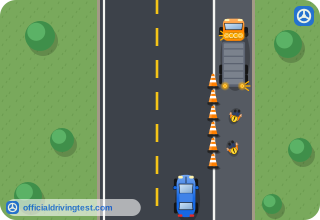
- Wider lanes than the rest of the roadway
- Higher posted speed limits than normal
- Sudden changes in road direction or condition
- Fewer warning signs than on other roads
Show answer
Correct answer: Sudden changes in road direction or condition
The manual says to look for sudden changes in road direction or condition and be prepared to stop.
Source: Massachusetts Driver's Manual (Revised April 2026), page 108 · Open this page in the manual (Manual page 108)
-
When must you yield the right-of-way to fire engines, ambulances and police cars?
- When they are using a siren and/or emergency flashing lights
- Only when they are traveling in the same lane that you are in
- Only when a police officer is also directing traffic at the scene
- Only when they are traveling above the posted speed limit
Show answer
Correct answer: When they are using a siren and/or emergency flashing lights
The manual says to always yield the right-of-way to emergency vehicles that are using a siren and/or emergency flashing lights.
Source: Massachusetts Driver's Manual (Revised April 2026), page 120 · Open this page in the manual (Manual page 120)
-
An emergency vehicle is coming toward you from any direction. What must you do?
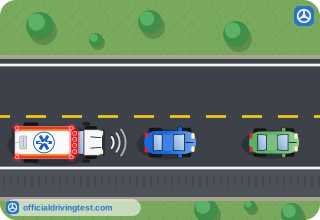
- Slow down and keep rolling toward the right edge of the road without stopping
- Pull over to the left side of the road and stop until the vehicle has passed
- Pull as close as possible to the right side of the road and stop until it has passed
- Stop immediately where you are, in your lane, until the vehicle has passed
Show answer
Correct answer: Pull as close as possible to the right side of the road and stop until it has passed
You must pull as close as possible to the right side of the road and stop until the vehicle has passed; slowly rolling is not acceptable.
Source: Massachusetts Driver's Manual (Revised April 2026), page 120 · Open this page in the manual (Manual page 120)
-
When you pull over for an approaching emergency vehicle, which turn signal should you use?
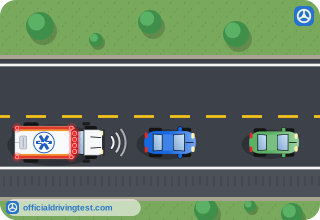
- Your left turn signal
- Your right turn signal
- Your hazard flashers
- No signal, because you are slowing down
Show answer
Correct answer: Your right turn signal
The manual says to check your mirrors, find a safe place to pull over to the right, and use your right turn signal.
Source: Massachusetts Driver's Manual (Revised April 2026), page 120 · Open this page in the manual (Manual page 120)
-
An emergency vehicle approaches while you are in the middle of an intersection. What should you do?
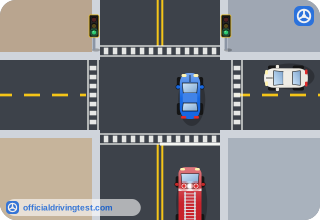
- Stop where you are in the intersection until the vehicle has passed
- Back up out of the intersection and then pull over to the right
- Pull over to the left inside the intersection and wait for it to pass
- Drive through the intersection and pull over as soon as it is safe
Show answer
Correct answer: Drive through the intersection and pull over as soon as it is safe
The manual says never to stop in the middle of an intersection; drive through it and pull over as soon as it is safe.
Source: Massachusetts Driver's Manual (Revised April 2026), page 120 · Open this page in the manual (Manual page 120)
-
After an emergency vehicle has passed you, which signal do you use before merging back into traffic?
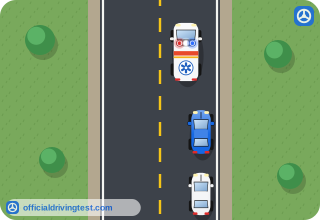
- Your left turn signal
- Your right turn signal
- Your hazard flashers
- No signal is needed
Show answer
Correct answer: Your left turn signal
After the emergency vehicle has passed, you use your left turn signal and make sure the lane is clear before merging back.
Source: Massachusetts Driver's Manual (Revised April 2026), page 120 · Open this page in the manual (Manual page 120)
-
What is the closest you may legally follow behind an emergency vehicle that is responding to an alarm?
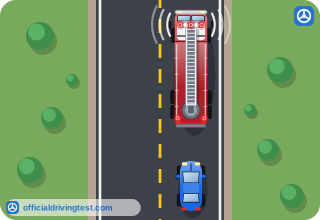
- 100 feet
- 200 feet
- 300 feet
- 500 feet
Show answer
Correct answer: 300 feet
It is illegal to follow closer than 300 feet behind an emergency vehicle responding to an alarm.
Source: Massachusetts Driver's Manual (Revised April 2026), page 120 · Open this page in the manual (Manual page 120)
-
Besides fire trucks, police cars and ambulances, for which stopped vehicle with flashing emergency lights must you slow down and stay alert?
- A delivery van that has its turn signal on and is parked at the curb
- A highway maintenance or recovery vehicle, such as a tow truck
- A taxi that is stopped to pick up a passenger at the roadside
- A bicycle with a flashing rear light stopped on the shoulder
Show answer
Correct answer: A highway maintenance or recovery vehicle, such as a tow truck
The manual says the rule also covers highway maintenance vehicles or recovery vehicles (tow truck, ramp truck, etc.) with flashing emergency lights.
Source: Massachusetts Driver's Manual (Revised April 2026), page 120 · Open this page in the manual (Manual page 120)
-
If you cannot safely move over for a stationary emergency vehicle with flashing lights, what must you still do?
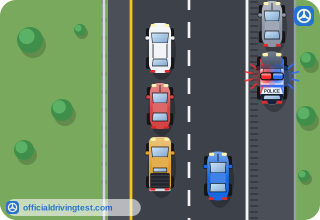
- Be cautious and reduce your speed to a reasonable and safe speed
- Keep your speed and sound your horn to warn the emergency crew
- Stop your vehicle until the emergency vehicle drives away
- Change lanes quickly toward the shoulder and keep your speed
Show answer
Correct answer: Be cautious and reduce your speed to a reasonable and safe speed
If moving over is not possible, you must still be cautious and reduce your speed to a reasonable and safe speed.
Source: Massachusetts Driver's Manual (Revised April 2026), page 120 · Open this page in the manual (Manual page 120)
-
At night, what should you do when passing an emergency vehicle that is stopped?
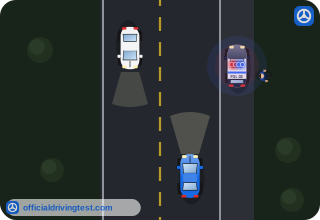
- Turn off your headlights
- Flash your high beams at it
- Dim your high beams
- Switch on your high beams to see better
Show answer
Correct answer: Dim your high beams
The manual says that at night you should be sure to dim your high beams when passing an emergency vehicle.
Source: Massachusetts Driver's Manual (Revised April 2026), page 120 · Open this page in the manual (Manual page 120)
-
If you need help and a police cruiser is stopped on the roadside, where should you pull your vehicle?
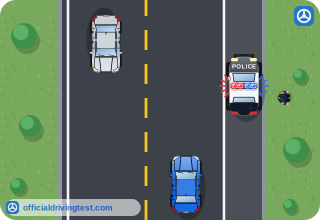
- Behind the police cruiser
- In front of the police cruiser
- Beside the cruiser, in the travel lane
- On the opposite side of the road
Show answer
Correct answer: In front of the police cruiser
The manual says to pull in front of the police cruiser and ask for help, and never to stop behind it.
Source: Massachusetts Driver's Manual (Revised April 2026), page 120 · Open this page in the manual (Manual page 120)
-
A police officer is dealing with another stopped motorist and you need help. What does the manual tell you to do?
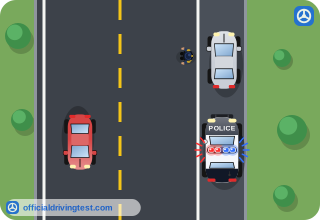
- Walk up to the officer and wait beside the other stopped motorist
- Stay in the driver's seat and sound your horn until the officer comes
- Stand in the travel lane to get the officer's attention
- Stand next to your vehicle on the shoulder until the officer is finished
Show answer
Correct answer: Stand next to your vehicle on the shoulder until the officer is finished
The manual says not to approach an officer who is dealing with a stopped motorist and to stand next to your vehicle on the shoulder until the officer is finished.
Source: Massachusetts Driver's Manual (Revised April 2026), page 121 · Open this page in the manual (Manual page 121)