Maryland: Emergencies and crashes — Part 1 Practice Test
Questions in this part include: “Which of these are the most common causes of reduced visibility?” · “What is traction?”
Independent educational site · not affiliated with any government agency or DMV
Ready? Test yourself
- Instant feedback with an explanation
- Every answer cites its source in the manual
- Your best score is saved on this device
Questions are original and based on the official manual "Maryland Driver’s Manual" (October 2025 Edition (DL-002 10-25)), Maryland Motor Vehicle Administration.
All 20 questions in this practice test
Take the test above first, then use this list to study. Tap “Show answer” to see the correct answer and explanation.
Show the questions and answersHide the questions
-
What does "visibility" mean when you drive?
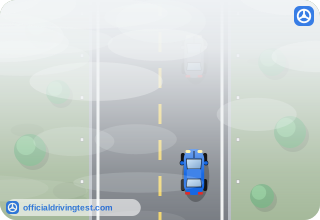
- Your ability to clearly see everything around you on the road
- How quickly your vehicle can start, stop, and change direction
- The distance you need to stop on a wet road
- How well other drivers can hear your vehicle
Show answer
Correct answer: Your ability to clearly see everything around you on the road
The manual defines visibility as your ability to clearly see everything around you on the road, such as vehicles, pedestrians, signs, signals, and pavement markings.
Source: Maryland Driver’s Manual (October 2025 Edition (DL-002 10-25)), page 27
-
Which of these are the most common causes of reduced visibility?
- Dust, smoke, wind, and glare
- Hills, curves, bridges, and tunnels
- Darkness, fog, heavy rain, and snow
- Parked cars, trucks, buses, and trailers
Show answer
Correct answer: Darkness, fog, heavy rain, and snow
The manual says the most common causes of reduced visibility are darkness, fog, heavy rain, and snow.
Source: Maryland Driver’s Manual (October 2025 Edition (DL-002 10-25)), page 27
-
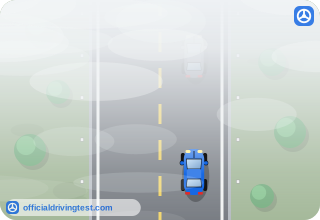
Compared with "normal" driving, driving when visibility is reduced requires:
- less concentration, because traffic moves slower
- more concentration and preparation
- the same attention as usual
- only a slower reaction time
Show answer
Correct answer: more concentration and preparation
The manual says driving in reduced visibility is more difficult than normal driving and requires more concentration and preparation.
Source: Maryland Driver’s Manual (October 2025 Edition (DL-002 10-25)), page 27
-
When visibility is reduced, what can you use as a guide?

- The headlights of the vehicles coming toward you
- The center of the road
- Signs and buildings beside the road
- The lines on the road edge or the right side of the road
Show answer
Correct answer: The lines on the road edge or the right side of the road
The manual advises using the lines on the edge of the road, or the right side of the road, as a guide in reduced visibility.
Source: Maryland Driver’s Manual (October 2025 Edition (DL-002 10-25)), page 27
-
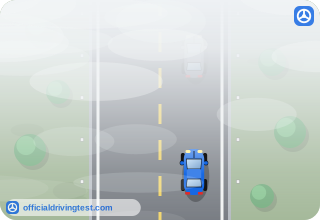
The fog is so thick that you cannot safely drive your vehicle. What does the manual say to do?
- Stop in your lane, turn on your high beams, and wait for the fog to clear
- Pull completely off the road to a safe location and use your emergency flashers
- Slow to a crawl and keep driving in your lane until the fog thins out
- Stop on the road and sound your horn
Show answer
Correct answer: Pull completely off the road to a safe location and use your emergency flashers
The manual says to pull completely off the road to a safe location and turn on your emergency flashers if the fog is too thick to drive safely.
Source: Maryland Driver’s Manual (October 2025 Edition (DL-002 10-25)), page 28
-
What is traction?
- The pressure of the air inside your tires
- The grip between your tires and the road
- The distance your vehicle slides when you brake
- The weight of your vehicle on its tires
Show answer
Correct answer: The grip between your tires and the road
The manual defines traction as the grip between your tires and the road that makes it possible for your vehicle to start, stop, and change direction.
Source: Maryland Driver’s Manual (October 2025 Edition (DL-002 10-25)), page 28
-
According to the manual, what should "good tread" on your tires be based on?
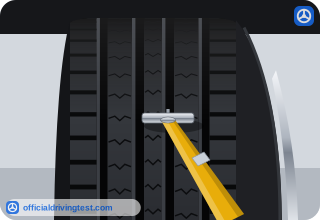
- What the tire maker recommends and the vehicle guidelines
- The age of the vehicle and the season of the year
- The speed limit of the road and the weather forecast
- The weight of the cargo you carry
Show answer
Correct answer: What the tire maker recommends and the vehicle guidelines
The manual says tires should have good tread, based on what the company that made the tires recommends and the guidelines for your vehicle.
Source: Maryland Driver’s Manual (October 2025 Edition (DL-002 10-25)), page 28
-
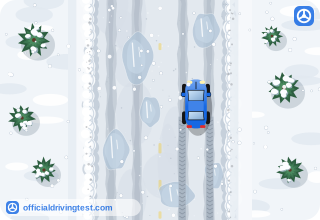
Why should you avoid slamming on your brakes in inclement weather?
- It may damage your headlights
- It may cause your tires to freeze
- It may cause your vehicle to skid
- It may turn off your wipers
Show answer
Correct answer: It may cause your vehicle to skid
The manual says slamming on your brakes may cause your vehicle to skid.
Source: Maryland Driver’s Manual (October 2025 Edition (DL-002 10-25)), page 28
-
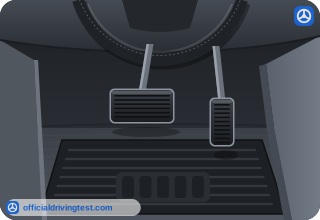
In inclement weather, if your vehicle does not have an anti-lock braking system, what should you do to prevent skidding?
- Press the brake pedal as hard as possible
- Pump the brakes
- Shift into neutral
- Turn the steering wheel quickly
Show answer
Correct answer: Pump the brakes
The manual says that without an anti-lock braking system you should pump the brakes to prevent skidding.
Source: Maryland Driver’s Manual (October 2025 Edition (DL-002 10-25)), page 28
-
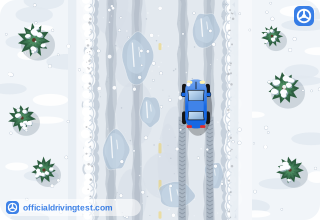
When driving in inclement weather, which of these should you avoid?
- Holding the steering wheel with both hands
- Changing speed slowly
- Keeping your hands at the sides of the wheel
- Jerking the steering wheel or quickly changing speed
Show answer
Correct answer: Jerking the steering wheel or quickly changing speed
The manual says to avoid jerking the steering wheel or quickly changing speed in inclement weather.
Source: Maryland Driver’s Manual (October 2025 Edition (DL-002 10-25)), page 28
-
Which of these freeze before other roads?
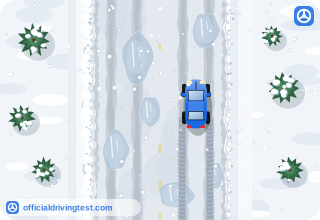
- Ramps and bridges
- Roads with a low speed limit
- Roads with a wide shoulder
- Roads in tunnels
Show answer
Correct answer: Ramps and bridges
The manual notes that ramps and bridges freeze before roads.
Source: Maryland Driver’s Manual (October 2025 Edition (DL-002 10-25)), page 28
-
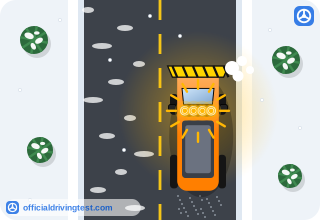
What does the manual say about ice on plowed roads in winter?
- Only on the shoulder, because plows clear the lanes completely
- Only on bridges
- They may refreeze at night or have icy patches from melted snow
- Nowhere, because plowing removes all ice
Show answer
Correct answer: They may refreeze at night or have icy patches from melted snow
The manual says plowed roads may refreeze at night or have icy patches from snow that melted during the day.
Source: Maryland Driver’s Manual (October 2025 Edition (DL-002 10-25)), page 28
-
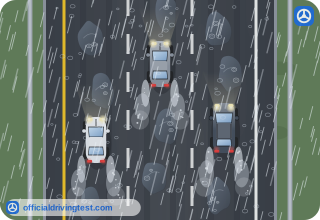
When driving in inclement weather, what does the manual say you should do instead of just reacting to what other drivers do?
- Follow the vehicle in front closely
- Think ahead and take action to stay safe
- Drive in the center of the road
- Wait for other drivers to act first
Show answer
Correct answer: Think ahead and take action to stay safe
The manual says it is important to think ahead and take action to stay safe, not just react to what other drivers do.
Source: Maryland Driver’s Manual (October 2025 Edition (DL-002 10-25)), page 28
-
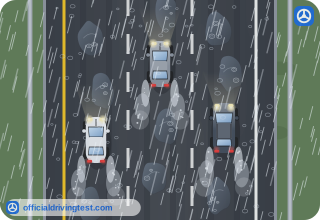
Which of these does the manual say to make sure is working well in inclement weather?
- Your parking brake
- Your horn
- Your rear-view mirror
- Your windshield wipers
Show answer
Correct answer: Your windshield wipers
The manual says to make sure your windshield wipers are working well in inclement weather.
Source: Maryland Driver’s Manual (October 2025 Edition (DL-002 10-25)), page 29
-
What does the manual say about a "completely safe" speed on ice and snow?
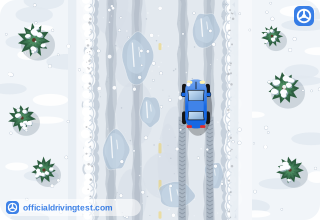
- There is no such thing as a completely safe speed
- A speed of 25 miles per hour is completely safe
- Any speed under the limit is completely safe
- A completely safe speed is half the limit
Show answer
Correct answer: There is no such thing as a completely safe speed
The manual says there is no such thing as a "completely safe" speed on ice and snow.
Source: Maryland Driver’s Manual (October 2025 Edition (DL-002 10-25)), page 29
-
What is "black ice"?
- Oil that has spilled onto the road and then frozen
- Wet leaves and mud frozen to the pavement surface
- A thin layer of ice on blacktop roads that is hard to see
- A dark patch of fog that settles over the road
Show answer
Correct answer: A thin layer of ice on blacktop roads that is hard to see
The manual says it can be very hard or impossible to see a thin layer of ice on blacktop (asphalt) roads, and this is sometimes called black ice.
Source: Maryland Driver’s Manual (October 2025 Edition (DL-002 10-25)), page 29
-
What causes black ice?
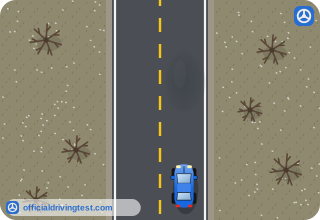
- Rain falling on dry salt
- Ice or snow melting and re-freezing
- Tires heating the road surface
- Cold wind blowing across the road
Show answer
Correct answer: Ice or snow melting and re-freezing
The manual says black ice is caused by ice or snow melting and re-freezing.
Source: Maryland Driver’s Manual (October 2025 Edition (DL-002 10-25)), page 29
-
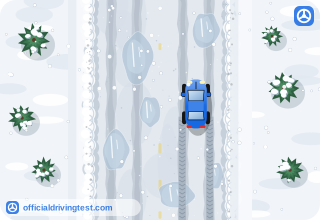
What does the manual say about four-wheel drive vehicles on ice and snow?
- They cannot slide on ice or snow because all four wheels are driven
- They can drive at normal speeds on ice and snow
- They need no extra care on ice and snow, unlike other vehicles
- They can also slide; driving on ice or snow is always dangerous
Show answer
Correct answer: They can also slide; driving on ice or snow is always dangerous
The manual says four-wheel drive vehicles can also slide on ice and snow, and driving on snow or ice is always dangerous and unpredictable.
Source: Maryland Driver’s Manual (October 2025 Edition (DL-002 10-25)), page 29
-
What does the manual suggest when driving on ice or snow-covered roads?
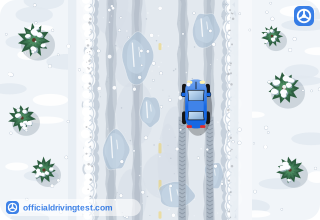
- Slow down, because nothing makes it safe to drive at normal speeds
- Drive at normal speeds if you have a four-wheel drive vehicle
- Follow a plow as closely as possible
- Use your high beams to see the ice
Show answer
Correct answer: Slow down, because nothing makes it safe to drive at normal speeds
The manual suggests slowing down, because nothing makes it safe to drive on ice or snow-covered roads at normal speeds.
Source: Maryland Driver’s Manual (October 2025 Edition (DL-002 10-25)), page 29
-
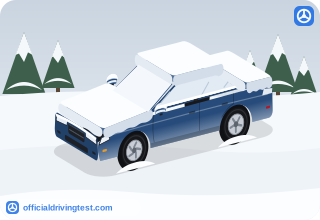
Before driving in snow or ice, what should you do with your windows and lights?
- Wipe only the windshield and leave the rest for later
- Clear them only after you start driving
- Keep them clear and remove all ice and snow from your vehicle
- Leave the snow on the roof for warmth
Show answer
Correct answer: Keep them clear and remove all ice and snow from your vehicle
The manual says to keep your windows and lights clear and to remove all ice and snow from your vehicle before driving.
Source: Maryland Driver’s Manual (October 2025 Edition (DL-002 10-25)), page 29