Kentucky: Right-of-way and turning
Who yields at intersections and four-way stops, turning lanes, two-point and three-point turnabouts, roundabouts, passing and being passed. Split into 4 shorter tests so you're not stuck in one long quiz.
Independent educational site · not affiliated with any government agency or DMV
Choose a part
Right-of-way and turning — Part 1
Questions in this part include: “What is an intersection?”
StartRight-of-way and turning — Part 2
Questions in this part include: “What is a turnabout?”
StartRight-of-way and turning — Part 3
Who yields at intersections and four-way stops, turning lanes, two-point and three-point turnabouts, roundabouts, passing and being passed. — Part 3
StartRight-of-way and turning — Part 4
Questions in this part include: “Which colors of flashing lights on an escort vehicle give a funeral procession the right-of-way at an intersection?”
StartAll 70 Right-of-way and turning questions with answers
Choose a part above to take a practice test, or study every question and answer here.
Show the questions and answersHide the questions
-
Which driver should you yield the right of way to at an intersection?
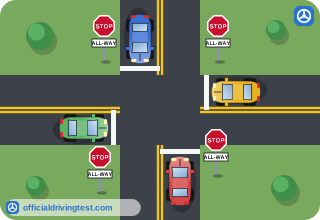
- The driver who is at or arrives before you at the intersection
- The driver who arrives after you at the intersection
- The driver in the larger vehicle at the intersection
- The driver who is traveling faster than you are
Show answer
Correct answer: The driver who is at or arrives before you at the intersection
You should yield to the driver who is at the intersection or arrives before you.
Source: Kentucky Driver Manual (Updated July 23, 2026), page 34 · Open this page in the manual (Manual page 34)
-
You are making a left turn. Whom should you yield the right of way to?
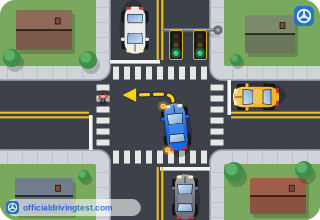
- Only opposing drivers who are going straight through the intersection
- Only drivers who are coming up behind you in your own lane
- Drivers in the opposing traffic lane, including vehicles turning right
- Drivers on the cross street who have a green light
Show answer
Correct answer: Drivers in the opposing traffic lane, including vehicles turning right
When making a left turn you yield to drivers in the opposing traffic lane, and this includes vehicles turning right.
Source: Kentucky Driver Manual (Updated July 23, 2026), page 34 · Open this page in the manual (Manual page 34)
-
You and another driver arrive at the same time at a four-way intersection controlled by stop signs. Which driver should you yield to?
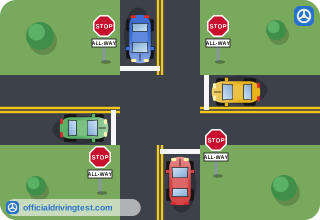
- The driver on your left
- The driver on your right
- The driver who is going straight ahead
- The driver in the larger vehicle
Show answer
Correct answer: The driver on your right
At a four-way stop-sign intersection you yield to the driver on your right if you both arrive at the same time.
Source: Kentucky Driver Manual (Updated July 23, 2026), page 34 · Open this page in the manual (Manual page 34)
-
You are entering a public highway from a driveway or a private road. Whom should you yield to?
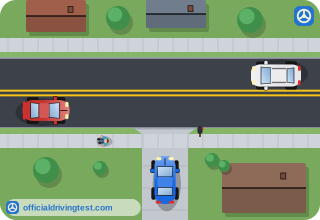
- Only drivers who are turning left onto the highway
- Nobody, if no stop sign is posted at the driveway
- Only drivers coming from your right on the highway
- Drivers on the public highway
Show answer
Correct answer: Drivers on the public highway
Drivers entering a public highway from a driveway or private road must give way to drivers already on the highway.
Source: Kentucky Driver Manual (Updated July 23, 2026), page 34 · Open this page in the manual (Manual page 34)
-
A driver on a minor road meets a driver on a main road. Who must yield?
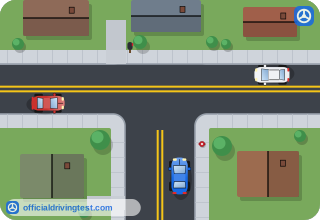
- The driver on the main road
- The driver who is traveling faster
- The driver who is traveling slower
- The driver on the minor road
Show answer
Correct answer: The driver on the minor road
Drivers on a minor road must yield to drivers on a main road.
Source: Kentucky Driver Manual (Updated July 23, 2026), page 34 · Open this page in the manual (Manual page 34)
-
You are on the entrance or acceleration ramp of a limited access or interstate highway. Whom should you yield the right of way to?
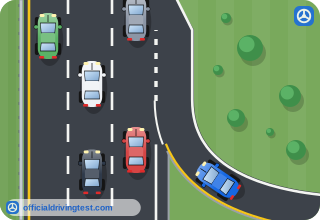
- Drivers who are leaving the highway at the next exit
- Drivers already on the highway
- Drivers behind you on the entrance ramp
- Only trucks and buses on the highway
Show answer
Correct answer: Drivers already on the highway
You should yield to drivers who are already on the limited access or interstate highway when you are on the entrance or acceleration ramp.
Source: Kentucky Driver Manual (Updated July 23, 2026), page 34 · Open this page in the manual (Manual page 34)
-
Which road users who are still in the intersection should you yield the right of way to?
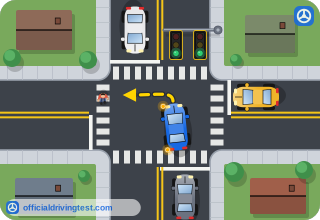
- Only pedestrians who are in a marked crosswalk
- Only other drivers who have a green light
- Pedestrians, bicyclists, and other drivers
- Only pedestrians and bicyclists in the crosswalk
Show answer
Correct answer: Pedestrians, bicyclists, and other drivers
You should yield to pedestrians, bicyclists, and other drivers who are still in the intersection.
Source: Kentucky Driver Manual (Updated July 23, 2026), page 34 · Open this page in the manual (Manual page 34)
-
What is true about assuming you have the right of way?
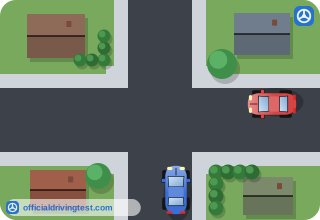
- No one should assume he or she automatically has it
- The driver in the larger vehicle always has it, whatever the situation
- The driver traveling faster always has it, whatever the situation
- The driver who is turning right always has it, whatever the situation
Show answer
Correct answer: No one should assume he or she automatically has it
Yielding rules are a guide, and the situation and circumstances at the intersection must always be considered.
Source: Kentucky Driver Manual (Updated July 23, 2026), page 34 · Open this page in the manual (Manual page 34)
-
What is an intersection?
- Only a place where a traffic signal is installed
- Any place where two roads meet
- Only a place where two highways cross
- Any place where a driveway meets a parking lot
Show answer
Correct answer: Any place where two roads meet
An intersection is any place where two roads meet.
Source: Kentucky Driver Manual (Updated July 23, 2026), page 34 · Open this page in the manual (Manual page 34)
-
At a stop sign, whom must you yield the right of way to?
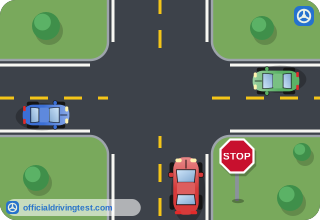
- Crossing vehicles and pedestrians in all directions
- Only vehicles that are approaching from your right side
- Only pedestrians who are already standing in a marked crosswalk
- Only vehicles that are already inside the intersection
Show answer
Correct answer: Crossing vehicles and pedestrians in all directions
At a stop sign you must yield the right of way to crossing vehicles and pedestrians in all directions.
Source: Kentucky Driver Manual (Updated July 23, 2026), page 38 · Open this page in the manual (Manual page 38)
-
If crosswalks are not apparent and you are required to stop, what must you do at an intersection?
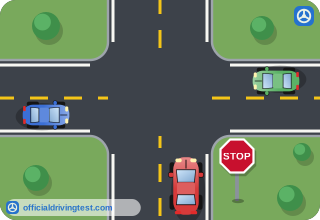
- Stop before entering the intersection
- Slow down and proceed if no pedestrians are visible
- Stop only if pedestrians are present
- Stop in the middle of the intersection
Show answer
Correct answer: Stop before entering the intersection
If crosswalks are not apparent, you must stop before entering the intersection.
Source: Kentucky Driver Manual (Updated July 23, 2026), page 39 · Open this page in the manual (Manual page 39)
-
When making a right turn, what should you avoid doing before the turn?
- Checking traffic to the rear
- Swinging wide to the left
- Signaling your intention
- Searching all corners
Show answer
Correct answer: Swinging wide to the left
For right turns, the manual says to avoid swinging wide to the left before making the turn.
Source: Kentucky Driver Manual (Updated July 23, 2026), page 42 · Open this page in the manual (Manual page 42)
-
From which part of your lane should you always turn right?
- The center of your lane
- Wherever there is the most room
- The portion nearest the center line
- The right-most portion of your lane
Show answer
Correct answer: The right-most portion of your lane
The manual says to always turn right from the right-most portion of your lane.
Source: Kentucky Driver Manual (Updated July 23, 2026), page 42 · Open this page in the manual (Manual page 42)
-
From which part of your lane should you always turn left?
- The left-most portion of your lane
- The center of your lane
- The portion nearest the right edge
- Wherever there is the most room
Show answer
Correct answer: The left-most portion of your lane
The manual says to always turn left from the left-most portion of your lane.
Source: Kentucky Driver Manual (Updated July 23, 2026), page 42 · Open this page in the manual (Manual page 42)
-
When making a left turn, to whom must you yield?
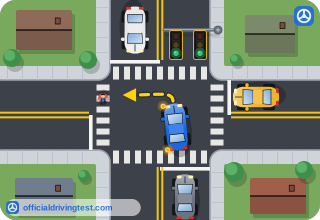
- Traffic behind you
- Parked vehicles
- Oncoming traffic
- No one; the turning driver has the right of way
Show answer
Correct answer: Oncoming traffic
When making a left turn, you yield to oncoming traffic.
Source: Kentucky Driver Manual (Updated July 23, 2026), page 42 · Open this page in the manual (Manual page 42)
-
When two or more lanes may be used for a turn, what should you do once you have entered your turning lane?
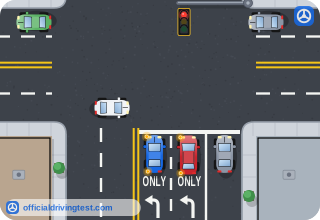
- Change lanes if the other lane moves faster
- Stay in that lane until the turn is completed
- Drift toward the outside lane to give room
- Move into whichever lane has more room
Show answer
Correct answer: Stay in that lane until the turn is completed
When turning from multiple lanes, you identify and enter your lane and stay in it until the turn is completed.
Source: Kentucky Driver Manual (Updated July 23, 2026), page 42 · Open this page in the manual (Manual page 42)
-
While turning, you should look through the turn to which place?
- The nearest point on the road ahead of you
- The center of the intersection
- The curb at the corner you are turning around
- The farthest point possible along your intended path
Show answer
Correct answer: The farthest point possible along your intended path
The manual tells drivers to look through the turn to the farthest point possible along the intended path.
Source: Kentucky Driver Manual (Updated July 23, 2026), page 42 · Open this page in the manual (Manual page 42)
-
When turning, which lane should you enter and maintain?
- The lane closest to the direction you want to go
- The lane with the least traffic ahead of you
- The center lane whenever there is one available
- The lane that is moving at the fastest speed
Show answer
Correct answer: The lane closest to the direction you want to go
You should enter and maintain proper position in the lane that is closest to the direction you want to go.
Source: Kentucky Driver Manual (Updated July 23, 2026), page 42 · Open this page in the manual (Manual page 42)
-
What is a turnabout?
- A turn made from the center lane across oncoming traffic at a signal
- A turn that uses a street, alley, or driveway to legally reverse your direction
- A turn at an intersection that continues around a block
- A curve in the road that turns traffic back toward where it began
Show answer
Correct answer: A turn that uses a street, alley, or driveway to legally reverse your direction
A turnabout uses a street, alley, or driveway to legally reverse the direction you are traveling when driving around a block is not practical or possible.
Source: Kentucky Driver Manual (Updated July 23, 2026), page 43 · Open this page in the manual (Manual page 43)
-
Before making a turnabout, how far in either direction should your car be visible?
- 100 feet
- 250 feet
- 1,000 feet
- 500 feet
Show answer
Correct answer: 500 feet
The manual says to make sure your car can be seen for 500 feet in either direction before a turnabout.
Source: Kentucky Driver Manual (Updated July 23, 2026), page 43 · Open this page in the manual (Manual page 43)
-
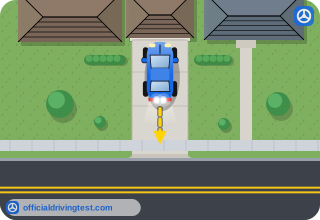
During a turnabout, you are backing onto a two-lane road. Where should you position the vehicle?
- To the right of the center line
- Centered in the roadway
- On the left side of the center line
- At an angle across both lanes
Show answer
Correct answer: To the right of the center line
When backing onto a two-lane road, you do not center the vehicle in the roadway; you position it to the right of the center line.
Source: Kentucky Driver Manual (Updated July 23, 2026), page 43 · Open this page in the manual (Manual page 43)
-
While backing slowly into a driveway for a turnabout, how should you steer?
- Rapidly all the way to the left
- Slowly, a quarter turn to the right
- Rapidly all the way to the right
- Keep the wheels straight
Show answer
Correct answer: Rapidly all the way to the right
In a turnabout you steer rapidly all the way to the right while backing slowly into the driveway.
Source: Kentucky Driver Manual (Updated July 23, 2026), page 43 · Open this page in the manual (Manual page 43)
-
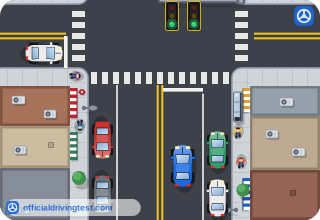
At all intersections, what should you do with your speed?
- Keep it steady if the light is green
- Reduce it
- Increase it to clear the intersection quickly
- Match the speed of the vehicle ahead
Show answer
Correct answer: Reduce it
The manual says that at all intersections you reduce your speed and search for hazards and traffic control devices.
Source: Kentucky Driver Manual (Updated July 23, 2026), page 43 · Open this page in the manual (Manual page 43)
-
Which of these should you search for at all intersections?
- Parking meters and bus shelters
- Cameras that record violations
- Business entrances
- Pedestrians and bicyclists
Show answer
Correct answer: Pedestrians and bicyclists
At all intersections you should search for traffic control devices, oncoming and cross traffic, pedestrians and bicyclists, roadway condition, and areas of limited visibility.
Source: Kentucky Driver Manual (Updated July 23, 2026), page 43 · Open this page in the manual (Manual page 43)
-
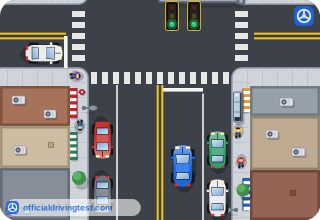
Which statement about other drivers at an intersection is correct?
- Do not rely on them; they may not yield the right of way
- Rely on them when you have a green light and a clear view of the road
- Rely on them when they have a red light or a stop sign
- Rely on them if they are using their turn signals
Show answer
Correct answer: Do not rely on them; they may not yield the right of way
You should not rely on others to obey traffic control signals or signs, since they may not yield the right of way, and you should be prepared to avoid a crash.
Source: Kentucky Driver Manual (Updated July 23, 2026), page 43 · Open this page in the manual (Manual page 43)
-
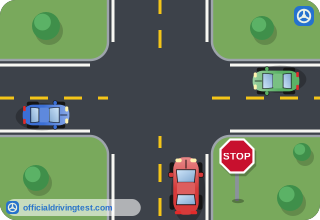
Before entering an intersection after stopping, in what order should you look?
- Right, then left, then right again
- Left only, then go if it is clear
- Left, then right, then left again
- Straight ahead, then right only
Show answer
Correct answer: Left, then right, then left again
After stopping at an intersection you look left and then right and left again before entering.
Source: Kentucky Driver Manual (Updated July 23, 2026), page 43 · Open this page in the manual (Manual page 43)
-
When the light at a traffic signal turns green, what should you avoid doing?
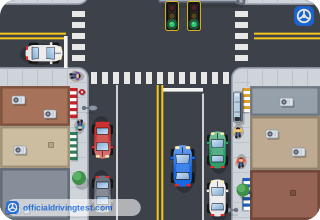
- Checking for crossing traffic
- Moving into the intersection immediately
- Checking that your path of travel is clear
- Making sure you have enough space to turn
Show answer
Correct answer: Moving into the intersection immediately
When the light turns green you take time to make sure your path is clear and there is no crossing traffic instead of moving immediately into the intersection.
Source: Kentucky Driver Manual (Updated July 23, 2026), page 43 · Open this page in the manual (Manual page 43)
-
At an intersection, what should you do even if other traffic has a red light or a stop sign?
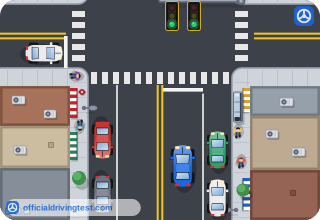
- Proceed without checking
- Sound your horn
- Flash your headlights
- Look both ways
Show answer
Correct answer: Look both ways
Someone may disobey traffic control devices, so you look both ways even if other traffic has a red light or a stop sign.
Source: Kentucky Driver Manual (Updated July 23, 2026), page 43 · Open this page in the manual (Manual page 43)
-
If a building or a row of parked vehicles blocks your view of a cross street, what should you do?
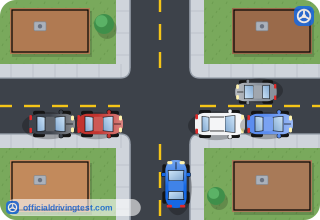
- Edge forward slowly until you can clearly see
- Accelerate through before anyone appears
- Sound your horn and then proceed
- Wait for the driver to wave you through
Show answer
Correct answer: Edge forward slowly until you can clearly see
If your view of a cross street is blocked, you edge forward slowly until you can clearly see.
Source: Kentucky Driver Manual (Updated July 23, 2026), page 43 · Open this page in the manual (Manual page 43)
-
If traffic in one lane is blocking your view of another lane at an intersection, what should you do?
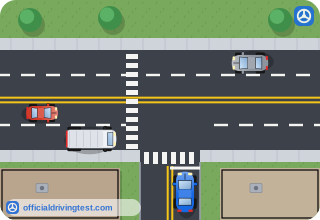
- Place the front of your vehicle into the other lane
- Edge forward and sound your horn
- Wait until it clears
- Speed up to pass the blocking vehicle
Show answer
Correct answer: Wait until it clears
You should wait until the blocking traffic clears; placing the front of your vehicle into the other lane to look may get you hit.
Source: Kentucky Driver Manual (Updated July 23, 2026), page 43 · Open this page in the manual (Manual page 43)
-
You are about to turn into a lane and an approaching vehicle has its turn signal active. What should you do?
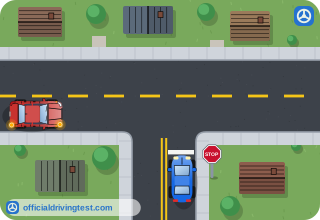
- Turn into the lane, since the driver will turn first
- Do not turn into the lane just because of the signal
- Assume the driver will give you extra space
- Flash your headlights and then turn
Show answer
Correct answer: Do not turn into the lane just because of the signal
The driver may plan to turn after passing you or may have forgotten to turn the signal off, so you should not turn into the lane just because of the signal.
Source: Kentucky Driver Manual (Updated July 23, 2026), page 43 · Open this page in the manual (Manual page 43)
-
In which direction do vehicles travel around the center island of a roundabout or traffic circle?
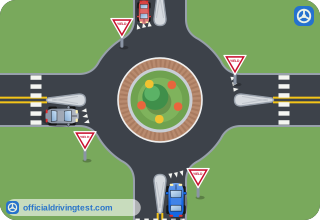
- Clockwise
- Whichever way is shortest
- Left or right, depending on the exit
- Counterclockwise
Show answer
Correct answer: Counterclockwise
Vehicles travel counterclockwise around a raised center island, and you enter a roundabout in a counterclockwise direction.
Source: Kentucky Driver Manual (Updated July 23, 2026), page 44 · Open this page in the manual (Manual page 44)
-
Who yields the right of way where traffic enters a roundabout or traffic circle?
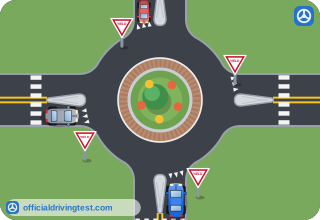
- Entering traffic yields to circulating traffic
- Circulating traffic yields to entering traffic
- The faster vehicle yields to the slower one
- The vehicle on the left yields to the one on the right
Show answer
Correct answer: Entering traffic yields to circulating traffic
Entering traffic yields the right of way to circulating traffic.
Source: Kentucky Driver Manual (Updated July 23, 2026), page 44 · Open this page in the manual (Manual page 44)
-
What should you do as you proceed to your exit in a roundabout or traffic circle?
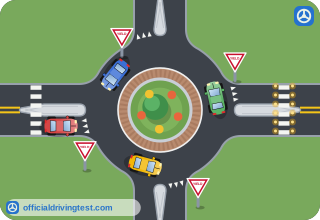
- Stop in the circle until your exit is clear
- Sound your horn before leaving the circle
- Signal your intent and exit
- Cross the center island to reach it
Show answer
Correct answer: Signal your intent and exit
In a roundabout you proceed to the appropriate exit, signal intent, and exit.
Source: Kentucky Driver Manual (Updated July 23, 2026), page 44 · Open this page in the manual (Manual page 44)
-
If you are turning left from a street with two or more lanes, which lane should you turn from?
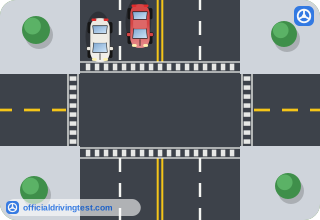
- The lane nearest the curb
- The middle lane of the street
- The lane with the fewest vehicles
- The lane nearest the center lane
Show answer
Correct answer: The lane nearest the center lane
A left turn from a street with two or more lanes is made from the lane nearest the center lane.
Source: Kentucky Driver Manual (Updated July 23, 2026), page 46 · Open this page in the manual (Manual page 46)
-
If you are turning right, which lane should you turn from?
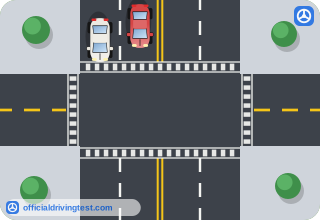
- The lane nearest the curb
- The lane nearest the center lane
- The lane with the most room
- Any lane you choose
Show answer
Correct answer: The lane nearest the curb
A right turn is made from the lane nearest the curb.
Source: Kentucky Driver Manual (Updated July 23, 2026), page 46 · Open this page in the manual (Manual page 46)
-
While turning into another street, which lane should you turn into?
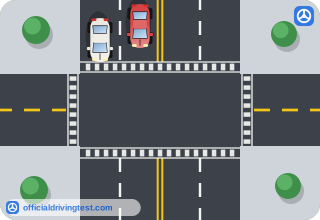
- The lane farthest from you
- The center lane of the street
- The lane nearest to you
- Any lane with the fewest vehicles
Show answer
Correct answer: The lane nearest to you
When turning into another street, you turn into the lane nearest to you.
Source: Kentucky Driver Manual (Updated July 23, 2026), page 46 · Open this page in the manual (Manual page 46)
-
When may you change to another lane after making a turn into a street?
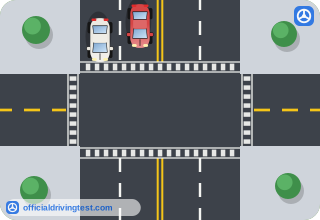
- As soon as you enter the intersection if you have signaled
- Only after finishing the turn, and when traffic is clear
- Halfway through the turn, as long as you have signaled first
- Any time during the turn if no vehicle is directly beside you
Show answer
Correct answer: Only after finishing the turn, and when traffic is clear
A lane change is made only after you have finished your turn and when the traffic is clear.
Source: Kentucky Driver Manual (Updated July 23, 2026), page 46 · Open this page in the manual (Manual page 46)
-
If you miss your turn, what should you do?
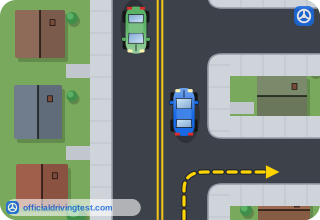
- Stop and back up to the intersection as soon as it is safe
- Make a U-turn at once at the nearest opening in traffic
- Stop in the lane until traffic clears and then turn around
- Go on to the next intersection and work your way back
Show answer
Correct answer: Go on to the next intersection and work your way back
If you miss your turn, you go on to the next intersection and work your way back to where you want to go.
Source: Kentucky Driver Manual (Updated July 23, 2026), page 46 · Open this page in the manual (Manual page 46)
-
How should you check your blind spots before changing lanes?
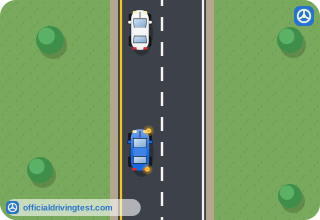
- Turn your head and look over your shoulder away from the direction you plan to move
- Lean forward and look through the windshield at the lane ahead
- Turn your head and look over your shoulder in the direction you plan to move
- Sound your horn and wait for the other driver to respond
Show answer
Correct answer: Turn your head and look over your shoulder in the direction you plan to move
You check your blind spots by turning your head and looking over your shoulder in the direction you plan to move.
Source: Kentucky Driver Manual (Updated July 23, 2026), page 46 · Open this page in the manual (Manual page 46)
-
When changing lanes, after you identify a gap in traffic and signal, what should you do before steering into the lane?
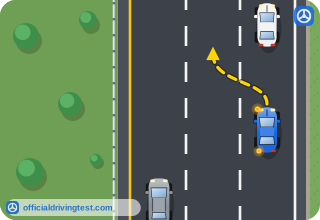
- Check only your rearview mirror before moving over
- Look again in the direction of the lane change
- Sound your horn to warn the drivers beside you
- Come to a complete stop in your lane
Show answer
Correct answer: Look again in the direction of the lane change
After identifying a gap and signaling, you look again in the direction of the lane change, then adjust speed and steer into the lane.
Source: Kentucky Driver Manual (Updated July 23, 2026), page 47 · Open this page in the manual (Manual page 47)
-
In general, on which side should you pass another vehicle?
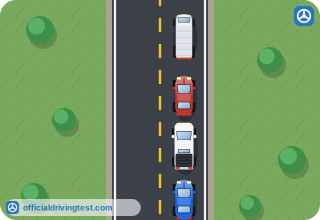
- On the right
- On the left
- On whichever side has more room
- On the shoulder
Show answer
Correct answer: On the left
In general, you should pass on the left.
Source: Kentucky Driver Manual (Updated July 23, 2026), page 47 · Open this page in the manual (Manual page 47)
-
Passing on the right can be dangerous because what is true?
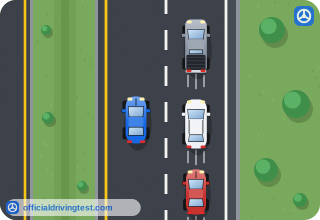
- Vehicles on the right side are easier to see
- Drivers on the right usually travel faster than the left lane
- The law never permits it
- Other drivers do not expect it
Show answer
Correct answer: Other drivers do not expect it
Passing on the right can be dangerous since other drivers do not expect it.
Source: Kentucky Driver Manual (Updated July 23, 2026), page 47 · Open this page in the manual (Manual page 47)
-
According to the manual, when may the operator of a vehicle overtake and pass another vehicle on the right?
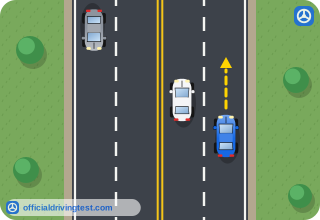
- Only when it is safe to do so
- Only on roads with three or more lanes
- Only when the other driver signals
- Only when the vehicle ahead is below the speed limit
Show answer
Correct answer: Only when it is safe to do so
A vehicle may overtake and pass another vehicle upon the right only when it is safe to do so.
Source: Kentucky Driver Manual (Updated July 23, 2026), page 47 · Open this page in the manual (Manual page 47)
-
According to the manual, when may a pass on the right be made by driving off the roadway?
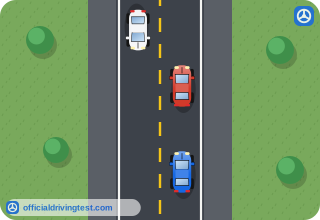
- Whenever the shoulder is wide enough and there is no oncoming traffic
- Only if the driver ahead slows down and signals you to go around on the shoulder
- Only if the vehicle being passed comes to a complete stop and it can be done safely
- Only if your speed is lower than the posted limit and the road is dry
Show answer
Correct answer: Only if the vehicle being passed comes to a complete stop and it can be done safely
Passing by driving off the roadway is allowed only if the vehicle being passed comes to a complete stop and the movement can be made safely.
Source: Kentucky Driver Manual (Updated July 23, 2026), page 47 · Open this page in the manual (Manual page 47)
-
Regarding oncoming vehicles, when should you pass?
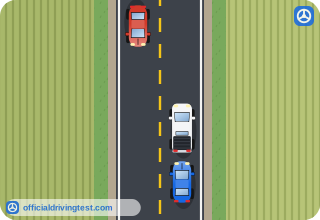
- Only if there are no oncoming vehicles
- Only if the oncoming vehicle is more than 100 feet away
- Only if the oncoming vehicle flashes its lights
- Only if the oncoming vehicle is in the far lane
Show answer
Correct answer: Only if there are no oncoming vehicles
You pass only if there are no oncoming vehicles.
Source: Kentucky Driver Manual (Updated July 23, 2026), page 47 · Open this page in the manual (Manual page 47)
-
What does Kentucky law require about a pass and the start of a “no passing zone”?
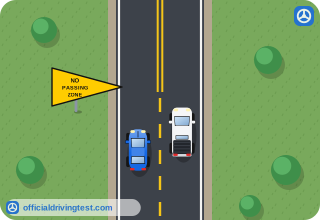
- The pass must be started before reaching the beginning of the zone
- The pass may continue in the zone if no vehicle is oncoming
- The pass must be completed before reaching the beginning of the zone
- The pass may be completed once you are halfway through the zone
Show answer
Correct answer: The pass must be completed before reaching the beginning of the zone
Kentucky law requires that a pass be completed before reaching the beginning of a “no passing zone”.
Source: Kentucky Driver Manual (Updated July 23, 2026), page 47 · Open this page in the manual (Manual page 47)
-
Kentucky law requires a pass to be completed before coming within what distance of an oncoming vehicle?
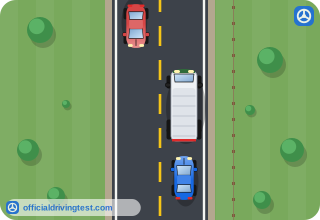
- 100 feet
- 200 feet
- 150 feet
- 300 feet
Show answer
Correct answer: 200 feet
Kentucky law requires that a pass be completed before coming within two hundred (200) feet of an oncoming vehicle.
Source: Kentucky Driver Manual (Updated July 23, 2026), page 47 · Open this page in the manual (Manual page 47)
-
What happens if you are still in the left lane when you reach a “no passing zone”?
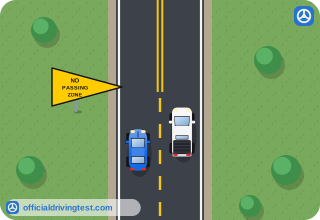
- You may finish the pass if no vehicle is oncoming
- You must stop in the left lane until traffic clears
- You are allowed to continue for a short distance
- You are violating the law
Show answer
Correct answer: You are violating the law
If you are still in the left lane when you reach the “no passing zone”, you are violating the law.
Source: Kentucky Driver Manual (Updated July 23, 2026), page 47 · Open this page in the manual (Manual page 47)
-
According to the manual, what is the danger of staying alongside the vehicle you are passing for a long time?
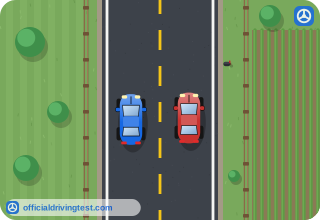
- The other vehicle may move toward your lane
- Your vehicle may use more fuel than the other vehicle
- The other driver may think you are racing and speed up
- Your headlights may blind the driver ahead
Show answer
Correct answer: The other vehicle may move toward your lane
The longer your vehicle stays alongside the other vehicle, the longer you are in danger of the other vehicle moving toward your lane.
Source: Kentucky Driver Manual (Updated July 23, 2026), page 47 · Open this page in the manual (Manual page 47)
-
When should you signal your intentions to pass?
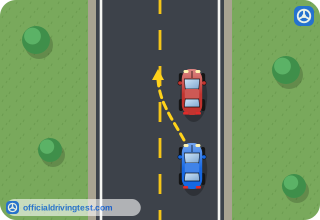
- Before checking your mirrors
- After you have moved into the left lane
- When it is safe to pass
- Only after the vehicle ahead signals
Show answer
Correct answer: When it is safe to pass
You signal your intentions when it is safe to pass.
Source: Kentucky Driver Manual (Updated July 23, 2026), page 47 · Open this page in the manual (Manual page 47)
-
After passing, what should you do before returning to the lane?
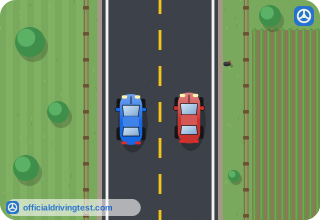
- Sound your horn to alert the driver you passed
- Turn on your hazard lights
- Flash your headlights at the passed driver
- Signal your intention to return to the lane
Show answer
Correct answer: Signal your intention to return to the lane
You signal your intention to return to the lane after passing.
Source: Kentucky Driver Manual (Updated July 23, 2026), page 47 · Open this page in the manual (Manual page 47)
-
Any time your view is blocked by a curve or a hill, what should you assume?
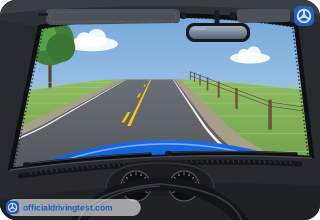
- There is an oncoming vehicle just out of sight
- The oncoming vehicle will slow to let you pass
- The other lane is probably empty
- Other drivers will give way to you
Show answer
Correct answer: There is an oncoming vehicle just out of sight
When a curve or hill blocks your view, you should assume there is an oncoming vehicle just out of sight, and not start to pass.
Source: Kentucky Driver Manual (Updated July 23, 2026), page 48 · Open this page in the manual (Manual page 48)
-
Why is it dangerous to pass where someone may enter or cross the road, such as at crossroads or in school zones?
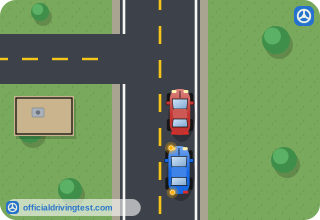
- Vehicles being passed are required to speed up near crossroads and parks
- Roads in business and shopping areas are always too narrow for a pass
- Your view of people and traffic may be blocked by the vehicle you are passing
- Drivers turning onto the road must wait for you to return to the right lane
Show answer
Correct answer: Your view of people and traffic may be blocked by the vehicle you are passing
While you are passing, the vehicle you are passing may block your view of people and traffic.
Source: Kentucky Driver Manual (Updated July 23, 2026), page 48 · Open this page in the manual (Manual page 48)
-
Why might drivers turning onto the roadway be a danger while you are passing in the left lane?
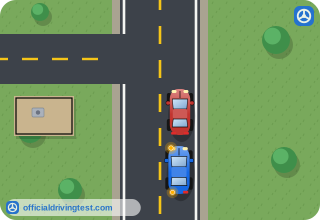
- They may not see your headlights in the right lane
- They may not expect to find you in the left lane
- They may turn without ever looking in their mirrors
- They are required to turn into the left lane first
Show answer
Correct answer: They may not expect to find you in the left lane
Other drivers turning onto the roadway into the left lane may not expect to find you in the left lane.
Source: Kentucky Driver Manual (Updated July 23, 2026), page 48 · Open this page in the manual (Manual page 48)
-
Before you pass, what should you look ahead for?
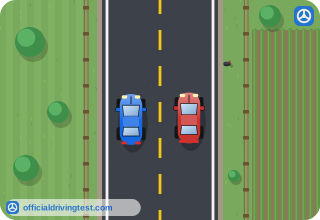
- Other drivers who may be planning to pass you in the lane to your right
- Road signs that tell you how many more miles remain on the highway
- The distance to the next exit so you can return to the right lane
- Road or other conditions that may cause other traffic to move into your lane
Show answer
Correct answer: Road or other conditions that may cause other traffic to move into your lane
Before passing, you look ahead for road or other conditions that may cause other traffic to move into your lane.
Source: Kentucky Driver Manual (Updated July 23, 2026), page 48 · Open this page in the manual (Manual page 48)
-
Before you pass, what should you make sure of regarding a private drive or intersection?
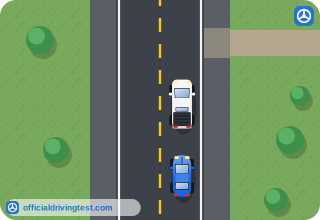
- That no one is going to pull in front of you from it
- That the vehicle you are passing is not about to turn into it
- That you have flashed your headlights at it
- That the lane to your right is clear beside it
Show answer
Correct answer: That no one is going to pull in front of you from it
Before passing, you make sure someone is not going to pull in front of you from a private drive or intersection.
Source: Kentucky Driver Manual (Updated July 23, 2026), page 48 · Open this page in the manual (Manual page 48)
-
You should never pull out to pass unless you know that you do what?
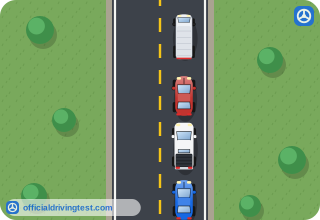
- Can rely on other drivers to make room for you
- Will have enough time to pass several vehicles at once
- Have enough space to return to your lane
- Have signaled for at least five seconds
Show answer
Correct answer: Have enough space to return to your lane
You never pull out to pass unless you know you have enough space to return to your lane.
Source: Kentucky Driver Manual (Updated July 23, 2026), page 48 · Open this page in the manual (Manual page 48)
-
Which is listed as something to do when you are being passed?
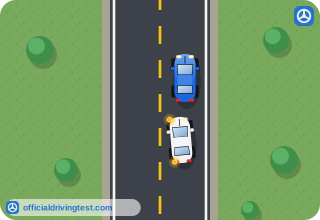
- Stay in your lane
- Speed up
- Brake hard
- Move into the left lane
Show answer
Correct answer: Stay in your lane
One thing to do when being passed is to stay in your lane.
Source: Kentucky Driver Manual (Updated July 23, 2026), page 48 · Open this page in the manual (Manual page 48)
-
Under Kentucky law, the operator of a vehicle about to be overtaken and passed must do what?
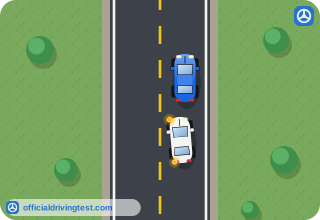
- Increase speed so that the passing vehicle returns quickly
- Give way to the left to leave room on the right side
- Give way to the right in favor of the overtaking vehicle
- Slow to a stop in the middle of the road
Show answer
Correct answer: Give way to the right in favor of the overtaking vehicle
Kentucky law requires the operator of a vehicle about to be overtaken and passed to give way to the right in favor of the overtaking vehicle.
Source: Kentucky Driver Manual (Updated July 23, 2026), page 48 · Open this page in the manual (Manual page 48)
-
In passing situations, road users are required to do what?
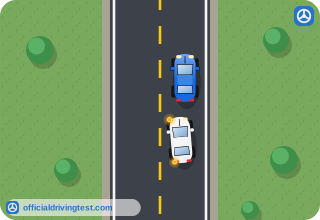
- Speed up so the pass is over sooner
- Work together to obtain clearance and avoid accidents
- Let the overtaking driver decide who yields
- Keep the same speed until the pass is complete
Show answer
Correct answer: Work together to obtain clearance and avoid accidents
Road users are required to work together in order to obtain clearance and avoid accidents in passing situations.
Source: Kentucky Driver Manual (Updated July 23, 2026), page 48 · Open this page in the manual (Manual page 48)
-
Which colors of flashing lights on an escort vehicle give a funeral procession the right-of-way at an intersection?
- Green, white, or purple
- Orange, green, or white
- Green or white only
- Yellow, red, or blue
Show answer
Correct answer: Yellow, red, or blue
A funeral procession may pass through an intersection with the right-of-way if it is led by an escort vehicle displaying flashing yellow, red, or blue lights.
Source: Kentucky Driver Manual (Updated July 23, 2026), page 68 · Open this page in the manual (Manual page 68)
-
Which of these is an exception to a funeral procession's right-of-way at an intersection?
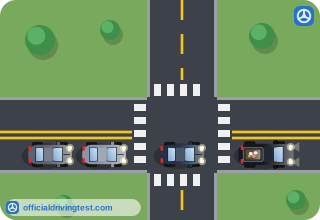
- The other driver is turning left
- The vehicle is a train or locomotive
- The other vehicle is a school bus
- The road has a speed limit above 35 mph
Show answer
Correct answer: The vehicle is a train or locomotive
The exceptions are an emergency vehicle needing the right-of-way, direction otherwise by a police or safety officer, and a train or locomotive.
Source: Kentucky Driver Manual (Updated July 23, 2026), page 68 · Open this page in the manual (Manual page 68)
-
When may you drive your vehicle between the vehicles of a funeral procession?
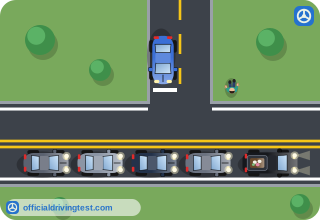
- When the procession is moving slowly
- When you have turned on your headlights
- When a police or safety officer authorizes it
- When there is a large gap between vehicles
Show answer
Correct answer: When a police or safety officer authorizes it
You must not drive between the vehicles of a funeral procession unless a police or safety officer authorizes it.
Source: Kentucky Driver Manual (Updated July 23, 2026), page 68 · Open this page in the manual (Manual page 68)
-
What must you not do for the purpose of securing right-of-way around a funeral procession?
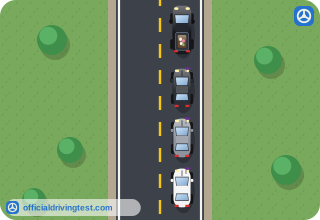
- Turn on your headlights
- Dim your lights for oncoming traffic
- Use your turn signal
- Reduce your speed
Show answer
Correct answer: Turn on your headlights
The manual says not to turn on your headlights or do any other act for the purpose of securing right-of-way around a funeral procession.
Source: Kentucky Driver Manual (Updated July 23, 2026), page 68 · Open this page in the manual (Manual page 68)
-
On which kind of road may you pass vehicles in a funeral procession without being directed to by an officer?
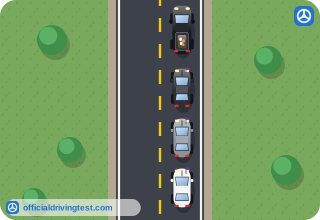
- An interstate highway or state parkway
- A residential street inside the city limits
- A business-district street in a town
- A street inside the urban-county limits
Show answer
Correct answer: An interstate highway or state parkway
Passing in a funeral procession is allowed without an officer's direction if the procession is on an interstate highway or state parkway.
Source: Kentucky Driver Manual (Updated July 23, 2026), page 69 · Open this page in the manual (Manual page 69)
-
When may you pass or overtake a vehicle in a funeral procession without being directed to by a police or safety officer?
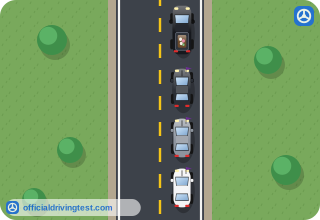
- When the procession is moving slowly through town
- When you have your headlights on
- When it is outside the city, town, or urban-county limits
- When no vehicle is coming from the opposite direction
Show answer
Correct answer: When it is outside the city, town, or urban-county limits
Passing is allowed without an officer's direction when the procession is on a street, road, or highway outside the city, town, or urban-county limits.
Source: Kentucky Driver Manual (Updated July 23, 2026), page 68 · Open this page in the manual (Manual page 68)
-
What penalty may you receive for violating the funeral procession law?
- A $100 fine or 30 days in jail
- A $250 fine or 90 days in jail
- A $500 fine or 6 months in jail
- A $1,000 fine and loss of license
Show answer
Correct answer: A $250 fine or 90 days in jail
Violating the funeral procession law may bring a $250 fine or 90 days in jail.
Source: Kentucky Driver Manual (Updated July 23, 2026), page 69 · Open this page in the manual (Manual page 69)
-
Who generally has the right of way at a narrow or single-lane bridge?
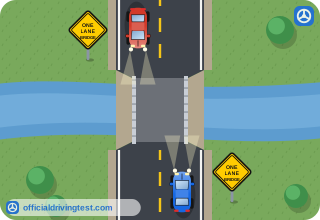
- The first driver to reach the bridge
- The driver traveling faster
- The driver with the larger vehicle
- The driver traveling uphill
Show answer
Correct answer: The first driver to reach the bridge
Drivers take turns crossing a narrow or single-lane bridge, and generally the first driver to the bridge has the right of way.
Source: Kentucky Driver Manual (Updated July 23, 2026), page 69 · Open this page in the manual (Manual page 69)
-
How should you approach a rural intersection that is not controlled by yield or stop signs?
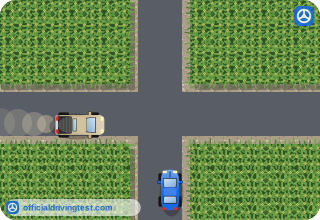
- Keep your speed, because you have the right of way over others
- Speed up to clear the intersection quickly
- Slow down only if you see another vehicle approaching
- Slow down and be prepared to stop for crossing or oncoming traffic
Show answer
Correct answer: Slow down and be prepared to stop for crossing or oncoming traffic
Uncontrolled rural intersections can be very dangerous, so you slow down and are prepared to stop for crossing or oncoming traffic.
Source: Kentucky Driver Manual (Updated July 23, 2026), page 70 · Open this page in the manual (Manual page 70)