Kentucky: Right-of-way and turning — Part 4 Practice Test
Questions in this part include: “Which colors of flashing lights on an escort vehicle give a funeral procession the right-of-way at an intersection?” · “What penalty may you receive for violating the funeral procession law?”
Independent educational site · not affiliated with any government agency or DMV
Ready? Test yourself
- Instant feedback with an explanation
- Every answer cites its source in the manual
- Your best score is saved on this device
Questions are original and based on the official manual "Kentucky Driver Manual" (Updated July 23, 2026), Kentucky State Police.
All 17 questions in this practice test
Take the test above first, then use this list to study. Tap “Show answer” to see the correct answer and explanation.
Show the questions and answersHide the questions
-
Why is it dangerous to pass where someone may enter or cross the road, such as at crossroads or in school zones?
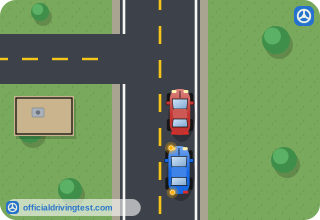
- Vehicles being passed are required to speed up near crossroads and parks
- Roads in business and shopping areas are always too narrow for a pass
- Your view of people and traffic may be blocked by the vehicle you are passing
- Drivers turning onto the road must wait for you to return to the right lane
Show answer
Correct answer: Your view of people and traffic may be blocked by the vehicle you are passing
While you are passing, the vehicle you are passing may block your view of people and traffic.
Source: Kentucky Driver Manual (Updated July 23, 2026), page 48 · Open this page in the manual (Manual page 48)
-
Why might drivers turning onto the roadway be a danger while you are passing in the left lane?
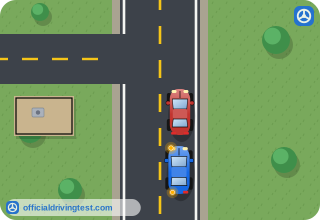
- They may not see your headlights in the right lane
- They may not expect to find you in the left lane
- They may turn without ever looking in their mirrors
- They are required to turn into the left lane first
Show answer
Correct answer: They may not expect to find you in the left lane
Other drivers turning onto the roadway into the left lane may not expect to find you in the left lane.
Source: Kentucky Driver Manual (Updated July 23, 2026), page 48 · Open this page in the manual (Manual page 48)
-
Before you pass, what should you look ahead for?
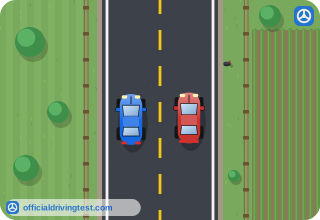
- Other drivers who may be planning to pass you in the lane to your right
- Road signs that tell you how many more miles remain on the highway
- The distance to the next exit so you can return to the right lane
- Road or other conditions that may cause other traffic to move into your lane
Show answer
Correct answer: Road or other conditions that may cause other traffic to move into your lane
Before passing, you look ahead for road or other conditions that may cause other traffic to move into your lane.
Source: Kentucky Driver Manual (Updated July 23, 2026), page 48 · Open this page in the manual (Manual page 48)
-
Before you pass, what should you make sure of regarding a private drive or intersection?
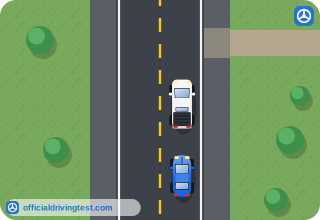
- That no one is going to pull in front of you from it
- That the vehicle you are passing is not about to turn into it
- That you have flashed your headlights at it
- That the lane to your right is clear beside it
Show answer
Correct answer: That no one is going to pull in front of you from it
Before passing, you make sure someone is not going to pull in front of you from a private drive or intersection.
Source: Kentucky Driver Manual (Updated July 23, 2026), page 48 · Open this page in the manual (Manual page 48)
-
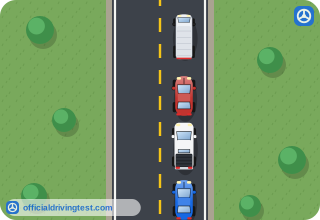
You should never pull out to pass unless you know that you do what?
- Can rely on other drivers to make room for you
- Will have enough time to pass several vehicles at once
- Have enough space to return to your lane
- Have signaled for at least five seconds
Show answer
Correct answer: Have enough space to return to your lane
You never pull out to pass unless you know you have enough space to return to your lane.
Source: Kentucky Driver Manual (Updated July 23, 2026), page 48 · Open this page in the manual (Manual page 48)
-
Which is listed as something to do when you are being passed?
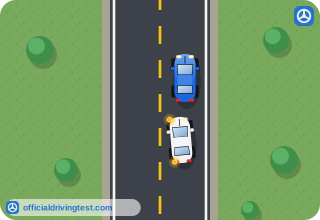
- Stay in your lane
- Speed up
- Brake hard
- Move into the left lane
Show answer
Correct answer: Stay in your lane
One thing to do when being passed is to stay in your lane.
Source: Kentucky Driver Manual (Updated July 23, 2026), page 48 · Open this page in the manual (Manual page 48)
-
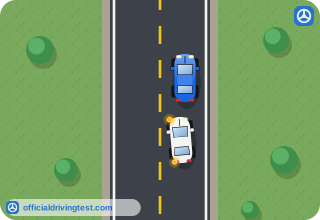
Under Kentucky law, the operator of a vehicle about to be overtaken and passed must do what?
- Increase speed so that the passing vehicle returns quickly
- Give way to the left to leave room on the right side
- Give way to the right in favor of the overtaking vehicle
- Slow to a stop in the middle of the road
Show answer
Correct answer: Give way to the right in favor of the overtaking vehicle
Kentucky law requires the operator of a vehicle about to be overtaken and passed to give way to the right in favor of the overtaking vehicle.
Source: Kentucky Driver Manual (Updated July 23, 2026), page 48 · Open this page in the manual (Manual page 48)
-
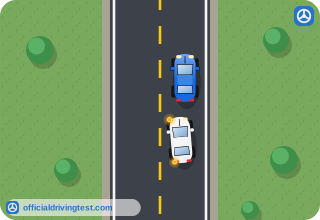
In passing situations, road users are required to do what?
- Speed up so the pass is over sooner
- Work together to obtain clearance and avoid accidents
- Let the overtaking driver decide who yields
- Keep the same speed until the pass is complete
Show answer
Correct answer: Work together to obtain clearance and avoid accidents
Road users are required to work together in order to obtain clearance and avoid accidents in passing situations.
Source: Kentucky Driver Manual (Updated July 23, 2026), page 48 · Open this page in the manual (Manual page 48)
-
Which colors of flashing lights on an escort vehicle give a funeral procession the right-of-way at an intersection?
- Green, white, or purple
- Orange, green, or white
- Green or white only
- Yellow, red, or blue
Show answer
Correct answer: Yellow, red, or blue
A funeral procession may pass through an intersection with the right-of-way if it is led by an escort vehicle displaying flashing yellow, red, or blue lights.
Source: Kentucky Driver Manual (Updated July 23, 2026), page 68 · Open this page in the manual (Manual page 68)
-
Which of these is an exception to a funeral procession's right-of-way at an intersection?
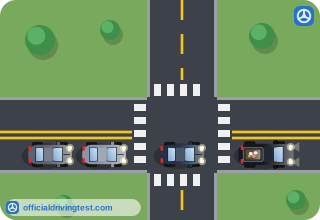
- The other driver is turning left
- The vehicle is a train or locomotive
- The other vehicle is a school bus
- The road has a speed limit above 35 mph
Show answer
Correct answer: The vehicle is a train or locomotive
The exceptions are an emergency vehicle needing the right-of-way, direction otherwise by a police or safety officer, and a train or locomotive.
Source: Kentucky Driver Manual (Updated July 23, 2026), page 68 · Open this page in the manual (Manual page 68)
-
When may you drive your vehicle between the vehicles of a funeral procession?
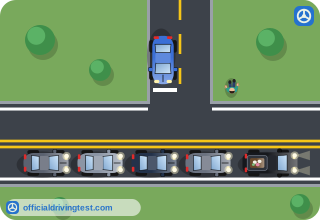
- When the procession is moving slowly
- When you have turned on your headlights
- When a police or safety officer authorizes it
- When there is a large gap between vehicles
Show answer
Correct answer: When a police or safety officer authorizes it
You must not drive between the vehicles of a funeral procession unless a police or safety officer authorizes it.
Source: Kentucky Driver Manual (Updated July 23, 2026), page 68 · Open this page in the manual (Manual page 68)
-
What must you not do for the purpose of securing right-of-way around a funeral procession?
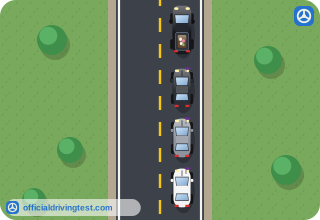
- Turn on your headlights
- Dim your lights for oncoming traffic
- Use your turn signal
- Reduce your speed
Show answer
Correct answer: Turn on your headlights
The manual says not to turn on your headlights or do any other act for the purpose of securing right-of-way around a funeral procession.
Source: Kentucky Driver Manual (Updated July 23, 2026), page 68 · Open this page in the manual (Manual page 68)
-
On which kind of road may you pass vehicles in a funeral procession without being directed to by an officer?
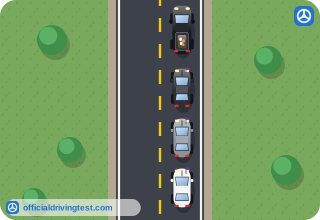
- An interstate highway or state parkway
- A residential street inside the city limits
- A business-district street in a town
- A street inside the urban-county limits
Show answer
Correct answer: An interstate highway or state parkway
Passing in a funeral procession is allowed without an officer's direction if the procession is on an interstate highway or state parkway.
Source: Kentucky Driver Manual (Updated July 23, 2026), page 69 · Open this page in the manual (Manual page 69)
-
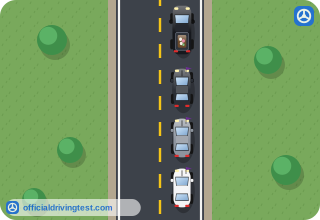
When may you pass or overtake a vehicle in a funeral procession without being directed to by a police or safety officer?
- When the procession is moving slowly through town
- When you have your headlights on
- When it is outside the city, town, or urban-county limits
- When no vehicle is coming from the opposite direction
Show answer
Correct answer: When it is outside the city, town, or urban-county limits
Passing is allowed without an officer's direction when the procession is on a street, road, or highway outside the city, town, or urban-county limits.
Source: Kentucky Driver Manual (Updated July 23, 2026), page 68 · Open this page in the manual (Manual page 68)
-
What penalty may you receive for violating the funeral procession law?
- A $100 fine or 30 days in jail
- A $250 fine or 90 days in jail
- A $500 fine or 6 months in jail
- A $1,000 fine and loss of license
Show answer
Correct answer: A $250 fine or 90 days in jail
Violating the funeral procession law may bring a $250 fine or 90 days in jail.
Source: Kentucky Driver Manual (Updated July 23, 2026), page 69 · Open this page in the manual (Manual page 69)
-
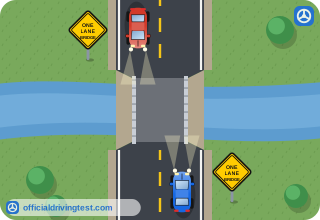
Who generally has the right of way at a narrow or single-lane bridge?
- The first driver to reach the bridge
- The driver traveling faster
- The driver with the larger vehicle
- The driver traveling uphill
Show answer
Correct answer: The first driver to reach the bridge
Drivers take turns crossing a narrow or single-lane bridge, and generally the first driver to the bridge has the right of way.
Source: Kentucky Driver Manual (Updated July 23, 2026), page 69 · Open this page in the manual (Manual page 69)
-
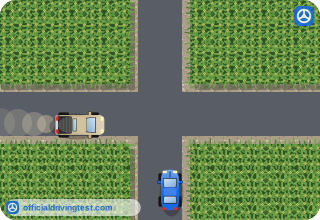
How should you approach a rural intersection that is not controlled by yield or stop signs?
- Keep your speed, because you have the right of way over others
- Speed up to clear the intersection quickly
- Slow down only if you see another vehicle approaching
- Slow down and be prepared to stop for crossing or oncoming traffic
Show answer
Correct answer: Slow down and be prepared to stop for crossing or oncoming traffic
Uncontrolled rural intersections can be very dangerous, so you slow down and are prepared to stop for crossing or oncoming traffic.
Source: Kentucky Driver Manual (Updated July 23, 2026), page 70 · Open this page in the manual (Manual page 70)