Kentucky: Right-of-way and turning — Part 1 Practice Test
Questions in this part include: “What is an intersection?” · “From which part of your lane should you always turn left?”
Independent educational site · not affiliated with any government agency or DMV
Ready? Test yourself
- Instant feedback with an explanation
- Every answer cites its source in the manual
- Your best score is saved on this device
Questions are original and based on the official manual "Kentucky Driver Manual" (Updated July 23, 2026), Kentucky State Police.
All 18 questions in this practice test
Take the test above first, then use this list to study. Tap “Show answer” to see the correct answer and explanation.
Show the questions and answersHide the questions
-
Which driver should you yield the right of way to at an intersection?
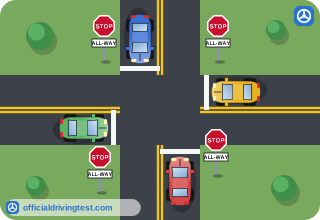
- The driver who is at or arrives before you at the intersection
- The driver who arrives after you at the intersection
- The driver in the larger vehicle at the intersection
- The driver who is traveling faster than you are
Show answer
Correct answer: The driver who is at or arrives before you at the intersection
You should yield to the driver who is at the intersection or arrives before you.
Source: Kentucky Driver Manual (Updated July 23, 2026), page 34 · Open this page in the manual (Manual page 34)
-
You are making a left turn. Whom should you yield the right of way to?
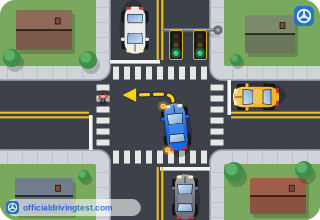
- Only opposing drivers who are going straight through the intersection
- Only drivers who are coming up behind you in your own lane
- Drivers in the opposing traffic lane, including vehicles turning right
- Drivers on the cross street who have a green light
Show answer
Correct answer: Drivers in the opposing traffic lane, including vehicles turning right
When making a left turn you yield to drivers in the opposing traffic lane, and this includes vehicles turning right.
Source: Kentucky Driver Manual (Updated July 23, 2026), page 34 · Open this page in the manual (Manual page 34)
-
You and another driver arrive at the same time at a four-way intersection controlled by stop signs. Which driver should you yield to?
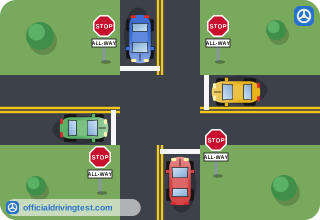
- The driver on your left
- The driver on your right
- The driver who is going straight ahead
- The driver in the larger vehicle
Show answer
Correct answer: The driver on your right
At a four-way stop-sign intersection you yield to the driver on your right if you both arrive at the same time.
Source: Kentucky Driver Manual (Updated July 23, 2026), page 34 · Open this page in the manual (Manual page 34)
-
You are entering a public highway from a driveway or a private road. Whom should you yield to?
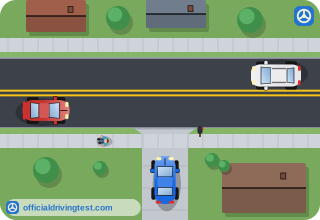
- Only drivers who are turning left onto the highway
- Nobody, if no stop sign is posted at the driveway
- Only drivers coming from your right on the highway
- Drivers on the public highway
Show answer
Correct answer: Drivers on the public highway
Drivers entering a public highway from a driveway or private road must give way to drivers already on the highway.
Source: Kentucky Driver Manual (Updated July 23, 2026), page 34 · Open this page in the manual (Manual page 34)
-
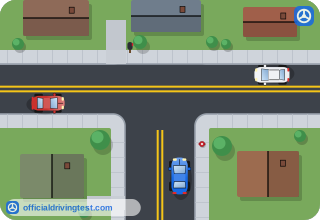
A driver on a minor road meets a driver on a main road. Who must yield?
- The driver on the main road
- The driver who is traveling faster
- The driver who is traveling slower
- The driver on the minor road
Show answer
Correct answer: The driver on the minor road
Drivers on a minor road must yield to drivers on a main road.
Source: Kentucky Driver Manual (Updated July 23, 2026), page 34 · Open this page in the manual (Manual page 34)
-
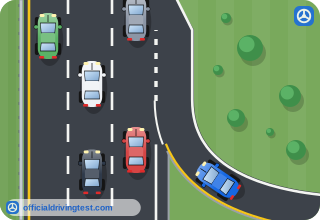
You are on the entrance or acceleration ramp of a limited access or interstate highway. Whom should you yield the right of way to?
- Drivers who are leaving the highway at the next exit
- Drivers already on the highway
- Drivers behind you on the entrance ramp
- Only trucks and buses on the highway
Show answer
Correct answer: Drivers already on the highway
You should yield to drivers who are already on the limited access or interstate highway when you are on the entrance or acceleration ramp.
Source: Kentucky Driver Manual (Updated July 23, 2026), page 34 · Open this page in the manual (Manual page 34)
-
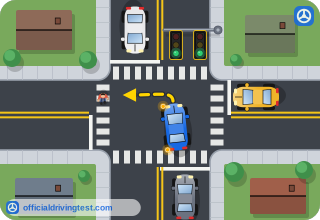
Which road users who are still in the intersection should you yield the right of way to?
- Only pedestrians who are in a marked crosswalk
- Only other drivers who have a green light
- Pedestrians, bicyclists, and other drivers
- Only pedestrians and bicyclists in the crosswalk
Show answer
Correct answer: Pedestrians, bicyclists, and other drivers
You should yield to pedestrians, bicyclists, and other drivers who are still in the intersection.
Source: Kentucky Driver Manual (Updated July 23, 2026), page 34 · Open this page in the manual (Manual page 34)
-
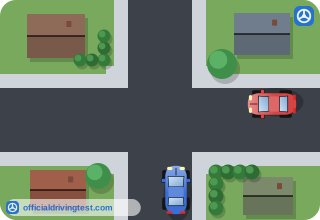
What is true about assuming you have the right of way?
- No one should assume he or she automatically has it
- The driver in the larger vehicle always has it, whatever the situation
- The driver traveling faster always has it, whatever the situation
- The driver who is turning right always has it, whatever the situation
Show answer
Correct answer: No one should assume he or she automatically has it
Yielding rules are a guide, and the situation and circumstances at the intersection must always be considered.
Source: Kentucky Driver Manual (Updated July 23, 2026), page 34 · Open this page in the manual (Manual page 34)
-
What is an intersection?
- Only a place where a traffic signal is installed
- Any place where two roads meet
- Only a place where two highways cross
- Any place where a driveway meets a parking lot
Show answer
Correct answer: Any place where two roads meet
An intersection is any place where two roads meet.
Source: Kentucky Driver Manual (Updated July 23, 2026), page 34 · Open this page in the manual (Manual page 34)
-
At a stop sign, whom must you yield the right of way to?
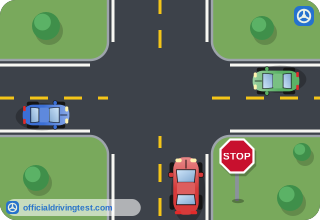
- Crossing vehicles and pedestrians in all directions
- Only vehicles that are approaching from your right side
- Only pedestrians who are already standing in a marked crosswalk
- Only vehicles that are already inside the intersection
Show answer
Correct answer: Crossing vehicles and pedestrians in all directions
At a stop sign you must yield the right of way to crossing vehicles and pedestrians in all directions.
Source: Kentucky Driver Manual (Updated July 23, 2026), page 38 · Open this page in the manual (Manual page 38)
-
If crosswalks are not apparent and you are required to stop, what must you do at an intersection?
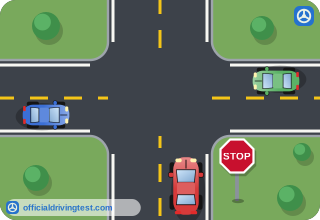
- Stop before entering the intersection
- Slow down and proceed if no pedestrians are visible
- Stop only if pedestrians are present
- Stop in the middle of the intersection
Show answer
Correct answer: Stop before entering the intersection
If crosswalks are not apparent, you must stop before entering the intersection.
Source: Kentucky Driver Manual (Updated July 23, 2026), page 39 · Open this page in the manual (Manual page 39)
-
When making a right turn, what should you avoid doing before the turn?
- Checking traffic to the rear
- Swinging wide to the left
- Signaling your intention
- Searching all corners
Show answer
Correct answer: Swinging wide to the left
For right turns, the manual says to avoid swinging wide to the left before making the turn.
Source: Kentucky Driver Manual (Updated July 23, 2026), page 42 · Open this page in the manual (Manual page 42)
-
From which part of your lane should you always turn right?
- The center of your lane
- Wherever there is the most room
- The portion nearest the center line
- The right-most portion of your lane
Show answer
Correct answer: The right-most portion of your lane
The manual says to always turn right from the right-most portion of your lane.
Source: Kentucky Driver Manual (Updated July 23, 2026), page 42 · Open this page in the manual (Manual page 42)
-
From which part of your lane should you always turn left?
- The left-most portion of your lane
- The center of your lane
- The portion nearest the right edge
- Wherever there is the most room
Show answer
Correct answer: The left-most portion of your lane
The manual says to always turn left from the left-most portion of your lane.
Source: Kentucky Driver Manual (Updated July 23, 2026), page 42 · Open this page in the manual (Manual page 42)
-
When making a left turn, to whom must you yield?
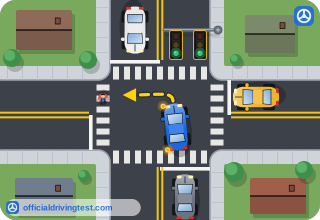
- Traffic behind you
- Parked vehicles
- Oncoming traffic
- No one; the turning driver has the right of way
Show answer
Correct answer: Oncoming traffic
When making a left turn, you yield to oncoming traffic.
Source: Kentucky Driver Manual (Updated July 23, 2026), page 42 · Open this page in the manual (Manual page 42)
-
When two or more lanes may be used for a turn, what should you do once you have entered your turning lane?
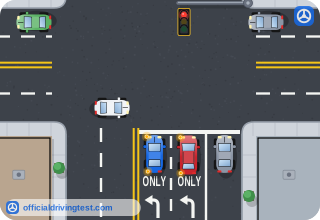
- Change lanes if the other lane moves faster
- Stay in that lane until the turn is completed
- Drift toward the outside lane to give room
- Move into whichever lane has more room
Show answer
Correct answer: Stay in that lane until the turn is completed
When turning from multiple lanes, you identify and enter your lane and stay in it until the turn is completed.
Source: Kentucky Driver Manual (Updated July 23, 2026), page 42 · Open this page in the manual (Manual page 42)
-
While turning, you should look through the turn to which place?
- The nearest point on the road ahead of you
- The center of the intersection
- The curb at the corner you are turning around
- The farthest point possible along your intended path
Show answer
Correct answer: The farthest point possible along your intended path
The manual tells drivers to look through the turn to the farthest point possible along the intended path.
Source: Kentucky Driver Manual (Updated July 23, 2026), page 42 · Open this page in the manual (Manual page 42)
-
When turning, which lane should you enter and maintain?
- The lane closest to the direction you want to go
- The lane with the least traffic ahead of you
- The center lane whenever there is one available
- The lane that is moving at the fastest speed
Show answer
Correct answer: The lane closest to the direction you want to go
You should enter and maintain proper position in the lane that is closest to the direction you want to go.
Source: Kentucky Driver Manual (Updated July 23, 2026), page 42 · Open this page in the manual (Manual page 42)