Kentucky: Right-of-way and turning — Part 3 Practice Test
Who yields at intersections and four-way stops, turning lanes, two-point and three-point turnabouts, roundabouts, passing and being passed. — Part 3
Independent educational site · not affiliated with any government agency or DMV
Ready? Test yourself
- Instant feedback with an explanation
- Every answer cites its source in the manual
- Your best score is saved on this device
Questions are original and based on the official manual "Kentucky Driver Manual" (Updated July 23, 2026), Kentucky State Police.
All 17 questions in this practice test
Take the test above first, then use this list to study. Tap “Show answer” to see the correct answer and explanation.
Show the questions and answersHide the questions
-
While turning into another street, which lane should you turn into?
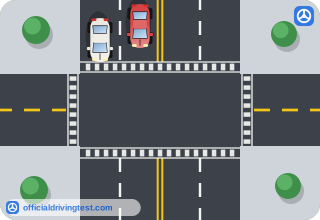
- The lane farthest from you
- The center lane of the street
- The lane nearest to you
- Any lane with the fewest vehicles
Show answer
Correct answer: The lane nearest to you
When turning into another street, you turn into the lane nearest to you.
Source: Kentucky Driver Manual (Updated July 23, 2026), page 46 · Open this page in the manual (Manual page 46)
-
When may you change to another lane after making a turn into a street?
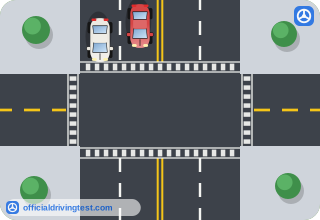
- As soon as you enter the intersection if you have signaled
- Only after finishing the turn, and when traffic is clear
- Halfway through the turn, as long as you have signaled first
- Any time during the turn if no vehicle is directly beside you
Show answer
Correct answer: Only after finishing the turn, and when traffic is clear
A lane change is made only after you have finished your turn and when the traffic is clear.
Source: Kentucky Driver Manual (Updated July 23, 2026), page 46 · Open this page in the manual (Manual page 46)
-
If you miss your turn, what should you do?
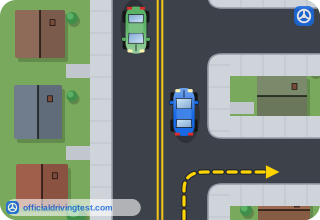
- Stop and back up to the intersection as soon as it is safe
- Make a U-turn at once at the nearest opening in traffic
- Stop in the lane until traffic clears and then turn around
- Go on to the next intersection and work your way back
Show answer
Correct answer: Go on to the next intersection and work your way back
If you miss your turn, you go on to the next intersection and work your way back to where you want to go.
Source: Kentucky Driver Manual (Updated July 23, 2026), page 46 · Open this page in the manual (Manual page 46)
-
How should you check your blind spots before changing lanes?
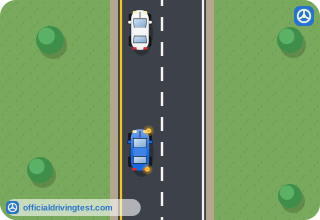
- Turn your head and look over your shoulder away from the direction you plan to move
- Lean forward and look through the windshield at the lane ahead
- Turn your head and look over your shoulder in the direction you plan to move
- Sound your horn and wait for the other driver to respond
Show answer
Correct answer: Turn your head and look over your shoulder in the direction you plan to move
You check your blind spots by turning your head and looking over your shoulder in the direction you plan to move.
Source: Kentucky Driver Manual (Updated July 23, 2026), page 46 · Open this page in the manual (Manual page 46)
-
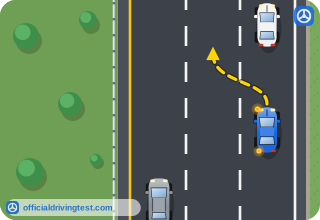
When changing lanes, after you identify a gap in traffic and signal, what should you do before steering into the lane?
- Check only your rearview mirror before moving over
- Look again in the direction of the lane change
- Sound your horn to warn the drivers beside you
- Come to a complete stop in your lane
Show answer
Correct answer: Look again in the direction of the lane change
After identifying a gap and signaling, you look again in the direction of the lane change, then adjust speed and steer into the lane.
Source: Kentucky Driver Manual (Updated July 23, 2026), page 47 · Open this page in the manual (Manual page 47)
-
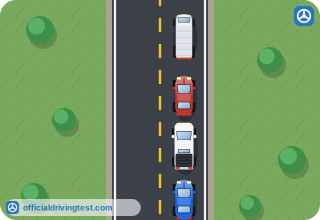
In general, on which side should you pass another vehicle?
- On the right
- On the left
- On whichever side has more room
- On the shoulder
Show answer
Correct answer: On the left
In general, you should pass on the left.
Source: Kentucky Driver Manual (Updated July 23, 2026), page 47 · Open this page in the manual (Manual page 47)
-
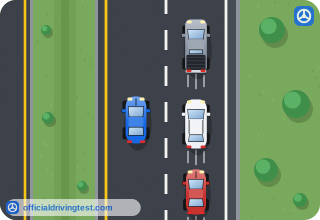
Passing on the right can be dangerous because what is true?
- Vehicles on the right side are easier to see
- Drivers on the right usually travel faster than the left lane
- The law never permits it
- Other drivers do not expect it
Show answer
Correct answer: Other drivers do not expect it
Passing on the right can be dangerous since other drivers do not expect it.
Source: Kentucky Driver Manual (Updated July 23, 2026), page 47 · Open this page in the manual (Manual page 47)
-
According to the manual, when may the operator of a vehicle overtake and pass another vehicle on the right?
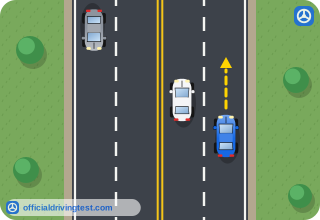
- Only when it is safe to do so
- Only on roads with three or more lanes
- Only when the other driver signals
- Only when the vehicle ahead is below the speed limit
Show answer
Correct answer: Only when it is safe to do so
A vehicle may overtake and pass another vehicle upon the right only when it is safe to do so.
Source: Kentucky Driver Manual (Updated July 23, 2026), page 47 · Open this page in the manual (Manual page 47)
-
According to the manual, when may a pass on the right be made by driving off the roadway?
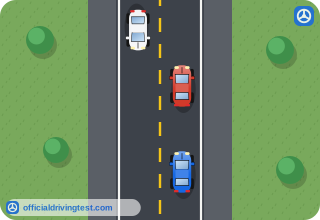
- Whenever the shoulder is wide enough and there is no oncoming traffic
- Only if the driver ahead slows down and signals you to go around on the shoulder
- Only if the vehicle being passed comes to a complete stop and it can be done safely
- Only if your speed is lower than the posted limit and the road is dry
Show answer
Correct answer: Only if the vehicle being passed comes to a complete stop and it can be done safely
Passing by driving off the roadway is allowed only if the vehicle being passed comes to a complete stop and the movement can be made safely.
Source: Kentucky Driver Manual (Updated July 23, 2026), page 47 · Open this page in the manual (Manual page 47)
-
Regarding oncoming vehicles, when should you pass?
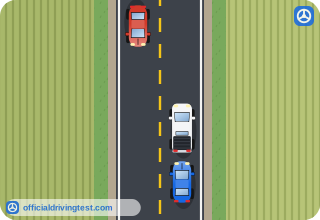
- Only if there are no oncoming vehicles
- Only if the oncoming vehicle is more than 100 feet away
- Only if the oncoming vehicle flashes its lights
- Only if the oncoming vehicle is in the far lane
Show answer
Correct answer: Only if there are no oncoming vehicles
You pass only if there are no oncoming vehicles.
Source: Kentucky Driver Manual (Updated July 23, 2026), page 47 · Open this page in the manual (Manual page 47)
-
What does Kentucky law require about a pass and the start of a “no passing zone”?
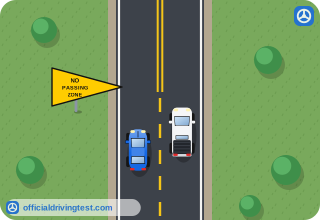
- The pass must be started before reaching the beginning of the zone
- The pass may continue in the zone if no vehicle is oncoming
- The pass must be completed before reaching the beginning of the zone
- The pass may be completed once you are halfway through the zone
Show answer
Correct answer: The pass must be completed before reaching the beginning of the zone
Kentucky law requires that a pass be completed before reaching the beginning of a “no passing zone”.
Source: Kentucky Driver Manual (Updated July 23, 2026), page 47 · Open this page in the manual (Manual page 47)
-
Kentucky law requires a pass to be completed before coming within what distance of an oncoming vehicle?
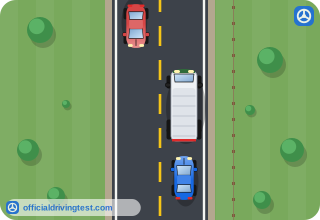
- 100 feet
- 200 feet
- 150 feet
- 300 feet
Show answer
Correct answer: 200 feet
Kentucky law requires that a pass be completed before coming within two hundred (200) feet of an oncoming vehicle.
Source: Kentucky Driver Manual (Updated July 23, 2026), page 47 · Open this page in the manual (Manual page 47)
-
What happens if you are still in the left lane when you reach a “no passing zone”?
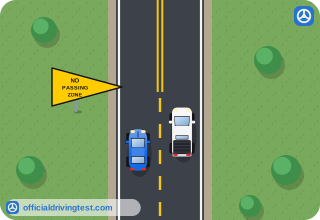
- You may finish the pass if no vehicle is oncoming
- You must stop in the left lane until traffic clears
- You are allowed to continue for a short distance
- You are violating the law
Show answer
Correct answer: You are violating the law
If you are still in the left lane when you reach the “no passing zone”, you are violating the law.
Source: Kentucky Driver Manual (Updated July 23, 2026), page 47 · Open this page in the manual (Manual page 47)
-
According to the manual, what is the danger of staying alongside the vehicle you are passing for a long time?
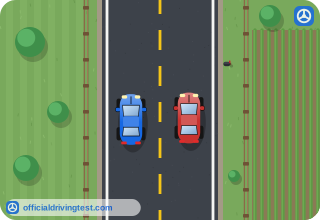
- The other vehicle may move toward your lane
- Your vehicle may use more fuel than the other vehicle
- The other driver may think you are racing and speed up
- Your headlights may blind the driver ahead
Show answer
Correct answer: The other vehicle may move toward your lane
The longer your vehicle stays alongside the other vehicle, the longer you are in danger of the other vehicle moving toward your lane.
Source: Kentucky Driver Manual (Updated July 23, 2026), page 47 · Open this page in the manual (Manual page 47)
-
When should you signal your intentions to pass?
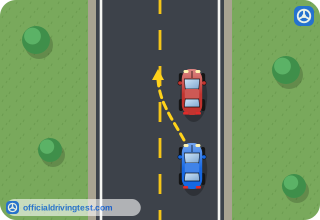
- Before checking your mirrors
- After you have moved into the left lane
- When it is safe to pass
- Only after the vehicle ahead signals
Show answer
Correct answer: When it is safe to pass
You signal your intentions when it is safe to pass.
Source: Kentucky Driver Manual (Updated July 23, 2026), page 47 · Open this page in the manual (Manual page 47)
-
After passing, what should you do before returning to the lane?
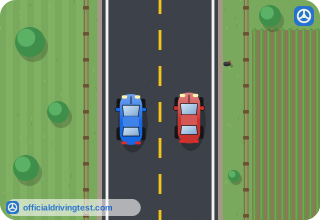
- Sound your horn to alert the driver you passed
- Turn on your hazard lights
- Flash your headlights at the passed driver
- Signal your intention to return to the lane
Show answer
Correct answer: Signal your intention to return to the lane
You signal your intention to return to the lane after passing.
Source: Kentucky Driver Manual (Updated July 23, 2026), page 47 · Open this page in the manual (Manual page 47)
-
Any time your view is blocked by a curve or a hill, what should you assume?
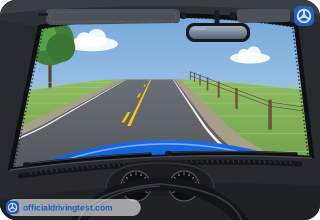
- There is an oncoming vehicle just out of sight
- The oncoming vehicle will slow to let you pass
- The other lane is probably empty
- Other drivers will give way to you
Show answer
Correct answer: There is an oncoming vehicle just out of sight
When a curve or hill blocks your view, you should assume there is an oncoming vehicle just out of sight, and not start to pass.
Source: Kentucky Driver Manual (Updated July 23, 2026), page 48 · Open this page in the manual (Manual page 48)