Kentucky: Right-of-way and turning — Part 2 Practice Test
Questions in this part include: “What is a turnabout?” · “While backing slowly into a driveway for a turnabout, how should you steer?”
Independent educational site · not affiliated with any government agency or DMV
Ready? Test yourself
- Instant feedback with an explanation
- Every answer cites its source in the manual
- Your best score is saved on this device
Questions are original and based on the official manual "Kentucky Driver Manual" (Updated July 23, 2026), Kentucky State Police.
All 18 questions in this practice test
Take the test above first, then use this list to study. Tap “Show answer” to see the correct answer and explanation.
Show the questions and answersHide the questions
-
What is a turnabout?
- A turn made from the center lane across oncoming traffic at a signal
- A turn that uses a street, alley, or driveway to legally reverse your direction
- A turn at an intersection that continues around a block
- A curve in the road that turns traffic back toward where it began
Show answer
Correct answer: A turn that uses a street, alley, or driveway to legally reverse your direction
A turnabout uses a street, alley, or driveway to legally reverse the direction you are traveling when driving around a block is not practical or possible.
Source: Kentucky Driver Manual (Updated July 23, 2026), page 43 · Open this page in the manual (Manual page 43)
-
Before making a turnabout, how far in either direction should your car be visible?
- 100 feet
- 250 feet
- 1,000 feet
- 500 feet
Show answer
Correct answer: 500 feet
The manual says to make sure your car can be seen for 500 feet in either direction before a turnabout.
Source: Kentucky Driver Manual (Updated July 23, 2026), page 43 · Open this page in the manual (Manual page 43)
-
During a turnabout, you are backing onto a two-lane road. Where should you position the vehicle?
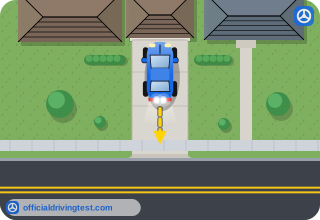
- To the right of the center line
- Centered in the roadway
- On the left side of the center line
- At an angle across both lanes
Show answer
Correct answer: To the right of the center line
When backing onto a two-lane road, you do not center the vehicle in the roadway; you position it to the right of the center line.
Source: Kentucky Driver Manual (Updated July 23, 2026), page 43 · Open this page in the manual (Manual page 43)
-
While backing slowly into a driveway for a turnabout, how should you steer?
- Rapidly all the way to the left
- Slowly, a quarter turn to the right
- Rapidly all the way to the right
- Keep the wheels straight
Show answer
Correct answer: Rapidly all the way to the right
In a turnabout you steer rapidly all the way to the right while backing slowly into the driveway.
Source: Kentucky Driver Manual (Updated July 23, 2026), page 43 · Open this page in the manual (Manual page 43)
-
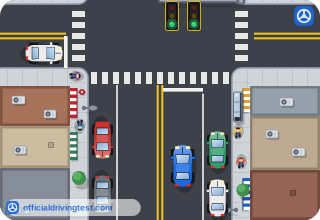
At all intersections, what should you do with your speed?
- Keep it steady if the light is green
- Reduce it
- Increase it to clear the intersection quickly
- Match the speed of the vehicle ahead
Show answer
Correct answer: Reduce it
The manual says that at all intersections you reduce your speed and search for hazards and traffic control devices.
Source: Kentucky Driver Manual (Updated July 23, 2026), page 43 · Open this page in the manual (Manual page 43)
-
Which of these should you search for at all intersections?
- Parking meters and bus shelters
- Cameras that record violations
- Business entrances
- Pedestrians and bicyclists
Show answer
Correct answer: Pedestrians and bicyclists
At all intersections you should search for traffic control devices, oncoming and cross traffic, pedestrians and bicyclists, roadway condition, and areas of limited visibility.
Source: Kentucky Driver Manual (Updated July 23, 2026), page 43 · Open this page in the manual (Manual page 43)
-
Which statement about other drivers at an intersection is correct?
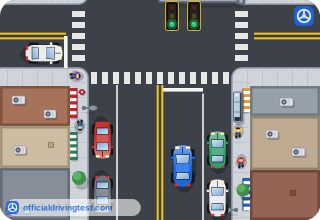
- Do not rely on them; they may not yield the right of way
- Rely on them when you have a green light and a clear view of the road
- Rely on them when they have a red light or a stop sign
- Rely on them if they are using their turn signals
Show answer
Correct answer: Do not rely on them; they may not yield the right of way
You should not rely on others to obey traffic control signals or signs, since they may not yield the right of way, and you should be prepared to avoid a crash.
Source: Kentucky Driver Manual (Updated July 23, 2026), page 43 · Open this page in the manual (Manual page 43)
-
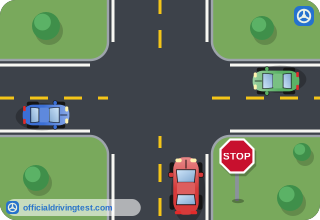
Before entering an intersection after stopping, in what order should you look?
- Right, then left, then right again
- Left only, then go if it is clear
- Left, then right, then left again
- Straight ahead, then right only
Show answer
Correct answer: Left, then right, then left again
After stopping at an intersection you look left and then right and left again before entering.
Source: Kentucky Driver Manual (Updated July 23, 2026), page 43 · Open this page in the manual (Manual page 43)
-
When the light at a traffic signal turns green, what should you avoid doing?
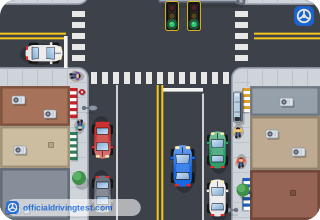
- Checking for crossing traffic
- Moving into the intersection immediately
- Checking that your path of travel is clear
- Making sure you have enough space to turn
Show answer
Correct answer: Moving into the intersection immediately
When the light turns green you take time to make sure your path is clear and there is no crossing traffic instead of moving immediately into the intersection.
Source: Kentucky Driver Manual (Updated July 23, 2026), page 43 · Open this page in the manual (Manual page 43)
-
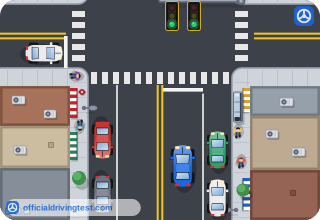
At an intersection, what should you do even if other traffic has a red light or a stop sign?
- Proceed without checking
- Sound your horn
- Flash your headlights
- Look both ways
Show answer
Correct answer: Look both ways
Someone may disobey traffic control devices, so you look both ways even if other traffic has a red light or a stop sign.
Source: Kentucky Driver Manual (Updated July 23, 2026), page 43 · Open this page in the manual (Manual page 43)
-
If a building or a row of parked vehicles blocks your view of a cross street, what should you do?
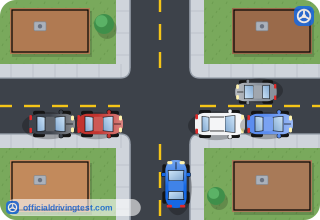
- Edge forward slowly until you can clearly see
- Accelerate through before anyone appears
- Sound your horn and then proceed
- Wait for the driver to wave you through
Show answer
Correct answer: Edge forward slowly until you can clearly see
If your view of a cross street is blocked, you edge forward slowly until you can clearly see.
Source: Kentucky Driver Manual (Updated July 23, 2026), page 43 · Open this page in the manual (Manual page 43)
-
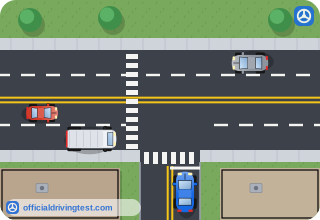
If traffic in one lane is blocking your view of another lane at an intersection, what should you do?
- Place the front of your vehicle into the other lane
- Edge forward and sound your horn
- Wait until it clears
- Speed up to pass the blocking vehicle
Show answer
Correct answer: Wait until it clears
You should wait until the blocking traffic clears; placing the front of your vehicle into the other lane to look may get you hit.
Source: Kentucky Driver Manual (Updated July 23, 2026), page 43 · Open this page in the manual (Manual page 43)
-
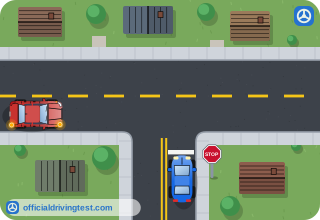
You are about to turn into a lane and an approaching vehicle has its turn signal active. What should you do?
- Turn into the lane, since the driver will turn first
- Do not turn into the lane just because of the signal
- Assume the driver will give you extra space
- Flash your headlights and then turn
Show answer
Correct answer: Do not turn into the lane just because of the signal
The driver may plan to turn after passing you or may have forgotten to turn the signal off, so you should not turn into the lane just because of the signal.
Source: Kentucky Driver Manual (Updated July 23, 2026), page 43 · Open this page in the manual (Manual page 43)
-
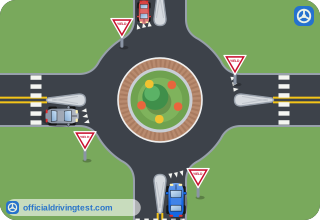
In which direction do vehicles travel around the center island of a roundabout or traffic circle?
- Clockwise
- Whichever way is shortest
- Left or right, depending on the exit
- Counterclockwise
Show answer
Correct answer: Counterclockwise
Vehicles travel counterclockwise around a raised center island, and you enter a roundabout in a counterclockwise direction.
Source: Kentucky Driver Manual (Updated July 23, 2026), page 44 · Open this page in the manual (Manual page 44)
-
Who yields the right of way where traffic enters a roundabout or traffic circle?
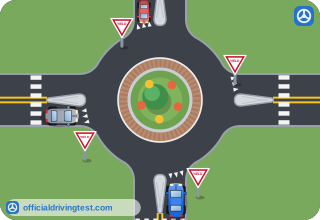
- Entering traffic yields to circulating traffic
- Circulating traffic yields to entering traffic
- The faster vehicle yields to the slower one
- The vehicle on the left yields to the one on the right
Show answer
Correct answer: Entering traffic yields to circulating traffic
Entering traffic yields the right of way to circulating traffic.
Source: Kentucky Driver Manual (Updated July 23, 2026), page 44 · Open this page in the manual (Manual page 44)
-
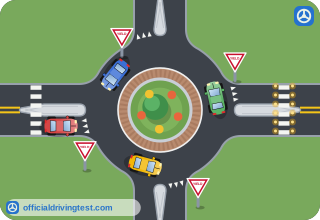
What should you do as you proceed to your exit in a roundabout or traffic circle?
- Stop in the circle until your exit is clear
- Sound your horn before leaving the circle
- Signal your intent and exit
- Cross the center island to reach it
Show answer
Correct answer: Signal your intent and exit
In a roundabout you proceed to the appropriate exit, signal intent, and exit.
Source: Kentucky Driver Manual (Updated July 23, 2026), page 44 · Open this page in the manual (Manual page 44)
-
If you are turning left from a street with two or more lanes, which lane should you turn from?
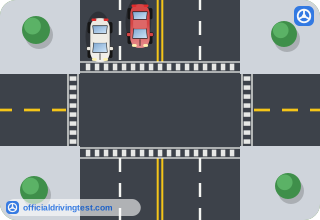
- The lane nearest the curb
- The middle lane of the street
- The lane with the fewest vehicles
- The lane nearest the center lane
Show answer
Correct answer: The lane nearest the center lane
A left turn from a street with two or more lanes is made from the lane nearest the center lane.
Source: Kentucky Driver Manual (Updated July 23, 2026), page 46 · Open this page in the manual (Manual page 46)
-
If you are turning right, which lane should you turn from?
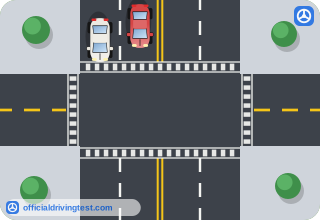
- The lane nearest the curb
- The lane nearest the center lane
- The lane with the most room
- Any lane you choose
Show answer
Correct answer: The lane nearest the curb
A right turn is made from the lane nearest the curb.
Source: Kentucky Driver Manual (Updated July 23, 2026), page 46 · Open this page in the manual (Manual page 46)