Guide, railroad and other signs in Iowa
The Iowa Driver’s License Manual shows or names everything on this page: 18 in all, on pages 7–8, 11–13.
Independent educational site · not affiliated with any government agency or DMV
Guide and service signs
US 30 WEST Woodbine
Guide signs show directions and distance to various locations, or areas such as cities, airports, state lines; or to places of interest such as national parks, historical areas, or museums.
Manual page 11
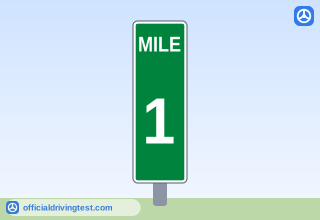
MILE 1
Mile markers show the number of miles from where the Interstate route entered the state you are traveling in. They can be used to calculate how far you are from your exit or destination and give your exact location in an emergency.
Manual page 11
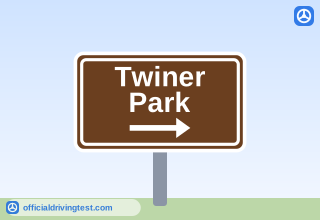
Twiner Park
Recreation and cultural points of interest. Provides direction to historical sites, parks, or recreational areas.
Manual page 11
FOOD—EXIT 44
Service signs show the location of various services; such as rest areas, fuel stations, campgrounds, or hospitals.
Manual page 11
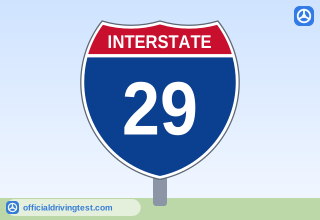
Interstate 29
The shape of a route sign indicates the type of roadway it is - interstate, U.S. highway, Iowa route, county road, etc. During a trip, follow the signs to stay on your route.
Manual page 11
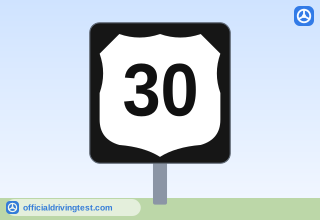
U.S. Highway 30
The shape of a route sign indicates the type of roadway it is - interstate, U.S. highway, Iowa route, county road, etc. During a trip, follow the signs to stay on your route.
Manual page 11
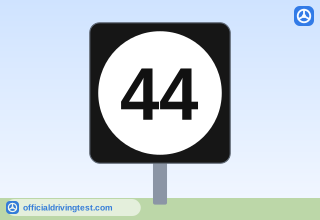
Iowa Route 44
The shape of a route sign indicates the type of roadway it is - interstate, U.S. highway, Iowa route, county road, etc. During a trip, follow the signs to stay on your route.
Manual page 11
Railroad crossings
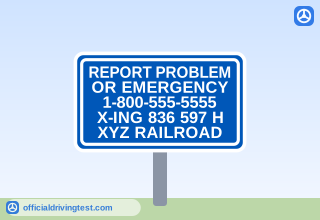
REPORT PROBLEM OR EMERGENCY (ENS Sign)
This blue sign is posted on both sides at each railroad crossings and provides critical information for reporting a problem or emergency on or near the tracks. It includes a phone number to contact the railroad and a unique crossing identification number. Drivers should use the phone number and crossing ID to report stalled vehicles, malfunctioning signals, or any other hazardous situation at the crossing.
Manual page 8
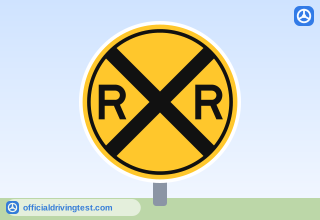
Railroad Crossing Ahead
Railroad crossing ahead.
Manual page 7
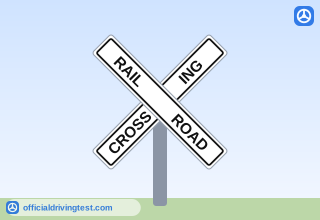
RAILROAD CROSSING (Crossbuck)
Railroad crossing signs are placed at each crossing. A number sign under the crossbucks shows how many sets of train tracks you must cross.
Manual page 7
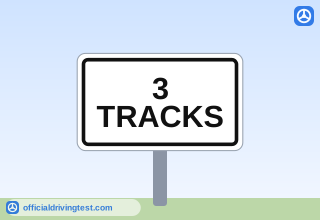
3 TRACKS
Multiple tracks are present. Multiple tracks may mean multiple trains. Wait until you can see clearly down the tracks in both directions before proceeding.
Manual page 7
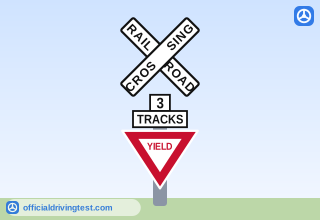
Crossbuck with 3 TRACKS and YIELD
Passively protected railroad crossings do not have lights or gates. They will only be marked with a crossbuck and a stop or yield sign. At this type of crossing, slow down and look for an oncoming train. Do not rely on any lights or gates, and always expect a train.
Manual page 12
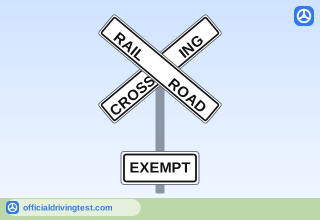
EXEMPT
You also do not have to stop if the crossing is marked with an "EXEMPT" sign.
Manual page 12
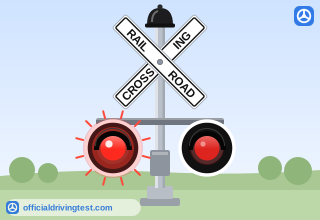
Railroad Flashing Red Lights
STOP when flashing. DO NOT proceed until lights stop flashing. If lights begin flashing after you start across the tracks, keep going.
Manual page 12
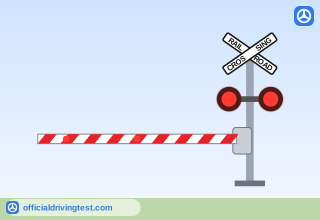
Lowered Gate and Flashing Red Lights
A train is approaching (even if you don't see it yet). Do not proceed until lights turn off and gates go up. It is illegal and dangerous to go around lowered gates.
Manual page 12
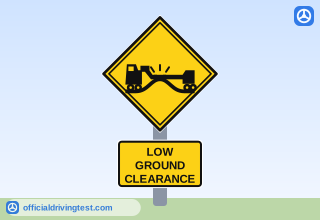
LOW GROUND CLEARANCE Crossing
Raised crossing ahead. If you drive anything low to the ground — like a lowboy, bus, truck, sports car or trailer — you are at risk of getting hung up on the tracks. Do not proceed until you know your vehicle will clear the tracks.
Manual page 13
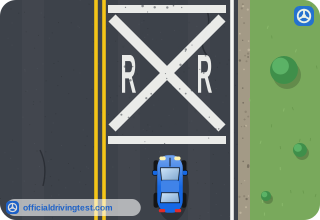
Railroad Crossing Pavement Marking (R X R)
RxR and a wide white line on the roadway mean you are approaching a railroad crossing. Stay behind the white stop line while waiting for a train to pass. No stop line? Stop at least 15 feet from the nearest rail.
Manual page 12
Other signs and symbols
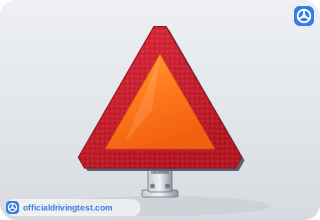
Slow-Moving Vehicle Emblem
A reflective orange triangle on the rear of a vehicle means it is traveling 35 mph or less. You may see this sign on road maintenance equipment, farm vehicles, or horse-drawn wagons.
Manual page 11