Indiana: Speed and following distance
Indiana speed limits, braking and following distances, rural roads, aggressive driving, night and bad weather. Split into 3 shorter tests so you're not stuck in one long quiz.
Independent educational site · not affiliated with any government agency or DMV
Choose a part
Speed and following distance — Part 1
Questions in this part include: “What is the maximum speed at which an MDC may be operated?”
StartSpeed and following distance — Part 2
Questions in this part include: “How far below the maximum established speed limit for the area are work site speed limits always set, at least?”
StartSpeed and following distance — Part 3
Questions in this part include: “Which vehicles are affected most by strong winds, according to the manual?”
StartAll 54 Speed and following distance questions with answers
Choose a part above to take a practice test, or study every question and answer here.
Show the questions and answersHide the questions
-
What is the maximum speed at which an MDC may be operated?
- 25 miles per hour
- 45 miles per hour
- 55 miles per hour
- 35 miles per hour
Show answer
Correct answer: 35 miles per hour
An MDC must operate at no more than 35 miles per hour.
Source: Indiana Driver’s Manual (July 2026), page 15 · Open this page in the manual (Manual page 15)
-
When following a driver who has signaled an intention to make a turn, what should you do?
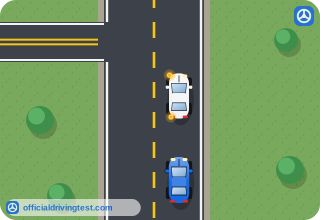
- Move to the left and pass
- Keep your speed and your distance
- Slow down and be prepared to stop
- Sound your horn to hurry the driver
Show answer
Correct answer: Slow down and be prepared to stop
The manual says to slow down and be prepared to stop when following a driver who has signaled a turn or has slowed down.
Source: Indiana Driver’s Manual (July 2026), page 40 · Open this page in the manual (Manual page 40)
-
What does Indiana law require drivers to do about speed?
- Drive 5 miles per hour below the posted limit
- Operate vehicles at the posted speed limit
- Match the speed of the traffic around them
- Keep to the lowest speed that is posted
Show answer
Correct answer: Operate vehicles at the posted speed limit
The manual says Indiana law requires drivers to operate vehicles at the posted speed limit.
Source: Indiana Driver’s Manual (July 2026), page 40 · Open this page in the manual (Manual page 40)
-
What does exceeding the posted speed limit reduce?
- The distance needed to stop a vehicle in an emergency
- The severity of a crash at the moment of impact
- The amount of fuel that the vehicle uses per mile
- The driver’s ability to steer safely around curves or objects
Show answer
Correct answer: The driver’s ability to steer safely around curves or objects
The manual says exceeding the posted speed limit reduces the driver’s ability to steer safely around curves or objects in the roadway.
Source: Indiana Driver’s Manual (July 2026), page 40 · Open this page in the manual (Manual page 40)
-
What does exceeding the posted speed limit do to the distance required to stop a vehicle in an emergency?
- It extends the distance
- It shortens the distance
- It does not change the distance
- It changes the distance only on wet roads
Show answer
Correct answer: It extends the distance
The manual says exceeding the posted speed limit extends the distance required to stop in emergency situations.
Source: Indiana Driver’s Manual (July 2026), page 40 · Open this page in the manual (Manual page 40)
-
What happens to crash severity as the speed of the vehicle at impact increases?
- It decreases
- It stays the same
- It increases
- It changes only for trucks
Show answer
Correct answer: It increases
The manual says crash severity increases with the speed of the vehicle at impact.
Source: Indiana Driver’s Manual (July 2026), page 40 · Open this page in the manual (Manual page 40)
-
On a rural interstate highway, what is the speed limit rule for passenger vehicles?
- They may not exceed 70 miles per hour or the posted speed limit
- They may not exceed 50 miles per hour or the posted speed limit
- They may not exceed 55 miles per hour or the posted speed limit
- They may not exceed 75 miles per hour or the posted speed limit
Show answer
Correct answer: They may not exceed 70 miles per hour or the posted speed limit
The manual says passenger vehicles on rural interstates may not exceed 70 miles per hour or the posted speed limit.
Source: Indiana Driver’s Manual (July 2026), page 40 · Open this page in the manual (Manual page 40)
-
On a rural interstate highway, what is the speed limit rule for trucks with a declared gross vehicle weight greater than 26,000 pounds?
- They may not exceed 45 miles per hour or the posted speed limit
- They may not exceed 55 miles per hour or the posted speed limit
- They may not exceed 65 miles per hour or the posted speed limit
- They may not exceed 75 miles per hour or the posted speed limit
Show answer
Correct answer: They may not exceed 65 miles per hour or the posted speed limit
The manual says such trucks may not exceed 65 miles per hour or the posted speed limit on rural interstates.
Source: Indiana Driver’s Manual (July 2026), page 40 · Open this page in the manual (Manual page 40)
-
On a rural state divided highway, what is the speed limit rule?
- Vehicles may not exceed 45 miles per hour or the posted speed limit
- Vehicles may not exceed 60 miles per hour or the posted speed limit
- Vehicles may not exceed 50 miles per hour or the posted speed limit
- Vehicles may not exceed 75 miles per hour or the posted speed limit
Show answer
Correct answer: Vehicles may not exceed 60 miles per hour or the posted speed limit
The manual says that on a rural state divided highway vehicles may not exceed 60 miles per hour or the posted speed limit.
Source: Indiana Driver’s Manual (July 2026), page 40 · Open this page in the manual (Manual page 40)
-
According to the manual, an urban area has a population of at least how many people?
- 50,000 people
- 10,000 people
- 25,000 people
- 100,000 people
Show answer
Correct answer: 50,000 people
The manual defines urban areas as those with a population of at least 50,000 people.
Source: Indiana Driver’s Manual (July 2026), page 41 · Open this page in the manual (Manual page 41)
-
In an urban area, what is the most you may drive on an interstate highway unless a lower limit is posted?
- 45 miles per hour
- 50 miles per hour
- 55 miles per hour
- 65 miles per hour
Show answer
Correct answer: 55 miles per hour
On an urban interstate highway, vehicles may not exceed 55 miles per hour or the posted speed limit.
Source: Indiana Driver’s Manual (July 2026), page 41 · Open this page in the manual (Manual page 41)
-
In an urban area, what is the most you may drive on a non-divided state highway unless a lower limit is posted?
- 35 miles per hour
- 55 miles per hour
- 45 miles per hour
- 65 miles per hour
Show answer
Correct answer: 55 miles per hour
On a non-divided state highway in an urban area, vehicles may not exceed 55 miles per hour or the posted speed limit.
Source: Indiana Driver’s Manual (July 2026), page 41 · Open this page in the manual (Manual page 41)
-
In an urban area, what is the most you may drive on a county road unless a lower limit is posted?
- 40 miles per hour
- 45 miles per hour
- 65 miles per hour
- 55 miles per hour
Show answer
Correct answer: 55 miles per hour
On county roads in urban areas, vehicles may not exceed 55 miles per hour or the posted speed limit.
Source: Indiana Driver’s Manual (July 2026), page 41 · Open this page in the manual (Manual page 41)
-
In most urban residential areas, what is the most you may drive unless a lower limit is posted?
- 30 miles per hour
- 20 miles per hour
- 25 miles per hour
- 35 miles per hour
Show answer
Correct answer: 30 miles per hour
In most urban residential areas, vehicles may not exceed 30 miles per hour or the posted speed limit.
Source: Indiana Driver’s Manual (July 2026), page 41 · Open this page in the manual (Manual page 41)
-
In an urban area, what is the most you may drive in an alley unless a lower limit is posted?
- 10 miles per hour
- 20 miles per hour
- 15 miles per hour
- 25 miles per hour
Show answer
Correct answer: 15 miles per hour
In alleys, vehicles may not exceed 15 miles per hour or the posted speed limit.
Source: Indiana Driver’s Manual (July 2026), page 41 · Open this page in the manual (Manual page 41)
-
What are the common hours for school zone speed limits?
- 6 a.m. to 3 p.m., Monday through Friday
- 7 a.m. to 4:30 p.m., Monday through Friday
- 8 a.m. to 5 p.m., Monday through Saturday
- 7 a.m. to 6 p.m., every day of the week
Show answer
Correct answer: 7 a.m. to 4:30 p.m., Monday through Friday
The manual lists 7 a.m. to 4:30 p.m., Monday through Friday, or when school speed limit beacons are flashing.
Source: Indiana Driver’s Manual (July 2026), page 41 · Open this page in the manual (Manual page 41)
-
What must you do when you are driving near a school?
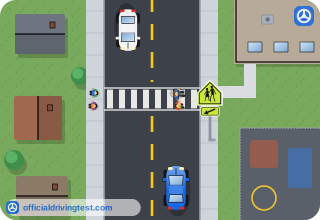
- Keep your speed and watch carefully for children
- Stop and wait until the children have left the area
- Slow down only if a crossing guard signals you to
- Slow down to the lower, posted school zone speed limit
Show answer
Correct answer: Slow down to the lower, posted school zone speed limit
Near a school you must slow down to the lower posted speed limit for the school zone.
Source: Indiana Driver’s Manual (July 2026), page 41 · Open this page in the manual (Manual page 41)
-
Who may establish lower speed limits for school zones whenever children are present?
- Local authorities
- The school principal
- The school bus driver
- The county health department
Show answer
Correct answer: Local authorities
The manual says local authorities may also establish lower school zone speed limits whenever children are present.
Source: Indiana Driver’s Manual (July 2026), page 41 · Open this page in the manual (Manual page 41)
-
How far below the maximum established speed limit for the area are work site speed limits always set, at least?
- 5 miles per hour
- 15 miles per hour
- 10 miles per hour
- 20 miles per hour
Show answer
Correct answer: 10 miles per hour
Work site speed limits are always at least 10 miles per hour below the maximum established speed limit for the area.
Source: Indiana Driver’s Manual (July 2026), page 41 · Open this page in the manual (Manual page 41)
-
Which statement about work site speed limits is correct?
- All of them are in effect at all times of day and night
- Some are in effect only while flashing, others at all times
- They are only advice, and drivers may choose to ignore them
- They apply only when workers are present near the road
Show answer
Correct answer: Some are in effect only while flashing, others at all times
The manual says some work site speed limits apply only when flashing and others apply at all times, and drivers must adhere to the posted limit.
Source: Indiana Driver’s Manual (July 2026), page 41 · Open this page in the manual (Manual page 41)
-
When a school bus is not on an interstate or state highway, what is its maximum speed limit unless the posted limit is lower?
- 30 miles per hour
- 35 miles per hour
- 45 miles per hour
- 40 miles per hour
Show answer
Correct answer: 40 miles per hour
Off interstates and state highways, the maximum speed limit for a school bus is 40 miles per hour unless the posted limit is lower.
Source: Indiana Driver’s Manual (July 2026), page 41 · Open this page in the manual (Manual page 41)
-
What is the maximum speed limit for a school bus on an interstate or highway, unless a lower limit is posted?
- 60 miles per hour
- 45 miles per hour
- 55 miles per hour
- 65 miles per hour
Show answer
Correct answer: 60 miles per hour
The maximum speed limit for a school bus on an interstate or highway is 60 miles per hour or the posted speed limit.
Source: Indiana Driver’s Manual (July 2026), page 41 · Open this page in the manual (Manual page 41)
-
Which of these makes driving at or above the posted speed limit even more dangerous?
- Light traffic on a clear day
- Driving a recently serviced vehicle
- Driving with worn tires
- Driving with a full tank of gas
Show answer
Correct answer: Driving with worn tires
The manual lists driving with worn tires among the conditions that make driving at the posted limit even more dangerous.
Source: Indiana Driver’s Manual (July 2026), page 41 · Open this page in the manual (Manual page 41)
-
According to the manual's chart, how many feet does a vehicle travel in one second at 55 miles per hour?
- 60.2 feet
- 80.7 feet
- 70.5 feet
- 90.1 feet
Show answer
Correct answer: 80.7 feet
The chart shows a vehicle travels 80.7 feet in one second at 55 miles per hour.
Source: Indiana Driver’s Manual (July 2026), page 41 · Open this page in the manual (Manual page 41)
-
According to the manual's chart, how many seconds does it take a vehicle to travel a football field at 70 miles per hour?
- 1.8 seconds
- 3.4 seconds
- 4.6 seconds
- 2.9 seconds
Show answer
Correct answer: 2.9 seconds
The chart shows 2.9 seconds to travel a football field at 70 miles per hour.
Source: Indiana Driver’s Manual (July 2026), page 41 · Open this page in the manual (Manual page 41)
-
According to the manual's chart, how many traffic lanes does a vehicle travel in one second at 70 miles per hour?
- 5.1 lanes
- 3.9 lanes
- 4.7 lanes
- 6.2 lanes
Show answer
Correct answer: 5.1 lanes
The chart shows a vehicle travels 5.1 traffic lanes in one second at 70 miles per hour.
Source: Indiana Driver’s Manual (July 2026), page 41 · Open this page in the manual (Manual page 41)
-
What is a good rule for how far to stay behind the vehicle ahead?
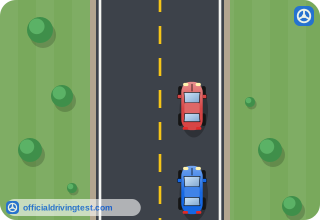
- About one second
- Four to five seconds, no more
- At least two to three seconds
- Ten seconds in all conditions
Show answer
Correct answer: At least two to three seconds
The manual says a good rule is to stay at least two to three seconds behind the vehicle ahead.
Source: Indiana Driver’s Manual (July 2026), page 41 · Open this page in the manual (Manual page 41)
-
How does the manual say to estimate your following time behind another vehicle?
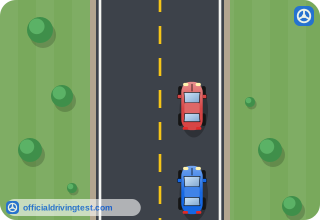
- Count the car lengths between your car and the vehicle ahead of you
- Watch for it to pass a fixed object, then estimate the time until you pass it
- Compare your speed with the speed limit shown on the nearest road sign
- Check the distance on your odometer while you follow the vehicle
Show answer
Correct answer: Watch for it to pass a fixed object, then estimate the time until you pass it
When following, watch for the vehicle to pass a fixed object and estimate the time before you pass the same object.
Source: Indiana Driver’s Manual (July 2026), page 41 · Open this page in the manual (Manual page 41)
-
Which of these affects a vehicle's ability to stop?
- The color of the vehicle
- The size of the fuel tank
- The brand of motor oil used
- Slickness of the pavement
Show answer
Correct answer: Slickness of the pavement
The manual lists the slickness of the pavement among the factors that affect a vehicle's ability to stop.
Source: Indiana Driver’s Manual (July 2026), page 41 · Open this page in the manual (Manual page 41)
-
What should you always do before driving in winter weather?
- Let your tires lose some air
- Turn on your high beams
- Clear your windows
- Drive around the block to test the brakes
Show answer
Correct answer: Clear your windows
The manual says always to clear your windows before driving in winter weather.
Source: Indiana Driver’s Manual (July 2026), page 43 · Open this page in the manual (Manual page 43)
-
Where may moisture freeze before other sections of the roadway?
- On long, straight rural roads
- On ramps, bridges, and overpasses
- In tunnels and parking lots
- On the center of divided highways
Show answer
Correct answer: On ramps, bridges, and overpasses
The manual says moisture on ramps, bridges, and overpasses may occasionally freeze before other sections of the roadway.
Source: Indiana Driver’s Manual (July 2026), page 43 · Open this page in the manual (Manual page 43)
-
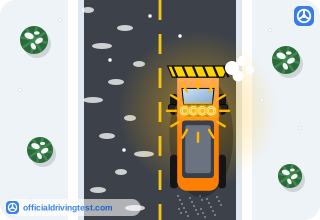
How should you drive near snowplows?
- Pass them as soon as possible
- Follow as closely as you can
- Stay close beside them
- Stay a safe distance behind them
Show answer
Correct answer: Stay a safe distance behind them
The manual says to stay a safe distance behind snowplows.
Source: Indiana Driver’s Manual (July 2026), page 43 · Open this page in the manual (Manual page 43)
-
How often should you brush the snow off your headlights and taillights in snowy weather?
- Only before you start the trip
- Only after the snow stops
- Frequently
- Only when the lights are off
Show answer
Correct answer: Frequently
The manual says to brush the snow off your headlights and taillights frequently.
Source: Indiana Driver’s Manual (July 2026), page 43 · Open this page in the manual (Manual page 43)
-
How much time should you allow your vehicle's engine to warm up before driving in very cold conditions?
- No time, because idling wastes fuel
- Plenty of time
- Exactly one minute
- Only until the heater blows warm air
Show answer
Correct answer: Plenty of time
The manual says always to allow the engine plenty of time to warm up before driving in very cold conditions.
Source: Indiana Driver’s Manual (July 2026), page 43 · Open this page in the manual (Manual page 43)
-
Where should you particularly watch for icy conditions when there is snowfall on the ground?

- At intersections
- On straight rural highways
- In parking lots only
- In the middle of the block
Show answer
Correct answer: At intersections
The manual says to watch for icy conditions when there is snowfall on the ground, particularly at intersections.
Source: Indiana Driver’s Manual (July 2026), page 43 · Open this page in the manual (Manual page 43)
-
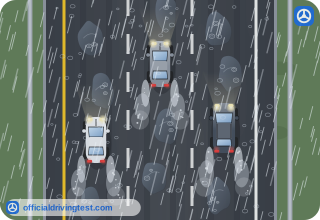
On wet roads, what is your vehicle actually traveling on, which can lead to hydroplaning?
- A thin layer of clean, pure water
- A layer of loose gravel and sand
- A thin layer of oil, dirt, and water
- A thin film of ice on the pavement
Show answer
Correct answer: A thin layer of oil, dirt, and water
The manual says that on wet roads your vehicle is traveling on a thin layer of oil, dirt, and water which can lead to hydroplaning.
Source: Indiana Driver’s Manual (July 2026), page 43 · Open this page in the manual (Manual page 43)
-
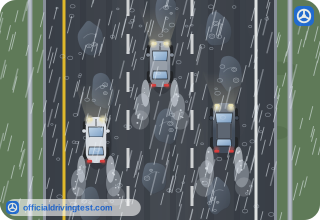
When your tires are in contact only with oil, dirt, and water, what happens?
- Braking becomes stronger because of the water
- There is no friction to brake, speed up, or turn
- Steering becomes easier at higher speeds
- Your tires cool down and grip the road better
Show answer
Correct answer: There is no friction to brake, speed up, or turn
The manual says there is no friction to brake, speed up, or turn, so a gust of wind or slight turn can cause a loss of control.
Source: Indiana Driver’s Manual (July 2026), page 44 · Open this page in the manual (Manual page 44)
-
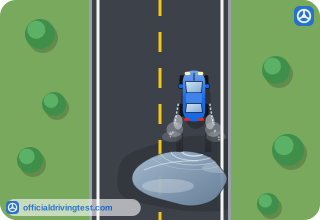
What should you do after driving through water puddles?
- Press the brake pedal once and hold it down
- Turn off your headlights until the road is dry
- Drive faster so the water shakes off the brakes
- Test your brakes by pumping them to help dry them
Show answer
Correct answer: Test your brakes by pumping them to help dry them
The manual says to test your brakes by pumping them, which will help to dry them.
Source: Indiana Driver’s Manual (July 2026), page 44 · Open this page in the manual (Manual page 44)
-
What should you do if the water on the road is deeper than your tire treads?
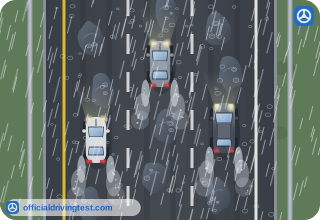
- Slow down
- Speed up to cross quickly
- Turn on your high beams
- Stop in the lane and wait
Show answer
Correct answer: Slow down
The manual says that if the water is deeper than your tire treads, you should slow down.
Source: Indiana Driver’s Manual (July 2026), page 44 · Open this page in the manual (Manual page 44)
-
Which vehicles are affected most by strong winds, according to the manual?
- High-profile vehicles, such as vans
- Low, long sports cars and sedans
- Vehicles that have new tires on them
- Vehicles equipped with anti-lock brakes
Show answer
Correct answer: High-profile vehicles, such as vans
The manual says strong winds have a significant effect on high-profile vehicles such as vans and sport utility vehicles.
Source: Indiana Driver’s Manual (July 2026), page 44 · Open this page in the manual (Manual page 44)
-
According to the manual, what are drivers more likely to be when driving at night?
- Overconfident about speed
- Fatigued
- Distracted by road signs
- Alert to hazards
Show answer
Correct answer: Fatigued
The manual says drivers are more likely to be fatigued while driving at night and may have a higher risk of accidents.
Source: Indiana Driver’s Manual (July 2026), page 44 · Open this page in the manual (Manual page 44)
-
What should you do under nighttime driving conditions, especially on unfamiliar roads?
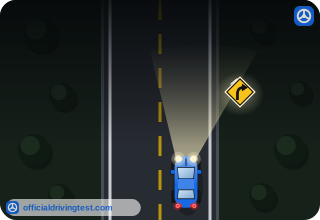
- Drive faster to spend less time on the road
- Keep your normal speed
- Follow vehicles more closely
- Reduce your normal speed
Show answer
Correct answer: Reduce your normal speed
The manual says that at night you should reduce normal speed, especially on unfamiliar roads.
Source: Indiana Driver’s Manual (July 2026), page 44 · Open this page in the manual (Manual page 44)
-
How can you avoid glare from the headlights of an approaching vehicle?
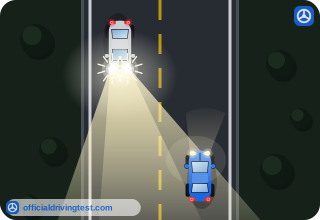
- Look toward the right side of the road, not into the lights
- Look directly at the lights so your eyes adjust to them
- Focus on the left side of the road, past the lights
- Close one eye until the other vehicle has passed you
Show answer
Correct answer: Look toward the right side of the road, not into the lights
To avoid glare, do not look directly into the lights of an approaching vehicle and focus on the right side of the road.
Source: Indiana Driver’s Manual (July 2026), page 44 · Open this page in the manual (Manual page 44)
-
Which action is named in the manual as one that can cause a dangerous driving accident?
- Disregarding a signal
- Driving at night
- Driving on a gravel road
- Using a hands-free device
Show answer
Correct answer: Disregarding a signal
A dangerous driving accident stems from aggressive driving, disregarding a signal, or speeding.
Source: Indiana Driver’s Manual (July 2026), page 45 · Open this page in the manual (Manual page 45)
-
Under Indiana law, how many of the listed actions must a person commit during one episode of continuous driving to be engaging in aggressive driving?
- At least two
- At least four
- At least three
- All of them
Show answer
Correct answer: At least three
Indiana law defines aggressive driving as committing at least three of the listed actions during one episode of continuous driving.
Source: Indiana Driver’s Manual (July 2026), page 46 · Open this page in the manual (Manual page 46)
-
Which of these is one of the actions listed in the manual as part of aggressive driving?
- Repeatedly flashing the vehicle’s headlights
- Using a turn signal before each lane change
- Stopping for a red traffic light
- Driving at the posted speed limit
Show answer
Correct answer: Repeatedly flashing the vehicle’s headlights
Repeatedly flashing the vehicle’s headlights is one of the listed aggressive driving actions.
Source: Indiana Driver’s Manual (July 2026), page 46 · Open this page in the manual (Manual page 46)
-
How does the manual compare driving on rural roads with driving on a paved interstate or city street?
- Rural roads are always safer because there is less traffic
- Rural roads are equally hazardous
- Rural roads can be more hazardous
- Rural roads are safer because they are narrower
Show answer
Correct answer: Rural roads can be more hazardous
The manual says driving on rural roads can be more hazardous than driving on a paved interstate or city street.
Source: Indiana Driver’s Manual (July 2026), page 46 · Open this page in the manual (Manual page 46)
-
Why must you slow down earlier when you approach a turn or stop on loose gravel?
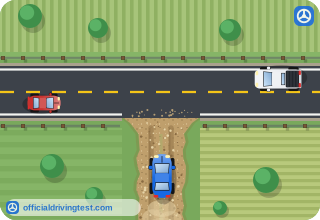
- Gravel makes your brake lights hard to see
- Traction is reduced, so skidding can occur
- Loose gravel makes the road narrower
- Gravel always hides oncoming vehicles
Show answer
Correct answer: Traction is reduced, so skidding can occur
Stopping and turning is harder on loose gravel because traction is reduced, so you must slow down earlier to reduce the risk of skidding.
Source: Indiana Driver’s Manual (July 2026), page 46 · Open this page in the manual (Manual page 46)
-
What does the manual advise using to make yourself more visible to other drivers on a dusty dirt road?

- Your high beam headlights
- Your hazard flashers
- Your parking lights only
- Your low beam headlights
Show answer
Correct answer: Your low beam headlights
Dust on dirt roads can reduce visibility, so the manual says to use your low beam headlights.
Source: Indiana Driver’s Manual (July 2026), page 46 · Open this page in the manual (Manual page 46)
-
What does the manual tell you to do when driving on narrow bridges and roads?
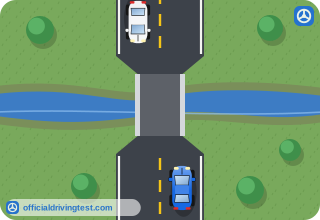
- Speed up so you cross before oncoming vehicles
- Sound your horn continuously while crossing
- Watch for narrow bridge signs and be prepared to stop
- Drive in the center of the bridge at all times
Show answer
Correct answer: Watch for narrow bridge signs and be prepared to stop
The manual says to always watch for narrow bridge signs and be prepared to stop for other vehicles.
Source: Indiana Driver’s Manual (July 2026), page 46 · Open this page in the manual (Manual page 46)
-
What should you do before approaching the crest of a steep hill on a rural road?
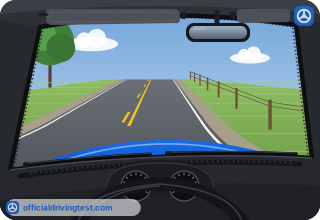
- Slow down and move to the right side of the road
- Speed up to climb the hill quickly
- Move to the center of the road to see farther
- Stop on the road before the crest and wait
Show answer
Correct answer: Slow down and move to the right side of the road
Before the crest of a steep hill, slow down, move to the right side of the road, and watch for oncoming vehicles.
Source: Indiana Driver’s Manual (July 2026), page 46 · Open this page in the manual (Manual page 46)
-
What should you never attempt to do when approaching a steep hill or crest?
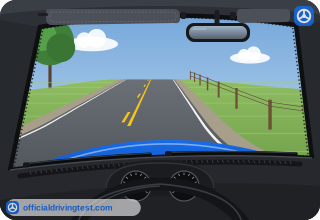
- Slow down
- Move to the right side of the road
- Watch for oncoming vehicles
- Pass another vehicle
Show answer
Correct answer: Pass another vehicle
The manual says never to attempt to pass another vehicle when approaching a steep hill or crest.
Source: Indiana Driver’s Manual (July 2026), page 46 · Open this page in the manual (Manual page 46)
-
What may reduce your ability to see vehicles approaching intersections and oncoming vehicles on curvy rural roads?
- Paved shoulders
- Crops such as corn
- Rumble strips
- Low beam headlights
Show answer
Correct answer: Crops such as corn
The manual says cultivated crops such as corn may reduce your ability to see vehicles approaching intersections and oncoming vehicles on curvy roads.
Source: Indiana Driver’s Manual (July 2026), page 46 · Open this page in the manual (Manual page 46)
-
According to the tips for teen drivers, what does going too fast give you?
- Better control of the vehicle
- More time to scan intersections
- Less time to stop or react
- More room in your lane
Show answer
Correct answer: Less time to stop or react
Going too fast gives you less time to stop or react.
Source: Indiana Driver’s Manual (July 2026), page 71 · Open this page in the manual (Manual page 71)