Indiana: Speed and following distance — Part 3 Practice Test
Questions in this part include: “Which vehicles are affected most by strong winds, according to the manual?” · “Which of these is one of the actions listed in the manual as part of aggressive driving?”
Independent educational site · not affiliated with any government agency or DMV
Ready? Test yourself
- Instant feedback with an explanation
- Every answer cites its source in the manual
- Your best score is saved on this device
Questions are original and based on the official manual "Indiana Driver’s Manual" (July 2026), Indiana Bureau of Motor Vehicles.
All 18 questions in this practice test
Take the test above first, then use this list to study. Tap “Show answer” to see the correct answer and explanation.
Show the questions and answersHide the questions
-
When your tires are in contact only with oil, dirt, and water, what happens?
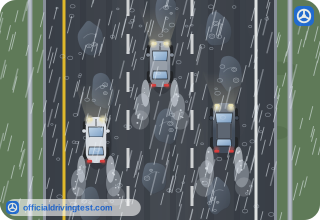
- Braking becomes stronger because of the water
- There is no friction to brake, speed up, or turn
- Steering becomes easier at higher speeds
- Your tires cool down and grip the road better
Show answer
Correct answer: There is no friction to brake, speed up, or turn
The manual says there is no friction to brake, speed up, or turn, so a gust of wind or slight turn can cause a loss of control.
Source: Indiana Driver’s Manual (July 2026), page 44 · Open this page in the manual (Manual page 44)
-
What should you do after driving through water puddles?
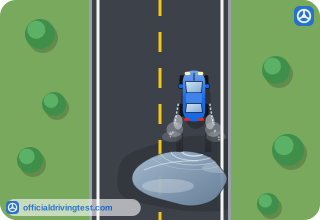
- Press the brake pedal once and hold it down
- Turn off your headlights until the road is dry
- Drive faster so the water shakes off the brakes
- Test your brakes by pumping them to help dry them
Show answer
Correct answer: Test your brakes by pumping them to help dry them
The manual says to test your brakes by pumping them, which will help to dry them.
Source: Indiana Driver’s Manual (July 2026), page 44 · Open this page in the manual (Manual page 44)
-
What should you do if the water on the road is deeper than your tire treads?
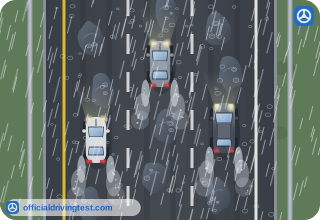
- Slow down
- Speed up to cross quickly
- Turn on your high beams
- Stop in the lane and wait
Show answer
Correct answer: Slow down
The manual says that if the water is deeper than your tire treads, you should slow down.
Source: Indiana Driver’s Manual (July 2026), page 44 · Open this page in the manual (Manual page 44)
-
Which vehicles are affected most by strong winds, according to the manual?
- High-profile vehicles, such as vans
- Low, long sports cars and sedans
- Vehicles that have new tires on them
- Vehicles equipped with anti-lock brakes
Show answer
Correct answer: High-profile vehicles, such as vans
The manual says strong winds have a significant effect on high-profile vehicles such as vans and sport utility vehicles.
Source: Indiana Driver’s Manual (July 2026), page 44 · Open this page in the manual (Manual page 44)
-
According to the manual, what are drivers more likely to be when driving at night?
- Overconfident about speed
- Fatigued
- Distracted by road signs
- Alert to hazards
Show answer
Correct answer: Fatigued
The manual says drivers are more likely to be fatigued while driving at night and may have a higher risk of accidents.
Source: Indiana Driver’s Manual (July 2026), page 44 · Open this page in the manual (Manual page 44)
-
What should you do under nighttime driving conditions, especially on unfamiliar roads?
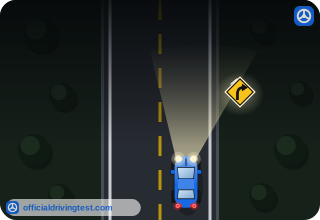
- Drive faster to spend less time on the road
- Keep your normal speed
- Follow vehicles more closely
- Reduce your normal speed
Show answer
Correct answer: Reduce your normal speed
The manual says that at night you should reduce normal speed, especially on unfamiliar roads.
Source: Indiana Driver’s Manual (July 2026), page 44 · Open this page in the manual (Manual page 44)
-
How can you avoid glare from the headlights of an approaching vehicle?
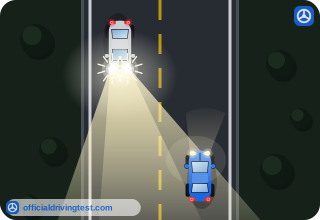
- Look toward the right side of the road, not into the lights
- Look directly at the lights so your eyes adjust to them
- Focus on the left side of the road, past the lights
- Close one eye until the other vehicle has passed you
Show answer
Correct answer: Look toward the right side of the road, not into the lights
To avoid glare, do not look directly into the lights of an approaching vehicle and focus on the right side of the road.
Source: Indiana Driver’s Manual (July 2026), page 44 · Open this page in the manual (Manual page 44)
-
Which action is named in the manual as one that can cause a dangerous driving accident?
- Disregarding a signal
- Driving at night
- Driving on a gravel road
- Using a hands-free device
Show answer
Correct answer: Disregarding a signal
A dangerous driving accident stems from aggressive driving, disregarding a signal, or speeding.
Source: Indiana Driver’s Manual (July 2026), page 45 · Open this page in the manual (Manual page 45)
-
Under Indiana law, how many of the listed actions must a person commit during one episode of continuous driving to be engaging in aggressive driving?
- At least two
- At least four
- At least three
- All of them
Show answer
Correct answer: At least three
Indiana law defines aggressive driving as committing at least three of the listed actions during one episode of continuous driving.
Source: Indiana Driver’s Manual (July 2026), page 46 · Open this page in the manual (Manual page 46)
-
Which of these is one of the actions listed in the manual as part of aggressive driving?
- Repeatedly flashing the vehicle’s headlights
- Using a turn signal before each lane change
- Stopping for a red traffic light
- Driving at the posted speed limit
Show answer
Correct answer: Repeatedly flashing the vehicle’s headlights
Repeatedly flashing the vehicle’s headlights is one of the listed aggressive driving actions.
Source: Indiana Driver’s Manual (July 2026), page 46 · Open this page in the manual (Manual page 46)
-
How does the manual compare driving on rural roads with driving on a paved interstate or city street?
- Rural roads are always safer because there is less traffic
- Rural roads are equally hazardous
- Rural roads can be more hazardous
- Rural roads are safer because they are narrower
Show answer
Correct answer: Rural roads can be more hazardous
The manual says driving on rural roads can be more hazardous than driving on a paved interstate or city street.
Source: Indiana Driver’s Manual (July 2026), page 46 · Open this page in the manual (Manual page 46)
-
Why must you slow down earlier when you approach a turn or stop on loose gravel?
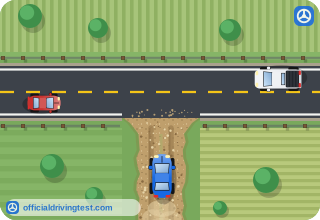
- Gravel makes your brake lights hard to see
- Traction is reduced, so skidding can occur
- Loose gravel makes the road narrower
- Gravel always hides oncoming vehicles
Show answer
Correct answer: Traction is reduced, so skidding can occur
Stopping and turning is harder on loose gravel because traction is reduced, so you must slow down earlier to reduce the risk of skidding.
Source: Indiana Driver’s Manual (July 2026), page 46 · Open this page in the manual (Manual page 46)
-
What does the manual advise using to make yourself more visible to other drivers on a dusty dirt road?
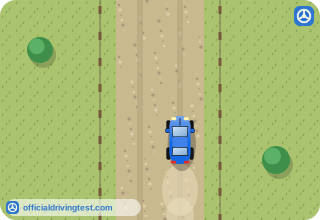
- Your high beam headlights
- Your hazard flashers
- Your parking lights only
- Your low beam headlights
Show answer
Correct answer: Your low beam headlights
Dust on dirt roads can reduce visibility, so the manual says to use your low beam headlights.
Source: Indiana Driver’s Manual (July 2026), page 46 · Open this page in the manual (Manual page 46)
-
What does the manual tell you to do when driving on narrow bridges and roads?
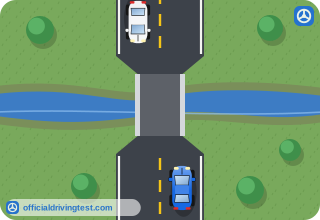
- Speed up so you cross before oncoming vehicles
- Sound your horn continuously while crossing
- Watch for narrow bridge signs and be prepared to stop
- Drive in the center of the bridge at all times
Show answer
Correct answer: Watch for narrow bridge signs and be prepared to stop
The manual says to always watch for narrow bridge signs and be prepared to stop for other vehicles.
Source: Indiana Driver’s Manual (July 2026), page 46 · Open this page in the manual (Manual page 46)
-
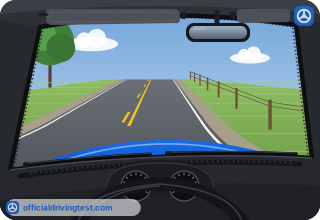
What should you do before approaching the crest of a steep hill on a rural road?
- Slow down and move to the right side of the road
- Speed up to climb the hill quickly
- Move to the center of the road to see farther
- Stop on the road before the crest and wait
Show answer
Correct answer: Slow down and move to the right side of the road
Before the crest of a steep hill, slow down, move to the right side of the road, and watch for oncoming vehicles.
Source: Indiana Driver’s Manual (July 2026), page 46 · Open this page in the manual (Manual page 46)
-
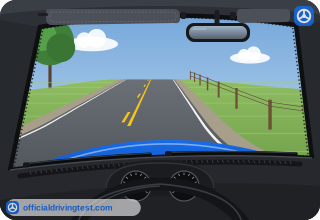
What should you never attempt to do when approaching a steep hill or crest?
- Slow down
- Move to the right side of the road
- Watch for oncoming vehicles
- Pass another vehicle
Show answer
Correct answer: Pass another vehicle
The manual says never to attempt to pass another vehicle when approaching a steep hill or crest.
Source: Indiana Driver’s Manual (July 2026), page 46 · Open this page in the manual (Manual page 46)
-
What may reduce your ability to see vehicles approaching intersections and oncoming vehicles on curvy rural roads?
- Paved shoulders
- Crops such as corn
- Rumble strips
- Low beam headlights
Show answer
Correct answer: Crops such as corn
The manual says cultivated crops such as corn may reduce your ability to see vehicles approaching intersections and oncoming vehicles on curvy roads.
Source: Indiana Driver’s Manual (July 2026), page 46 · Open this page in the manual (Manual page 46)
-
According to the tips for teen drivers, what does going too fast give you?
- Better control of the vehicle
- More time to scan intersections
- Less time to stop or react
- More room in your lane
Show answer
Correct answer: Less time to stop or react
Going too fast gives you less time to stop or react.
Source: Indiana Driver’s Manual (July 2026), page 71 · Open this page in the manual (Manual page 71)