Indiana: Speed and following distance — Part 1 Practice Test
Questions in this part include: “What is the maximum speed at which an MDC may be operated?” · “According to the manual, an urban area has a population of at least how many people?”
Independent educational site · not affiliated with any government agency or DMV
Ready? Test yourself
- Instant feedback with an explanation
- Every answer cites its source in the manual
- Your best score is saved on this device
Questions are original and based on the official manual "Indiana Driver’s Manual" (July 2026), Indiana Bureau of Motor Vehicles.
All 18 questions in this practice test
Take the test above first, then use this list to study. Tap “Show answer” to see the correct answer and explanation.
Show the questions and answersHide the questions
-
What is the maximum speed at which an MDC may be operated?
- 25 miles per hour
- 45 miles per hour
- 55 miles per hour
- 35 miles per hour
Show answer
Correct answer: 35 miles per hour
An MDC must operate at no more than 35 miles per hour.
Source: Indiana Driver’s Manual (July 2026), page 15 · Open this page in the manual (Manual page 15)
-
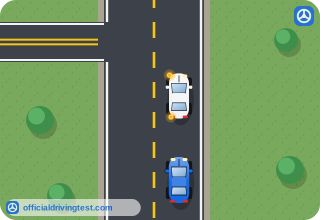
When following a driver who has signaled an intention to make a turn, what should you do?
- Move to the left and pass
- Keep your speed and your distance
- Slow down and be prepared to stop
- Sound your horn to hurry the driver
Show answer
Correct answer: Slow down and be prepared to stop
The manual says to slow down and be prepared to stop when following a driver who has signaled a turn or has slowed down.
Source: Indiana Driver’s Manual (July 2026), page 40 · Open this page in the manual (Manual page 40)
-
What does Indiana law require drivers to do about speed?
- Drive 5 miles per hour below the posted limit
- Operate vehicles at the posted speed limit
- Match the speed of the traffic around them
- Keep to the lowest speed that is posted
Show answer
Correct answer: Operate vehicles at the posted speed limit
The manual says Indiana law requires drivers to operate vehicles at the posted speed limit.
Source: Indiana Driver’s Manual (July 2026), page 40 · Open this page in the manual (Manual page 40)
-
What does exceeding the posted speed limit reduce?
- The distance needed to stop a vehicle in an emergency
- The severity of a crash at the moment of impact
- The amount of fuel that the vehicle uses per mile
- The driver’s ability to steer safely around curves or objects
Show answer
Correct answer: The driver’s ability to steer safely around curves or objects
The manual says exceeding the posted speed limit reduces the driver’s ability to steer safely around curves or objects in the roadway.
Source: Indiana Driver’s Manual (July 2026), page 40 · Open this page in the manual (Manual page 40)
-
What does exceeding the posted speed limit do to the distance required to stop a vehicle in an emergency?
- It extends the distance
- It shortens the distance
- It does not change the distance
- It changes the distance only on wet roads
Show answer
Correct answer: It extends the distance
The manual says exceeding the posted speed limit extends the distance required to stop in emergency situations.
Source: Indiana Driver’s Manual (July 2026), page 40 · Open this page in the manual (Manual page 40)
-
What happens to crash severity as the speed of the vehicle at impact increases?
- It decreases
- It stays the same
- It increases
- It changes only for trucks
Show answer
Correct answer: It increases
The manual says crash severity increases with the speed of the vehicle at impact.
Source: Indiana Driver’s Manual (July 2026), page 40 · Open this page in the manual (Manual page 40)
-
On a rural interstate highway, what is the speed limit rule for passenger vehicles?
- They may not exceed 70 miles per hour or the posted speed limit
- They may not exceed 50 miles per hour or the posted speed limit
- They may not exceed 55 miles per hour or the posted speed limit
- They may not exceed 75 miles per hour or the posted speed limit
Show answer
Correct answer: They may not exceed 70 miles per hour or the posted speed limit
The manual says passenger vehicles on rural interstates may not exceed 70 miles per hour or the posted speed limit.
Source: Indiana Driver’s Manual (July 2026), page 40 · Open this page in the manual (Manual page 40)
-
On a rural interstate highway, what is the speed limit rule for trucks with a declared gross vehicle weight greater than 26,000 pounds?
- They may not exceed 45 miles per hour or the posted speed limit
- They may not exceed 55 miles per hour or the posted speed limit
- They may not exceed 65 miles per hour or the posted speed limit
- They may not exceed 75 miles per hour or the posted speed limit
Show answer
Correct answer: They may not exceed 65 miles per hour or the posted speed limit
The manual says such trucks may not exceed 65 miles per hour or the posted speed limit on rural interstates.
Source: Indiana Driver’s Manual (July 2026), page 40 · Open this page in the manual (Manual page 40)
-
On a rural state divided highway, what is the speed limit rule?
- Vehicles may not exceed 45 miles per hour or the posted speed limit
- Vehicles may not exceed 60 miles per hour or the posted speed limit
- Vehicles may not exceed 50 miles per hour or the posted speed limit
- Vehicles may not exceed 75 miles per hour or the posted speed limit
Show answer
Correct answer: Vehicles may not exceed 60 miles per hour or the posted speed limit
The manual says that on a rural state divided highway vehicles may not exceed 60 miles per hour or the posted speed limit.
Source: Indiana Driver’s Manual (July 2026), page 40 · Open this page in the manual (Manual page 40)
-
According to the manual, an urban area has a population of at least how many people?
- 50,000 people
- 10,000 people
- 25,000 people
- 100,000 people
Show answer
Correct answer: 50,000 people
The manual defines urban areas as those with a population of at least 50,000 people.
Source: Indiana Driver’s Manual (July 2026), page 41 · Open this page in the manual (Manual page 41)
-
In an urban area, what is the most you may drive on an interstate highway unless a lower limit is posted?
- 45 miles per hour
- 50 miles per hour
- 55 miles per hour
- 65 miles per hour
Show answer
Correct answer: 55 miles per hour
On an urban interstate highway, vehicles may not exceed 55 miles per hour or the posted speed limit.
Source: Indiana Driver’s Manual (July 2026), page 41 · Open this page in the manual (Manual page 41)
-
In an urban area, what is the most you may drive on a non-divided state highway unless a lower limit is posted?
- 35 miles per hour
- 55 miles per hour
- 45 miles per hour
- 65 miles per hour
Show answer
Correct answer: 55 miles per hour
On a non-divided state highway in an urban area, vehicles may not exceed 55 miles per hour or the posted speed limit.
Source: Indiana Driver’s Manual (July 2026), page 41 · Open this page in the manual (Manual page 41)
-
In an urban area, what is the most you may drive on a county road unless a lower limit is posted?
- 40 miles per hour
- 45 miles per hour
- 65 miles per hour
- 55 miles per hour
Show answer
Correct answer: 55 miles per hour
On county roads in urban areas, vehicles may not exceed 55 miles per hour or the posted speed limit.
Source: Indiana Driver’s Manual (July 2026), page 41 · Open this page in the manual (Manual page 41)
-
In most urban residential areas, what is the most you may drive unless a lower limit is posted?
- 30 miles per hour
- 20 miles per hour
- 25 miles per hour
- 35 miles per hour
Show answer
Correct answer: 30 miles per hour
In most urban residential areas, vehicles may not exceed 30 miles per hour or the posted speed limit.
Source: Indiana Driver’s Manual (July 2026), page 41 · Open this page in the manual (Manual page 41)
-
In an urban area, what is the most you may drive in an alley unless a lower limit is posted?
- 10 miles per hour
- 20 miles per hour
- 15 miles per hour
- 25 miles per hour
Show answer
Correct answer: 15 miles per hour
In alleys, vehicles may not exceed 15 miles per hour or the posted speed limit.
Source: Indiana Driver’s Manual (July 2026), page 41 · Open this page in the manual (Manual page 41)
-
What are the common hours for school zone speed limits?
- 6 a.m. to 3 p.m., Monday through Friday
- 7 a.m. to 4:30 p.m., Monday through Friday
- 8 a.m. to 5 p.m., Monday through Saturday
- 7 a.m. to 6 p.m., every day of the week
Show answer
Correct answer: 7 a.m. to 4:30 p.m., Monday through Friday
The manual lists 7 a.m. to 4:30 p.m., Monday through Friday, or when school speed limit beacons are flashing.
Source: Indiana Driver’s Manual (July 2026), page 41 · Open this page in the manual (Manual page 41)
-
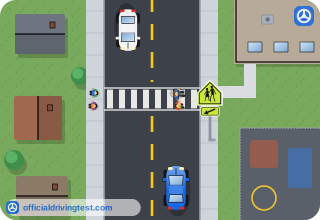
What must you do when you are driving near a school?
- Keep your speed and watch carefully for children
- Stop and wait until the children have left the area
- Slow down only if a crossing guard signals you to
- Slow down to the lower, posted school zone speed limit
Show answer
Correct answer: Slow down to the lower, posted school zone speed limit
Near a school you must slow down to the lower posted speed limit for the school zone.
Source: Indiana Driver’s Manual (July 2026), page 41 · Open this page in the manual (Manual page 41)
-
Who may establish lower speed limits for school zones whenever children are present?
- Local authorities
- The school principal
- The school bus driver
- The county health department
Show answer
Correct answer: Local authorities
The manual says local authorities may also establish lower school zone speed limits whenever children are present.
Source: Indiana Driver’s Manual (July 2026), page 41 · Open this page in the manual (Manual page 41)