Indiana: Speed and following distance — Part 2 Practice Test
Questions in this part include: “How far below the maximum established speed limit for the area are work site speed limits always set, at least?” · “According to the manual's chart, how many traffic lanes does a vehicle travel in one second at 70 miles per hour?”
Independent educational site · not affiliated with any government agency or DMV
Ready? Test yourself
- Instant feedback with an explanation
- Every answer cites its source in the manual
- Your best score is saved on this device
Questions are original and based on the official manual "Indiana Driver’s Manual" (July 2026), Indiana Bureau of Motor Vehicles.
All 18 questions in this practice test
Take the test above first, then use this list to study. Tap “Show answer” to see the correct answer and explanation.
Show the questions and answersHide the questions
-
How far below the maximum established speed limit for the area are work site speed limits always set, at least?
- 5 miles per hour
- 15 miles per hour
- 10 miles per hour
- 20 miles per hour
Show answer
Correct answer: 10 miles per hour
Work site speed limits are always at least 10 miles per hour below the maximum established speed limit for the area.
Source: Indiana Driver’s Manual (July 2026), page 41 · Open this page in the manual (Manual page 41)
-
Which statement about work site speed limits is correct?
- All of them are in effect at all times of day and night
- Some are in effect only while flashing, others at all times
- They are only advice, and drivers may choose to ignore them
- They apply only when workers are present near the road
Show answer
Correct answer: Some are in effect only while flashing, others at all times
The manual says some work site speed limits apply only when flashing and others apply at all times, and drivers must adhere to the posted limit.
Source: Indiana Driver’s Manual (July 2026), page 41 · Open this page in the manual (Manual page 41)
-
When a school bus is not on an interstate or state highway, what is its maximum speed limit unless the posted limit is lower?
- 30 miles per hour
- 35 miles per hour
- 45 miles per hour
- 40 miles per hour
Show answer
Correct answer: 40 miles per hour
Off interstates and state highways, the maximum speed limit for a school bus is 40 miles per hour unless the posted limit is lower.
Source: Indiana Driver’s Manual (July 2026), page 41 · Open this page in the manual (Manual page 41)
-
What is the maximum speed limit for a school bus on an interstate or highway, unless a lower limit is posted?
- 60 miles per hour
- 45 miles per hour
- 55 miles per hour
- 65 miles per hour
Show answer
Correct answer: 60 miles per hour
The maximum speed limit for a school bus on an interstate or highway is 60 miles per hour or the posted speed limit.
Source: Indiana Driver’s Manual (July 2026), page 41 · Open this page in the manual (Manual page 41)
-
Which of these makes driving at or above the posted speed limit even more dangerous?
- Light traffic on a clear day
- Driving a recently serviced vehicle
- Driving with worn tires
- Driving with a full tank of gas
Show answer
Correct answer: Driving with worn tires
The manual lists driving with worn tires among the conditions that make driving at the posted limit even more dangerous.
Source: Indiana Driver’s Manual (July 2026), page 41 · Open this page in the manual (Manual page 41)
-
According to the manual's chart, how many feet does a vehicle travel in one second at 55 miles per hour?
- 60.2 feet
- 80.7 feet
- 70.5 feet
- 90.1 feet
Show answer
Correct answer: 80.7 feet
The chart shows a vehicle travels 80.7 feet in one second at 55 miles per hour.
Source: Indiana Driver’s Manual (July 2026), page 41 · Open this page in the manual (Manual page 41)
-
According to the manual's chart, how many seconds does it take a vehicle to travel a football field at 70 miles per hour?
- 1.8 seconds
- 3.4 seconds
- 4.6 seconds
- 2.9 seconds
Show answer
Correct answer: 2.9 seconds
The chart shows 2.9 seconds to travel a football field at 70 miles per hour.
Source: Indiana Driver’s Manual (July 2026), page 41 · Open this page in the manual (Manual page 41)
-
According to the manual's chart, how many traffic lanes does a vehicle travel in one second at 70 miles per hour?
- 5.1 lanes
- 3.9 lanes
- 4.7 lanes
- 6.2 lanes
Show answer
Correct answer: 5.1 lanes
The chart shows a vehicle travels 5.1 traffic lanes in one second at 70 miles per hour.
Source: Indiana Driver’s Manual (July 2026), page 41 · Open this page in the manual (Manual page 41)
-
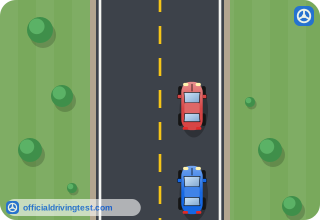
What is a good rule for how far to stay behind the vehicle ahead?
- About one second
- Four to five seconds, no more
- At least two to three seconds
- Ten seconds in all conditions
Show answer
Correct answer: At least two to three seconds
The manual says a good rule is to stay at least two to three seconds behind the vehicle ahead.
Source: Indiana Driver’s Manual (July 2026), page 41 · Open this page in the manual (Manual page 41)
-
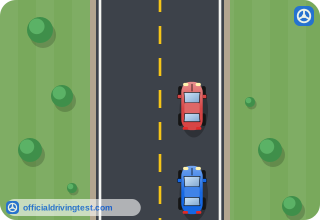
How does the manual say to estimate your following time behind another vehicle?
- Count the car lengths between your car and the vehicle ahead of you
- Watch for it to pass a fixed object, then estimate the time until you pass it
- Compare your speed with the speed limit shown on the nearest road sign
- Check the distance on your odometer while you follow the vehicle
Show answer
Correct answer: Watch for it to pass a fixed object, then estimate the time until you pass it
When following, watch for the vehicle to pass a fixed object and estimate the time before you pass the same object.
Source: Indiana Driver’s Manual (July 2026), page 41 · Open this page in the manual (Manual page 41)
-
Which of these affects a vehicle's ability to stop?
- The color of the vehicle
- The size of the fuel tank
- The brand of motor oil used
- Slickness of the pavement
Show answer
Correct answer: Slickness of the pavement
The manual lists the slickness of the pavement among the factors that affect a vehicle's ability to stop.
Source: Indiana Driver’s Manual (July 2026), page 41 · Open this page in the manual (Manual page 41)
-
What should you always do before driving in winter weather?
- Let your tires lose some air
- Turn on your high beams
- Clear your windows
- Drive around the block to test the brakes
Show answer
Correct answer: Clear your windows
The manual says always to clear your windows before driving in winter weather.
Source: Indiana Driver’s Manual (July 2026), page 43 · Open this page in the manual (Manual page 43)
-
Where may moisture freeze before other sections of the roadway?
- On long, straight rural roads
- On ramps, bridges, and overpasses
- In tunnels and parking lots
- On the center of divided highways
Show answer
Correct answer: On ramps, bridges, and overpasses
The manual says moisture on ramps, bridges, and overpasses may occasionally freeze before other sections of the roadway.
Source: Indiana Driver’s Manual (July 2026), page 43 · Open this page in the manual (Manual page 43)
-
How should you drive near snowplows?

- Pass them as soon as possible
- Follow as closely as you can
- Stay close beside them
- Stay a safe distance behind them
Show answer
Correct answer: Stay a safe distance behind them
The manual says to stay a safe distance behind snowplows.
Source: Indiana Driver’s Manual (July 2026), page 43 · Open this page in the manual (Manual page 43)
-
How often should you brush the snow off your headlights and taillights in snowy weather?
- Only before you start the trip
- Only after the snow stops
- Frequently
- Only when the lights are off
Show answer
Correct answer: Frequently
The manual says to brush the snow off your headlights and taillights frequently.
Source: Indiana Driver’s Manual (July 2026), page 43 · Open this page in the manual (Manual page 43)
-
How much time should you allow your vehicle's engine to warm up before driving in very cold conditions?
- No time, because idling wastes fuel
- Plenty of time
- Exactly one minute
- Only until the heater blows warm air
Show answer
Correct answer: Plenty of time
The manual says always to allow the engine plenty of time to warm up before driving in very cold conditions.
Source: Indiana Driver’s Manual (July 2026), page 43 · Open this page in the manual (Manual page 43)
-
Where should you particularly watch for icy conditions when there is snowfall on the ground?

- At intersections
- On straight rural highways
- In parking lots only
- In the middle of the block
Show answer
Correct answer: At intersections
The manual says to watch for icy conditions when there is snowfall on the ground, particularly at intersections.
Source: Indiana Driver’s Manual (July 2026), page 43 · Open this page in the manual (Manual page 43)
-
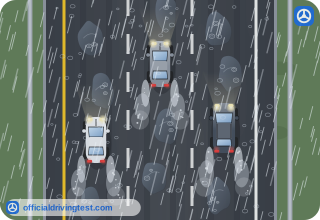
On wet roads, what is your vehicle actually traveling on, which can lead to hydroplaning?
- A thin layer of clean, pure water
- A layer of loose gravel and sand
- A thin layer of oil, dirt, and water
- A thin film of ice on the pavement
Show answer
Correct answer: A thin layer of oil, dirt, and water
The manual says that on wet roads your vehicle is traveling on a thin layer of oil, dirt, and water which can lead to hydroplaning.
Source: Indiana Driver’s Manual (July 2026), page 43 · Open this page in the manual (Manual page 43)