Traffic signals in Indiana
The Indiana Driver’s Manual shows or names everything on this page: 21 in all, on pages 31–36, 41.
Independent educational site · not affiliated with any government agency or DMV
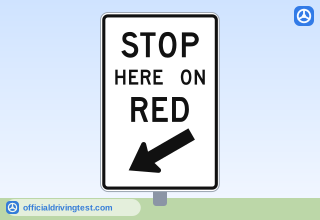
STOP HERE ON RED
Traffic regulation signs regulate traffic speed as well as movement and display rules which drivers must obey.
Manual page 32 · Open this page in the manual (Manual page 32)
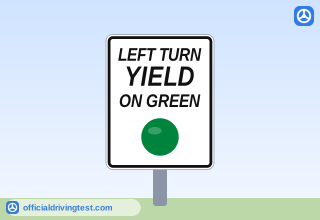
LEFT TURN YIELD ON GREEN
Traffic regulation signs regulate traffic speed as well as movement and display rules which drivers must obey.
Manual page 31 · Open this page in the manual (Manual page 31)
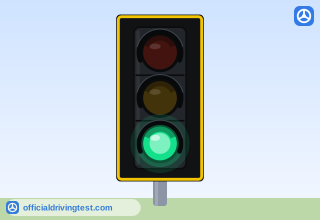
Green Signal
A green light means go. If you are facing a green light, you have the right of way and may drive through an intersection as long as the intersection is clear of other vehicles and pedestrians.
Manual page 33 · Open this page in the manual (Manual page 33)
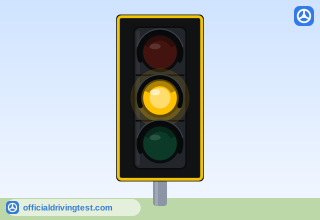
Yellow Signal
A steady yellow light means the green light has ended and the signal is about to turn red. If you are facing a steady yellow light, your right of way is ending. If you are approaching the intersection and are too close to stop safely, you may complete your movement.
Manual page 33 · Open this page in the manual (Manual page 33)
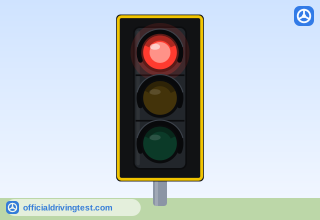
Red Signal
A red light means stop. Traffic entering an intersection from other directions has the right of way. If you are facing a red light, you may not enter the intersection until the light facing you turns green and the intersection is clear.
Manual page 33 · Open this page in the manual (Manual page 33)
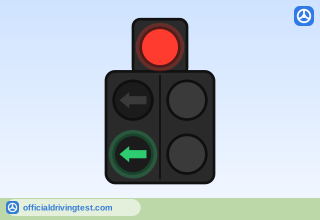
Five-Section Left-Turn Signal
If you are facing a green arrow displayed with a red or green light, you have the right of way and may turn through an intersection, as long as the intersection is clear.
Manual page 33 · Open this page in the manual (Manual page 33)
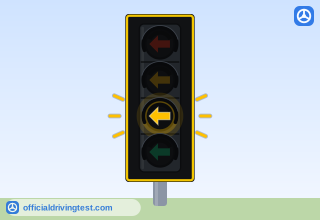
Four-Section Left-Turn Arrow Signal
A yellow flashing arrow for a turning movement means that you may proceed with the turn only after you have yielded the right of way to pedestrians and oncoming traffic.
Manual page 34 · Open this page in the manual (Manual page 34)
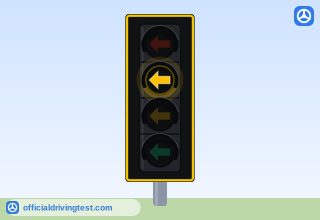
Steady Yellow Left Arrow
If you are facing a steady yellow light or arrow, your right of way is ending.
Manual page 34 · Open this page in the manual (Manual page 34)
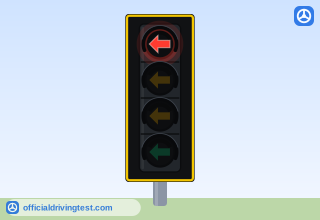
Red Left Arrow
If you are facing a red light or arrow, your right of way has ended. If you are in the middle of an intersection, you may turn once oncoming traffic has stopped. If you are facing a red light or arrow, you may not enter the intersection until the light facing you turns green and the intersection is clear.
Manual page 34 · Open this page in the manual (Manual page 34)
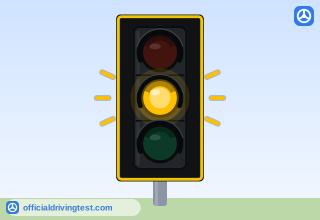
Flashing Yellow Signal
A yellow flashing light displayed without an arrow at an intersection means that you should slow down and use caution when traveling through an intersection. If turning left, you must yield to oncoming traffic and pedestrians. All traffic on the cross street is required to yield the right of way to you. However, you should watch for other vehicles or pedestrians attempting to cross the intersection.
Manual page 34 · Open this page in the manual (Manual page 34)
Pedestrian Crossing Beacon Assembly
Another type of yellow flashing light is a rectangular rapid flashing beacon. Rectangular rapid flashing beacons are used at crosswalks and only flash when activated by a pedestrian.
Manual page 34 · Open this page in the manual (Manual page 34)
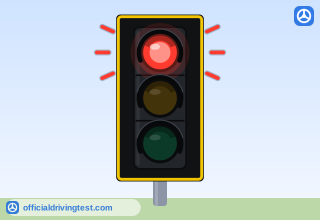
Flashing Red Signal
A red flashing light at an intersection is equivalent to a stop sign and means that you must come to a complete stop before proceeding with caution to enter the intersection.
Manual page 34 · Open this page in the manual (Manual page 34)
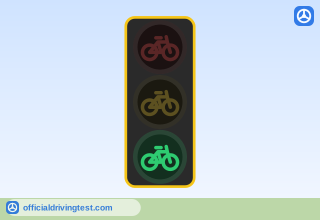
Bicycle Signal
A signal that displays only bicycle symbols controls a bike lane or a separate bike path and is only applicable to bicyclists. As with vehicular signals, red means stop, yellow means the right-of-way is ending, and green means go.
Manual page 35 · Open this page in the manual (Manual page 35)
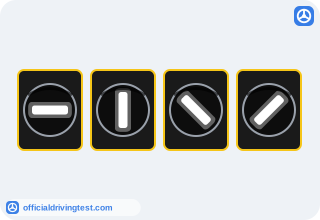
Transit Signal (White Bars)
A signal that displays white rectangular bars control a bus or transit lane and are only applicable to bus or transit operators.
Manual page 35 · Open this page in the manual (Manual page 35)
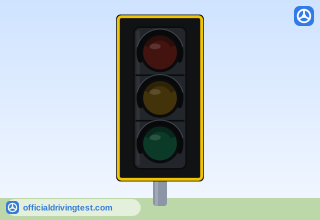
Dark Signal
If you are approaching an intersection with a non-operating signal, you should stop before entering the intersection. After stopping, you may proceed with caution only after you have yielded the right of way to: Cross-traffic that has already entered the intersection; Any vehicle that stopped before you and is entering the intersection; Any vehicle that arrived at the same time as you and is to your right; Any pedestrian traffic
Manual page 35 · Open this page in the manual (Manual page 35)
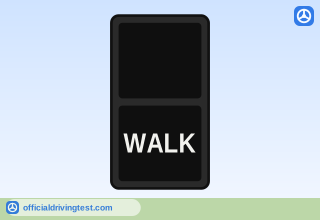
WALK (Words)
Pedestrian signals display the word “WALK” or a symbol of a person walking when pedestrians may safely cross a street or intersection.
Manual page 36 · Open this page in the manual (Manual page 36)
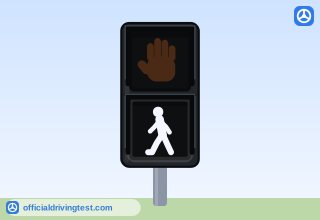
WALK (Symbol)
Pedestrian signals display the word “WALK” or a symbol of a person walking when pedestrians may safely cross a street or intersection.
Manual page 36 · Open this page in the manual (Manual page 36)
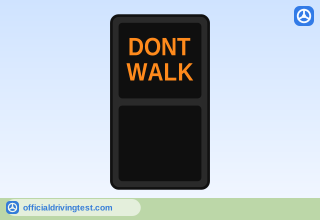
DONT WALK (Words)
Pedestrian signals display the words “DON’T WALK” or a symbol of a raised hand when it is not safe for pedestrians to cross a street or intersection. The words or symbols flash to alert pedestrians that the time in which to safely cross the street or intersection is ending.
Manual page 36 · Open this page in the manual (Manual page 36)
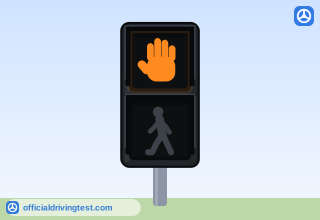
DONT WALK (Raised Hand)
Pedestrian signals display the words “DON’T WALK” or a symbol of a raised hand when it is not safe for pedestrians to cross a street or intersection. The words or symbols flash to alert pedestrians that the time in which to safely cross the street or intersection is ending.
Manual page 36 · Open this page in the manual (Manual page 36)
Hybrid Beacon Sequence
A pedestrian hybrid beacon is a signal used to facilitate pedestrian crossing, and which may be found at a mid-block crosswalk. The pedestrian hybrid beacon is dark unless it has been activated by a pedestrian. Once activated by a pedestrian, the pedestrian hybrid beacon will display a flashing yellow light to allow drivers to clear the crossing. The flashing yellow will be followed by a steady yellow light to warn drivers that their right of way is ending. Then, two steady red lights will be displayed while the pedestrian crosses, and then the two red lights will flash to allow drivers to proceed through if the crossing is clear of pedestrians. The pedestrian hybrid beacon will then go dark until activated again by a pedestrian.
Manual page 36 · Open this page in the manual (Manual page 36)
School Speed Limit Beacon
If you are driving near a school, you must slow down to the lower, posted speed limit for the school zone. Common hours for school zone speed limits are 7 a.m. to 4:30 p.m., Monday through Friday or when school speed limit beacons are flashing.
Manual page 41 · Open this page in the manual (Manual page 41)