Indiana: Traffic signals Practice Test
Red, yellow and green lights, arrows, flashing signals, pedestrian signals and hybrid beacons.
Independent educational site · not affiliated with any government agency or DMV
Ready? Test yourself
- Instant feedback with an explanation
- Every answer cites its source in the manual
- Your best score is saved on this device
Questions are original and based on the official manual "Indiana Driver’s Manual" (July 2026), Indiana Bureau of Motor Vehicles.
All 18 questions in this practice test
Take the test above first, then use this list to study. Tap “Show answer” to see the correct answer and explanation.
Show the questions and answersHide the questions
-
What are traffic control devices such as stop lights and signs used for?
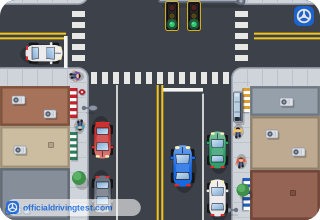
- To control traffic flow and indicate right of way at intersections and crossings
- To record the speed of vehicles passing through intersections and crossings
- To mark the boundary between city and county roads and streets in towns
- To show drivers the location of nearby parks, rest areas and fuel stops
Show answer
Correct answer: To control traffic flow and indicate right of way at intersections and crossings
The manual says traffic control devices such as stop lights and signs control traffic flow and indicate right of way at intersections and pedestrian crossings.
Source: Indiana Driver’s Manual (July 2026), page 33 · Open this page in the manual (Manual page 33)
-
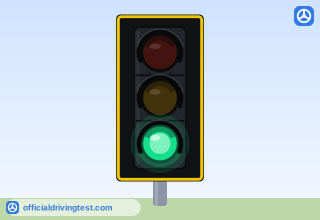
If you are facing a green light, when may you drive through an intersection?
- Only after you have come to a full stop and looked both ways
- Only if no vehicle is waiting on the cross street
- As long as the intersection is clear of other vehicles and pedestrians
- Only after the light has been green for several seconds
Show answer
Correct answer: As long as the intersection is clear of other vehicles and pedestrians
A green light means go, and you may drive through as long as the intersection is clear of other vehicles and pedestrians.
Source: Indiana Driver’s Manual (July 2026), page 33 · Open this page in the manual (Manual page 33)
-
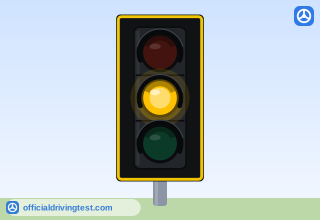
What does a steady yellow light mean?
- The red light has ended and the signal is about to turn green
- The green light has ended and the signal is about to turn red
- Cross traffic has been stopped and you may speed through
- Drivers must stop immediately, even in the middle of the crossing
Show answer
Correct answer: The green light has ended and the signal is about to turn red
A steady yellow light means the green light has ended and the signal is about to turn red, so your right of way is ending.
Source: Indiana Driver’s Manual (July 2026), page 33 · Open this page in the manual (Manual page 33)
-
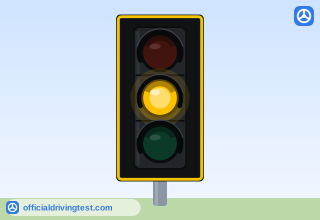
You approach an intersection and the light is steady yellow. You are too close to stop safely. What may you do?
- Brake hard and stop even if you end up in the crosswalk
- Turn around before you reach the intersection
- Wait in place until the light turns green again
- Complete your movement through the intersection
Show answer
Correct answer: Complete your movement through the intersection
If you are approaching the intersection and are too close to stop safely on a steady yellow, you may complete your movement.
Source: Indiana Driver’s Manual (July 2026), page 33 · Open this page in the manual (Manual page 33)
-
If you are facing a red light, when may you enter the intersection?
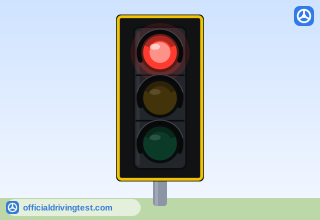
- Not until the light facing you turns green and the intersection is clear
- Once the cross-street traffic has slowed down enough for you to pass
- As soon as the light turns yellow for traffic on the cross street
- Whenever no vehicle is visible on the cross street
Show answer
Correct answer: Not until the light facing you turns green and the intersection is clear
Facing a red light, you may not enter the intersection until the light facing you turns green and the intersection is clear.
Source: Indiana Driver’s Manual (July 2026), page 33 · Open this page in the manual (Manual page 33)
-
What does a yellow flashing arrow for a turning movement mean?
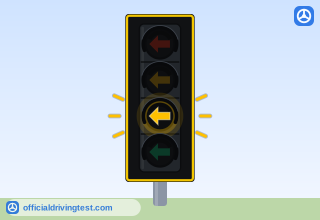
- You have the right of way and may turn without yielding
- You must come to a full stop and wait until the arrow turns green
- You may turn only after yielding to pedestrians and oncoming traffic
- The turn lane is closed and you must go straight
Show answer
Correct answer: You may turn only after yielding to pedestrians and oncoming traffic
A yellow flashing arrow means you may proceed with the turn only after yielding the right of way to pedestrians and oncoming traffic.
Source: Indiana Driver’s Manual (July 2026), page 34 · Open this page in the manual (Manual page 34)
-
What does a yellow flashing light without an arrow at an intersection mean?
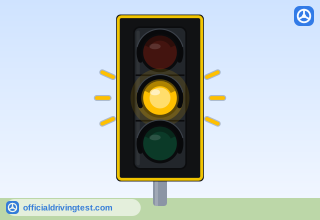
- Come to a complete stop before entering the intersection
- Slow down and use caution when traveling through the intersection
- Stop and yield to all traffic on the cross street
- The signal is out of order and the intersection is closed
Show answer
Correct answer: Slow down and use caution when traveling through the intersection
A yellow flashing light without an arrow means you should slow down and use caution when traveling through the intersection.
Source: Indiana Driver’s Manual (July 2026), page 34 · Open this page in the manual (Manual page 34)
-
When do rectangular rapid flashing beacons at crosswalks flash?
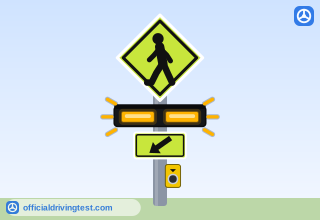
- Continuously, day and night
- Only during rush hour traffic
- Only when activated by a pedestrian
- Only when a vehicle approaches too fast
Show answer
Correct answer: Only when activated by a pedestrian
Rectangular rapid flashing beacons are used at crosswalks and only flash when activated by a pedestrian.
Source: Indiana Driver’s Manual (July 2026), page 34 · Open this page in the manual (Manual page 34)
-
What must you do at a red flashing light at an intersection?
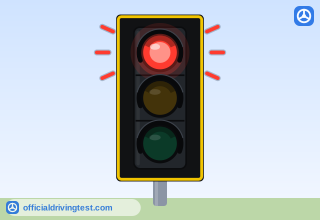
- Slow down and treat it like a yield sign, stopping only if needed
- Treat it like a stop sign: stop completely, then proceed with caution
- Stop only if cross traffic is present
- Proceed with caution because the signal is out of order
Show answer
Correct answer: Treat it like a stop sign: stop completely, then proceed with caution
A red flashing light at an intersection is equivalent to a stop sign: you must come to a complete stop before proceeding with caution.
Source: Indiana Driver’s Manual (July 2026), page 34 · Open this page in the manual (Manual page 34)
-
Who must obey a signal that displays only bicycle symbols?
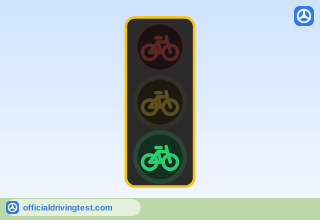
- All drivers in the adjacent lane
- Only bicyclists
- Only pedestrians at the crosswalk
- Only motorcyclists and motor driven cycle operators
Show answer
Correct answer: Only bicyclists
A signal that displays only bicycle symbols controls a bike lane or separate bike path and is only applicable to bicyclists.
Source: Indiana Driver’s Manual (July 2026), page 35 · Open this page in the manual (Manual page 35)
-
A bicycle traffic signal does not change to green. When may the bicycle operator proceed through the steady red light?
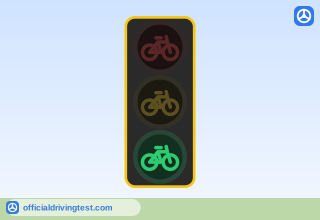
- After slowing down and looking both ways for approaching traffic
- After walking the bicycle across with the pedestrians who are crossing
- After the signal for the cross street has turned yellow
- After a complete stop of at least two minutes, using due caution
Show answer
Correct answer: After a complete stop of at least two minutes, using due caution
A bicycle operator may proceed through a steady red light if the operator comes to a complete stop for at least two minutes and exercises due caution.
Source: Indiana Driver’s Manual (July 2026), page 35 · Open this page in the manual (Manual page 35)
-
What does a signal that displays white rectangular bars control?
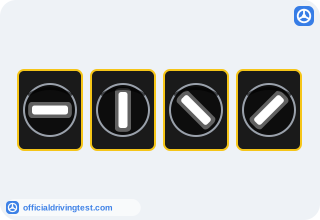
- A bus or transit lane
- A bicycle lane
- A pedestrian crosswalk
- A freeway entrance ramp
Show answer
Correct answer: A bus or transit lane
A signal that displays white rectangular bars controls a bus or transit lane and applies only to bus or transit operators.
Source: Indiana Driver’s Manual (July 2026), page 35 · Open this page in the manual (Manual page 35)
-
Where must you stop when approaching a red light or a stop sign that has a stop line?
- Just past the stop line, in the crosswalk
- In the middle of the crosswalk
- At the solid white stop line
- Wherever you have the best view of cross traffic
Show answer
Correct answer: At the solid white stop line
When approaching a red light or stop sign, you must stop at the solid white stop line.
Source: Indiana Driver’s Manual (July 2026), page 35 · Open this page in the manual (Manual page 35)
-
There is no stop line at a stop sign, but there is a crosswalk. Where should you come to a complete stop?
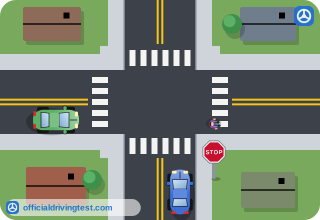
- After entering the crosswalk, at the edge of the intersection
- Before entering the crosswalk on your side of the intersection
- In the middle of the crosswalk, so you can see both ways
- Past the crosswalk, at the start of the cross street lane
Show answer
Correct answer: Before entering the crosswalk on your side of the intersection
With no stop line, you should stop perpendicular to the stop sign or before entering the crosswalk on your side of the intersection.
Source: Indiana Driver’s Manual (July 2026), page 35 · Open this page in the manual (Manual page 35)
-
There is no stop line and no crosswalk at a red light. Where should you come to a complete stop?
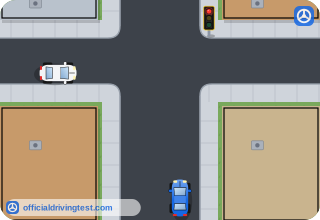
- In the middle of the intersection
- At the far side of the intersection
- Wherever you have the best view of cross traffic
- Before entering the intersection
Show answer
Correct answer: Before entering the intersection
If there is no crosswalk, you should come to a complete stop before entering the intersection.
Source: Indiana Driver’s Manual (July 2026), page 35 · Open this page in the manual (Manual page 35)
-
If a red light fails to change to green, which operator may proceed through it after a complete stop of at least two minutes, using due caution?
- A motorcycle operator
- An autocycle operator
- A school bus driver
- A tractor-trailer driver
Show answer
Correct answer: A motorcycle operator
Motorcycle and motor driven cycle operators may proceed through a steady red light after stopping for at least two minutes and using due caution; the rule does not apply to autocycles.
Source: Indiana Driver’s Manual (July 2026), page 35 · Open this page in the manual (Manual page 35)
-
What should you do when approaching an intersection with a non-operating signal?
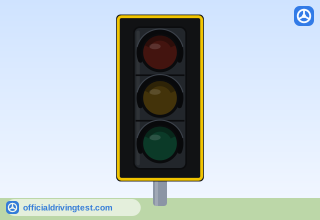
- Slow down and proceed if the way looks clear
- Treat the signal as a yield sign
- Follow the vehicle ahead of you through
- Stop before entering the intersection
Show answer
Correct answer: Stop before entering the intersection
Approaching an intersection with a non-operating signal, you should stop before entering the intersection and proceed with caution only after yielding.
Source: Indiana Driver’s Manual (July 2026), page 35 · Open this page in the manual (Manual page 35)
-
As you approach an intersection with a green light, what should you always be prepared to do?
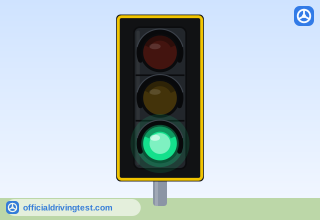
- Stop in case the light changes
- Speed up to clear the intersection
- Sound your horn to warn cross traffic
- Change lanes to the left
Show answer
Correct answer: Stop in case the light changes
The tips say to always be prepared to stop as you approach an intersection with a green light in case the light changes.
Source: Indiana Driver’s Manual (July 2026), page 71 · Open this page in the manual (Manual page 71)