Idaho: Speed and following distance
Idaho speed limits, the basic rule, stopping distances, following distance and driving at night and in bad weather. Split into 3 shorter tests so you're not stuck in one long quiz.
Independent educational site · not affiliated with any government agency or DMV
Choose a part
Speed and following distance — Part 1
Questions in this part include: “Which describes reckless driving under the handbook?”
StartSpeed and following distance — Part 2
Questions in this part include: “Where does the passing speed limit exception, allowing you to exceed the posted limit, not apply?”
StartSpeed and following distance — Part 3
Questions in this part include: “About how far ahead can you see at night when using the high beams of your headlights?”
StartAll 55 Speed and following distance questions with answers
Choose a part above to take a practice test, or study every question and answer here.
Show the questions and answersHide the questions
-
Which describes reckless driving under the handbook?
- Driving more than 5 mph over the speed limit
- Driving with willful disregard for safety
- Driving without having a valid license
- Driving only on a private road or lot
Show answer
Correct answer: Driving with willful disregard for safety
You must not drive recklessly with willful disregard for the safety of people or property on a public road or private property.
Source: Idaho Driver's Handbook (July 2026), page 43 · Open this page in the manual (Manual page 43)
-
According to the School Zone sign description, what has increased penalties?
- Stopping beside the school crossing
- Violating school zone speed limits
- Driving through a school crossing at night
- Turning at a school intersection
Show answer
Correct answer: Violating school zone speed limits
There are increased penalties for violation of school zone speed limits.
Source: Idaho Driver's Handbook (July 2026), page 50 · Open this page in the manual (Manual page 50)
-
What does Idaho's basic rule law require of your driving speed at all times?
- It must be reasonable and prudent
- It must match the speed of the car ahead
- It must stay within 5 mph of the limit
- It must never drop below the posted limit
Show answer
Correct answer: It must be reasonable and prudent
Idaho law has a basic rule requiring you to drive at a speed that is reasonable and prudent at all times.
Source: Idaho Driver's Handbook (July 2026), page 68 · Open this page in the manual (Manual page 68)
-
You drive below the posted speed limit but too slowly for conditions, impeding the safe flow of traffic. What are you doing?
- Driving legally, since you are under the limit
- Breaking the law only on interstate highways
- Violating the basic rule law
- Breaking the law only in school zones
Show answer
Correct answer: Violating the basic rule law
If you drive too slow for existing conditions and impede the safe flow of traffic, you are violating the basic rule law, even if you are under the posted speed limit.
Source: Idaho Driver's Handbook (July 2026), page 68 · Open this page in the manual (Manual page 68)
-
Under the basic rule, you need to think about how your speed affects other traffic. Who does the handbook include in that traffic?
- Only vehicles going your direction
- Pedestrians and bicycle riders too
- Only trucks and buses
- Only vehicles in your own lane
Show answer
Correct answer: Pedestrians and bicycle riders too
Whenever you drive, you need to think about how your speed affects other traffic, including pedestrians and bicycle riders.
Source: Idaho Driver's Handbook (July 2026), page 68 · Open this page in the manual (Manual page 68)
-
What is the maximum speed on Idaho state highways?
- 55 mph, or 60 where posted
- 60 mph, or 65 where posted
- 50 mph, or 55 where posted
- 65 mph, or 70 where posted
Show answer
Correct answer: 65 mph, or 70 where posted
Vehicles shall not exceed 65 miles per hour on state highways, and 70 may be allowed where posted.
Source: Idaho Driver's Handbook (July 2026), page 68 · Open this page in the manual (Manual page 68)
-
Unless otherwise posted, what is the maximum speed in any residential, business, or urban district in Idaho?
- 35 mph
- 25 mph
- 30 mph
- 45 mph
Show answer
Correct answer: 35 mph
The maximum speed in any residential, business, or urban district is 35 miles per hour unless otherwise posted.
Source: Idaho Driver's Handbook (July 2026), page 68 · Open this page in the manual (Manual page 68)
-
Which lane may you not drive in for a period of time that impedes other traffic traveling at a lawful speed?
- The extreme right-hand lane
- The middle lane of three lanes
- The extreme left-hand lane
- Any lane next to a curb
Show answer
Correct answer: The extreme left-hand lane
You may not operate a vehicle in the extreme left-hand lane for a period of time that impedes the flow of other traffic traveling at a lawful rate of speed.
Source: Idaho Driver's Handbook (July 2026), page 69 · Open this page in the manual (Manual page 69)
-
What speed limit must you observe in a school zone?
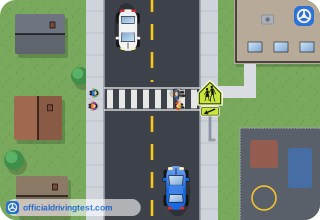
- 20 mph, whether posted or not
- The posted school zone speed limit
- Half of the road's normal limit
- 10 mph below the normal limit
Show answer
Correct answer: The posted school zone speed limit
In school zones, you must observe the posted speed limits.
Source: Idaho Driver's Handbook (July 2026), page 69 · Open this page in the manual (Manual page 69)
-
Where is it illegal to take part in a vehicle race, speed exhibition, or speed contest?
- On any public road, street, or highway
- Only on interstates and state highways
- Only in residential or business districts
- Only in school zones and work zones
Show answer
Correct answer: On any public road, street, or highway
It is illegal to engage in any vehicle race, speed exhibition, or speed contest on any public road, street, or highway.
Source: Idaho Driver's Handbook (July 2026), page 69 · Open this page in the manual (Manual page 69)
-
Your speed determines how much time you have to react and also what else?
- Which lane you must drive in
- How bright your headlights must be
- How often to check your mirrors
- How long it takes you to stop
Show answer
Correct answer: How long it takes you to stop
The speed at which you are traveling determines how much time you have to react and how long it takes you to stop.
Source: Idaho Driver's Handbook (July 2026), page 71 · Open this page in the manual (Manual page 71)
-
According to the handbook's stopping-distance chart, about how far does a car traveling 35 mph need to stop on a dry road?
- Between 60 and 100 feet
- Between 15 and 30 feet
- Between 150 and 200 feet
- Between 250 and 300 feet
Show answer
Correct answer: Between 60 and 100 feet
The chart shows that for a car traveling 35 mph, the thinking and braking distance on a dry road is between 60 and 100 feet.
Source: Idaho Driver's Handbook (July 2026), page 71 · Open this page in the manual (Manual page 71)
-
According to the handbook's stopping-distance chart, how far does a car traveling 35 mph need to stop on a wet road?
- About 40 feet
- About 70 feet
- 120 feet or more
- About 90 feet
Show answer
Correct answer: 120 feet or more
The chart shows that for a car traveling 35 mph, the thinking and braking distance on a wet road is 120 feet or more.
Source: Idaho Driver's Handbook (July 2026), page 71 · Open this page in the manual (Manual page 71)
-
According to the handbook's stopping-distance chart, how far does a car traveling 35 mph need to stop on a packed snow road?
- About 50 feet
- 180 feet or more
- About 90 feet
- About 110 feet
Show answer
Correct answer: 180 feet or more
The chart shows that for a car traveling 35 mph, the thinking and braking distance on a packed snow road is 180 feet or more.
Source: Idaho Driver's Handbook (July 2026), page 71 · Open this page in the manual (Manual page 71)
-
On the handbook's chart for a car traveling 35 mph, which road condition needs a stopping distance of 600 feet or more?
- Wet road
- Dry road
- Packed snow road
- Icy road
Show answer
Correct answer: Icy road
The chart shows the thinking and braking distance increasing as weather worsens, reaching 600 feet or more on an icy road at 35 mph.
Source: Idaho Driver's Handbook (July 2026), page 71 · Open this page in the manual (Manual page 71)
-
When stopping behind another vehicle, how much space is a safe driving habit to leave?
- Enough to see where its rear tires touch the ground
- Enough to just see the bottom of its license plate
- About two feet, so no one can cut in front of you
- At least three full car lengths, on any road
Show answer
Correct answer: Enough to see where its rear tires touch the ground
A safe driving habit is to leave enough distance to see the rear tires (where they touch the ground) of the vehicle in front of you.
Source: Idaho Driver's Handbook (July 2026), page 71 · Open this page in the manual (Manual page 71)
-
Why should you leave room to see the rear tires of the vehicle ahead when you stop behind it?
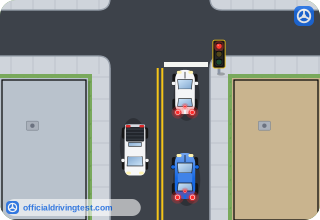
- So its driver can open the trunk safely
- So pedestrians can walk between the two cars safely
- So you can go around it if it stalls, without backing
- So your engine does not overheat in traffic
Show answer
Correct answer: So you can go around it if it stalls, without backing
This space may keep you from hitting the vehicle ahead if someone crashes into your rear, or allow you room to go around a stalled vehicle without backing.
Source: Idaho Driver's Handbook (July 2026), page 71 · Open this page in the manual (Manual page 71)
-
A passenger vehicle that is not towing is passing a vehicle traveling below the posted limit on a two-lane road posted 55 mph or more. By up to how much may it exceed the posted limit?
- 15 miles per hour
- 5 miles per hour
- 10 miles per hour
- 20 miles per hour
Show answer
Correct answer: 15 miles per hour
The passing speed limit exception allows exceeding the posted limit by up to 15 miles per hour while passing.
Source: Idaho Driver's Handbook (July 2026), page 77 · Open this page in the manual (Manual page 77)
-
The passing speed limit exception applies only when the posted speed limit is at least what?
- 35 miles per hour
- 45 miles per hour
- 55 miles per hour
- 50 miles per hour
Show answer
Correct answer: 55 miles per hour
The posted speed limit must be 55 miles per hour or greater for the exception to apply.
Source: Idaho Driver's Handbook (July 2026), page 77 · Open this page in the manual (Manual page 77)
-
Where does the passing speed limit exception, allowing you to exceed the posted limit, not apply?
- On two-lane roadways
- In work zones
- On rural highways
- On roads with a center line
Show answer
Correct answer: In work zones
The passing speed limit exception does not apply in work zones.
Source: Idaho Driver's Handbook (July 2026), page 77 · Open this page in the manual (Manual page 77)
-
After using the passing speed limit exception, what must you do as soon as practicable?
- Stay in the left lane until the next intersection
- Slow to 10 miles per hour below the posted limit
- Pull onto the shoulder and stop
- Return to the right lane and slow to the posted limit
Show answer
Correct answer: Return to the right lane and slow to the posted limit
You must return to the right-hand lane and reduce speed to the posted speed limit as soon as practicable.
Source: Idaho Driver's Handbook (July 2026), page 77 · Open this page in the manual (Manual page 77)
-
What is "tailgating"?
- Driving too fast for conditions
- Driving too close to the car ahead
- Passing too close to a vehicle
- Following without using your signals
Show answer
Correct answer: Driving too close to the car ahead
Tailgating is driving too close to the car ahead and is a common cause of crashes.
Source: Idaho Driver's Handbook (July 2026), page 79 · Open this page in the manual (Manual page 79)
-
When following another car, how much space must you leave?
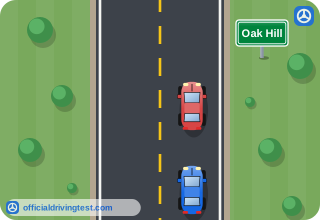
- Two car lengths at any speed
- Only what the car ahead leaves
- Enough space for another vehicle to enter
- Enough space to stop in any situation
Show answer
Correct answer: Enough space to stop in any situation
You must leave yourself enough space to stop in any situation.
Source: Idaho Driver's Handbook (July 2026), page 79 · Open this page in the manual (Manual page 79)
-
When should you especially test your brakes, to know how quickly they will stop you?
- When the road is wet, icy, or snowy
- When the road is dry and smooth
- When driving at night
- In heavy traffic only
Show answer
Correct answer: When the road is wet, icy, or snowy
The manual says to test your brakes often, particularly when the road is wet, icy or snowy.
Source: Idaho Driver's Handbook (July 2026), page 79 · Open this page in the manual (Manual page 79)
-
Which following distance rule is the minimum recommended safest procedure?
- The two-second rule
- The four-second rule
- The three-second rule
- The five-second rule
Show answer
Correct answer: The three-second rule
The three-second following distance rule is the minimum recommended safest procedure.
Source: Idaho Driver's Handbook (July 2026), page 79 · Open this page in the manual (Manual page 79)
-
At high speeds or in bad weather, what should you do with your following distance?
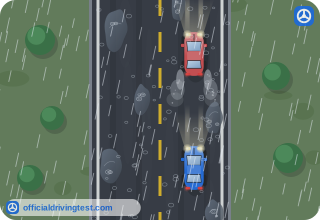
- Keep it at three seconds
- Increase it
- Decrease it
- Keep it the same as in dry weather
Show answer
Correct answer: Increase it
At high speeds or in bad weather you will need to increase your following distance.
Source: Idaho Driver's Handbook (July 2026), page 79 · Open this page in the manual (Manual page 79)
-
In the three-second rule, what do you do as the car ahead passes a fixed object such as a sign or tree?
- Count off two seconds
- Count off five seconds
- Count off six seconds
- Count off three seconds
Show answer
Correct answer: Count off three seconds
You choose a fixed object and, as the car ahead passes it, count off three seconds.
Source: Idaho Driver's Handbook (July 2026), page 79 · Open this page in the manual (Manual page 79)
-
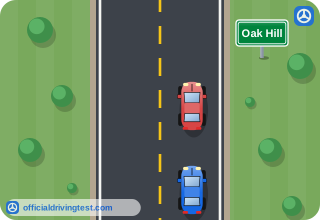
After the car ahead passes a fixed object, how long should it take you to reach that same object to have enough distance for a sudden stop?
- At least three seconds
- At least one second
- At least two seconds
- At least half a second
Show answer
Correct answer: At least three seconds
If it takes at least three seconds before you pass the object, you have enough distance for a sudden stop.
Source: Idaho Driver's Handbook (July 2026), page 80 · Open this page in the manual (Manual page 80)
-
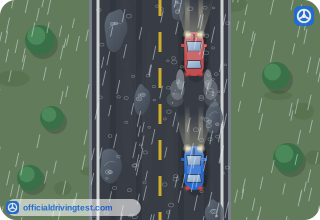
What should you do with the three-second following distance in bad weather?
- Keep it exactly the same as in good weather
- Shorten it because you will be driving more slowly
- Increase it several times for an extra margin of safety
- Use it only on roads with a posted speed limit
Show answer
Correct answer: Increase it several times for an extra margin of safety
In bad weather the three seconds should be increased several times to give an extra margin of safety.
Source: Idaho Driver's Handbook (July 2026), page 80 · Open this page in the manual (Manual page 80)
-
Where should you stay in your lane to help keep a space cushion around your vehicle?
- Close to the right edge of your lane
- In the middle of your lane
- Close to the center line of the road
- Wherever the lane is widest
Show answer
Correct answer: In the middle of your lane
The manual says to stay in the middle of your lane and make sure there is enough room ahead to stop or pass safely.
Source: Idaho Driver's Handbook (July 2026), page 80 · Open this page in the manual (Manual page 80)
-
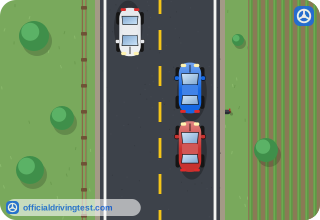
What should you do if a car follows too closely behind you?
- Speed up to keep ahead of it
- Brake hard to warn the driver
- Stay in your lane and keep your speed the same
- Slow down and let it pass
Show answer
Correct answer: Slow down and let it pass
The manual says to slow down and let a car that follows too closely pass.
Source: Idaho Driver's Handbook (July 2026), page 80 · Open this page in the manual (Manual page 80)
-
How far ahead do good drivers keep an eye on what is happening?
- About ten to 15 seconds ahead
- About two to three seconds ahead
- About 30 seconds ahead
- About one second ahead
Show answer
Correct answer: About ten to 15 seconds ahead
Good drivers watch about ten to 15 seconds ahead, which is about a block in city driving.
Source: Idaho Driver's Handbook (July 2026), page 89 · Open this page in the manual (Manual page 89)
-
What does looking ten to 15 seconds ahead help you avoid?
- Checking your mirrors before changing lanes
- Reading the road signs along the way
- Last minute lane changes, turns and stops
- Slowing down for traffic lights ahead
Show answer
Correct answer: Last minute lane changes, turns and stops
By looking ahead you avoid the last minute lane changes, turns and stops that often cause crashes.
Source: Idaho Driver's Handbook (July 2026), page 89 · Open this page in the manual (Manual page 89)
-
How often should you check the traffic behind you?
- Only before changing lanes or turns
- Frequently, several times a minute
- Once every few minutes of driving
- Only when you hear another horn
Show answer
Correct answer: Frequently, several times a minute
The manual says to check traffic behind you frequently (several times a minute).
Source: Idaho Driver's Handbook (July 2026), page 90 · Open this page in the manual (Manual page 90)
-
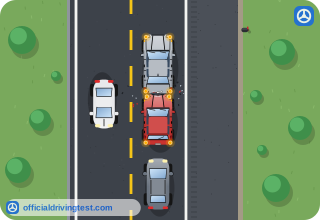
What does the manual say causes most rear-end collisions?
- Vehicles with burned-out brake lights
- Drivers who brake too early
- Vehicles following too closely
- Drivers who check mirrors too often
Show answer
Correct answer: Vehicles following too closely
Most rear-end collisions are caused by vehicles following too closely.
Source: Idaho Driver's Handbook (July 2026), page 90 · Open this page in the manual (Manual page 90)
-
When driving down long hills in the mountains, how should you control your speed?
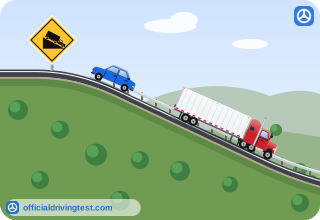
- Shift into neutral
- Use a lower gear
- Disengage the clutch
- Turn off the engine
Show answer
Correct answer: Use a lower gear
The manual says to use a lower gear to control speeds on long hills and never to coast by shifting to neutral or disengaging the clutch.
Source: Idaho Driver's Handbook (July 2026), page 107 · Open this page in the manual (Manual page 107)
-
On a mountain road, where should you position your vehicle?
- Near the center line, for a better view of the curves ahead
- In the middle of your lane, as far as possible from both edges
- Wherever the road surface looks smoothest and driest
- Close to the right edge of the road, away from oncoming traffic
Show answer
Correct answer: Close to the right edge of the road, away from oncoming traffic
The manual says to stay close to the right edge of the road, away from oncoming traffic, when driving in the mountains.
Source: Idaho Driver's Handbook (July 2026), page 107 · Open this page in the manual (Manual page 107)
-
At night, how should you drive so you have time to react to danger?
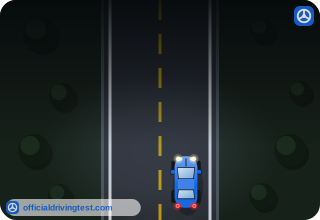
- Slowly enough that you can stop within the distance you can see ahead
- At the posted speed limit, since other drivers expect that speed
- Fast enough to get through the dark hours as quickly as you can
- At the speed of the vehicle ahead of you, whatever its speed is
Show answer
Correct answer: Slowly enough that you can stop within the distance you can see ahead
The manual says to drive slowly enough at night to stop within the distance you can see ahead.
Source: Idaho Driver's Handbook (July 2026), page 108 · Open this page in the manual (Manual page 108)
-
About how far ahead can you see at night when using the high beams of your headlights?
- About 250 feet
- About 600 feet
- About 350 feet
- About 150 feet
Show answer
Correct answer: About 350 feet
The manual says the distance you can see ahead is about 350 feet with high beams and about 100 feet with low beams.
Source: Idaho Driver's Handbook (July 2026), page 109 · Open this page in the manual (Manual page 109)
-
About how far ahead can you see at night when using the low beams of your headlights?
- About 50 feet
- About 100 feet
- About 200 feet
- About 300 feet
Show answer
Correct answer: About 100 feet
The manual says the distance you can see ahead is about 100 feet when using the low beams.
Source: Idaho Driver's Handbook (July 2026), page 109 · Open this page in the manual (Manual page 109)
-
How should your following distance change at night?
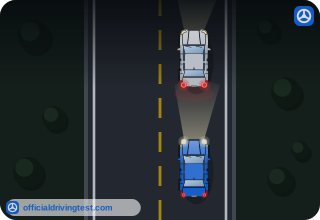
- Keep it the same, because the taillights show the vehicle ahead
- Decrease it so you can stay within the other vehicle's light
- Match it to the width of the lane that you are driving in
- Increase the following distance between your vehicle and the one in front
Show answer
Correct answer: Increase the following distance between your vehicle and the one in front
The manual says to increase the following distance between your vehicle and the one in front of you to make night driving safer.
Source: Idaho Driver's Handbook (July 2026), page 109 · Open this page in the manual (Manual page 109)
-
Which times of the day does the manual call the most dangerous?
- The hours around midnight
- Midday on bright, clear days
- The gray hours of twilight and dawn
- The late-evening hours when traffic is heaviest
Show answer
Correct answer: The gray hours of twilight and dawn
The manual says the gray hours of twilight and dawn are the most dangerous times of the day.
Source: Idaho Driver's Handbook (July 2026), page 109 · Open this page in the manual (Manual page 109)
-
How should you adjust your passing at night?
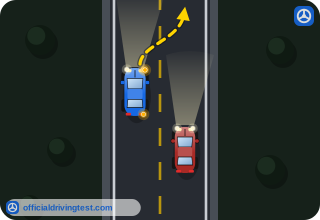
- Allow less distance, because the road is less busy
- Allow more distance and time for passing
- Pass only with your high beams on
- Pass only on the right side of the road
Show answer
Correct answer: Allow more distance and time for passing
The manual says to allow more distance and time for passing at night.
Source: Idaho Driver's Handbook (July 2026), page 109 · Open this page in the manual (Manual page 109)
-
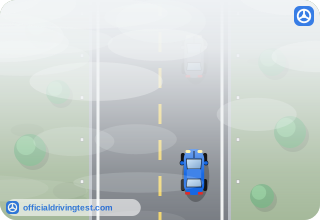
What is the safest thing to do in fog, dust storms or heavy rain?
- Do not drive at all
- Drive at your normal speed using high beams
- Follow closely behind the taillights ahead
- Use cruise control to hold a steady speed
Show answer
Correct answer: Do not drive at all
The handbook says it is safest not to drive in fog, dust storms, or in heavy rain, and to reduce your speed if you must.
Source: Idaho Driver's Handbook (July 2026), page 110 · Open this page in the manual (Manual page 110)
-
In which condition should you not use cruise control?
- When the road is dry and the traffic is light
- When you drive during daylight hours
- When the road is wet and/or icy
- When you drive downhill on dry pavement
Show answer
Correct answer: When the road is wet and/or icy
For safety reasons, you should not use cruise control if the road is wet and/or icy.
Source: Idaho Driver's Handbook (July 2026), page 110 · Open this page in the manual (Manual page 110)
-
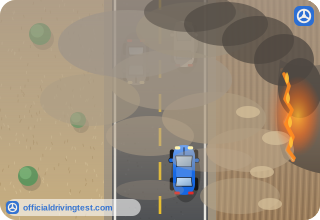
In fog, smoke, dust or rain, why should you slow down more when you see red taillights ahead?
- The driver ahead is sure to be turning
- The vehicle may be stopped or creeping along
- The driver ahead is signaling you to pass
- The taillights show the road ahead is dry
Show answer
Correct answer: The vehicle may be stopped or creeping along
Red taillights ahead may belong to a vehicle that is stopped or creeping along.
Source: Idaho Driver's Handbook (July 2026), page 110 · Open this page in the manual (Manual page 110)
-
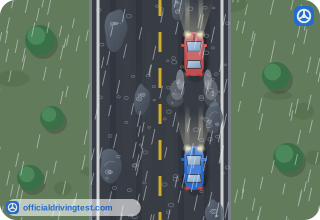
How do wet roads compare with icy roads, according to the handbook?
- Wet roads are always much safer than icy roads
- Wet roads can be as dangerous as icy roads
- Wet roads are dangerous only after dark
- Wet roads are dangerous only above 55 miles per hour
Show answer
Correct answer: Wet roads can be as dangerous as icy roads
The handbook states that wet roads can be as dangerous as icy roads, so you should always reduce your speed in wet weather.
Source: Idaho Driver's Handbook (July 2026), page 111 · Open this page in the manual (Manual page 111)
-
When are roads more dangerous than usual in a rainstorm?
- After several hours of heavy rain, when puddles stand on the road
- Just after the rain stops and the road begins to dry
- At the start of a light rain, when oil and water form a greasy film
- Only when the rain turns to sleet
Show answer
Correct answer: At the start of a light rain, when oil and water form a greasy film
Roads are more dangerous at the start of a light rain because road oil and water mix to form a greasy film.
Source: Idaho Driver's Handbook (July 2026), page 111 · Open this page in the manual (Manual page 111)
-
Up to what speed do most tires grip a wet road surface?
- 35 miles per hour
- 25 miles per hour
- 45 miles per hour
- 65 miles per hour
Show answer
Correct answer: 35 miles per hour
At speeds up to 35 miles per hour, most tires grip the road surface even when it is wet.
Source: Idaho Driver's Handbook (July 2026), page 111 · Open this page in the manual (Manual page 111)
-
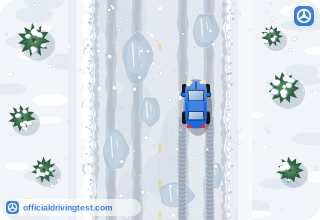
What are the keys to safety on slippery roads?
- Slower speeds, gentler stops and turns, and longer following distances
- Higher speeds, harder braking, and shorter following distances
- Steady speeds, sharper turns, and normal following distances
- Slower speeds, quicker stops, and shorter following distances
Show answer
Correct answer: Slower speeds, gentler stops and turns, and longer following distances
The handbook names slower speeds, gentler stops and turns, and longer following distances as the keys to safety on slippery roads.
Source: Idaho Driver's Handbook (July 2026), page 113 · Open this page in the manual (Manual page 113)
-
How can you avoid spinning your tires when starting out on a slippery road?
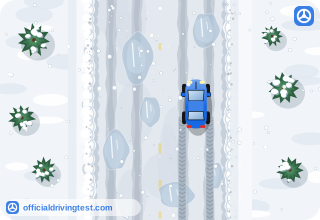
- Press the gas pedal hard so the tires bite
- Raise the engine speed before you release the brake
- Start out in the highest gear available
- Gently press the gas pedal until the car starts to roll
Show answer
Correct answer: Gently press the gas pedal until the car starts to roll
The handbook says to avoid spinning your tires by gently pressing your gas pedal until the car starts to roll.
Source: Idaho Driver's Handbook (July 2026), page 113 · Open this page in the manual (Manual page 113)
-
On slick roads, you should start slowing your car down at least how many times sooner than normal when turning or stopping?
- Two times sooner
- Three times sooner
- Four times sooner
- Five times sooner
Show answer
Correct answer: Three times sooner
The handbook says to start slowing at least three times sooner than you normally do when turning or stopping.
Source: Idaho Driver's Handbook (July 2026), page 113 · Open this page in the manual (Manual page 113)
-
How should you stop on a slick road in a vehicle without anti-lock brakes?
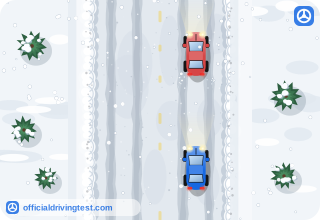
- Press the brake pedal as hard as you can and hold it
- Turn the wheel sharply while you brake
- Avoid sudden steering movements and pump the brake gently
- Shift to neutral and coast to a stop
Show answer
Correct answer: Avoid sudden steering movements and pump the brake gently
The handbook says to avoid sudden movements of the steering wheel and pump the brake gently; anti-lock brakes allow steady pressure.
Source: Idaho Driver's Handbook (July 2026), page 113 · Open this page in the manual (Manual page 113)
-
What does the handbook say to use on very slippery roads?
- Tire chains
- Cruise control
- High beams
- Emergency flashers
Show answer
Correct answer: Tire chains
The handbook says to use tire chains on very slippery roads.
Source: Idaho Driver's Handbook (July 2026), page 113 · Open this page in the manual (Manual page 113)
-
Why may ice form sooner and stay longer on bridges and overpasses?
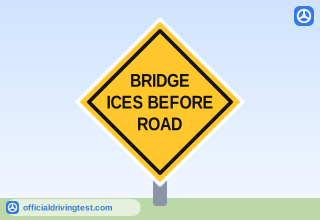
- Their undersides are exposed and they lack ground warmth
- Salt is never spread on bridges
- They get less sunlight because of the guardrails
- They are made of material that never warms up
Show answer
Correct answer: Their undersides are exposed and they lack ground warmth
Bridges and overpasses are exposed on their undersides and deprived of ground warmth, so ice forms sooner and remains longer.
Source: Idaho Driver's Handbook (July 2026), page 113 · Open this page in the manual (Manual page 113)