Idaho: Speed and following distance — Part 1 Practice Test
Questions in this part include: “Which describes reckless driving under the handbook?” · “Where is it illegal to take part in a vehicle race, speed exhibition, or speed contest?”
Independent educational site · not affiliated with any government agency or DMV
Ready? Test yourself
- Instant feedback with an explanation
- Every answer cites its source in the manual
- Your best score is saved on this device
Questions are original and based on the official manual "Idaho Driver's Handbook" (July 2026), Idaho Transportation Department.
All 19 questions in this practice test
Take the test above first, then use this list to study. Tap “Show answer” to see the correct answer and explanation.
Show the questions and answersHide the questions
-
Which describes reckless driving under the handbook?
- Driving more than 5 mph over the speed limit
- Driving with willful disregard for safety
- Driving without having a valid license
- Driving only on a private road or lot
Show answer
Correct answer: Driving with willful disregard for safety
You must not drive recklessly with willful disregard for the safety of people or property on a public road or private property.
Source: Idaho Driver's Handbook (July 2026), page 43 · Open this page in the manual (Manual page 43)
-
According to the School Zone sign description, what has increased penalties?
- Stopping beside the school crossing
- Violating school zone speed limits
- Driving through a school crossing at night
- Turning at a school intersection
Show answer
Correct answer: Violating school zone speed limits
There are increased penalties for violation of school zone speed limits.
Source: Idaho Driver's Handbook (July 2026), page 50 · Open this page in the manual (Manual page 50)
-
What does Idaho's basic rule law require of your driving speed at all times?
- It must be reasonable and prudent
- It must match the speed of the car ahead
- It must stay within 5 mph of the limit
- It must never drop below the posted limit
Show answer
Correct answer: It must be reasonable and prudent
Idaho law has a basic rule requiring you to drive at a speed that is reasonable and prudent at all times.
Source: Idaho Driver's Handbook (July 2026), page 68 · Open this page in the manual (Manual page 68)
-
You drive below the posted speed limit but too slowly for conditions, impeding the safe flow of traffic. What are you doing?
- Driving legally, since you are under the limit
- Breaking the law only on interstate highways
- Violating the basic rule law
- Breaking the law only in school zones
Show answer
Correct answer: Violating the basic rule law
If you drive too slow for existing conditions and impede the safe flow of traffic, you are violating the basic rule law, even if you are under the posted speed limit.
Source: Idaho Driver's Handbook (July 2026), page 68 · Open this page in the manual (Manual page 68)
-
Under the basic rule, you need to think about how your speed affects other traffic. Who does the handbook include in that traffic?
- Only vehicles going your direction
- Pedestrians and bicycle riders too
- Only trucks and buses
- Only vehicles in your own lane
Show answer
Correct answer: Pedestrians and bicycle riders too
Whenever you drive, you need to think about how your speed affects other traffic, including pedestrians and bicycle riders.
Source: Idaho Driver's Handbook (July 2026), page 68 · Open this page in the manual (Manual page 68)
-
What is the maximum speed on Idaho state highways?
- 55 mph, or 60 where posted
- 60 mph, or 65 where posted
- 50 mph, or 55 where posted
- 65 mph, or 70 where posted
Show answer
Correct answer: 65 mph, or 70 where posted
Vehicles shall not exceed 65 miles per hour on state highways, and 70 may be allowed where posted.
Source: Idaho Driver's Handbook (July 2026), page 68 · Open this page in the manual (Manual page 68)
-
Unless otherwise posted, what is the maximum speed in any residential, business, or urban district in Idaho?
- 35 mph
- 25 mph
- 30 mph
- 45 mph
Show answer
Correct answer: 35 mph
The maximum speed in any residential, business, or urban district is 35 miles per hour unless otherwise posted.
Source: Idaho Driver's Handbook (July 2026), page 68 · Open this page in the manual (Manual page 68)
-
Which lane may you not drive in for a period of time that impedes other traffic traveling at a lawful speed?
- The extreme right-hand lane
- The middle lane of three lanes
- The extreme left-hand lane
- Any lane next to a curb
Show answer
Correct answer: The extreme left-hand lane
You may not operate a vehicle in the extreme left-hand lane for a period of time that impedes the flow of other traffic traveling at a lawful rate of speed.
Source: Idaho Driver's Handbook (July 2026), page 69 · Open this page in the manual (Manual page 69)
-
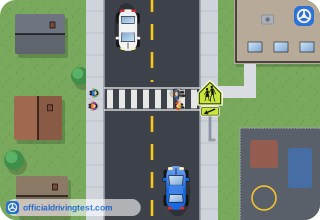
What speed limit must you observe in a school zone?
- 20 mph, whether posted or not
- The posted school zone speed limit
- Half of the road's normal limit
- 10 mph below the normal limit
Show answer
Correct answer: The posted school zone speed limit
In school zones, you must observe the posted speed limits.
Source: Idaho Driver's Handbook (July 2026), page 69 · Open this page in the manual (Manual page 69)
-
Where is it illegal to take part in a vehicle race, speed exhibition, or speed contest?
- On any public road, street, or highway
- Only on interstates and state highways
- Only in residential or business districts
- Only in school zones and work zones
Show answer
Correct answer: On any public road, street, or highway
It is illegal to engage in any vehicle race, speed exhibition, or speed contest on any public road, street, or highway.
Source: Idaho Driver's Handbook (July 2026), page 69 · Open this page in the manual (Manual page 69)
-
Your speed determines how much time you have to react and also what else?
- Which lane you must drive in
- How bright your headlights must be
- How often to check your mirrors
- How long it takes you to stop
Show answer
Correct answer: How long it takes you to stop
The speed at which you are traveling determines how much time you have to react and how long it takes you to stop.
Source: Idaho Driver's Handbook (July 2026), page 71 · Open this page in the manual (Manual page 71)
-
According to the handbook's stopping-distance chart, about how far does a car traveling 35 mph need to stop on a dry road?
- Between 60 and 100 feet
- Between 15 and 30 feet
- Between 150 and 200 feet
- Between 250 and 300 feet
Show answer
Correct answer: Between 60 and 100 feet
The chart shows that for a car traveling 35 mph, the thinking and braking distance on a dry road is between 60 and 100 feet.
Source: Idaho Driver's Handbook (July 2026), page 71 · Open this page in the manual (Manual page 71)
-
According to the handbook's stopping-distance chart, how far does a car traveling 35 mph need to stop on a wet road?
- About 40 feet
- About 70 feet
- 120 feet or more
- About 90 feet
Show answer
Correct answer: 120 feet or more
The chart shows that for a car traveling 35 mph, the thinking and braking distance on a wet road is 120 feet or more.
Source: Idaho Driver's Handbook (July 2026), page 71 · Open this page in the manual (Manual page 71)
-
According to the handbook's stopping-distance chart, how far does a car traveling 35 mph need to stop on a packed snow road?
- About 50 feet
- 180 feet or more
- About 90 feet
- About 110 feet
Show answer
Correct answer: 180 feet or more
The chart shows that for a car traveling 35 mph, the thinking and braking distance on a packed snow road is 180 feet or more.
Source: Idaho Driver's Handbook (July 2026), page 71 · Open this page in the manual (Manual page 71)
-
On the handbook's chart for a car traveling 35 mph, which road condition needs a stopping distance of 600 feet or more?
- Wet road
- Dry road
- Packed snow road
- Icy road
Show answer
Correct answer: Icy road
The chart shows the thinking and braking distance increasing as weather worsens, reaching 600 feet or more on an icy road at 35 mph.
Source: Idaho Driver's Handbook (July 2026), page 71 · Open this page in the manual (Manual page 71)
-
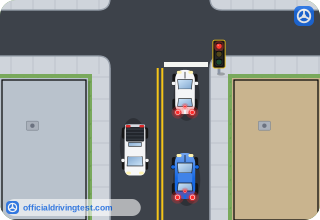
When stopping behind another vehicle, how much space is a safe driving habit to leave?
- Enough to see where its rear tires touch the ground
- Enough to just see the bottom of its license plate
- About two feet, so no one can cut in front of you
- At least three full car lengths, on any road
Show answer
Correct answer: Enough to see where its rear tires touch the ground
A safe driving habit is to leave enough distance to see the rear tires (where they touch the ground) of the vehicle in front of you.
Source: Idaho Driver's Handbook (July 2026), page 71 · Open this page in the manual (Manual page 71)
-
Why should you leave room to see the rear tires of the vehicle ahead when you stop behind it?
- So its driver can open the trunk safely
- So pedestrians can walk between the two cars safely
- So you can go around it if it stalls, without backing
- So your engine does not overheat in traffic
Show answer
Correct answer: So you can go around it if it stalls, without backing
This space may keep you from hitting the vehicle ahead if someone crashes into your rear, or allow you room to go around a stalled vehicle without backing.
Source: Idaho Driver's Handbook (July 2026), page 71 · Open this page in the manual (Manual page 71)
-
A passenger vehicle that is not towing is passing a vehicle traveling below the posted limit on a two-lane road posted 55 mph or more. By up to how much may it exceed the posted limit?
- 15 miles per hour
- 5 miles per hour
- 10 miles per hour
- 20 miles per hour
Show answer
Correct answer: 15 miles per hour
The passing speed limit exception allows exceeding the posted limit by up to 15 miles per hour while passing.
Source: Idaho Driver's Handbook (July 2026), page 77 · Open this page in the manual (Manual page 77)
-
The passing speed limit exception applies only when the posted speed limit is at least what?
- 35 miles per hour
- 45 miles per hour
- 55 miles per hour
- 50 miles per hour
Show answer
Correct answer: 55 miles per hour
The posted speed limit must be 55 miles per hour or greater for the exception to apply.
Source: Idaho Driver's Handbook (July 2026), page 77 · Open this page in the manual (Manual page 77)