Idaho: Speed and following distance — Part 2 Practice Test
Questions in this part include: “Where does the passing speed limit exception, allowing you to exceed the posted limit, not apply?” · “In the three-second rule, what do you do as the car ahead passes a fixed object such as a sign or tree?”
Independent educational site · not affiliated with any government agency or DMV
Ready? Test yourself
- Instant feedback with an explanation
- Every answer cites its source in the manual
- Your best score is saved on this device
Questions are original and based on the official manual "Idaho Driver's Handbook" (July 2026), Idaho Transportation Department.
All 18 questions in this practice test
Take the test above first, then use this list to study. Tap “Show answer” to see the correct answer and explanation.
Show the questions and answersHide the questions
-
Where does the passing speed limit exception, allowing you to exceed the posted limit, not apply?
- On two-lane roadways
- In work zones
- On rural highways
- On roads with a center line
Show answer
Correct answer: In work zones
The passing speed limit exception does not apply in work zones.
Source: Idaho Driver's Handbook (July 2026), page 77 · Open this page in the manual (Manual page 77)
-
After using the passing speed limit exception, what must you do as soon as practicable?
- Stay in the left lane until the next intersection
- Slow to 10 miles per hour below the posted limit
- Pull onto the shoulder and stop
- Return to the right lane and slow to the posted limit
Show answer
Correct answer: Return to the right lane and slow to the posted limit
You must return to the right-hand lane and reduce speed to the posted speed limit as soon as practicable.
Source: Idaho Driver's Handbook (July 2026), page 77 · Open this page in the manual (Manual page 77)
-
What is "tailgating"?
- Driving too fast for conditions
- Driving too close to the car ahead
- Passing too close to a vehicle
- Following without using your signals
Show answer
Correct answer: Driving too close to the car ahead
Tailgating is driving too close to the car ahead and is a common cause of crashes.
Source: Idaho Driver's Handbook (July 2026), page 79 · Open this page in the manual (Manual page 79)
-
When following another car, how much space must you leave?
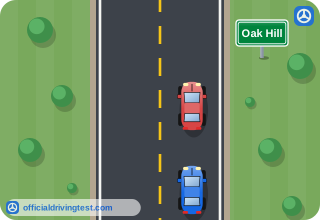
- Two car lengths at any speed
- Only what the car ahead leaves
- Enough space for another vehicle to enter
- Enough space to stop in any situation
Show answer
Correct answer: Enough space to stop in any situation
You must leave yourself enough space to stop in any situation.
Source: Idaho Driver's Handbook (July 2026), page 79 · Open this page in the manual (Manual page 79)
-
When should you especially test your brakes, to know how quickly they will stop you?
- When the road is wet, icy, or snowy
- When the road is dry and smooth
- When driving at night
- In heavy traffic only
Show answer
Correct answer: When the road is wet, icy, or snowy
The manual says to test your brakes often, particularly when the road is wet, icy or snowy.
Source: Idaho Driver's Handbook (July 2026), page 79 · Open this page in the manual (Manual page 79)
-
Which following distance rule is the minimum recommended safest procedure?
- The two-second rule
- The four-second rule
- The three-second rule
- The five-second rule
Show answer
Correct answer: The three-second rule
The three-second following distance rule is the minimum recommended safest procedure.
Source: Idaho Driver's Handbook (July 2026), page 79 · Open this page in the manual (Manual page 79)
-
At high speeds or in bad weather, what should you do with your following distance?
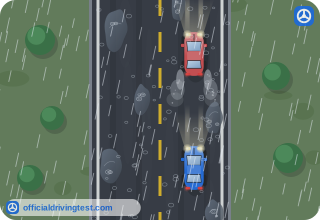
- Keep it at three seconds
- Increase it
- Decrease it
- Keep it the same as in dry weather
Show answer
Correct answer: Increase it
At high speeds or in bad weather you will need to increase your following distance.
Source: Idaho Driver's Handbook (July 2026), page 79 · Open this page in the manual (Manual page 79)
-
In the three-second rule, what do you do as the car ahead passes a fixed object such as a sign or tree?
- Count off two seconds
- Count off five seconds
- Count off six seconds
- Count off three seconds
Show answer
Correct answer: Count off three seconds
You choose a fixed object and, as the car ahead passes it, count off three seconds.
Source: Idaho Driver's Handbook (July 2026), page 79 · Open this page in the manual (Manual page 79)
-
After the car ahead passes a fixed object, how long should it take you to reach that same object to have enough distance for a sudden stop?
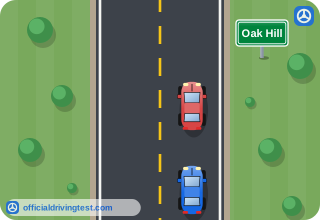
- At least three seconds
- At least one second
- At least two seconds
- At least half a second
Show answer
Correct answer: At least three seconds
If it takes at least three seconds before you pass the object, you have enough distance for a sudden stop.
Source: Idaho Driver's Handbook (July 2026), page 80 · Open this page in the manual (Manual page 80)
-
What should you do with the three-second following distance in bad weather?
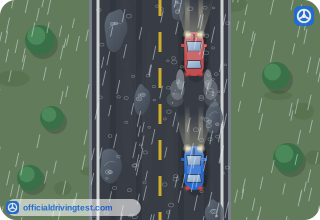
- Keep it exactly the same as in good weather
- Shorten it because you will be driving more slowly
- Increase it several times for an extra margin of safety
- Use it only on roads with a posted speed limit
Show answer
Correct answer: Increase it several times for an extra margin of safety
In bad weather the three seconds should be increased several times to give an extra margin of safety.
Source: Idaho Driver's Handbook (July 2026), page 80 · Open this page in the manual (Manual page 80)
-
Where should you stay in your lane to help keep a space cushion around your vehicle?
- Close to the right edge of your lane
- In the middle of your lane
- Close to the center line of the road
- Wherever the lane is widest
Show answer
Correct answer: In the middle of your lane
The manual says to stay in the middle of your lane and make sure there is enough room ahead to stop or pass safely.
Source: Idaho Driver's Handbook (July 2026), page 80 · Open this page in the manual (Manual page 80)
-
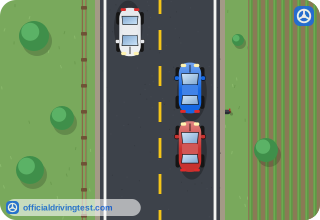
What should you do if a car follows too closely behind you?
- Speed up to keep ahead of it
- Brake hard to warn the driver
- Stay in your lane and keep your speed the same
- Slow down and let it pass
Show answer
Correct answer: Slow down and let it pass
The manual says to slow down and let a car that follows too closely pass.
Source: Idaho Driver's Handbook (July 2026), page 80 · Open this page in the manual (Manual page 80)
-
How far ahead do good drivers keep an eye on what is happening?
- About ten to 15 seconds ahead
- About two to three seconds ahead
- About 30 seconds ahead
- About one second ahead
Show answer
Correct answer: About ten to 15 seconds ahead
Good drivers watch about ten to 15 seconds ahead, which is about a block in city driving.
Source: Idaho Driver's Handbook (July 2026), page 89 · Open this page in the manual (Manual page 89)
-
What does looking ten to 15 seconds ahead help you avoid?
- Checking your mirrors before changing lanes
- Reading the road signs along the way
- Last minute lane changes, turns and stops
- Slowing down for traffic lights ahead
Show answer
Correct answer: Last minute lane changes, turns and stops
By looking ahead you avoid the last minute lane changes, turns and stops that often cause crashes.
Source: Idaho Driver's Handbook (July 2026), page 89 · Open this page in the manual (Manual page 89)
-
How often should you check the traffic behind you?
- Only before changing lanes or turns
- Frequently, several times a minute
- Once every few minutes of driving
- Only when you hear another horn
Show answer
Correct answer: Frequently, several times a minute
The manual says to check traffic behind you frequently (several times a minute).
Source: Idaho Driver's Handbook (July 2026), page 90 · Open this page in the manual (Manual page 90)
-
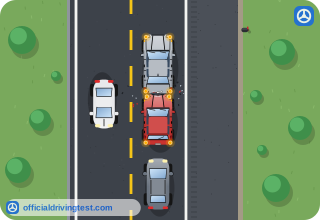
What does the manual say causes most rear-end collisions?
- Vehicles with burned-out brake lights
- Drivers who brake too early
- Vehicles following too closely
- Drivers who check mirrors too often
Show answer
Correct answer: Vehicles following too closely
Most rear-end collisions are caused by vehicles following too closely.
Source: Idaho Driver's Handbook (July 2026), page 90 · Open this page in the manual (Manual page 90)
-
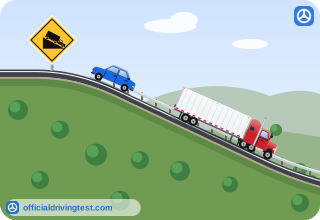
When driving down long hills in the mountains, how should you control your speed?
- Shift into neutral
- Use a lower gear
- Disengage the clutch
- Turn off the engine
Show answer
Correct answer: Use a lower gear
The manual says to use a lower gear to control speeds on long hills and never to coast by shifting to neutral or disengaging the clutch.
Source: Idaho Driver's Handbook (July 2026), page 107 · Open this page in the manual (Manual page 107)
-
On a mountain road, where should you position your vehicle?
- Near the center line, for a better view of the curves ahead
- In the middle of your lane, as far as possible from both edges
- Wherever the road surface looks smoothest and driest
- Close to the right edge of the road, away from oncoming traffic
Show answer
Correct answer: Close to the right edge of the road, away from oncoming traffic
The manual says to stay close to the right edge of the road, away from oncoming traffic, when driving in the mountains.
Source: Idaho Driver's Handbook (July 2026), page 107 · Open this page in the manual (Manual page 107)