Idaho: Speed and following distance — Part 3 Practice Test
Questions in this part include: “About how far ahead can you see at night when using the high beams of your headlights?” · “In which condition should you not use cruise control?”
Independent educational site · not affiliated with any government agency or DMV
Ready? Test yourself
- Instant feedback with an explanation
- Every answer cites its source in the manual
- Your best score is saved on this device
Questions are original and based on the official manual "Idaho Driver's Handbook" (July 2026), Idaho Transportation Department.
All 18 questions in this practice test
Take the test above first, then use this list to study. Tap “Show answer” to see the correct answer and explanation.
Show the questions and answersHide the questions
-
At night, how should you drive so you have time to react to danger?
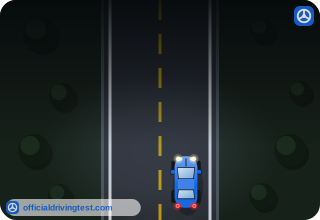
- Slowly enough that you can stop within the distance you can see ahead
- At the posted speed limit, since other drivers expect that speed
- Fast enough to get through the dark hours as quickly as you can
- At the speed of the vehicle ahead of you, whatever its speed is
Show answer
Correct answer: Slowly enough that you can stop within the distance you can see ahead
The manual says to drive slowly enough at night to stop within the distance you can see ahead.
Source: Idaho Driver's Handbook (July 2026), page 108 · Open this page in the manual (Manual page 108)
-
About how far ahead can you see at night when using the high beams of your headlights?
- About 250 feet
- About 600 feet
- About 350 feet
- About 150 feet
Show answer
Correct answer: About 350 feet
The manual says the distance you can see ahead is about 350 feet with high beams and about 100 feet with low beams.
Source: Idaho Driver's Handbook (July 2026), page 109 · Open this page in the manual (Manual page 109)
-
About how far ahead can you see at night when using the low beams of your headlights?
- About 50 feet
- About 100 feet
- About 200 feet
- About 300 feet
Show answer
Correct answer: About 100 feet
The manual says the distance you can see ahead is about 100 feet when using the low beams.
Source: Idaho Driver's Handbook (July 2026), page 109 · Open this page in the manual (Manual page 109)
-
How should your following distance change at night?
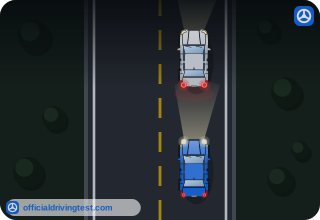
- Keep it the same, because the taillights show the vehicle ahead
- Decrease it so you can stay within the other vehicle's light
- Match it to the width of the lane that you are driving in
- Increase the following distance between your vehicle and the one in front
Show answer
Correct answer: Increase the following distance between your vehicle and the one in front
The manual says to increase the following distance between your vehicle and the one in front of you to make night driving safer.
Source: Idaho Driver's Handbook (July 2026), page 109 · Open this page in the manual (Manual page 109)
-
Which times of the day does the manual call the most dangerous?
- The hours around midnight
- Midday on bright, clear days
- The gray hours of twilight and dawn
- The late-evening hours when traffic is heaviest
Show answer
Correct answer: The gray hours of twilight and dawn
The manual says the gray hours of twilight and dawn are the most dangerous times of the day.
Source: Idaho Driver's Handbook (July 2026), page 109 · Open this page in the manual (Manual page 109)
-
How should you adjust your passing at night?
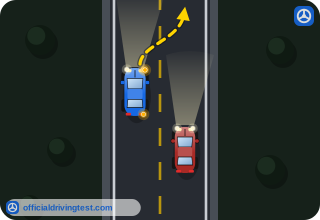
- Allow less distance, because the road is less busy
- Allow more distance and time for passing
- Pass only with your high beams on
- Pass only on the right side of the road
Show answer
Correct answer: Allow more distance and time for passing
The manual says to allow more distance and time for passing at night.
Source: Idaho Driver's Handbook (July 2026), page 109 · Open this page in the manual (Manual page 109)
-
What is the safest thing to do in fog, dust storms or heavy rain?
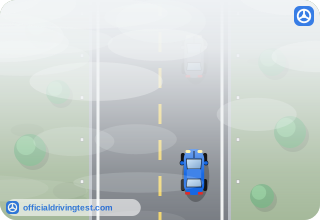
- Do not drive at all
- Drive at your normal speed using high beams
- Follow closely behind the taillights ahead
- Use cruise control to hold a steady speed
Show answer
Correct answer: Do not drive at all
The handbook says it is safest not to drive in fog, dust storms, or in heavy rain, and to reduce your speed if you must.
Source: Idaho Driver's Handbook (July 2026), page 110 · Open this page in the manual (Manual page 110)
-
In which condition should you not use cruise control?
- When the road is dry and the traffic is light
- When you drive during daylight hours
- When the road is wet and/or icy
- When you drive downhill on dry pavement
Show answer
Correct answer: When the road is wet and/or icy
For safety reasons, you should not use cruise control if the road is wet and/or icy.
Source: Idaho Driver's Handbook (July 2026), page 110 · Open this page in the manual (Manual page 110)
-
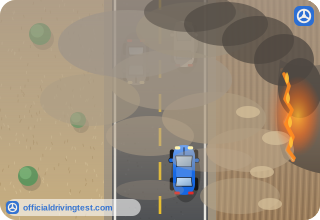
In fog, smoke, dust or rain, why should you slow down more when you see red taillights ahead?
- The driver ahead is sure to be turning
- The vehicle may be stopped or creeping along
- The driver ahead is signaling you to pass
- The taillights show the road ahead is dry
Show answer
Correct answer: The vehicle may be stopped or creeping along
Red taillights ahead may belong to a vehicle that is stopped or creeping along.
Source: Idaho Driver's Handbook (July 2026), page 110 · Open this page in the manual (Manual page 110)
-
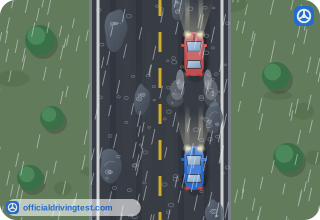
How do wet roads compare with icy roads, according to the handbook?
- Wet roads are always much safer than icy roads
- Wet roads can be as dangerous as icy roads
- Wet roads are dangerous only after dark
- Wet roads are dangerous only above 55 miles per hour
Show answer
Correct answer: Wet roads can be as dangerous as icy roads
The handbook states that wet roads can be as dangerous as icy roads, so you should always reduce your speed in wet weather.
Source: Idaho Driver's Handbook (July 2026), page 111 · Open this page in the manual (Manual page 111)
-
When are roads more dangerous than usual in a rainstorm?
- After several hours of heavy rain, when puddles stand on the road
- Just after the rain stops and the road begins to dry
- At the start of a light rain, when oil and water form a greasy film
- Only when the rain turns to sleet
Show answer
Correct answer: At the start of a light rain, when oil and water form a greasy film
Roads are more dangerous at the start of a light rain because road oil and water mix to form a greasy film.
Source: Idaho Driver's Handbook (July 2026), page 111 · Open this page in the manual (Manual page 111)
-
Up to what speed do most tires grip a wet road surface?
- 35 miles per hour
- 25 miles per hour
- 45 miles per hour
- 65 miles per hour
Show answer
Correct answer: 35 miles per hour
At speeds up to 35 miles per hour, most tires grip the road surface even when it is wet.
Source: Idaho Driver's Handbook (July 2026), page 111 · Open this page in the manual (Manual page 111)
-
What are the keys to safety on slippery roads?
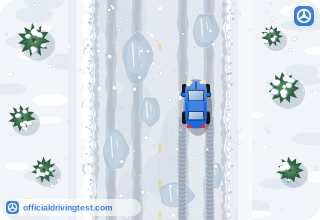
- Slower speeds, gentler stops and turns, and longer following distances
- Higher speeds, harder braking, and shorter following distances
- Steady speeds, sharper turns, and normal following distances
- Slower speeds, quicker stops, and shorter following distances
Show answer
Correct answer: Slower speeds, gentler stops and turns, and longer following distances
The handbook names slower speeds, gentler stops and turns, and longer following distances as the keys to safety on slippery roads.
Source: Idaho Driver's Handbook (July 2026), page 113 · Open this page in the manual (Manual page 113)
-
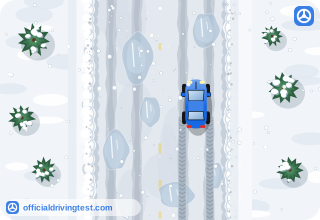
How can you avoid spinning your tires when starting out on a slippery road?
- Press the gas pedal hard so the tires bite
- Raise the engine speed before you release the brake
- Start out in the highest gear available
- Gently press the gas pedal until the car starts to roll
Show answer
Correct answer: Gently press the gas pedal until the car starts to roll
The handbook says to avoid spinning your tires by gently pressing your gas pedal until the car starts to roll.
Source: Idaho Driver's Handbook (July 2026), page 113 · Open this page in the manual (Manual page 113)
-
On slick roads, you should start slowing your car down at least how many times sooner than normal when turning or stopping?
- Two times sooner
- Three times sooner
- Four times sooner
- Five times sooner
Show answer
Correct answer: Three times sooner
The handbook says to start slowing at least three times sooner than you normally do when turning or stopping.
Source: Idaho Driver's Handbook (July 2026), page 113 · Open this page in the manual (Manual page 113)
-
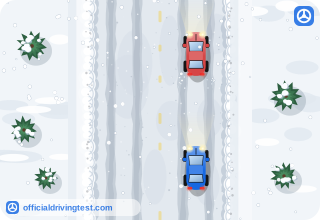
How should you stop on a slick road in a vehicle without anti-lock brakes?
- Press the brake pedal as hard as you can and hold it
- Turn the wheel sharply while you brake
- Avoid sudden steering movements and pump the brake gently
- Shift to neutral and coast to a stop
Show answer
Correct answer: Avoid sudden steering movements and pump the brake gently
The handbook says to avoid sudden movements of the steering wheel and pump the brake gently; anti-lock brakes allow steady pressure.
Source: Idaho Driver's Handbook (July 2026), page 113 · Open this page in the manual (Manual page 113)
-
What does the handbook say to use on very slippery roads?
- Tire chains
- Cruise control
- High beams
- Emergency flashers
Show answer
Correct answer: Tire chains
The handbook says to use tire chains on very slippery roads.
Source: Idaho Driver's Handbook (July 2026), page 113 · Open this page in the manual (Manual page 113)
-
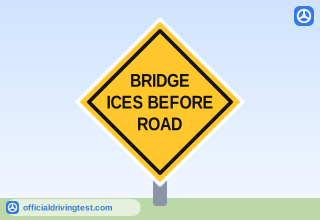
Why may ice form sooner and stay longer on bridges and overpasses?
- Their undersides are exposed and they lack ground warmth
- Salt is never spread on bridges
- They get less sunlight because of the guardrails
- They are made of material that never warms up
Show answer
Correct answer: Their undersides are exposed and they lack ground warmth
Bridges and overpasses are exposed on their undersides and deprived of ground warmth, so ice forms sooner and remains longer.
Source: Idaho Driver's Handbook (July 2026), page 113 · Open this page in the manual (Manual page 113)