Idaho: Right-of-way and turning
Who yields at intersections, turns, U-turns, roundabouts, special interchanges, passing and funeral processions. Split into 3 shorter tests so you're not stuck in one long quiz.
Independent educational site · not affiliated with any government agency or DMV
Choose a part
Right-of-way and turning — Part 1
Questions in this part include: “What is the most common sign seen when approaching a roundabout?”
StartRight-of-way and turning — Part 2
Questions in this part include: “U-turns are not legal where which signs are posted?”
StartRight-of-way and turning — Part 3
Questions in this part include: “How does the manual describe the right-of-way?”
StartAll 48 Right-of-way and turning questions with answers
Choose a part above to take a practice test, or study every question and answer here.
Show the questions and answersHide the questions
-
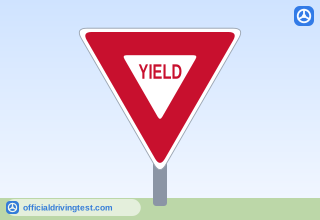
What must you do when you approach a yield sign?
- Stop completely every time, then proceed when the way is clear
- Slow down and yield to other vehicles and pedestrians, stopping if necessary
- Keep your speed and let other vehicles yield to you
- Slow down and yield only to vehicles, since pedestrians must wait
Show answer
Correct answer: Slow down and yield to other vehicles and pedestrians, stopping if necessary
You must slow down and yield the right-of-way to other vehicles and pedestrians, and stop if necessary.
Source: Idaho Driver's Handbook (July 2026), page 44 · Open this page in the manual (Manual page 44)
-
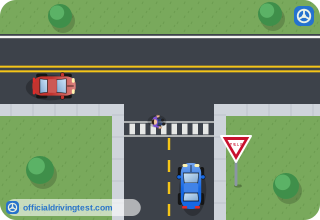
At a yield sign, pedestrians are in or about to enter the crosswalk. What must you do?
- Slow down and pass behind the pedestrians
- Stop only if they are already in your lane
- Proceed carefully once the first pedestrian has passed
- Stop until they have crossed the highway, then proceed
Show answer
Correct answer: Stop until they have crossed the highway, then proceed
If pedestrians are in or about to enter the crosswalk, you stop until they have crossed the highway and then proceed.
Source: Idaho Driver's Handbook (July 2026), page 45 · Open this page in the manual (Manual page 45)
-
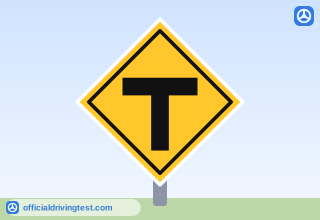
At a 3-way T intersection marked by the 3-way Intersection warning sign, what must you do?
- Stop and yield only to drivers approaching from your right
- Slow down, sound your horn, and then proceed through the intersection
- Speed up to clear the intersection before cross traffic arrives
- Stop and yield to drivers approaching from the other two directions
Show answer
Correct answer: Stop and yield to drivers approaching from the other two directions
The manual says you must stop and yield to drivers approaching from the other two directions.
Source: Idaho Driver's Handbook (July 2026), page 49 · Open this page in the manual (Manual page 49)
-
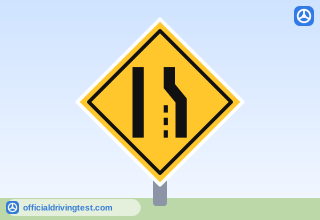
Where a Lane Ends/Merge Left sign shows two lanes becoming one, who must yield?
- Traffic in the through lane
- Merging traffic
- Drivers in the faster moving lane
- Trucks and other large vehicles
Show answer
Correct answer: Merging traffic
At a Lane Ends/Merge Left sign, merging traffic must yield.
Source: Idaho Driver's Handbook (July 2026), page 50 · Open this page in the manual (Manual page 50)
-
Which way must you turn to enter and to exit a roundabout?
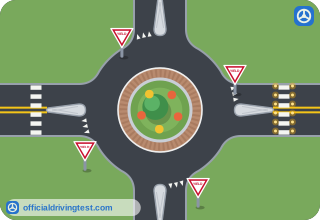
- Left
- Right
- Left to enter and right to exit
- Right to enter and left to exit
Show answer
Correct answer: Right
A roundabout is a one-way circular intersection where you must always turn right to enter and exit.
Source: Idaho Driver's Handbook (July 2026), page 62 · Open this page in the manual (Manual page 62)
-
What is the most common sign seen when approaching a roundabout?
- A regulatory sign with a large letter R
- A stop sign with a circular arrow below it
- A warning sign with an arrow in a circle pattern
- A guide sign with a round green border
Show answer
Correct answer: A warning sign with an arrow in a circle pattern
The most common sign seen when approaching a roundabout is a warning sign with an arrow in a circle pattern.
Source: Idaho Driver's Handbook (July 2026), page 62 · Open this page in the manual (Manual page 62)
-
In a roundabout, who must yield the right-of-way?
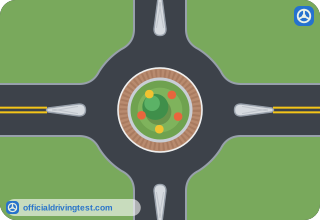
- All drivers must yield to vehicles already in the circle
- Drivers already in the circle must yield to those entering
- Larger vehicles have the right-of-way over smaller ones
- Drivers turning right must yield to those going straight
Show answer
Correct answer: All drivers must yield to vehicles already in the circle
All drivers must yield the right-of-way to vehicles already in the roundabout circle.
Source: Idaho Driver's Handbook (July 2026), page 62 · Open this page in the manual (Manual page 62)
-
In which direction must drivers enter a roundabout, even when they plan a left turn or a U-turn?
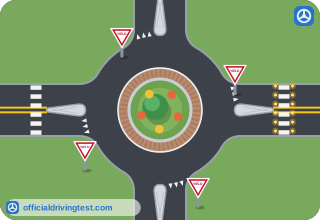
- Counter-clockwise
- Clockwise
- Clockwise for a left turn, counter-clockwise for a right turn
- Straight across the center island
Show answer
Correct answer: Counter-clockwise
Drivers must enter counter-clockwise and merge into the circle whatever their intended movement.
Source: Idaho Driver's Handbook (July 2026), page 62 · Open this page in the manual (Manual page 62)
-
Who must you yield to when entering and exiting a roundabout, besides vehicles already in the circle?
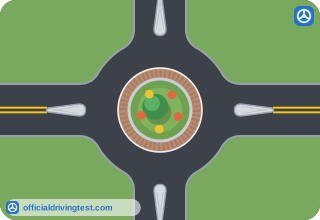
- Parked vehicles
- Vehicles waiting behind you
- Pedestrians and bicyclists
- Only vehicles that are exiting
Show answer
Correct answer: Pedestrians and bicyclists
Drivers should yield to pedestrians and bicyclists when entering and exiting the roundabout.
Source: Idaho Driver's Handbook (July 2026), page 62 · Open this page in the manual (Manual page 62)
-
What should you do with your speed in a roundabout?
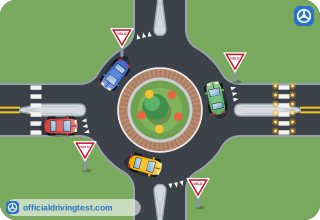
- Keep up with the traffic ahead of you
- Slow down and keep your speed low
- Speed up to merge into the circle
- Stop in the circle to let others enter
Show answer
Correct answer: Slow down and keep your speed low
Drivers should slow down and keep their speed low in a roundabout.
Source: Idaho Driver's Handbook (July 2026), page 62 · Open this page in the manual (Manual page 62)
-
As you approach your exit from a roundabout, which signal should you turn on?
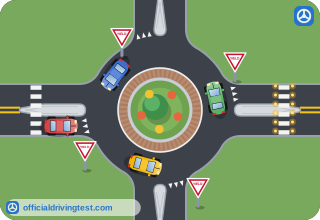
- Your left turn signal
- Your hazard lights
- No signal is needed
- Your right turn signal
Show answer
Correct answer: Your right turn signal
Turn your right turn signal on as you approach your exit.
Source: Idaho Driver's Handbook (July 2026), page 62 · Open this page in the manual (Manual page 62)
-
What is a thru-turn?
- A lane for turning right without stopping at the signal
- A circular intersection with a large central island
- A method of managing traffic by prohibiting direct left turns
- An intersection where all U-turns are prohibited
Show answer
Correct answer: A method of managing traffic by prohibiting direct left turns
A thru-turn manages intersection traffic by prohibiting direct left turns.
Source: Idaho Driver's Handbook (July 2026), page 63 · Open this page in the manual (Manual page 63)
-
How do you complete a left turn at a thru-turn intersection?
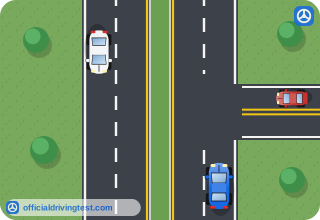
- Continue through, make a U-turn at the next signal, return and turn right
- Wait in the center lane and turn left when traffic is clear
- Turn right, then make a U-turn at the next block
- Make a U-turn before the intersection, then continue straight
Show answer
Correct answer: Continue through, make a U-turn at the next signal, return and turn right
At a thru-turn you continue through, U-turn downstream at the next signal, head back and turn right.
Source: Idaho Driver's Handbook (July 2026), page 63 · Open this page in the manual (Manual page 63)
-
You must stop at an intersection that has no marked stop line and no crosswalk. Where do you stop?
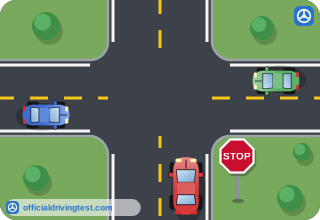
- Exactly 50 feet before the edge of the intersection
- Even with the stop sign, wherever it stands
- At the point nearest the crossing road, before entering it
- Just inside the intersection, to see cross traffic
Show answer
Correct answer: At the point nearest the crossing road, before entering it
Idaho law requires you to stop at a marked stop line, or before the crosswalk on the near side, or at the point nearest the intersecting highway before entering it.
Source: Idaho Driver's Handbook (July 2026), page 69 · Open this page in the manual (Manual page 69)
-
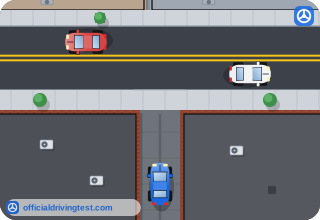
You are entering a street from an alley, driveway, or private road. Where must you stop?
- Just past the sidewalk, at the curb
- Only when a vehicle is approaching
- Before crossing the sidewalk
- At the center line of the street
Show answer
Correct answer: Before crossing the sidewalk
When entering a street from an alley, building, driveway, or private road, stop before crossing the sidewalk and yield to pedestrians and traffic.
Source: Idaho Driver's Handbook (July 2026), page 70 · Open this page in the manual (Manual page 70)
-
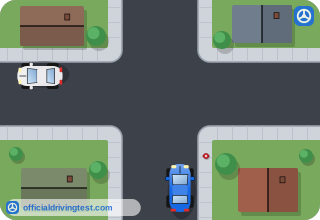
How should you approach an intersection to make a right turn?
- From the center of the lane, then swing wide to the left
- In the left-hand lane, so you have room to swing wide
- Straddling two lanes so no one passes you on the right
- In the right-hand lane, as close to the right curb as is reasonable
Show answer
Correct answer: In the right-hand lane, as close to the right curb as is reasonable
For a right turn, signal and approach the intersection in the right-hand lane, staying as close to the right curb as is reasonable.
Source: Idaho Driver's Handbook (July 2026), page 73 · Open this page in the manual (Manual page 73)
-
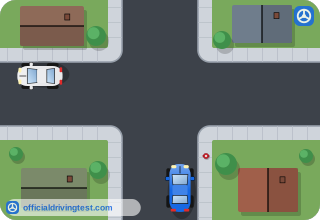
When you complete a right turn, which lane of the cross street should you turn into?
- The left-hand lane
- Any open lane
- The right-hand lane
- The center lane
Show answer
Correct answer: The right-hand lane
After yielding, turn into the right-hand lane of the cross street; do not swing wide.
Source: Idaho Driver's Handbook (July 2026), page 73 · Open this page in the manual (Manual page 73)
-
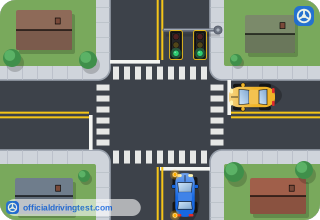
When preparing to turn left, in which lane should you approach the intersection?
- The right-hand lane, so faster traffic can pass on the left
- The lane closest to the left that is open to your direction
- Any lane, as long as you signal at least 100 feet ahead
- The center of the road, straddling the center line
Show answer
Correct answer: The lane closest to the left that is open to your direction
For a left turn, signal and approach the intersection in the lane closest to the left that is open to traffic going your direction.
Source: Idaho Driver's Handbook (July 2026), page 73 · Open this page in the manual (Manual page 73)
-
On a two-lane road, where in your lane should you position your vehicle before turning left?
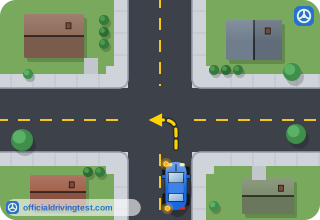
- On the right side of your lane
- Centered, away from both edges
- Partly over the center line
- On the left side of your lane
Show answer
Correct answer: On the left side of your lane
If you are on a two-lane road, you should move to the left side of your lane before turning left.
Source: Idaho Driver's Handbook (July 2026), page 73 · Open this page in the manual (Manual page 73)
-
When making a left turn, to whom must you yield the right-of-way?
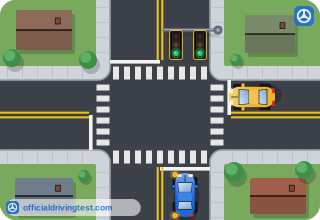
- Pedestrians and oncoming vehicles
- Only vehicles waiting behind you
- No one, once your signal is on
- Only pedestrians, never vehicles
Show answer
Correct answer: Pedestrians and oncoming vehicles
When turning left, yield the right-of-way to pedestrians and oncoming vehicles.
Source: Idaho Driver's Handbook (July 2026), page 73 · Open this page in the manual (Manual page 73)
-
When it is safe to complete a left turn, which lane should you turn into?
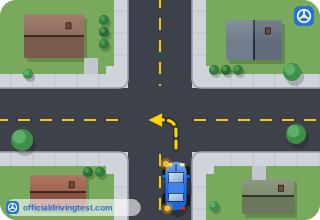
- Any lane, if you signal first
- The oncoming lane, then move over later
- The nearest lane going in your direction
- The lane farthest from the center line
Show answer
Correct answer: The nearest lane going in your direction
When safe, turn into the nearest lane where traffic moves in the direction you want to go, and do not cut the corner.
Source: Idaho Driver's Handbook (July 2026), page 73 · Open this page in the manual (Manual page 73)
-
Vehicles turning left must remain in their lane of travel until when?
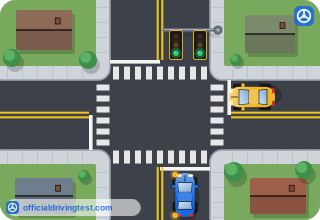
- Until they reach the center of the intersection
- Until after completing the turn
- Until the signal turns yellow
- Until they pass the first crosswalk
Show answer
Correct answer: Until after completing the turn
Vehicles turning left must remain in their lane of travel until after completing the turn.
Source: Idaho Driver's Handbook (July 2026), page 73 · Open this page in the manual (Manual page 73)
-
U-turns are not legal where which signs are posted?
- Yield signs
- Speed limit signs
- One way signs
- “No U-turn” signs
Show answer
Correct answer: “No U-turn” signs
U-turns are not legal where “No U-turn” signs are posted.
Source: Idaho Driver's Handbook (July 2026), page 73 · Open this page in the manual (Manual page 73)
-
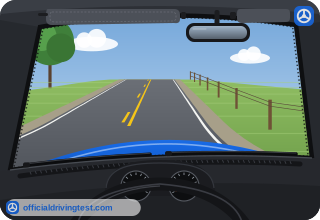
U-turns may not be made on a curve or near the crest of a hill where approaching vehicles from either direction cannot see your vehicle within what distance?
- 500 feet
- 100 feet
- 200 feet
- 1,000 feet
Show answer
Correct answer: 500 feet
U-turns may not be made on any curve, or the approach of or near the crest of a hill, where the vehicle cannot be seen by approaching vehicles from either direction within 500 feet.
Source: Idaho Driver's Handbook (July 2026), page 73 · Open this page in the manual (Manual page 73)
-
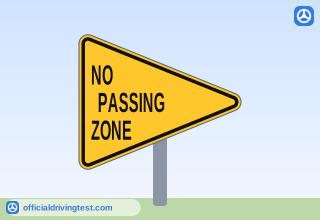
May you make a U-turn in a no passing zone?
- Yes, if no traffic is in sight
- Yes, if you signal for five seconds
- No, U-turns are not allowed there
- Yes, but only during daylight
Show answer
Correct answer: No, U-turns are not allowed there
The handbook lists a no passing zone among the places where U-turns may not be made.
Source: Idaho Driver's Handbook (July 2026), page 73 · Open this page in the manual (Manual page 73)
-
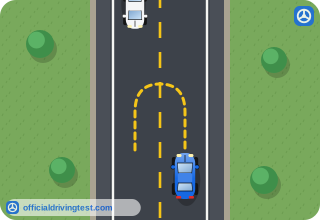
What must you do before completing a U-turn?
- Sound your horn twice
- Stop and yield to all traffic
- Turn on your hazard lights
- Flash your headlights
Show answer
Correct answer: Stop and yield to all traffic
Stop and yield to all traffic before completing a U-turn.
Source: Idaho Driver's Handbook (July 2026), page 73 · Open this page in the manual (Manual page 73)
-
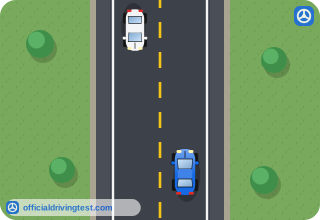
When making a U-turn, what is the first step?
- Move into the left lane and signal for five seconds
- Slow down and turn from the center of the road
- Pull to the far right edge of the road and stop
- Stop on the left edge of the road and turn on your hazard lights
Show answer
Correct answer: Pull to the far right edge of the road and stop
The first step is to pull to the far right edge of the road and stop.
Source: Idaho Driver's Handbook (July 2026), page 74 · Open this page in the manual (Manual page 74)
-
When making a U-turn, which blind spot do you check before you signal and turn sharply left?
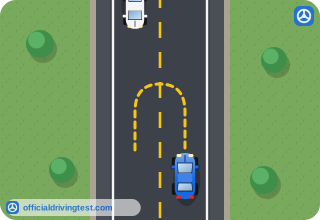
- Your right-rear blind spot
- Your left-rear blind spot
- Your right-front blind spot
- No blind spot; only the mirrors are checked
Show answer
Correct answer: Your left-rear blind spot
The second step is to check the front and rear of the vehicle and your left-rear blind spot, then signal and turn sharply left while moving slowly.
Source: Idaho Driver's Handbook (July 2026), page 74 · Open this page in the manual (Manual page 74)
-
During a U-turn, what do you do once your vehicle is headed toward the target area?
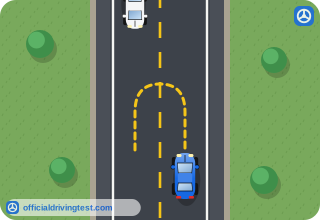
- Stop again and wait for the traffic to clear
- Turn on your hazard lights and continue slowly
- Sound your horn and stay at a slow speed
- Recheck the rear and accelerate to traffic speed
Show answer
Correct answer: Recheck the rear and accelerate to traffic speed
Once the vehicle is headed toward the target area, you recheck to the rear and accelerate to the speed of the traffic.
Source: Idaho Driver's Handbook (July 2026), page 74 · Open this page in the manual (Manual page 74)
-
In most cases, where does the law require you to stay on the road?
- As far to the right side of the road as possible
- In the middle of the road
- Next to the center line
- In whichever lane has the faster traffic
Show answer
Correct answer: As far to the right side of the road as possible
In most cases the law requires you to stay as far to the right side of the road as possible.
Source: Idaho Driver's Handbook (July 2026), page 74 · Open this page in the manual (Manual page 74)
-
Which of these is an exception to the rule to stay as far to the right as possible?
- When approaching a crosswalk
- When driving below the speed limit
- When preparing to make a left turn
- When driving in rain or snow
Show answer
Correct answer: When preparing to make a left turn
Preparing to make a left turn is one of the listed exceptions to keeping to the right.
Source: Idaho Driver's Handbook (July 2026), page 74 · Open this page in the manual (Manual page 74)
-
You may enter the left lane temporarily, even when you should keep right, in order to avoid which of these?
- A yellow traffic light turning red ahead
- An obstruction, a pedestrian, or an animal
- A stop sign at the next intersection
- A railroad crossing sign on the right
Show answer
Correct answer: An obstruction, a pedestrian, or an animal
The manual lists entering the left lane temporarily to avoid an obstruction, a pedestrian, or an animal as an exception.
Source: Idaho Driver's Handbook (July 2026), page 74 · Open this page in the manual (Manual page 74)
-
How does the manual describe the right-of-way?
- Something that belongs to the faster driver
- Something that belongs to the larger vehicle
- Something the first driver to signal may claim
- Something to be given, not taken
Show answer
Correct answer: Something to be given, not taken
The manual says to always remember that right-of-way is something to be given, not taken.
Source: Idaho Driver's Handbook (July 2026), page 74 · Open this page in the manual (Manual page 74)
-
As you approach a yield sign, what should you always do?
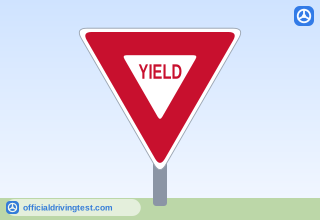
- Slow down and be prepared to stop
- Maintain your speed and sound the horn
- Speed up to get ahead of cross-traffic
- Pull onto the shoulder and wait
Show answer
Correct answer: Slow down and be prepared to stop
The manual says that approaching a yield sign you should always slow down and be prepared to stop.
Source: Idaho Driver's Handbook (July 2026), page 75 · Open this page in the manual (Manual page 75)
-
You stopped to enter a street from an alley, driveway, or garage. What must you do next?
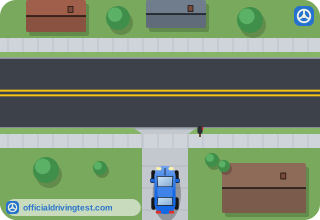
- Enter at once, since you have already stopped
- Sound your horn and then enter
- Yield to other drivers
- Enter if the street has fewer than two lanes
Show answer
Correct answer: Yield to other drivers
After stopping to enter a street from an alley, driveway, or garage, you must yield to other drivers.
Source: Idaho Driver's Handbook (July 2026), page 75 · Open this page in the manual (Manual page 75)
-
After stopping for a stop sign at a two-way stop, what must you do?
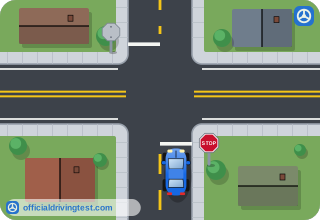
- Proceed, because you have already stopped
- Yield to cross-traffic
- Wait three seconds and then proceed
- Flash your headlights and proceed
Show answer
Correct answer: Yield to cross-traffic
After stopping at a two-way stop you must yield to cross-traffic.
Source: Idaho Driver's Handbook (July 2026), page 75 · Open this page in the manual (Manual page 75)
-
At a four-way stop, which vehicle has the right of way?
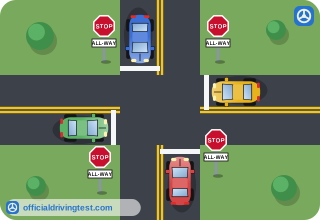
- The vehicle that is going straight
- The largest vehicle
- The vehicle on the left
- The first vehicle to arrive
Show answer
Correct answer: The first vehicle to arrive
The first vehicle to arrive at a four-way stop has the right of way.
Source: Idaho Driver's Handbook (July 2026), page 75 · Open this page in the manual (Manual page 75)
-
Two vehicles arrive at a four-way stop at the same time. Which one must yield?
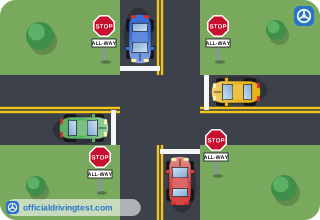
- The vehicle on the left
- The vehicle on the right
- The vehicle that is going straight
- The vehicle that is moving faster
Show answer
Correct answer: The vehicle on the left
If two vehicles arrive at the same time, the vehicle on the left must yield to the vehicle on the right.
Source: Idaho Driver's Handbook (July 2026), page 75 · Open this page in the manual (Manual page 75)
-
At an unmarked intersection with no signs or signals, you arrive at the same time as a vehicle on your right. What must you do?
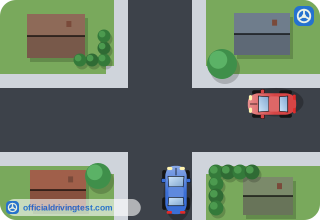
- Go first, since you are on the left
- Go first if you signal
- Yield to that vehicle
- Speed up to clear the intersection
Show answer
Correct answer: Yield to that vehicle
At an uncontrolled intersection, if two vehicles arrive at the same time, the vehicle on the left must yield to the vehicle on the right.
Source: Idaho Driver's Handbook (July 2026), page 75 · Open this page in the manual (Manual page 75)
-
At an unmarked three-way T intersection where you will have to turn either right or left, what must you do?
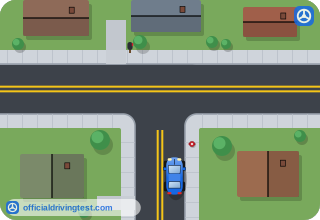
- Yield only to vehicles approaching from your left side
- Stop and/or yield to drivers from the other two directions
- Go first, because you are the one turning at the T
- Yield only to oncoming vehicles from straight ahead
Show answer
Correct answer: Stop and/or yield to drivers from the other two directions
At an unmarked three-way T intersection you must stop and/or yield to any drivers approaching from the other two directions.
Source: Idaho Driver's Handbook (July 2026), page 75 · Open this page in the manual (Manual page 75)
-
When making a left turn, what must you always yield to, unless a traffic-control device directs otherwise?
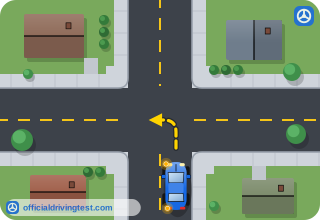
- Vehicles approaching from behind you
- Only vehicles that are also turning
- Vehicles parked at the curb
- Oncoming traffic in the intersection
Show answer
Correct answer: Oncoming traffic in the intersection
When making a left turn, always yield to oncoming traffic in the intersection unless directed otherwise by a traffic-control device.
Source: Idaho Driver's Handbook (July 2026), page 76 · Open this page in the manual (Manual page 76)
-
A funeral procession is proceeding through an intersection and your light is green. What must you do?
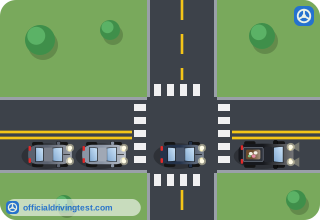
- Enter, because a green light gives you the right of way
- Enter by driving between the vehicles
- Enter after sounding your horn
- Not enter unless you can do so without crossing its path
Show answer
Correct answer: Not enter unless you can do so without crossing its path
You may not enter an intersection when the procession is proceeding through, regardless of the traffic light color, unless you can do so without crossing its path.
Source: Idaho Driver's Handbook (July 2026), page 78 · Open this page in the manual (Manual page 78)
-
As you approach a place where other cars, people or animals may cross your path, what should you not rely on?
- Your mirrors on the left side
- Your headlights in the daytime
- Your owner's manual instructions
- Traffic lights or stop signs
Show answer
Correct answer: Traffic lights or stop signs
The manual says to look to both sides and not to rely on traffic lights or stop signs.
Source: Idaho Driver's Handbook (July 2026), page 89 · Open this page in the manual (Manual page 89)
-
You are stopped and about to turn right. Which way should you check first?
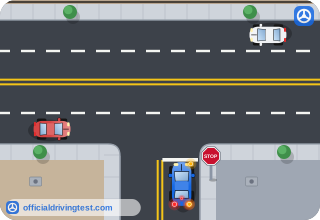
- Right first, then left and rear
- Only to the left, since traffic comes from there
- Only to the rear, since bicyclists come from behind
- Left first, then right, ignoring the rear
Show answer
Correct answer: Right first, then left and rear
Always look left, right and to the rear, checking the right first, because a bicyclist riding against traffic or on the sidewalk may be approaching on your right.
Source: Idaho Driver's Handbook (July 2026), page 99 · Open this page in the manual (Manual page 99)
-
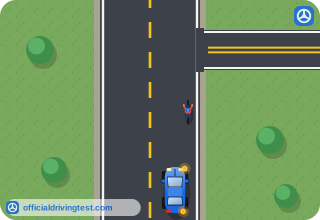
A bicyclist is ahead of you and you are preparing to turn right. How do you avoid a "right hook" crash?
- Speed up and turn before the bicyclist reaches the turn
- Sound your horn and turn ahead of the bicyclist
- Move alongside the bicyclist and turn right together
- Slow and stay behind the bicyclist until they pass your turn
Show answer
Correct answer: Slow and stay behind the bicyclist until they pass your turn
Do not assume you can beat the bicyclist to the turn; slow and remain behind until they pass the point where you will turn.
Source: Idaho Driver's Handbook (July 2026), page 99 · Open this page in the manual (Manual page 99)
-
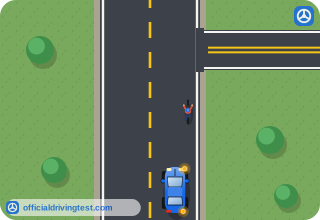
What is the broadside crash caused by misjudging a right turn ahead of a bicyclist called?
- A left cross
- A right hook
- A door crash
- A side swipe
Show answer
Correct answer: A right hook
The manual calls this broadside crash a right hook.
Source: Idaho Driver's Handbook (July 2026), page 99 · Open this page in the manual (Manual page 99)
-
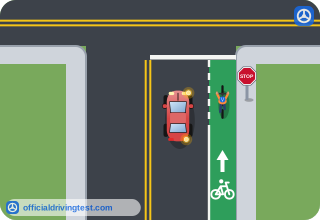
What should you remember when making a right turn across a bike lane?
- Bicyclists must yield to turning vehicles
- You are turning across a dedicated travel lane
- The bike lane is part of your own travel lane
- Bicyclists will always be on the sidewalk
Show answer
Correct answer: You are turning across a dedicated travel lane
On streets with bike lanes you are turning across a dedicated travel lane, so always look for and expect bicyclists.
Source: Idaho Driver's Handbook (July 2026), page 99 · Open this page in the manual (Manual page 99)
-
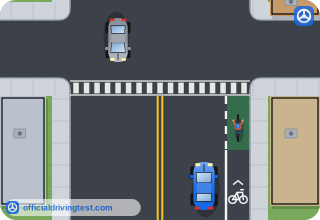
When turning right at an intersection where the bike lane lines are dashed, what may you do with the bike lane?
- Never enter it before the corner
- Park in it while waiting for the light
- Occupy it in the dashed line area
- Pass bicyclists on their right inside it
Show answer
Correct answer: Occupy it in the dashed line area
You may occupy the bike lane in the dashed line area, which prevents bicyclists from approaching along your right side.
Source: Idaho Driver's Handbook (July 2026), page 100 · Open this page in the manual (Manual page 100)